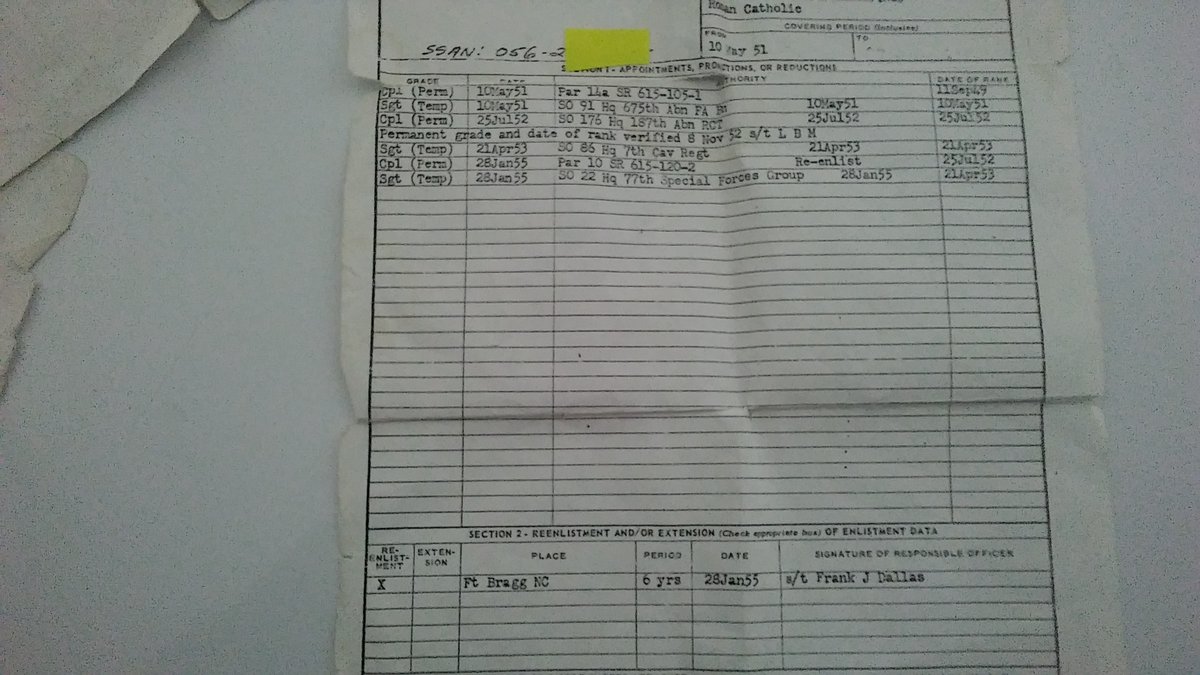
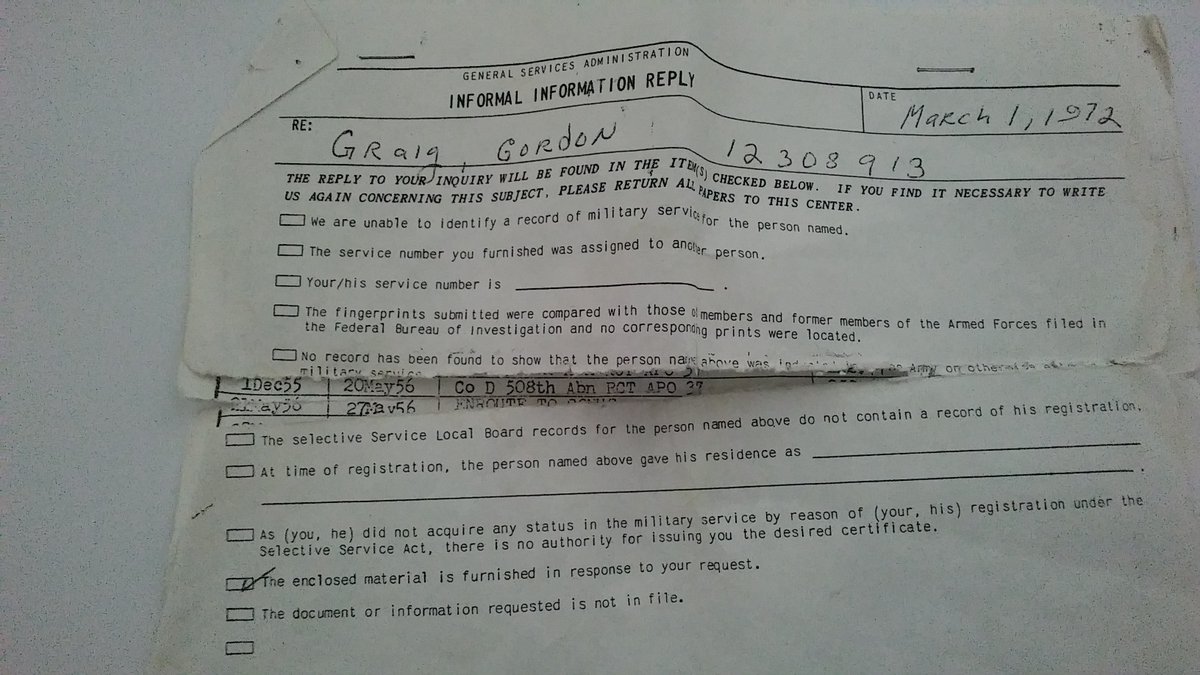
Here Is Some Documentation To Show My Father's Military Service JUST In Case Some Thought I Was Embellishing.
Military Historians Will Recognize The Documents That Can No Longer Be Retrieved.
@USArmy@FortCampbell @DeptofDefense
High in the Olympic Mountains, the alpine tarns of Upper Royal Basin reflect some of the most rugged scenery at Olympic National Park.
Jagged peaks and clear water = not a bad place to stop and stare for a while.
Photo by Hwei Ling Ng
The Short-Baseline Near Detector is pushing the boundaries of neutrino science. This pioneering experiment is set to observe over one million neutrinos every year — more than any other experiment of its kind!
https://t.co/YSguRAMtuv
#Neutrino70
That’s a wrap on today’s #Okeanos dive! Tomorrow we expect to plunge to 5,500 meters (3.4 miles) to explore abyssal plain habitats of the #CookIslands. Get ready!
Welcome back to Earth! @NASA astronaut Chris Williams and Roscosmos cosmonauts Sergey Kud-Sverchkov and Sergei Mikaev landed in Kazakhstan at 6:27 a.m. ET (3:27 p.m. local time) today after living in space for eight months. More...
LIVE: Watch as @Astro_ChrisW and cosmonauts Sergey Kud-Sverchkov and Sergei Mikaev say farewell to the @Space_Station and board their Soyuz MS-28 spacecraft. https://t.co/vTlOtSsjab
Russia wants to receive another 30,000 troops from North Korea. Since June, preparations have been underway in Russia’s Voronezh region to receive them. North Korea is also preparing to transfer additional launchers for ballistic missiles to Russia.
This is a threat not only to Ukraine. Russia is helping North Korea learn how to wage war, improve its weapons, and gain real combat experience in using them. All of this is a threat to everyone in Asia who is within range of North Korean missiles.
From the evening address. (2/3)
Thanks to @NASAWebb's unprecedented sensitivity, we've cut through the thick dust that obscures Centaurus A’s center, showing a densely packed tapestry of stars and an active, everchanging galaxy.
Check it out through this interactive experience >> https://t.co/5AtB0t8HaE
Up next: Re-entry and landing.
Soyuz MS-28 has departed the space station after 241 days, and the deorbit burn slated for 4:31 am CT will commit the spacecraft to its return to Earth. Tune in at 4:15 am to follow the crew through their landing at 5:25 am. https://t.co/0tGwqaSya3
No #Okeanos dive today as the ship transits to Friday’s dive site. The team will also use the day to conduct CTD (conductivity, temperature, depth) operations. Stay tuned for info about tomorrow’s dive!
Learn more about the cruise: https://t.co/tfcd6G8N3U
Ever wondered how an idea becomes a spacecraft? Well first, we gotta scope it out! 🎶
Learn more about how telescopes work here: https://t.co/JMysOtpIxV
HiRISE 3D: Small and Recent
Craters here are distinctive in day and night infrared, relatively abundant over this area: are these primaries or secondaries? We can look for directional indicators.
https://t.co/2SaqYRZ1O6
NASA/JPL-Caltech/University of Arizona
#Mars#NASA
Our #HubbleTopImage features the heavyweight of the Leo Triplet 💪
Messier 66 has an unusual anatomy, with asymmetric spiral arms and an apparently displaced core. Astronomers believe that Messier 66's once orderly shape has been distorted by the gravitational pull of its two neighbours. 1/2
Six new multi-year @NASA projects will study everything from retreating glaciers to air quality to clouds generated by wildfires.
Despite their different topics, all of the missions will use sensors mounted on aircraft. https://t.co/u41C5yq5nY
The Southern Crown (Corona Australis) dazzles with young and ancient celestial jewels. The Corona Australis Cloud is a collage of reflection and emission nebulae on the left of today’s image. At 430 light years away, this cloud is one of the closest star-forming regions to Earth. It contains gas cool enough (-260 Celsius or -440 Fahrenheit) to collapse into protostars. Recently formed stars paint blue hues across the cloud as their light reflects off surrounding material. The waltz of the R Coronae Australis binary system stirs up the nebula NGC 6729. The younger of the pair ionizes nearby gas with its ultraviolet light, causing it to glow. The Chandelier Cluster (NGC 6723) dangles from the top right, but is actually tens of thousands of light years farther away than its apparent star-forming neighbor. While NGC 6723 experienced multiple periods of star formation creating slightly younger stars, the chandelier twinkles with stars almost as old as the universe.
Image Credit: DES/DOE/FNAL/DECam/CTIO/NOIRLab/NSF/AURA Image
Processing: T.A. Rector (UAA/NOIRLab), R. Colombari & M. Zamani (NOIRLab)
Text: Keighley Rockcliffe (NASA GSFC, UMBC CSST, CRESST II)
This might be the best episode of Small Steps, Giant Leaps ever (but we may be biased)
Hear from our very own Kassandra Stephens, about her role as the voice between the @Space_Station and the ground team that coordinates the science on board: https://t.co/HKCIeXU9mX
MicroBooNE: A game-changer for neutrino research!
This experiment demonstrated the power of liquid-argon detector technology for neutrino research, paving the way for SBND, ICARUS, and @DUNEScience. #Neutrino70
Learn more: https://t.co/HxCMsj5pRs
https://t.co/h1EX4VzgGl
🚀 When people think of NASA careers, they often picture astronauts and engineers.
But it also takes...
📸 Photographers to capture history.
🎨 Designers to visualize complex ideas.
✍️ Writers to explain groundbreaking discoveries.
🎥 Videographers to document missions.
📱 Communications professionals to connect NASA with millions around the world.
NASA photographer Jim Ross captured this remarkable perspective while flying aboard one of the agency's F-18 aircraft during the America 250 flyover over Washington, D.C. ✈️
Because exploration isn't just about making history—it's about sharing it.
Celebrating a legacy in Earth Observation! 🎉 🚀
On July 23, 1972, Landsat 1 launched into orbit and changed the way we see our planet. As the first satellite in what would become the world’s longest-running Earth observing program, Landsat 1 began a legacy of continuous, trusted, and scientifically valuable land imaging that still supports research, decision making, and stewardship today.
Within days of the launch, Landsat 1 acquired an image of an astounding 81,000-acre (327.8 square kilometers) fire burning in isolated, central Alaska. For the first time ever, scientists and resource management officials were able to see the full extent of damage from a fire in a single image while it was still burning.
Landsat 1 marked the beginning of a long partnership between the USGS and NASA that continues today. NASA developed, launched, and operated the satellite, while the USGS helped shape its scientific objectives and established the EROS Data Center to archive and distribute its imagery. Together, the two agencies laid the foundation for the enduring Landsat program.
From that first launch to the missions operating today, and those planned for the future, Landsat represents more than five decades of innovation, collaboration, and watching Earth change.
Here’s to where it all began! 🛰️🌎
🔗 Learn more about the first Landsat mission: https://t.co/IYva849EUX
📸1: Landsat 1 launched July 23, 1972, aboard a Delta 0900 rocket from Vandenberg Air Force Base in California. Credit: NASA
📸2: Smoke from a large wildfire in a central Alaska can be seen on this false color image acquired by Landsat 1 on July 27, 1972. Credit: USGS
#EarthObservation #LandsatLegacy