Bugatti just lost its all-time speed record. To the Chinese EV in this video. 308 mph at Papenburg, on a battery.
The Chiron Super Sport had held the record for six years. 1,600 hp, 8.0L W16, four turbochargers. Bugatti needed every horse of that to hit 304 mph. BYD's Yangwang U9 Xtreme did 308 with four electric motors and a battery pack.
Marc Basseng, the driver, won the Nürburgring 24 Hours. He said the run was "technically not possible with a combustion engine." He's right.
A combustion engine produces a power curve that peaks at a specific RPM and falls off either side. Past 9,000 RPM the valves float, the connecting rods stretch, the pistons can't reverse direction fast enough. The W16 is the absolute thermodynamic ceiling of 100 years of internal combustion. Every mph past 290 cost exponentially more engineering for diminishing returns.
The U9 Xtreme uses four electric motors. Each produces 744 hp. Each spins to 30,000 RPM. No valves. No pistons. No connecting rods. Total system output is 2,978 hp, almost double Bugatti's W16. Power-to-weight is 1,217 hp per tonne.
The motors were never the hard part. Mate Rimac said this years ago. The constraint was always the battery, because to deliver 2,978 hp into four wheels you have to discharge faster than any production EV ever has.
BYD built the world's first 1,200-volt production car. Everyone else uses 800V. The Blade Battery runs lithium iron phosphate cells with a 30C discharge rate, ten times what a conventional EV battery handles. Heat generation falls 67% versus 800V at matching output.
That last number is the whole game. Heat is what kills high-power EV runs. Other automakers derate within seconds at full power because the battery cooks itself. BYD's architecture lets the Xtreme hold maximum discharge long enough to actually approach the aerodynamic limit of the chassis.
Bugatti spent 20 years engineering the W16 to its physical ceiling. BYD spent 18 months building the architecture that cleared it.
They're making 30 of them.
The crown for fastest production car on Earth has belonged to Bugatti, Koenigsegg, Hennessey, SSC. All combustion, all European or American. The crown is Chinese now, and it runs on a battery.
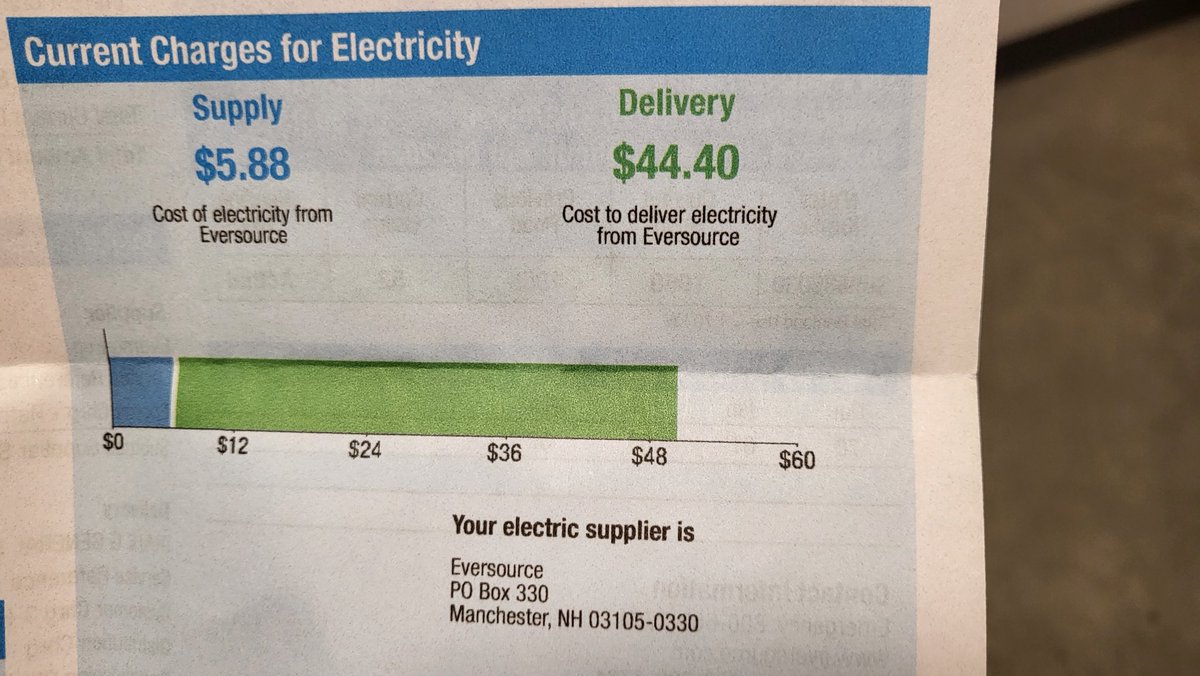
Most electricity price data focus on rates—but households experience bills, which depend on usage, efficiency, and system costs.
That’s why places can have average-looking rates but still some of the highest bills in the country.
I moderated a roundtable earlier this week at a storage conference on energy storage + load growth in PJM.
The main Q: CAISO & ERCOT have ~10,000 MW+ of storage each. PJM has <500 MW. Wtf??!!
Several developers & investors raised great points worth sharing.
1- Renewables penetration
- This is an obvious one, wind + solar is not huge in PJM unlike ERCOT or CAISO creating less volatility. PJM States import a lot of RECs from MISO
- But hey, SPP has HUGE amounts of wind, LOT of negative pricing, and less batteries than PJM!! Clearly RE penetration is not the only reason and anyway this will change with lot of solar coming online
2- ELCC risk
- With not much energy arbitrage, capacity market is important for revenues. But storage accreditation is variable and projections are heading down. For 4-hr, from ~60% ELCC today to just 25%(!!) in 2032. Investors are obviously wary
- One solution: allow storage & large loads to contract resource adequacy risk bilaterally, or BIGPAL. Load flexes if storage runs out. No impact on the rest of the market, maximum contractual flexibility & innovation
- Another one that came up A LOT: LDES. Short duration ELCC risk is driving lot of interest in long duration storage (12hr+) that would get ~100% ELCC. I was surprised to see so many developers mention LDES. Keep an eye on this one, particularly with LDES mandates also under discussion in several PJM States.
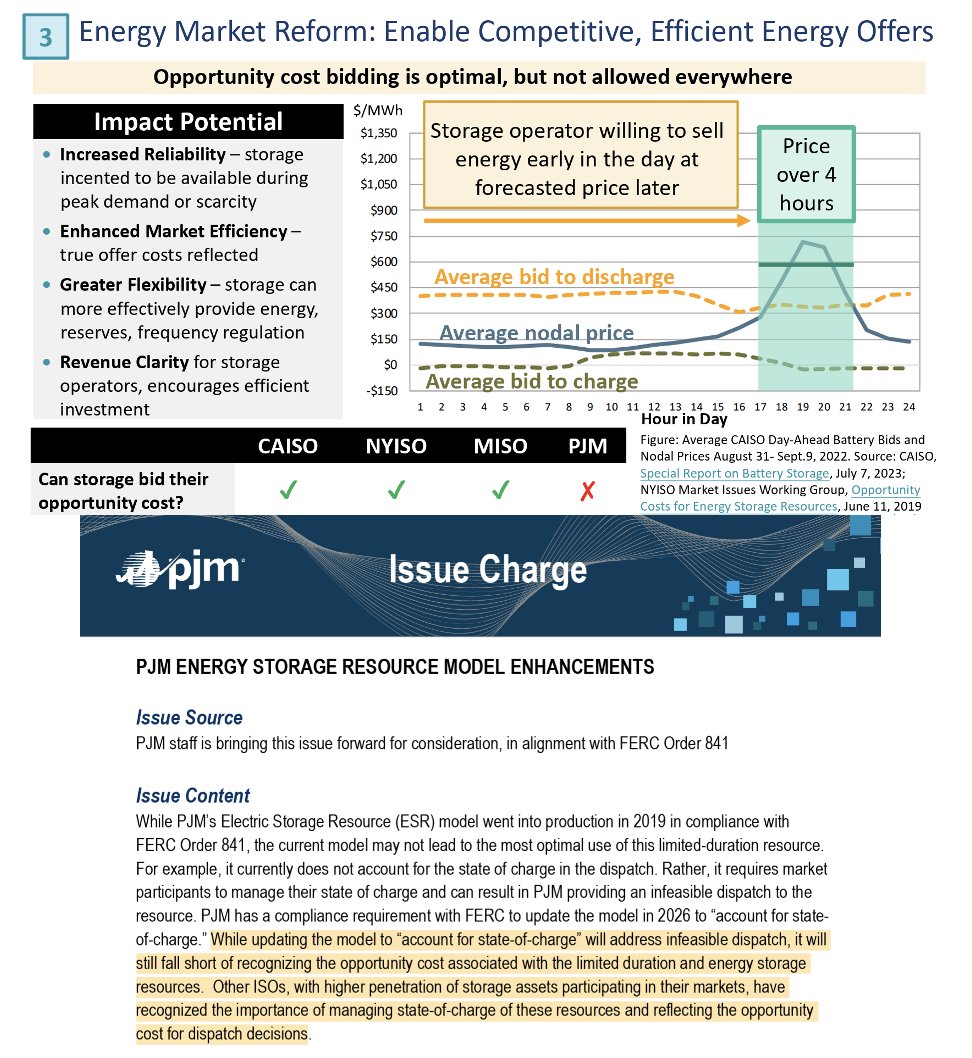
3- Storage bidding in the energy market
- B/c of the market monitor’s focus on market power mitigation, batteries cannot bid their opportunity cost in PJM. They can only bid their charging cost. This is crazy and needs to change
- Thankfully, PJM has recognized this and is undertaking a stakeholder process to allow short duration resources to bid their opportunity cost. Freedom & markets! 🇺🇸
4- Surplus IX Service
- Can wind/solar developers use their surplus IX capacity to add batteries? A developer pointed out this is completely unusable for wind. Because the capacity injection rights are SO LOW compared to wind ELCC, adding storage has no RA value.
- It’s the opposite for solar though, expect to see more movement there
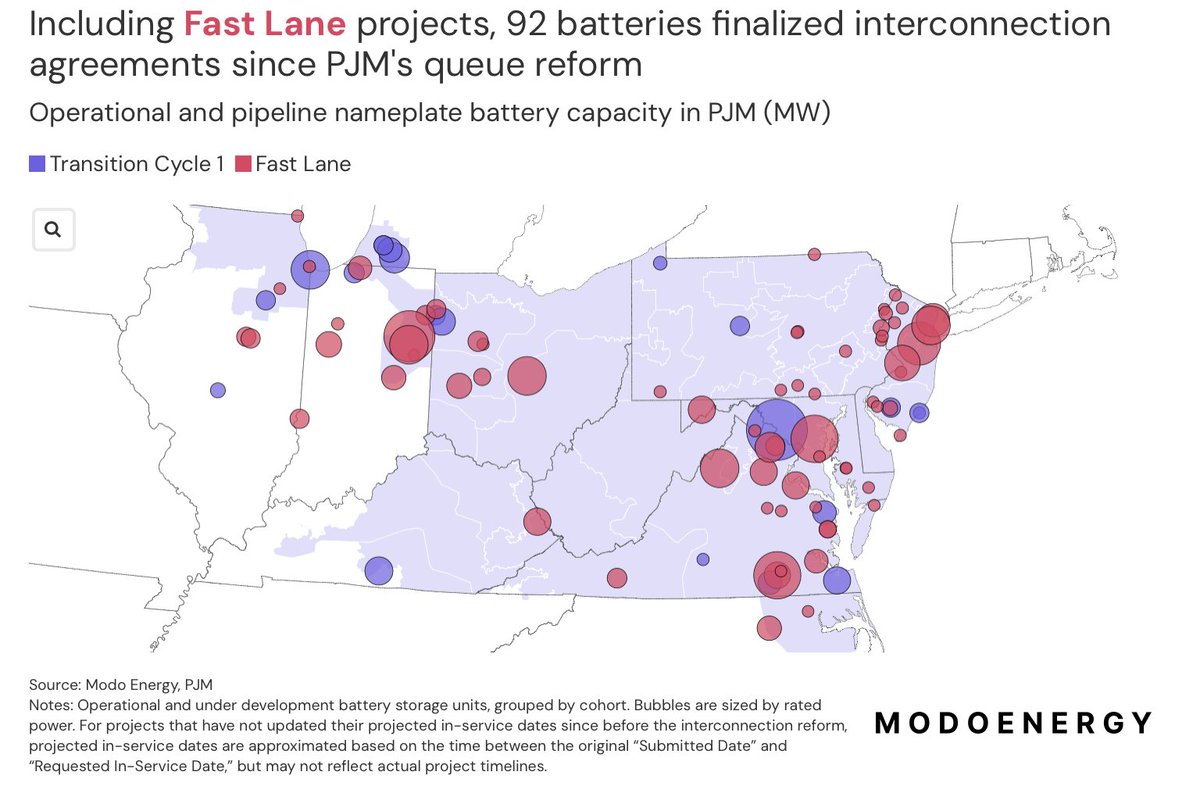
5- Future outlook: A LOT of storage is coming on
- 2,300 MW was approved in the RRI expedited queue
- 6,400 MW already has an IX agreement across Fast Lane + TC1 queue as per great data from Modo Energy
- Load growth, IX queue reforms, as well as mandates from MD, NJ, VA are going to keep pushing this
- Co-location docket will also create opportunities for storage to directly site with large loads, if PJM can expand some of the configuration options
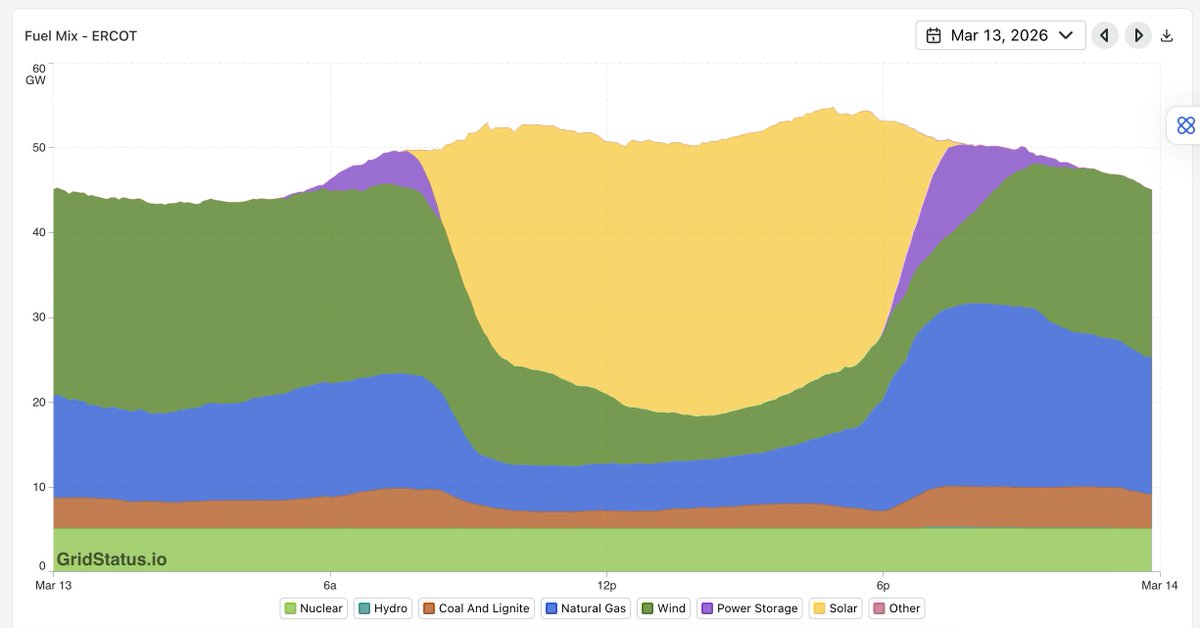
nuke bros conveniently forget batteries discharge and charge in daily cycles
"this cell phone only lasts 10 hours! that's why landlines are so much better! reliable!"
Battery storage in ERCOT is now routinely providing 10%-20% of power required by the Texas grid during times of peak demand. Five years ago, we had no batteries in ERCOT. The next 5 years are going to be nuts.
Gotta be honest: not great that paying data centers to turn off is our plan for grid reliability through 2030. A curtailment payment? Come on. This is bad! We have to stop managing the failure and build the grid we should have built in the first place. What are we doing here?!
Here are all the lighthouses of the Northern Seas, each light is the right color, each turns or pulses at the right frequency, and is scaled with its brightness. You can also see how far they are visible.
I had Claude Code build this and upload it here: https://t.co/ZX6pyJhlr9
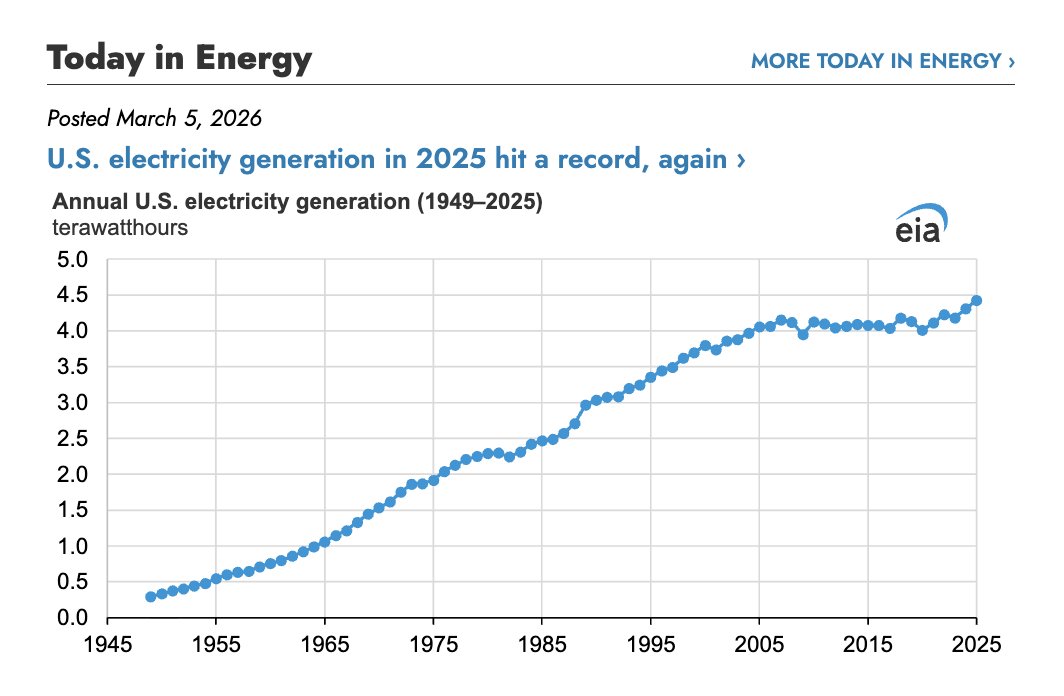
yes we've entered a new era of load growth but the real anomaly was the the first 20 or so years of this century, now we're growing electricity generation like we used to
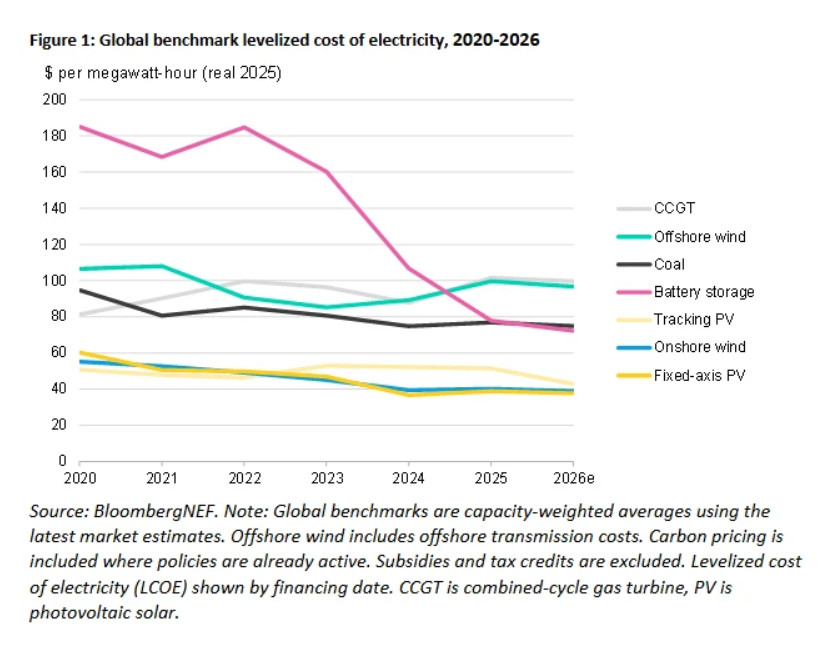
Good morning with good news: Combined solar and battery plant's global average cost is 44% LOWER than the cost of combined-cycle gas plant!
Solar & battery: $57/MWh
Gas: $102/MWh
Solar: $39/MWh
Land wind: $40/MWh
Offshore wind: $100/MWh
WOW!!!
https://t.co/FmJMKgzunk
Lazard's LCOE, and actual investments, come to a very different conclusion.
Can anyone with S&P access cross check Liz and share the key assumptions?
💠For a 627-MW West Texas data center, a dedicated combined-cycle gas plant offers a 20-year cost of roughly $2.9 billion
💠A solar + battery system costs about $6.2 billion over the same horizon - a $3.5 billion premium...
(source: S&P global)
6/ Caveat: $2.3B is Jupiter's estimate, future rounds of ISO-NE studies such as the Boston 2033 reliability plan will weigh in on the true value of transmission savings, but the point remains. Will be interesting to see how this plays out.
1/ It's a strange world where a 700 MW battery can save the grid $2.3B, but not receive a penny (nickel?) of that. But at scales this large, it's a problem that will materially raise the cost of electric bills and hurt competitiveness.