@MJS759040357531 It’s the ML-models prediction of whether a vessel displays features and behavior resembling a vessel belonging to the shadow fleet. The models considers various variables, weighted to predict as accurately as possible.
SPARTA II, a sanctioned Russian MoD-linked cargo ship, caught fire in the Gulf of Finland this morning after a reported drone strike.
Our shadow fleet model scores it 3.9%. That's not a miss. Here's an OSINT read on what the data shows, and what it doesn't. 🧵
—
THE INCIDENT
→ 09:35 local: Estonia's Police and Border Guard receive reports of fire and possible explosions aboard, ~11 nm north of Vaindloo, in an international shipping lane
→ Leningrad Oblast governor Drozdenko says the Kaliningrad-bound ship was hit by two drones
→ ~10:00: the vessel drifts out of Estonia's EEZ
→ No injuries or pollution reported so far
→ No one has claimed the attack
—
THE AIS TRACK
SPARTA II (IMO 9160994, MMSI 273394890) left the St Petersburg port area on the evening of 20 Nov and ran west through the night at 10–13 kn along the main deep-water lane.
Last fix in our feed: 07:06 UTC, 59.985N 26.229E, 11.6 kn, course 254, destination RUBLT (Baltiysk).
That's 10.8 nm NNW of Vaindloo, roughly 30 minutes before the fire was reported, which fits the reported position.
[Our feed shows no new position through at least 08:17 UTC.]
Caveat: GNSS jamming is used in the eastern Gulf to counter drones. AIS positions in this area should be cross-checked, not taken at face value.
—
THE VESSEL
→ Owned by Oboronlogistika, the Russian MoD-linked logistics company
→ On the US OFAC SDN list since May 2022
→ Linked in open sources to the 2024–25 evacuation of Russian military equipment from Syria
→ Runs on the St Petersburg–Kaliningrad supply line
→ Ukraine's National Resistance Center has claimed its crew was instructed to track NATO warships during the Aurora 23 exercise
—
WHY 3.9% IS THE RIGHT SCORE
Our model at Rendezvous learns the behavioural signature of sanctions-evading tankers. SPARTA II isn't one. It's a state logistics ship sailing openly under the Russian flag, broadcasting AIS with a declared destination.
"Shadow fleet" is one risk category in the Baltic, not the whole picture. A vessel can score low on evasion and still be of high interest because of its ownership, its cargo and the security context around it. Reading one model in isolation risks missing the vessels that matter most.
—
SECOND-ORDER EFFECTS
Finland restricted air and sea traffic in the eastern Gulf twice this morning. This comes days after a reported drone strike on a Russian warship near Gogland.
This is a busy civilian corridor bordered by NATO EEZs. Anyone routing, insuring or chartering through the eastern Gulf of Finland should treat it as an elevated-risk corridor while these strikes continue.
#OSINT #MaritimeSecurity #BalticSea #GulfOfFinland
In October, Russia's crude export revenue hit its highest level since June 2022, CREA estimates. That's despite Ukrainian strikes on its Baltic export ports, and two Russian vessels hit by drones at sea in November.
So what's happening to the shadow fleet in the Baltic? The structural trends, the outlook, and what we currently observe:
THE PARADOX: THE MONEY IS STILL FLOWING
Volumes held and prices did the rest. Russia shipped about 3.55M b/d of crude in the four weeks to 25 Oct, while Dated Brent peaked at $136 in early October. CREA puts October's crude revenue at €449M a day, up 19% on September, and estimates that 60% of Russia's seaborne oil moved on sanctioned shadow tankers.
Sanctions name the ships. Price sets the revenue. CREA estimates a fully enforced $30 cap would have cut October's seaborne oil revenue by 25%.
THE SQUEEZE HAS TURNED PHYSICAL
The sanctions lists keep growing: the EU's passed 670 vessels with its 21st package in July, and its cap on Russian crude is frozen at $44.10/bbl. But the bigger change in 2026 is kinetic.
→ 11 Nov: Ukraine strikes Ust-Luga, a terminal that has shipped about 562,000 b/d of crude this year, and Ukraine's SBU claims a strike on a Russian corvette in the Gulf of Finland
→ 21 Nov: SPARTA II, a sanctioned MoD-linked cargo ship, is hit by a drone at sea west of Gogland and drifts into Finnish waters. Finland calls Ukraine the likely perpetrator; no one has claimed it
That is two Russian vessels hit in 10 days, in waters used by civilian traffic. Primorsk and Ust-Luga handle about 42% of Russia's oil exports, which makes them the main target. Earlier this year, shadow tankers sat idling in the Gulf of Finland waiting for damaged terminals to reopen.
FOUR STRUCTURAL TRENDS
1. The sanctions list is running out of targets. By June, 68% of the 862 shadow tankers that have carried Russian oil since 2023 were sanctioned in at least one jurisdiction. 314 are still not on the EU list.
2. The fleet is moving under the Russian flag. Russian-flagged tankers carried 19.5% of shadow fleet shipments in Q1 2026, up from 4.3% at the end of 2024. A Russian-flagged ship can't be treated as stateless, which removes Europe's strongest legal hook. The pace has slowed, though: new Russian registrations fell from 25 in December 2025 to 3 in June.
3. Europe now boards ships. Sweden has intercepted shadow vessels since March, the UK seized its first in June, and the EU's July package lets member states confiscate the assets of ships they board.
4. Russia answers with its navy. Warships have escorted shadow tankers in the Gulf of Finland since May 2025, and Sweden's navy describes a sustained Baltic Fleet patrol near the main shipping routes.
WHAT OUR DATA SHOWS (9–22 Nov)
→ No confirmed ship-to-ship transfers with sanctioned counterparties anywhere in the Baltic in 14 days
→ One of our STS candidate clusters in the Gulf of Finland sits exactly where the SPARTA II rescue took place. Most likely a rescue, not a transfer: proximity is not evidence
OUTLOOK
→ Price is the swing factor. Brent has fallen 32% from its peak to around $93, and the IEA expects the market to return to surplus this quarter. That is likely to matter more for Russia's oil revenue than any new listing.
→ Ice is the next constraint. Last winter the Gulf of Finland saw its worst ice in 15 years, and Primorsk and Vysotsk required icebreaker escorts for ships without ice class. Many shadow tankers have none.
→ Expect fewer boardings of stateless ships and more Russian-flagged, escorted transits. Enforcement is likely to become a political decision more than a legal one.
→ Kinetic risk in the eastern Gulf of Finland is likely to stay elevated while Ukraine targets Baltic export infrastructure.
→ The Baltic risk picture now has three layers: sanctions evasion, state military logistics, and kinetic risk to shipping. Tracking one is no longer enough, and none of them can be read without the oil price.
Photo: France24
#OSINT #MaritimeSecurity #BalticSea #ShadowFleet
Fire boats with the Finnish Coast Guard are continuing attempts to save the Russian military-linked cargo ship, M/V SPARTA II (IMO: 9160994), which had just departed St. Petersburg before it was attacked and set ablaze by several unidentified drones earlier today in the Gulf of Finland.
A second sanctioned Russian military logistics ship entered Finnish waters today.
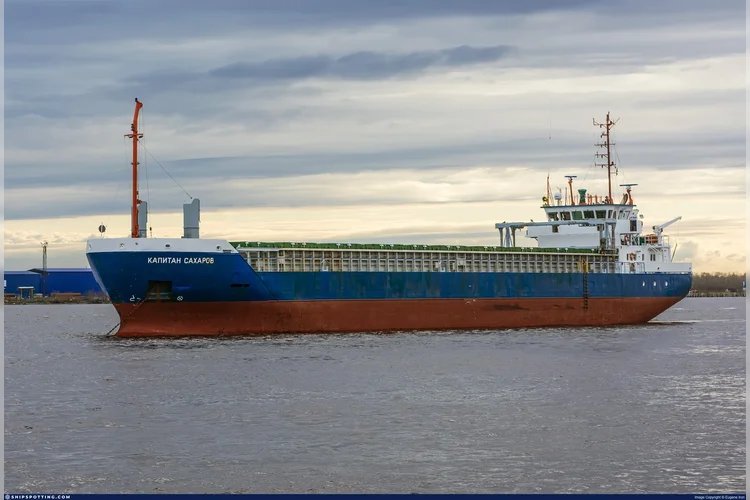
KAPITAN SAKHAROV stood by SPARTA II after the drone strike in the Gulf of Finland. It's not a random passer-by. It comes from the same supply chain. An OSINT read 👇
THE VESSEL
→ IMO 9279434, MMSI 273395150, 82.5 m general cargo ship, built 2004 in the Netherlands (ex-Flinterbjorn / Flinterbay)
→ Owned and managed by Northern Shipping Company
→ In 2022 the US State Department said the company performs services for Russia's MoD, including on MoD orders
→ Sanctioned by the US in May 2022 along with 27 of the company's vessels, and by Canada in June 2025
→ Ukraine's military intelligence (GUR) lists it under "transportation of military cargo", records AIS shutdowns, and lists port calls including Baltiysk, Kronstadt and Kaliningrad
WHAT HAPPENED TODAY (UTC, our AIS data)
→ 08:48–10:06: westbound at 8–9 kn on the main lane, roughly two hours behind SPARTA II on the same route
→ 10:06: sharp turn north-northwest
→ 10:27: SPARTA II drifts into Finnish territorial waters
→ 10:27–17:00: slow manoeuvring at 0–3.5 kn near the burning ship, south of Loviisa
→ 21:10: still stationary at 60.046N 26.095E
SPARTA II's 16 crew were evacuated to another Russian vessel. Finnish reporting points to KAPITAN SAKHAROV, but no official source has named it yet.
WHAT IT TELLS US
Both ships filed Kaliningrad as their destination. Both belong to companies that work for the Russian MoD. Both are under US sanctions. And they were on the same lane within hours of each other.
This doesn't look like an escort. It looks like the nearest ship on the same military supply run, diverted to help. That's the point: the St Petersburg–Kaliningrad sea line is busy enough that a second MoD-linked vessel was close by when the first one was hit.
WHY SHADOW FLEET MODELS MISS THIS
Our shadow fleet model at Rendezvous scores KAPITAN SAKHAROV at 2.8% and SPARTA II at 3.9%. Both correct. Neither is a sanctions-evading tanker.
They are something else: state military logistics sailing openly through a corridor bordered by NATO members. That needs its own risk category.
FINLAND
Finland let Russian vessels take part in the rescue - foreign ships need Finnish permission to join rescue operations in its waters - and is letting Russia tow SPARTA II back. That's maritime rescue working as it should: the crew comes first.
Still open: what SPARTA II was carrying, and which ship took the crew home. Finnish media say the evacuation ship left for Russia this evening, but KAPITAN SAKHAROV's AIS still showed it stationary at 21:10 UTC.
#OSINT #MaritimeSecurity #BalticSea #GulfOfFinland
Sweden’s Transport Agency lifted its operating ban on the tanker Sea Owl 1 this morning. The vessel has been at anchor off Trelleborg since March.
The Swedish Coast Guard, supported by police, boarded the 228-metre tanker in Swedish territorial waters on 12 March. It was reportedly sailing in ballast from Santos, Brazil, to Primorsk, under a Comoros flag the Coast Guard suspected was false. The agency imposed the ban the next day.
In May, the agency said a reported reflagging to Cameroon meant the ship could likely leave soon. Days later, Cameroon confirmed the ship held no valid registration there.
The agency now says it has confirmed directly with Equatorial Guinea that the ship is correctly registered there, and that nothing on its side prevents departure.
The vessel remains on the EU sanctions list. The agency’s decision rests on registration and documentation, not sanctions status. Where and when it sails next has not been announced.
Sources: Transportstyrelsen (12 Oct), Kustbevakningen (12 Mar).
#maritimesafety #Baltic #OSINT #shadowfleet
Idag blev det ett extra avsnitt av Geopodden.
Kansle det starkaste avsnitt vi släppt och under alla omständigheter det som berört mig själv djupast.
Om du tror på friheten - dela det!
https://t.co/2HUECViZ5v
Legitimate doesn't mean unproblematic.
Every week, tankers serving Russia's oil trade pass through the Baltic within sight of Swedish and Danish coasts. Much of that traffic is entirely legal, and the law of the sea guarantees it passage. We traced one fleet of four to see what the legal traffic looks like when you follow it all the way back.
The paper trail is tidy. Two product tankers were bought from Western owners five days apart in January 2023, days before the EU ban on Russian fuel imports took effect. They went to two different Istanbul companies that shared the same safety manager, the firm legally responsible for how a ship is run. A crude tanker joined that March under the same arrangement. Through 2023 and 2024 they ran the Primorsk route under Turkish flag.
Then the whole fleet moved. A web domain for a company registered to a PO box in an Omani free zone was created in July 2024. Ten weeks later the first ship transferred in. Within a year all four had followed, each reflagging to Palau. One changed flag twice in a single month, ending sixteen years under Greek ownership.
Two sellers in Istanbul, one buyer in Oman, one safety manager across both Istanbul companies. The four now carry names from a single Turkish celestial set: star, full moon, cosmos, Milky Way. That reads like common control, though no register will confirm it. Oman does not publish shareholders.
Day-to-day safety and security rest with two Russian masters, listed on the owning company's own website. The site was built in a Russian-language setting.
And it is all in order. All four are insured by an established US marine insurer and certified by major classification societies. Not one ship, company or person in the chain is sanctioned. The insurance holds because the oil price cap works on declarations: the shipowner states the cargo was bought under the ceiling, and the declaration is taken on trust. Nobody checks the invoice.
Ships like these keep coming. Through the Sound, past Bornholm, out through the Skagerrak and back, carrying Russian cargoes on routes the law permits and passage the law protects. The dark fleet gets the headlines: the uninsured ships, the false flags, the cut cables. But much of what moves Russia's oil past our coasts looks like this instead. Certified, insured, compliant, and owned by no one you can name.
Sources: Rendezvous, Equasis (IHS Maritime), VesselFinder AIS, VesselTracker, MagicPort, company website, domain records, European Commission.
#Baltic #OSINT #shadowfleet #maritimesecurity #sanctions
Sanctioned shadow fleet tanker Baltic Star passing closely along the Swedish coastline, looking likely to head through Øresund.
Seems to have filled up on crude in Ust-Luga and declared destination Dakar, Senegal where it’s currently headed.
1/ Something is happening off Kaliningrad. 6 shadow fleet vessels just clustered near the exclave - several showing AIS positions plotted on land. Not a data error. That's GNSS spoofing.
2/ Kaliningrad is the Baltic's most active GNSS interference zone. Spoofing feeds a vessel's receiver a false position, which its AIS then broadcasts as real, teleporting it on the map while it runs ship-to-ship transfers or port calls unseen.
3/ Researchers triangulated a spoofing emitter to Kaliningrad, with a jammer confirmed active in the same zone (Defense News, July 2025). Sweden's Maritime Administration warns some shadow fleet tankers may themselves be mobile spoofing platforms.
4/ Rule of thumb: AIS positions on land near Kaliningrad = spoofed, not real. Cross-check against SAR/satellite imagery instead. Activity has been escalating since late 2024 with no sign of slowing.
Source: https://t.co/oqkDKl6Y5n
Russia installs heavy machine guns on “shadow fleet” vessel for the first time, @dossier_center reports
Images provided to Delfi showed two 12.7 mm Kord heavy machine guns mounted on the floating storage and regasification unit (FSRU) Marshal Vasilevsky.
https://t.co/2W2YjdHBjm