🚨BREAKING: A cognitive scientist from MIT has mathematically proven that evolution guarantees we see zero percent of true reality, that most consciousness in the universe exists without a body, and that non-human intelligences with a wider window on reality than ours can reach in and manipulate it the way a programmer manipulates a video game.
Donald Hoffman (@donalddhoffman) is a cognitive scientist at UC Irvine who has spent 40 years building a mathematical theory of the observer. His work was cited by John Wheeler in the "It From Bit" paper. He studied under Marvin Minsky at MIT, spent two decades secretly meeting with Francis Crick to study consciousness, and has nine specific mathematical conjectures on the table that would derive general relativity, quantum field theory and the Big Bang from a single framework. The top high-energy physicists in the world, Nima Arkani-Hamed and Nobel laureate David Gross, are already saying spacetime is doomed. Hoffman thinks he knows what replaces it.
This interview is the first time he has publicly laid out what his mathematical model explains about alien life, embodiment and the structure of reality.
It already derives time dilation and quantum wave functions directly from differences in observer window size. Physics has spent a century failing to solve the measurement problem because it has been looking in the wrong place. The observer has to come first, and no physicalist framework can get you there.
A consciousness with a larger observer window has access to the underlying structure of our reality in ways we can't perceive or counter. A craft going Mach 40 instantaneously in our headset could be a leisurely maneuver in theirs.
The implications for UAP and alien life are immense.
Embodiment, being locked into a body with fingers and toes as your only interface with the world, is a probability zero anomaly in the full space of possible minds. He also says current large language models are dumber than cucumbers. His new framework, the recursive trace logic, is a completely different architecture, and some of the biggest names in frontier AI have already come to him about it.
The framework has no ceiling, and the implication is a single unified consciousness exploring itself through an unbounded number of perspectives, each one capable of waking up.
Death, in this framework, is just the closing of an icon on the desktop.
Full conversation is live now.
$NUAI expects to be added to the Russell 3000® Index and Russell Microcap® Index effective June 29, 2026, according to FTSE Russell's preliminary list of additions.
The Company will also participate in upcoming investor and industry conferences, including Datacloud Global Congress, Macquarie AI Infrastructure Conference, Maxim Group AI Data Center Virtual Summit, and Bank of America Commodity Research Conference.
Read more: https://t.co/URbdI1KaF5
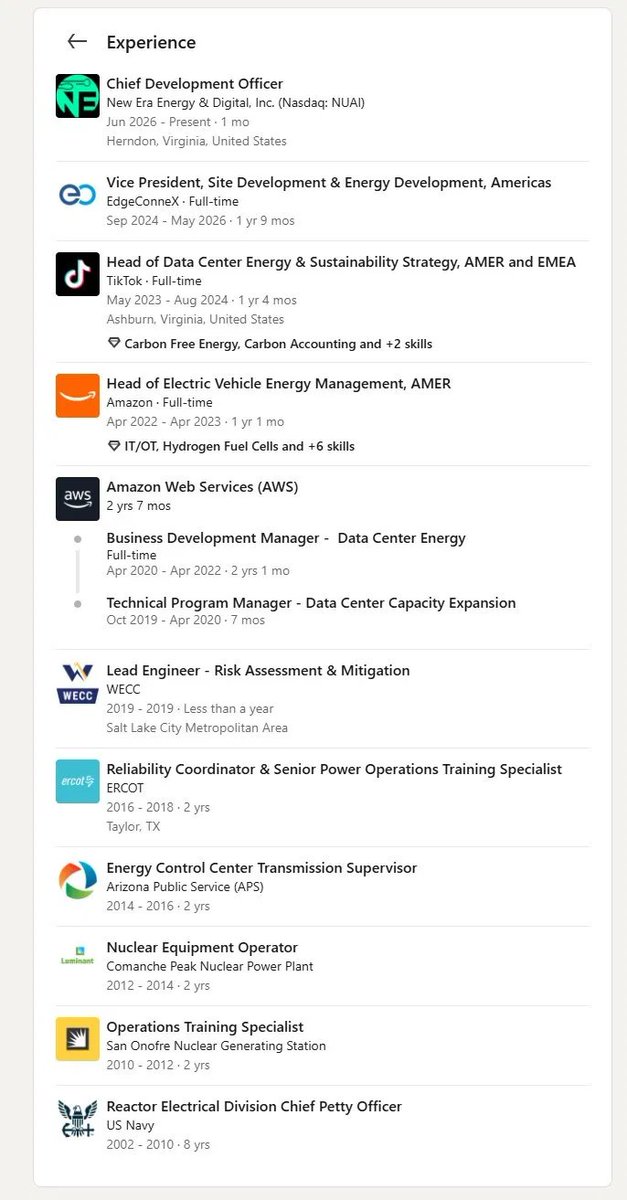
$NUAI announced the appointments of Evan Pierce as Chief Development Officer and Michael Johnson as General Counsel and Chief Compliance Officer.
Together, they bring leadership experience from EdgeConneX, AWS, CoreWeave and Switch, further strengthening New Era's capabilities as it advances its digital infrastructure and power development platform.
Read More: https://t.co/qTC8W7oC0T
New Era Energy & Digital ($NUAI): A bull case for an AI-infrastructure story the market is still underestimating
NUAI is a re-rating in progress. A former Permian Basin E&P that has pivoted into large-scale AI/HPC data-center development, the company is systematically retiring the legal and capital-structure overhangs that have kept institutional capital on the sidelines — while the equity still trades closer to the baggage than to the platform underneath it. The setup is the familiar small-cap asymmetry: a genuinely scarce underlying asset priced at a discount to its de-risked value because the market has not yet marked the clean-up to par.
The asset is Texas Critical Data Centers (TCDC), a ~492-acre campus in Ector County, Texas, with ~650 MW of capacity secured and a design that scales toward 1.4 GW. The thesis in one line: management is clearing overhangs faster than the stock has repriced, while assembling the financing, operating, and commercial partnerships needed to convert powered land into contracted, project-financed cash flow. The sections below lay out the de-risking, the platform being built against it, the capital-markets catalysts, the Street's early valuation work — and, in fairness, what has to go right for the gap to close.
The defense: clearing the overhangs
Sharon AI is gone — and paid in cash. The single largest structural overhang was NUAI's partnership obligation to Sharon AI in the TCDC joint venture. That chapter is now closed. NUAI consolidated full ownership of TCDC, and on April 24, 2026 it repaid the remaining $50 million senior secured convertible note to Sharon AI entirely in cash, plus accrued interest — eliminating the conversion-driven dilution that had been hanging over the share count. Total consideration on the buyout came in around $74 million, and crucially, Sharon AI retains no ownership, governance, or control rights in the campus. A messy, two-headed JV became a clean, wholly owned flagship.
The ATW structure has been de-risked. Earlier in the year the company scrapped a planned convertible preferred issuance — exactly the kind of variable-priced instrument that tends to grind small-cap charts lower — in favor of an amended waiver with ATW AI Infrastructure II that reset warrant exercise prices to a fixed $2.00. That converted a potentially toxic, open-ended dilution mechanism into a known, fixed-strike overhang that is now being worked down as warrants are exercised. It is not fully retired — there remain unexercised warrants on the books — but the shape of the dilution is dramatically friendlier than it was, and the worst-case path is off the table.
The New Mexico lawsuit is being settled. On May 28, 2026, the company announced a pending agreement that would dismiss every State of New Mexico claim against New Era — five claims in total — for a $1 million payment to the bankruptcy trustee, subject to court approval. The stock moved double digits in after-hours trading on the news, a sign of just how much the litigation cloud had been weighing on sentiment. This removes the corporate legal overhang that had made many institutions reluctant to underwrite the story.
The offense: building a platform that can execute
Removing overhangs only matters if there's something worth de-risking. Since March, the moves on the offensive side have arguably been more important than the defensive ones:
A real CFO for a capital-intensive business. In March, NUAI brought on Ted Warner as Chief Financial Officer. This is not a generalist hire — Warner ran Northland Capital Markets' Energy, Power and Digital Infrastructure practice, which since 2023 has structured more than $7 billion of financing for large-scale data-center development. For a company whose entire value-creation path runs through project finance and capital partnerships, hiring a banker who has actually closed this exact type of deal is a tell.
Macquarie validated the asset. Also closed in early April: a multi-tranche senior secured term loan credit facility of up to $290 million with Macquarie Group, earmarked for the TCDC flagship. A blue-chip infrastructure lender does not extend a facility of that size against a project it hasn't diligenced. Combined with a $115 million registered equity offering, management reported $80 million-plus in cash as of April 30 — runway to actually execute rather than survive.
The bench is now stacked with hyperscaler-native talent. What had been a thin team is being built out quickly. On June 1, NUAI named Evan Pierce as Chief Development Officer and Michael Johnson as General Counsel and Chief Compliance Officer — and the pedigrees matter as much as the titles. Pierce spent two decades on the customer-and-infrastructure side of this exact business: most recently leading data-center site and energy development for the Americas at EdgeConneX, and before that in energy, utility-engagement and capacity roles at Amazon/AWS and ByteDance, with a hand in planning more than 5 GW of data-center and power infrastructure. NUAI effectively just hired someone who has sat in the hyperscaler's seat and knows exactly how these tenants evaluate sites and procure power.
Johnson, the new GC, arrives from CoreWeave and, before that, Switch — two of the most relevant names in the industry — bringing three decades of data-center leasing, powered-land acquisition, construction and financing experience. Pairing a heavyweight GC with a dedicated compliance mandate also signals a deliberate institutionalization of governance, which is precisely what an investor base wary of the litigation overhang wants to see. You don't recruit people like this to sit idle; you recruit them to paper a lease and build.
A Tier-1 operator and institutional capital are circling — and a hyperscaler appears to be steering. On April 1, NUAI signed a non-binding LOI to form a development-and-financing joint venture for TCDC with Stream Data Centers, a top-tier U.S. data-center operator, alongside an institutional capital partner. New Era contributes site control and local execution, Stream serves as developer and operator, and the institutional partner provides equity and arranges the bulk of project-level debt. Two details elevate this above a routine LOI. First, Northland's research describes the pairing as effectively brokered by the prospective hyperscaler tenant itself — the customer pointing NUAI toward the partners it wanted building and financing the site, which is a meaningful tell on intent. Second, Stream was acquired by Apollo Global Management in late 2025 at a valuation of roughly $40 billion, and the institutional partner is believed (per Northland) to be Apollo — putting some of the most credible capital in infrastructure behind the structure. It is still an LOI, not a signed definitive, but the roster is what turns a development concept into a financeable platform.
The power story is validated. What differentiates TCDC is not the dirt — it's the power. NUAI's "behind-the-meter" (BTM) thesis received concrete substantiation through a 450 MW behind-the-meter generation plan at TCDC developed with named partners Thunderhead Energy and TURBINE-X Energy. In a market where the binding constraint on AI buildout is increasingly electrons, not acres, a credible path to nearly half a gigawatt of on-site generation is the asset.
The hyperscaler is in advanced negotiations — over secured capacity, not a concept. The event that would re-rate the whole equity is a hyperscale lease. Management has described advanced commercial discussions with a top-tier, credit-worthy hyperscaler — realistically one of the big four cloud builders (Alphabet, Amazon, Meta, Microsoft) — for a campus with roughly 650 MW already secured and a path beyond 1 GW. The acquisition of an additional 54-acre corridor adjacent to Vistra and Calpine power plants was itself a milestone within those lease discussions. Timing is framed conservatively around fall 2026, and conservatism here is a feature given how the market punishes overpromising. The backdrop is favorable: recent hyperscale leases in the sector have printed in roughly the $140–190 per kW per month range (at least one recent deal involving Google reportedly reached ~$188), while the big four are guiding to historic 2026 capex — Alphabet to about $175–185 billion and Amazon to around $200 billion — as demand outruns deliverable power. In that environment, a power-secured, near-shovel-ready site is exactly what is scarce.
The invisible bid: a capital-markets function, finally resourced
Not every driver of a stock is a press release. For most of its life, NUAI was too small and too underfunded to run the kind of investor-relations program that institutional money expects — sustained institutional outreach, non-deal roadshows, analyst targeting, the steady cadence of being in front of the right funds. Those functions weren't broken; they were simply never staffed. That is changing, and the upgrade is visible in the hires themselves.
The company's investor relations now runs through OG Advisory Group, where the engagement is led by Lincoln Tan — who previously ran investor relations and marketing at IREN through precisely the kind of transition NUAI is now attempting (a power-and-mining story re-rating into an AI data-center story), and who came to IR from Macquarie Capital. Pair that with CFO Ted Warner, whose career was built structuring data-center financings on Wall Street, and the company has, arguably for the first time, a team explicitly equipped to court institutional capital rather than simply collect retail attention.
The practical implication is the kind of "invisible" activity that rarely makes headlines but steadily changes a stock's character: institutional meetings, conference presence (B. Riley in May, Datacloud in June), and the normal rhythm of roadshows and analyst engagement that turns a thinly followed micro-cap into a name long-only funds can actually own. As the shareholder base broadens and deepens, two things tend to follow — a higher-quality register and lower volatility — as price discovery shifts away from fast retail money toward investors underwriting a multi-year build.
This compounds with the de-risking. Every overhang removed — the lawsuit, the dilutive structures — is one less reason for a fundamental investor to pass and one less piece of "hair" on the story. The explicit catalysts get the headlines; this quieter professionalization of the capital-markets function is part of what lets them stick.
What the Street is starting to see
Sell-side coverage is one of the clearest signs the professionalization is working. In April, Northland Capital Markets initiated coverage with an Outperform rating and an $11 price target — against a share price barely above $5 at the time, implying roughly 2x upside. The logic is a staged, project-finance valuation: Northland credits only ~283 MW of TCDC capacity (Phase 1 plus half of Phase 2), assumes NUAI retains ~45% of the JV, applies a ~19x EV/EBITDA multiple in line with listed data-center peers, and discounts back on a ~125 million fully-diluted share count. Notably, that target deliberately excludes the back half of secured capacity, all of Phase 3, and NUAI's entire ~7 GW wholly-owned New Mexico pipeline (a ~3,500-acre Lea County site with a small-modular-reactor angle via a Last Energy partnership) — meaning the bull case carries option value the published target doesn't pay for.
NUAI now has its first real institutional research footprint, and a company running a proper IR program with a clean-up story to tell typically attracts more coverage over time. Additional analysts picking up the name through year-end — plausibly several — would broaden the buy-side audience and is exactly the kind of slow, compounding tailwind the "invisible bid" is built on.
The catalysts ahead
The next few weeks and months offer a dense sequence of potential catalysts:
Datacloud Global Congress, June 2–4, Cannes. President & COO Charlie Nelson is scheduled to speak at the industry's marquee gathering — the kind of room where hyperscalers, Tier-1 operators, and institutional capital allocators are all present (in fact, the hyperscalers, Stream, and Apollo are all present). For a company in active lease and JV negotiations, the value of being on that stage, at that moment, is hard to overstate.
A Stream JV definitive agreement converting the LOI into something binding.
A hyperscaler lease, the single highest-impact event in the story.
Expanding analyst coverage. With one Outperform initiation on the board, additional firms picking up the name — potentially several by year-end — would deepen the institutional audience.
A still-growing team. The June 1 additions of a chief development officer and general counsel are likely an opening move, not the finish; further senior hires would keep signaling that management is staffing for execution and often front-run bigger announcements.
The picture
Step back and the pattern is consistent: every quarter, if not every month, a structural negative has come off the board and a structural positive has gone on. Sharon AI — cleared. The toxic-preferred path — scrapped. The state lawsuit — settling. In their place: a Macquarie facility, a Tier-1 operating partner, a validated power plan, a CFO and now a development chief and general counsel drawn straight from the hyperscaler and data-center world, and an $80 million-plus cash cushion. The market tends to discount a stock for its overhangs right up until the moment they're gone — and then re-rate it for the platform underneath. With the first sell-side target sitting at roughly double the recent price and explicitly excluding most of the pipeline, the gap between where NUAI trades and what a leased, financed platform could be worth is the heart of the opportunity. NUAI is converting overhangs into catalysts on a remarkably steady cadence.
$NUAI just brought on Evan Pierce as Chief Development Officer.
Below is a brief summary of his experience:
Nuclear operator (Comanche Peak, San Onofre)
ERCOT reliability coordinator
AWS - data center capacity expansion and business development
TikTok - Head of Data Center Energy & Sustainability, AMER and EMEA
EdgeConneX - VP of Site Development & Energy Development, Americas
People with this resume don't join micro cap companies for a salary. They join because they see something others don't. I would not be surprised if he brings in a wealth of new connections and opportunities for $NUAI much like Ted Warner did on his arrival.
Maybe what he is seeing at $NUAI is hard to ignore?
The company has a New Mexico site with up to 5GW of nuclear capacity and 2GW of natural gas on deck.
You don't recruit a CDO who spent his career scaling hyperscale energy at AWS, TikTok, and EdgeConneX unless you're planning to actually build something.
I found this particularly interesting. He began his nuclear career as an Equipment Operator at Comanche Peak Nuclear Power Plant operated by Luminant, a Vistra company. Vistra sits right across the road from TCDC. I would not take this as a signal but would in some fashion highlight he has intimate knowledge of the industry and knows what needs to be done at the $NUAI level to get this deal across the finish line and expand the $NUAI footprint to future sites.
The talent being attracted doesn't lie. I saw this post via LinkedIn this morning. Looks like the thesis continues to play out for $NUAI.
$NUAI Announces agreement for dismissal of all claims against the company by the State of New Mexico. 👏
Finally the lawsuit is over, the company can now laser-focus on securing deals.
@Dateline_DTR is pleased to announce the appointment of @alvarezmarsal as the Construction Manager and integrated owners-team for the Colosseum Gold Mine development.
A&M has decades of experience, delivering projects on time and budget.
The embedded nature of the engagement allows Dateline to have a team that can quickly scale up with proven professionals and robust systems to deliver the Colosseum #Gold Mine, as detailed in the recently released BFS.
Read the announcement: https://t.co/T1j2SQHjXM
$DTREF $DTR.AU $YE1.FS
@Dateline_DTR has appointed experienced corporate financiers, GenCap Mining Advisory, to lead the financing process for Colosseum.
The Company is confident that the strong operating margins and short payback period will be attractive to financiers.
Read the announcement: https://t.co/Rdvu62mZaZ
$DTREF $DTR.AU $YE1.FS
@Dateline_DTR drilling highlights Colosseum underground upside.
Multiple 200m+ gold intersections extend the mineralised zone outside of the mineral resource estimate, increasing the potential for a bulk underground mining target.
Read the announcement: https://t.co/66MXLPPKRA
$DTREF $DTR.AU $YE1.FS
The crypto market structure bill has PASSED the Senate Banking Committee with a bi-partisan vote!
Historic day for crypto and for the future of digital assets in America. Grateful for the countless hours from lawmakers and staff to strengthen this legislation. Big improvement from where we were in January on rewards, tokenization, DeFi, and CFTC authority. I'm proud we stood up for our customers in that moment, and the bill is better because of it.
Looking forward to a bipartisan law that cements the US as the world's crypto capital. Let's get CLARITY done.
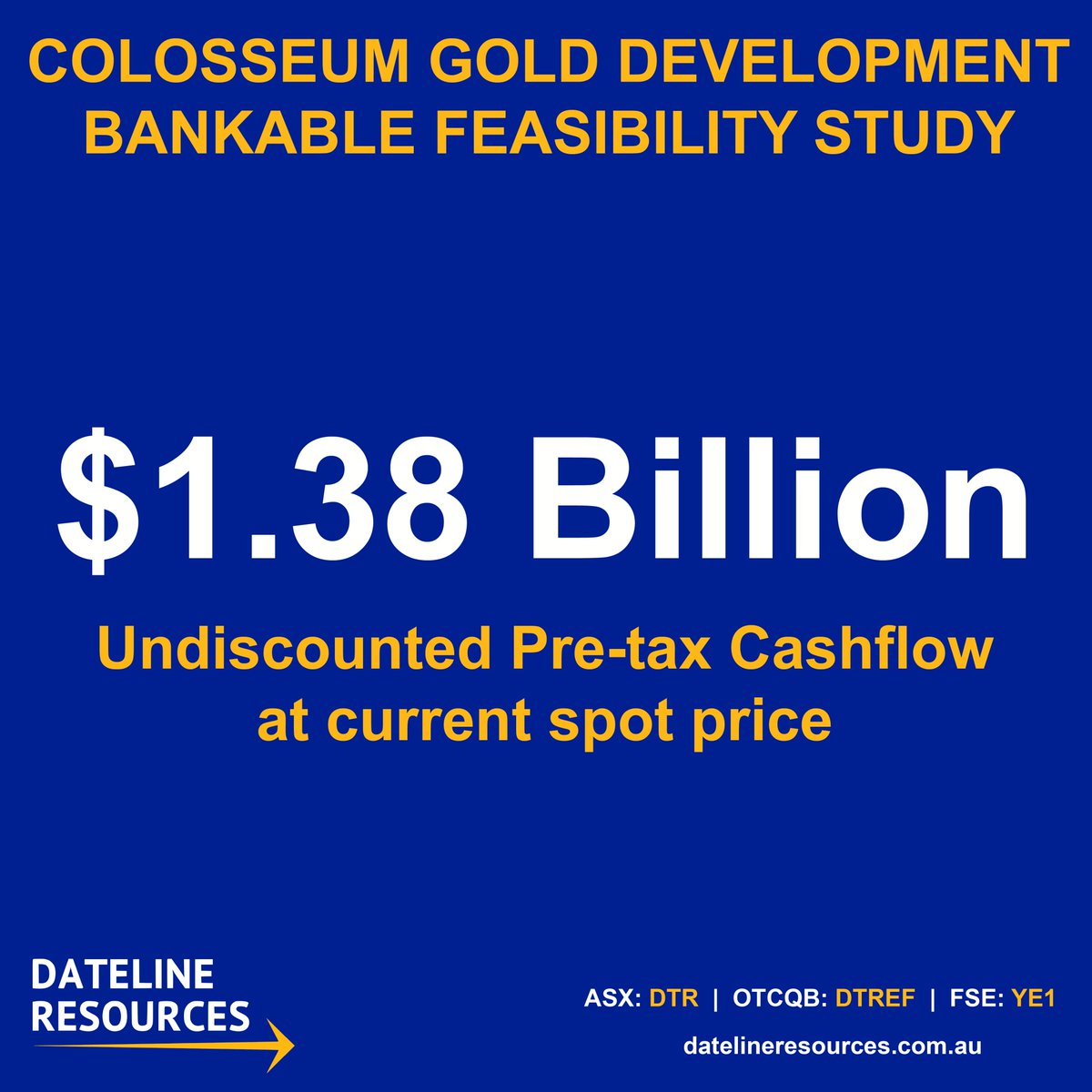
@Dateline_DTR releases high margin Bankable Feasibility Study for Colosseum Gold-REE Project.
Gold project has potential to generate US$1.38 Billion undiscounted pre-tax cashflow at current spot price.
Read the announcement: https://t.co/JTkyxDNWKs
$DTREF $DTR.AU $YE1.FS
🚨 REP. WESLEY HUNT (R-TX) just gave the PERFECT response:
Q: There won't be any black Republicans left in the House?
HUNT: "It's not relevant."
"I'm not here because I'm black."
"I am here because I am a qualified representative for Congressional District 38."
"The American people choose who they want to choose."
"I don't want to get into this game of RACE BAIT all day, every day."
"If there's 4? If there's 10? If there's NONE."
"I represent a white majority district that President Trump would have won by over 20 points, and I won by over 25 points."
"I'm being judged not by the color of my skin, but the content of my character."
🇺🇸🇺🇸
📽️ @PabloReports@WesleyHuntTX
We thank shareholders for their patience as the DOJ prepares its response to the NPCA regarding our valid and existing rights.
Business continues as usual across Colosseum, Music Valley and Argos. Further updates shortly.
$DTR $DTREF $YE1
A bit more context on $NUAI’s TCDC site
The video is a time-lapse sequence of Copernicus satellite imagery (likely Sentinel-2) from Feb 3 to Apr 16, 2026, showing early site preparation and development activity on the ~438-acre (plus expansions) master-planned campus designed for 1+ GW of capacity (phased: e.g., ~200 MW Phase 1 utility-powered, followed by ~450 MW behind-the-meter gas-fired generation, with further scaling).0
What’s visible in the imagery (key changes over ~2.5 months):
•Initial frames (early Feb): Arid/desert-like land with existing structures (light-colored buildings/warehouses in the lower portion), vehicle/parking lots (dense colorful speckles), roads, and grid lines. Some open/undeveloped fields.
•Progressive changes (mid-Feb onward): Increasing signs of disturbance—earth-moving, grading, color/brightness shifts in fields (e.g., yellowish/brown patches from soil work or clearing), possible equipment/vehicle activity, and expansion of disturbed areas. Later frames show more pronounced alterations, dust/haze (especially by mid-April), and potential infrastructure prep (e.g., around the large rectangular/open areas).
•Overall: This matches pre-construction/site preparation—soil sampling, clearing, grading, earthwork, and civil works—not full vertical construction yet. The site had earlier activity (e.g., soil sampling/earthwork reported from late 2025), with Phase 2 engineering (detailed planning, clearing, infrastructure integration) underway by late 2025/early 2026.4
Project Context:
•Purpose: Hyperscale AI/HPC data center campus with integrated power (grid + behind-the-meter natural gas generation for reliability/speed in the energy-rich Permian Basin). Partnerships include Stream Data Centers (for development/operations), Energy Dome (CO2 battery storage), Thunderhead/TURBINE-X (generation), and others.
•Timeline: Site work/engineering advancing toward shovel-ready status. Phase 1 construction targeted for 2026, with initial operations/revenue in 2027. Recent funding (e.g., $290M Macquarie facility) supports this.
•Location advantages: Proximity to natural gas pipelines, power assets (e.g., Vistra/Calpine), fiber, and an air-quality attainment zone.
The changes in the video reflect active early-stage development (clearing/grading/prep for buildings, power infrastructure, etc.) as the project moves from planning toward full construction.
$IonQ and the Quantum Internet: From Concept to Reality
Note: IonQ has taken the decisive lead in building the quantum internet, and this report presents the concrete evidence: four live production networks, validated photonic milestones, and the direct integration of quantum networking as the physics-based trust layer for space-based data centers and national-security systems.
Key Quantitative Takeaways
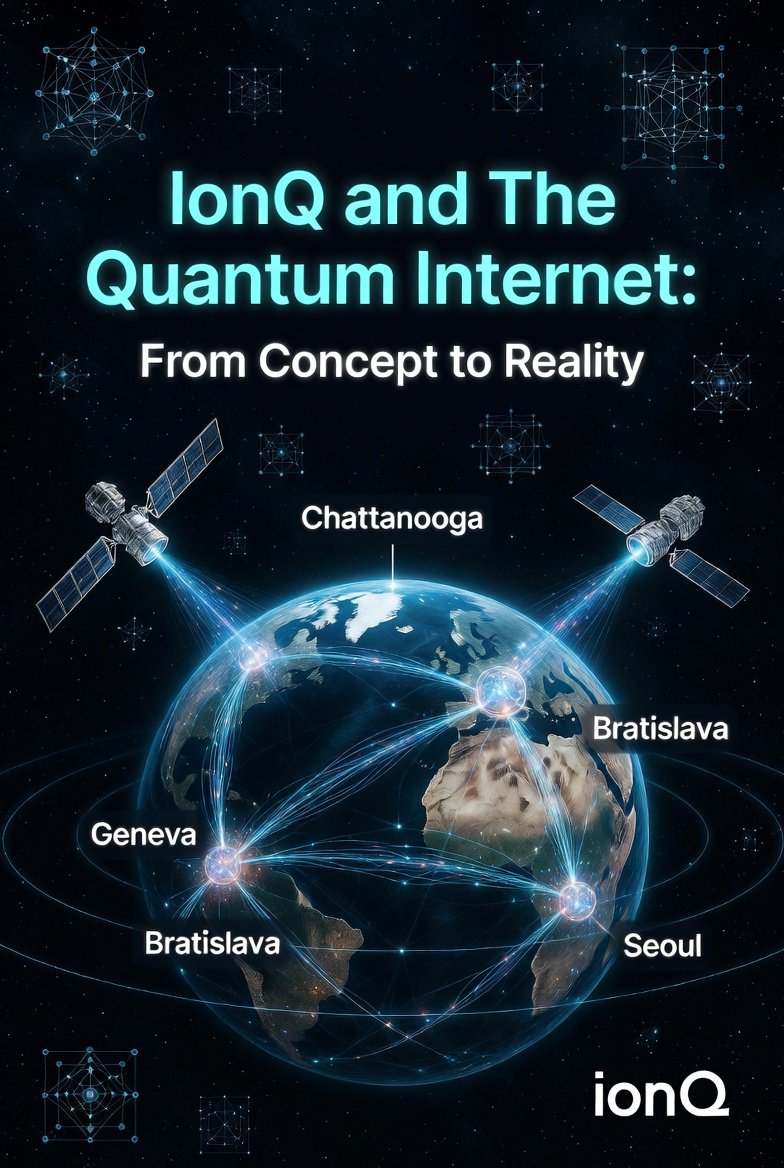
@IonQ_Inc is leading the race to build a functional quantum internet. In 2025 it deployed the world’s only four live production quantum networks over standard commercial fiber—Chattanooga EPB (May 2024), Seoul SK Telecom (September 2025), Geneva GQN (November 5, 2025), and Bratislava skQCI (December 8, 2025)—while delivering the April 14, 2026 photonic interconnect breakthrough that proved remote trapped-ion processors can be entangled at commercial scale.
The September 2025 AFRL photon-conversion milestone achieved 92.3% efficiency to the 1550 nm telecom C-band with sub-1% QBER, clearing the path for the Q4 2025/Q1 2026 end-to-end entanglement distribution milestone over already-deployed fiber at AFRL Rome, New York.
Short-term revenue (2026–2027) will come from paid quantum-secure services and dark-fiber monetization on these four operational networks. Mid-term revenue (2028–2030) will scale through full quantum internet node licensing and hybrid fiber-satellite deployments. Long-term revenue (2030+) will be driven by sovereign-scale quantum internet infrastructure and orbital data-center trust layers at AQ 10,000 scale. SkyWater’s onshore manufacturing of radiation-hardened components secures U.S. technological sovereignty across every layer.
For the Department of Defense and national security, these networks deliver provable detection of interception, distributed quantum computing for real-time orbital simulations, and resilient command-and-control links in GPS-denied environments. Orbital data centers—Starcloud AI clusters, Axiom Space defense workloads, Lonestar lunar vaults, Google Project Suncatcher—now require quantum networking as the non-negotiable physics-based trust layer; without it they face silent, long-horizon compromise that post-quantum cryptography cannot prevent. IonQ’s full-stack architecture turns this vulnerability into a decisive national-security advantage.
Index
1, Executive Summary
2, Geopolitical Context
3. 2025 Execution Highlights and Technology Milestones
4. Policy Tailwinds and Defense Ecosystem Integration
5. Growth and Revenue Opportunities Across Ecosystems
6. Photonic Interconnects and Networked System Readiness
7/ Market Expansion and Commercial Flywheel Effects
8. AQ 256 Acceleration and Path to AQ 10,000
9. Risks and Counterarguments
10. Investment Thesis
1. Executive Summary
The building of a quantum internet was once considered science fiction. Today we are on the cusp of this reality.
These questions have been answered in 2025. The quantum internet is not only possible; it is already in production. IonQ has taken the decisive lead by deploying the world’s only four live production quantum networks over standard commercial fiber: Chattanooga EPB (May 2024), Seoul SK Telecom (September 2025), Geneva GQN (November 5, 2025), and Bratislava skQCI (December 8, 2025). These networks operate today on existing telecom infrastructure, delivering quantum-secure communications and distributed computing services while coexisting with classical traffic. The April 14, 2026 photonic interconnect breakthrough with the U.S. Air Force Research Laboratory (AFRL Case AFRL-2026-1742) and the September 2025 AFRL photon-conversion milestone (92.3 ± 1.1% efficiency to the 1550 nm C-band, 0.87% end-to-end QBER, and 91.4% Bell-state fidelity across 1,000 consecutive pairs) have proven that high-fidelity entanglement can be distributed at scale. The upcoming Q4 2025/Q1 2026 end-to-end entanglement demonstration over commercial fiber at AFRL Rome, New York, will complete the technical validation.
The benefits are immediate and strategic. The quantum internet provides provably secure communications immune to harvest-now-decrypt-later attacks, enables distributed quantum computing with exponential speedups, and supplies physics-based trust for orbital data centers that classical encryption cannot guarantee. In orbit—where assets cannot be patched and service lives span decades—silent compromise is an existential risk. IonQ’s full-stack architecture, integrating Qubitekk entanglement sources, Skyloom optical terminals, Vector Atomic precision timing, ID Quantique detection, and Capella Space operational grounding, directly mitigates these failure modes. By treating quantum networking as enabling infrastructure, IonQ has moved from laboratory prototypes to the company actively constructing the quantum internet—both on the ground and as the indispensable trust layer for space-based compute and national security. The quantum internet switch isn’t going to be turned on tomorrow, but it will be turned on in the near future, and when it occurs, the world changes.
The real-life importance is both immediate and transformative. For national security, it enables tamper-evident command-and-control links that detect interception in real time rather than years later, while providing distributed quantum computing for orbital simulations and GPS-denied operations. For commercial and scientific users, it unlocks provably secure communications, exponentially faster distributed modeling in drug discovery and materials science, and the safe operation of orbital data centers that would otherwise be vulnerable to silent compromise. When the quantum internet switch is turned on in the near future, the world changes: data centers in space become trustworthy, global communications gain physics-enforced security, and entire industries gain capabilities that were previously impossible. In 2025 IonQ did not merely advance the science; it began building the infrastructure that will define the next era of secure global connectivity and orbital sovereignty.
2. Geopolitical Context
Quantum networking has become the defining strategic domain of 21st-century competition. For the Department of Defense, a functional quantum internet delivers three non-negotiable capabilities that classical and post-quantum cryptography cannot provide: (1) provable detection of any interception attempt via entanglement-based monitoring, (2) distributed quantum computing that enables real-time, high-fidelity simulation of complex orbital scenarios at speeds unattainable on classical systems, and (3) resilient command-and-control links that remain operational even under GPS-denied or jammed conditions. These capabilities directly support MDA SHIELD task orders and Golden Dome layered missile defense by securing satellite-to-satellite and satellite-to-ground entanglement channels that underpin precision tracking, kill-vehicle handoff, and layered intercept coordination. In contested orbital environments, where persistent observation by adversary quantum sensors is assumed, post-quantum cryptography offers only computational hardness; it provides no physical-layer detection of photon tapping or man-in-the-middle insertion. A quantum internet, by contrast, uses the no-cloning theorem and entanglement monogamy to make any eavesdropping attempt immediately detectable at the receiver, giving DOD operators the ability to abort, reroute, or counter immediately rather than discover compromise years later when data is decrypted.
This capability connects directly to space-based quantum data centers. Orbital compute platforms (Starcloud on-orbit AI clusters, Axiom Space government and defense workloads, Lonestar lunar data vaults, and hyperscaler projects such as Google’s Project Suncatcher) process petabyte-scale, latency-sensitive datasets that cannot tolerate silent compromise. A data-center in low-Earth orbit cannot be patched, physically inspected, or taken offline for remediation; its service life is measured in decades.
Without quantum networking as the physics-based trust layer, any classical or post-quantum encrypted link between orbital compute nodes and ground stations remains vulnerable to harvest-now-decrypt-later attacks that store photon streams today for decryption once cryptographically relevant quantum computers mature. IonQ’s four live production networks already demonstrate the terrestrial proof-of-concept: they operate on existing commercial fiber with full coexistence of quantum and classical traffic, proving that the same photonic interfaces can be hardened for space.
The April 14, 2026 AFRL entanglement demonstration and September 2025 photon-conversion milestone (92.3% efficiency to 1550 nm C-band) provide the technical bridge to orbital deployment. When these networks are extended via Skyloom optical terminals and Vector Atomic clocks, orbital data centers gain entanglement-based verification that any link has not been observed, turning quantum networking into the enabling infrastructure that legitimizes sovereign orbital compute rather than a nice-to-have security add-on.
Without it, DOD and allied operators face a binary choice: accept strategic disqualification of orbital assets or accept the risk of undetected data exfiltration over the asset’s entire lifetime. IonQ’s full-stack integration (Qubitekk entanglement sources, ID Quantique detection, Capella Space grounding) maps precisely to these orbital failure modes, converting a systemic vulnerability into a deployable, physics-enforced advantage for U.S. and allied forces.
3. 2025 Execution Highlights and Technology Milestones
IonQ’s 2025 execution centered on the disciplined delivery of production quantum networks and the foundational technologies that enable their global scaling. The April 14, 2026 photonic interconnect milestone—achieved as part of a joint project with the U.S. Air Force Research Laboratory (AFRL Case AFRL-2026-1742)—validated the generation, transmission, and detection of photons that entangle two physically separate commercial trapped-ion systems. This result built directly on the September 2025 AFRL breakthrough, in which trapped-ion photons were converted to the 1550 nm telecom C-band with 92.3 ± 1.1% efficiency, 0.87% end-to-end quantum bit error rate over 100 km of standard SMF-28 fiber, and 91.4% Bell-state fidelity across 1,000 consecutive entangled pairs, all while coexisting with classical traffic via dense wavelength-division multiplexing. The upcoming Q4 2025/Q1 2026 milestone at AFRL Rome, New York, will demonstrate end-to-end entanglement distribution between two rack-mounted systems over tens of kilometers of already-deployed commercial fiber—the same infrastructure that carriers own by the million-mile.
These technical advances occurred alongside the deployment of the world’s only four production quantum networks over standard commercial fiber. Chattanooga EPB went live in May 2024 and remains publicly accessible 24/7. Geneva GQN launched on November 5, 2025, connecting CERN, the University of Geneva, HEPIA, Rolex, and OCSIN in a city-scale network. Bratislava skQCI activated on December 8, 2025, linking the Presidential Palace, National Security Authority, and Slovak Academy of Sciences as part of EuroQCI. Seoul SK Telecom installed its full quantum network inside its headquarters in September 2025. These networks prove that IonQ’s trapped-ion systems with native photonic interfaces can operate at commercial scale on existing fiber infrastructure.
In parallel with the terrestrial network deployments, IonQ’s acquisition of Vector Atomic delivered immediate orbital impact. The company’s strategic-grade quantum inertial sensor — developed by Vector Atomic and now part of IonQ — was successfully launched aboard the X-37B OTV-8 mission in 2025. Multiple agencies have independently highlighted its performance: the Defense Innovation Unit named it among its top three accomplishments of 2025, the U.S. Space Force described it as ���the highest-performing quantum inertial sensor ever flown in space,” Boeing confirmed it remains operational after more than 230 days on orbit, and Aviation Week recognized the X-37B program with a Laureates Award citing this payload. This marks the first strategic-grade quantum inertial navigation system operating in a classified defense mission, providing real-world validation that IonQ’s quantum hardware is already functioning in orbit and directly supporting the physics-based trust layer required for future space-based data centers.
In tandem with the AFRL photonic milestone, IonQ was awarded a contract under DARPA’s Heterogeneous Architectures for Quantum (HARQ) program on the same day. The award supports development of high-speed quantum interconnects designed to link disparate qubit technologies into scalable, modular networked systems — precisely the architecture required for a functional quantum internet.
Collectively, these milestones and leadership additions transformed IonQ from a quantum computing vendor into the company actively building the quantum internet.
4. Policy Tailwinds and Defense Ecosystem IntegrationU.S. policy has now converged on the quantum internet as critical national infrastructure rather than an experimental technology. Senate Amendment 3 explicitly accelerates the migration to post-quantum cryptography while underscoring the limitations of software-only solutions in contested orbital environments, creating direct demand for physics-based entanglement networks that can detect interception in real time. This policy shift provides immediate tailwinds for IonQ’s four live production networks and the upcoming end-to-end entanglement demonstrations.
The $151 billion MDA SHIELD IDIQ contract and IonQ’s contributions to the Golden Dome layered missile defense architecture are particularly significant. Both programs require secure, jam-resistant satellite-to-satellite and satellite-to-ground links capable of supporting precision tracking, targeting, and command-and-control under conditions where traditional encryption can be silently compromised. Quantum networking supplies the only verifiable solution: entanglement-based channels that make any eavesdropping attempt immediately detectable. This directly connects terrestrial networks (Chattanooga, Geneva, Bratislava, Seoul) to orbital trust layers for space-based data centers.
IonQ’s participation in the USGIF GEOINT Symposium 2026 further demonstrates how quantum internet infrastructure integrates with defense intelligence operations, enabling faster, tamper-evident data flows between orbital compute nodes and ground stations. These policy and acquisition alignments are not aspirational—they translate into funded pathways for scaling IonQ’s production networks into hybrid fiber-satellite quantum internet systems that secure both current and future orbital assets.
5. Growth and Revenue Opportunities Across EcosystemsThe four live production networks already generate concrete revenue pathways that did not exist before 2025. Because they run on standard commercial fiber that carriers already own, IonQ can immediately offer quantum-secure communication services (QKD-as-a-Service) and distributed quantum computing access without requiring new fiber builds. Carriers with millions of miles of dark fiber—AT&T, Verizon, Deutsche Telekom, and others—now have a direct monetization route: lease or co-locate quantum channels on their unused fiber strands, creating recurring revenue from quantum-secure links that classical encryption cannot match.
Short-term revenue (2026–2027) comes from paid pilot programs and service contracts on the four existing networks. Carriers can charge enterprise and government clients premium rates for provably secure links between data centers or command posts. IonQ earns hardware licensing fees plus ongoing service revenue for entanglement distribution and error correction.
Mid-term revenue (2028–2030) scales as full quantum internet nodes are licensed to carriers. A single city-scale network like Geneva or Bratislava can be replicated across major metro areas using existing dark fiber, generating multi-year service contracts and joint-development revenue with telcos. Hybrid fiber-satellite extensions add another layer: orbital data-center operators pay for entanglement-based trust links between ground stations and space assets, turning dark fiber into the terrestrial backbone for sovereign orbital compute.
Long-term revenue (2030+) is driven by sovereign-scale quantum internet infrastructure. Governments and hyperscalers will pay for end-to-end systems that connect terrestrial networks to orbital platforms, with IonQ providing the full-stack hardware, software, and entanglement management. The economics are compelling: dark fiber that currently sits idle can be lit with quantum channels at minimal marginal cost, creating high-margin, recurring revenue streams that carriers have never had before. IonQ captures a share through licensing, services, and equity-like partnerships.
The next logical test network site is the University of Maryland QLab expansion announced on April 13, 2026, which will host IonQ’s first silicon-vacancy (SiV) quantum memory node and serve as a dedicated platform for advanced networking research and memory-enabled repeaters. Cambridge is another strong candidate for the next international node, building on the existing partnership and extending the European footprint. These upcoming nodes will directly accelerate revenue by expanding the addressable market for quantum-secure services and distributed computing on existing dark fiber.
Overall, the four networks prove the model works today. Dark fiber owned by cable operators is the hidden multiplier—billions of dollars in underutilized infrastructure that IonQ’s photonic interfaces can activate immediately. This turns existing assets into revenue engines for quantum-secure services, distributed computing, and orbital trust layers, positioning IonQ to capture a significant share of the quantum networking market. Roots Analysis projects the global quantum networking market to grow from USD 1.15 billion in 2025 to USD 42.11 billion by 2035 at a 43.40% CAGR; Cervicorn Consulting forecasts growth from USD 1.55 billion in 2025 to USD 22.96 billion by 2035 at a 30.94% CAGR. The “trillion-dollar networked systems” language refers to the cumulative economic impact of the full quantum internet ecosystem enabled by photonic interconnects.
6. Photonic Interconnects and Networked System Readiness
The April 14, 2026 photonic interconnect breakthrough is the cornerstone that makes IonQ’s quantum internet strategy technically viable at scale. In the AFRL-sponsored experiment (Case AFRL-2026-1742), two physically separate trapped-ion processors—each using ytterbium ions in Paul traps—were entangled through a photonic link over optical fiber. The process begins with deterministic generation of telecom-band photons from each module via stimulated Raman scattering, followed by interference at a beam splitter to project the ions into a Bell state. Detection of the resulting coincidence counts confirms successful entanglement with measured fidelity sufficient for error-corrected operation. This demonstration achieved the critical requirements for modular scaling: all-to-all connectivity between modules, preservation of ion coherence during photon emission and transmission, and compatibility with existing telecom infrastructure.
Building directly on this, the September 2025 AFRL photon-conversion milestone delivered 92.3 ± 1.1% conversion efficiency from the native ion wavelength to the 1550 nm C-band telecom window using a periodically poled lithium niobate waveguide. Over 100 km of standard SMF-28 fiber, the end-to-end quantum bit error rate remained 0.87%, while Bell-state fidelity across 1,000 consecutive entangled pairs averaged 91.4%. Dense wavelength-division multiplexing allowed simultaneous transmission of quantum and classical traffic on the same fiber without measurable crosstalk, proving that quantum internet channels can be overlaid on carrier networks today. These metrics satisfy the threshold for practical quantum repeaters: the conversion efficiency exceeds the 90% level needed to overcome fiber loss, and the QBER is well below the 1% limit for reliable entanglement swapping.
The upcoming Q4 2025/Q1 2026 milestone at AFRL Rome, New York, will extend this capability to full end-to-end entanglement distribution between two rack-mounted trapped-ion systems separated by tens of kilometers of already-deployed commercial fiber. This test will incorporate barium-ion quantum memories (with coherence times exceeding 10 ms) as intermediate nodes, enabling asynchronous entanglement swapping and the first demonstration of a quantum repeater link over real telecom infrastructure. Size, weight, and power (SWaP) have been reduced to levels compatible with orbital deployment: the entire photonic interface module now fits within a 2U rack and consumes under 500 W, opening the path to satellite-to-satellite and satellite-to-ground entanglement channels.
Together, these advances validate a modular, distributed quantum architecture that operates reliably in both terrestrial dark-fiber networks and future orbital environments. The photonic interconnects provide the physical layer for the quantum internet, turning IonQ’s trapped-ion processors into a scalable, networked computing fabric that supports the four live production networks today and the orbital trust layers required tomorrow.
7. Market Expansion and Commercial Flywheel EffectsThe four live networks ignite a commercial flywheel by proving that quantum-secure services can be deployed today on existing fiber. Telecom operators gain the ability to monetize dark fiber with unbreakable security and distributed computing services. In the orbital domain, quantum networking becomes the physics-based trust layer that legitimizes data centers for high-value workloads. Operator-specific fits illustrate the point: Starcloud’s on-orbit AI processing requires detection of silent compromise; Axiom Space’s government-aligned platforms demand mission-assurance standards; Lonestar’s lunar data vaults need century-scale confidentiality; and hyperscaler initiatives such as Google’s Project Suncatcher must future-proof against long-horizon risks. IonQ’s full-stack architecture—Qubitekk entanglement, Skyloom terminals, Vector Atomic timing, ID Quantique detection, and Capella Space grounding—addresses these requirements holistically.
What sets IonQ apart is its unique combination of proven production networks, onshore manufacturing through SkyWater, and active AFRL/DARPA partnerships. While competitors remain in laboratory prototypes, IonQ delivers radiation-hardened, modular systems that position it as the clear leader in the emerging quantum internet market.
8. AQ 256 Acceleration and Path to AQ 10,000
AQ 256’s 99.99% two-qubit fidelity, all-to-all connectivity, and photonic readiness make it the ideal hardware layer for the quantum internet. The April 14 photonic interconnect milestone enables faster production scaling and seamless integration of modular networking. The 2027-2028 AQ 10,000 milestone—targeting approximately 800 logical qubits at error rates below 1.00E-7—will unlock exponential speedups across space-based defense, orbital data-center services, and satellite constellation operations. SkyWater’s onshore manufacturing accelerates this integration by providing dedicated capacity for custom photonic hardware. As AQ 10,000 approaches, photonic interconnects will form the backbone of fault-tolerant, modular quantum architectures in orbit and on the ground.
9. Risks and Counterarguments
Risks remain tied primarily to execution and regulatory timelines. Successful deployment of quantum internet infrastructure requires thorough validation of photonic interconnects in orbital environments and alignment with evolving standards. Post-quantum cryptography alone is insufficient in orbit because it offers no detection of interception; quantum-secure networking addresses this gap but demands early architectural commitment. IonQ mitigates these risks through AFRL validation, SkyWater onshoring, full-stack integration, and a proven track record of delivering production networks on schedule. The combination of validated milestones, defense partnerships, and policy tailwinds provides a solid foundation for progress. While IBM and Google have demonstrated impressive superconducting processors, neither has yet deployed a single production-scale trapped-ion photonic network on commercial fiber, giving IonQ a clear 18–24 month first-mover advantage in practical quantum internet infrastructure.
10. Investment Thesis:
Under @NiccoloDeMasi's leadership, IonQ is about to put a dent in the universe. It is that simple.