China has massive economic exposure to the Middle East:
China has spent over $269 billion on investments and construction contracts across the Middle East since 2005.
Saudi Arabia is the largest recipient at $82 billion, followed by the UAE at $48 billion, and Iraq at $40 billion.
Furthermore, Chinese investments and construction contracts in Iran have reached $25 billion.
Meanwhile, Middle East trade with China has more than doubled since 2017, to $317 billion in 2024.
That is nearly 4 times the $85 billion in trade with the US in 2024.
China is heavily tied to the Middle East's economy.
BREAKING: We have received the full details on the US-Iran 2-week ceasefire announced by President Trump:
Details include:
1. The 2-week pause is subject to Iran agreeing to the "complete, immediate, and safe opening" of the Strait of Hormuz
2. Trump describes this as a "double sided ceasefire" brokered by Pakistan
3. Trump says the US has "already met and exceeded all military objectives"
4. Trump says the US and Iran are "far along with a definitive agreement for long-term peace"
5. Trump says Iran's 10-point proposal is a "workable basis" and this two-week period will allow an agreement to be finalized
We now await comment from Iran.
BREAKING: Iran has delivered its highly anticipated "10-point" response to the US' "15-point peace plan."
Iran's 10-point plan includes:
1. Guarantee that Iran will not be attacked again
2. Permanent end to the war, not just a ceasefire
3. End to Israeli strikes in Lebanon
4. Lifting of all US sanctions on Iran
5. End to all regional fighting against Iranian allies
6. In return, Iran would open the Strait of Hormuz
7. Iran would impose a Hormuz fee of $2 million per ship
8. Iran would split these fees with Oman
9. Iran to provide rules for safe passage through Hormuz
10. Iran to use Hormuz fees for reconstruction instead of reparations
President Trump's "deadline" for a peace deal with Iran is 25 hours away.
Key Events This Week:
1. Markets React to Trump's "48 Hour Warning" - 6 PM ET Today
2. March ISM Non-Manufacturing data - Monday
3. Trump's "Iran Power Plant and Bridge Day" - Tuesday
4. Fed Meeting Minutes - Wednesday
5. February PCE Inflation data - Thursday
6. US Q4 2025 GDP data - Thursday
7. March CPI Inflation data - Friday
8. April MI Inflation Expectations data - Friday
9. April MI Consumer Sentiment data - Friday
We expect extreme volatility ahead.
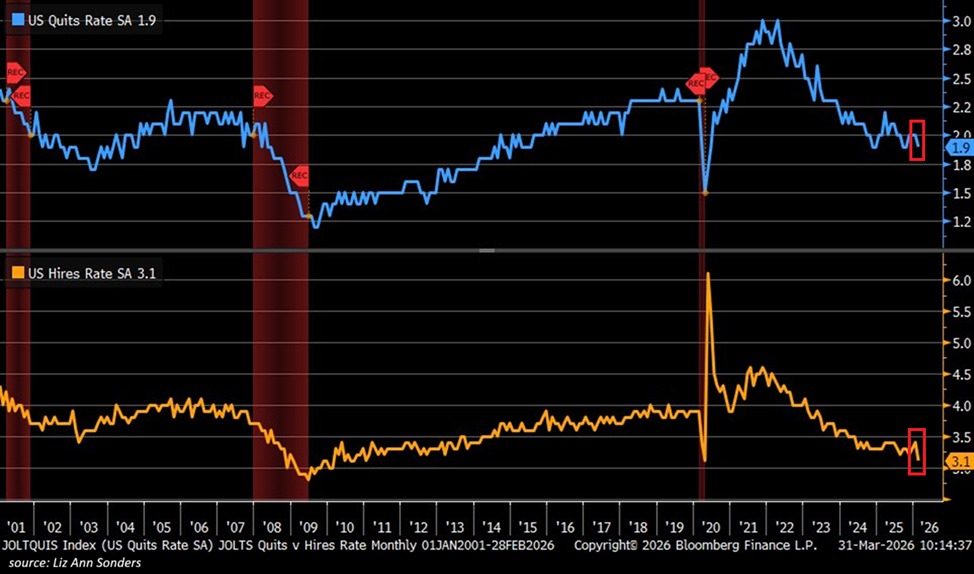
The US economy is going through a hiring recession:
The number of hires as a % of total employment fell -0.3 percentage points in February, to 3.1%, in-line with the 2020 pandemic low.
This is also the lowest level since January 2011, and just 0.3 percentage points above the 2008 Financial Crisis low of 2.8%.
At the same time, the private hiring rate declined -0.4 percentage points to 3.3%, the lowest since February 2010.
Back then, the US unemployment rate stood at 9.7%, more than double the current 4.4%.
Furthermore, the quits rate decreased -0.1 percentage point in February, to 1.9%, the lowest since the 2020 pandemic.
The US job market is in bad shape.
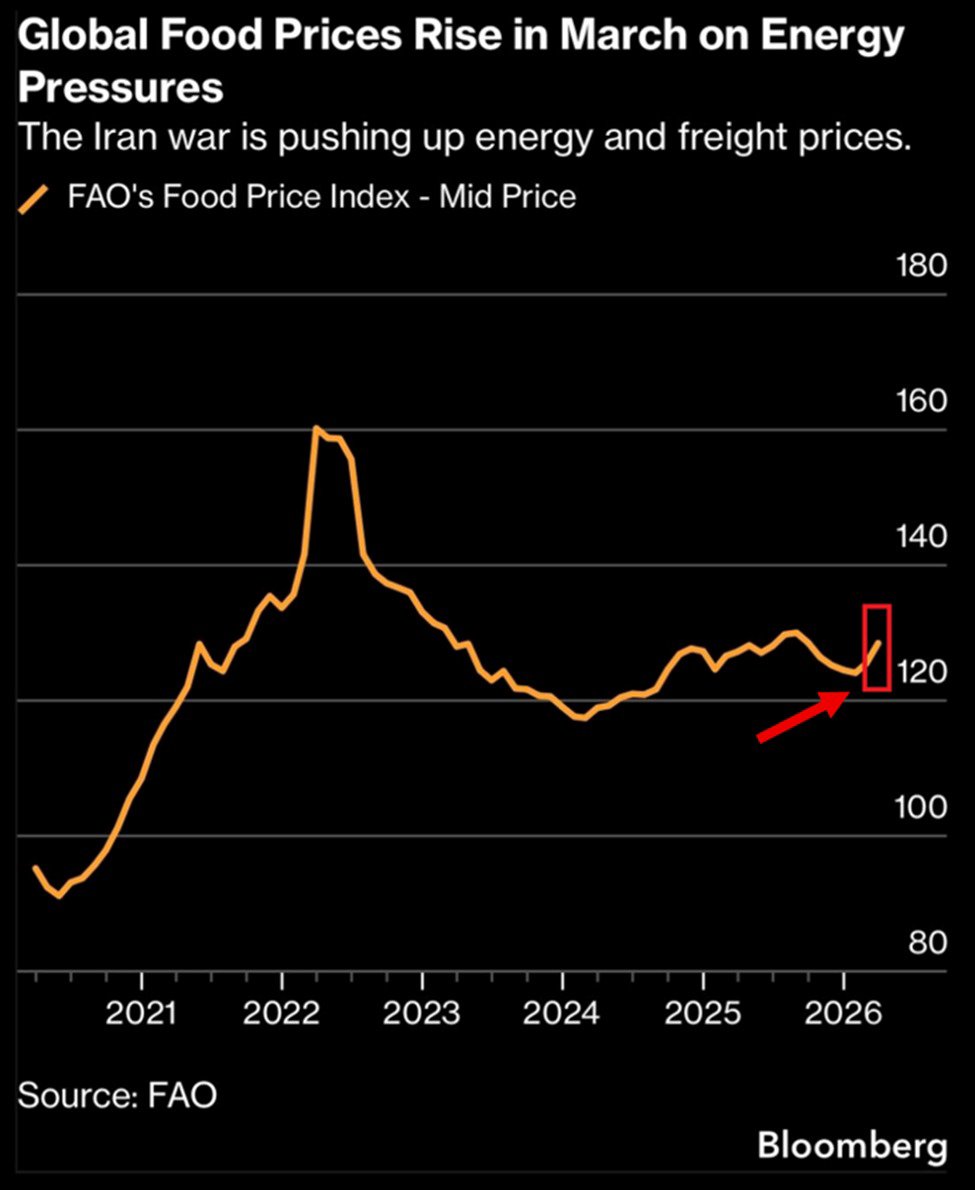
Global food prices are rising as energy costs spike:
The World Food Price Index jumped +2.4% in March, to 128.5 points, the highest since September 2025.
This index tracks the cost of grains, sugar, meat, dairy, and vegetable oils globally.
This marks the 2nd consecutive monthly increase, after February ended a 5-month streak of declines.
Surging energy and freight costs, along with disrupted flows of grains and fertilizers through the Strait of Hormuz, are the major drivers.
The energy crisis is spreading into food.