For years, we’ve accepted that powerful software has to be complicated.
More settings.
More menus.
More dashboards.
More things to learn.
But complexity isn’t a feature.
It’s often a sign that the software hasn’t fully understood the user.
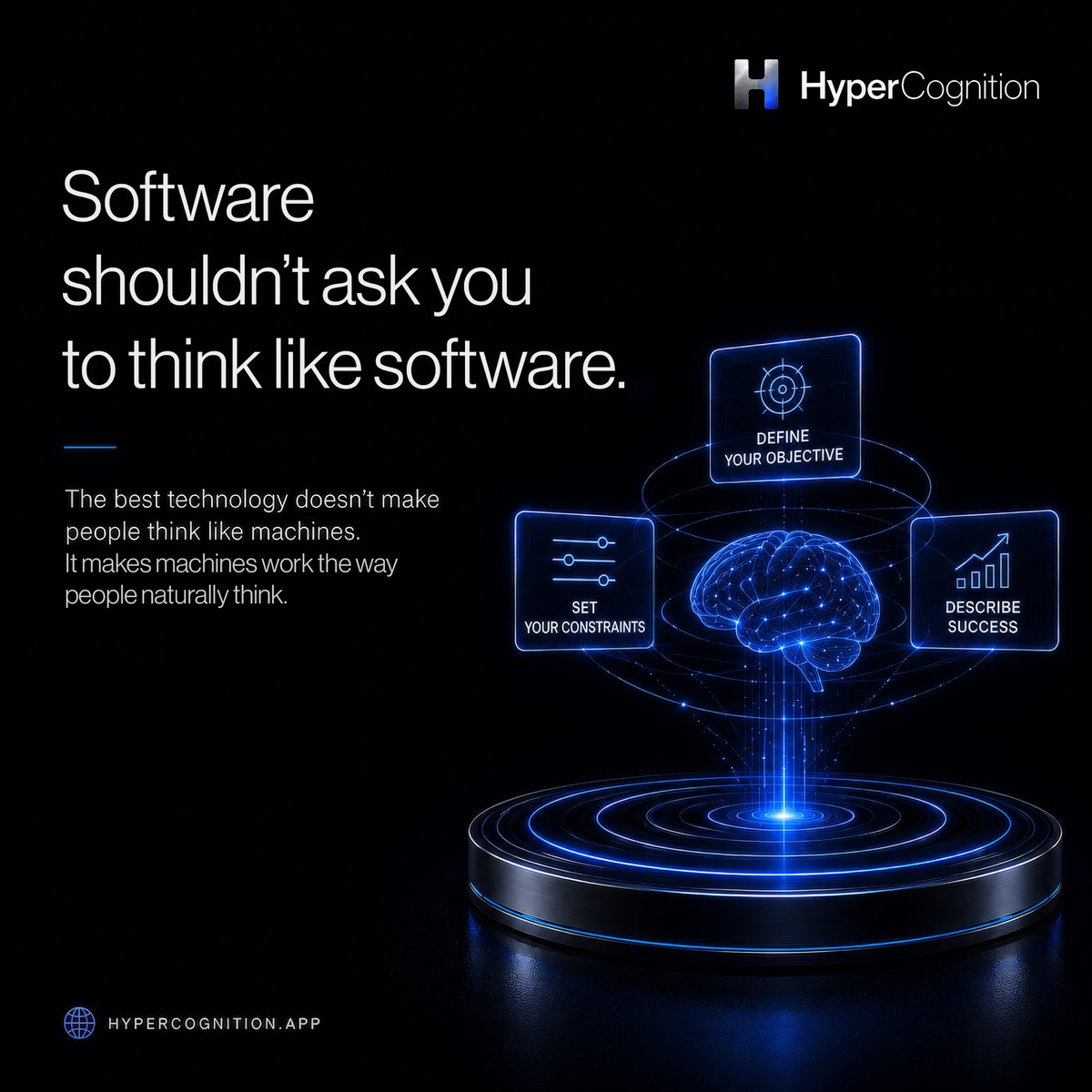
The best technology doesn’t make people think like machines.
It makes machines work the way people naturally think.
Define your objective.
Set your constraints.
Describe what success looks like.
The system should handle everything else.
That’s the shift AI makes possible.
Not more software…
Better abstraction.
The future belongs to platforms that remove complexity without removing control.
That’s the direction we’re building with HyperCognition.
The smartest systems don’t try to do everything.
They know what to ignore.
Every unnecessary alert creates distraction.
Every unnecessary trade increases risk.
Every unnecessary decision consumes attention.
As AI becomes more capable, one question becomes increasingly important:
What should it deliberately choose not to do?
Restraint is a feature.
Not a limitation.
The future of intelligent systems won’t be defined by how many actions they can take.
It will be defined by how consistently they avoid the wrong ones.
Because precision isn’t about doing more.
It’s about doing less, with greater intent.
HyperCognition is being built on the belief that intelligent systems should maximise relevance, not activity.
There is no universally good signal.
A signal is only valuable in context.
The same piece of information can mean opportunity to one trader, noise to another and unacceptable risk to someone else.
That is why generic alerts have limited value.
They treat every user as though they share the same:
Strategy.
Time horizon.
Risk tolerance.
Market exposure.
Definition of opportunity.
Intelligent systems should not simply deliver more signals.
They should understand which signals matter to a specific user, under specific conditions, at a specific moment.
The future of market intelligence will be personal, programmable and context-aware.
Not more information.
More relevance.
Market information does not remain valuable forever.
A signal can be relevant now, misleading ten minutes later and completely useless by the time most systems react to it.
That is why intelligence cannot be static.
It must continuously reassess:
What changed.
What became more important.
What lost relevance.
What no longer fits the user’s strategy.
The value of information is not determined only by accuracy.
It is also determined by timing, context and how quickly conditions evolve around it.
The next generation of market intelligence will not simply collect more data.
It will understand when information has expired.
Because in fast-moving markets, stale intelligence is often more dangerous than no intelligence at all.
🎁 $10,000 HCG AIRDROP
1,000 lucky participants will share $10,000 worth of $HCG.
📅 28 October – 7 November
How to enter:
• Follow @RealHyperCog
• Like this post
• Repost this post
• Comment below
• Join the HyperCognition Telegram community
Then submit your details through the official airdrop bot.
⚠️ Use an ERC-20 compatible wallet that you control. Do not submit an exchange deposit address.
👉 Entry is simple. Good luck.
#HCG #Airdrop #Crypto #Giveaway #AI
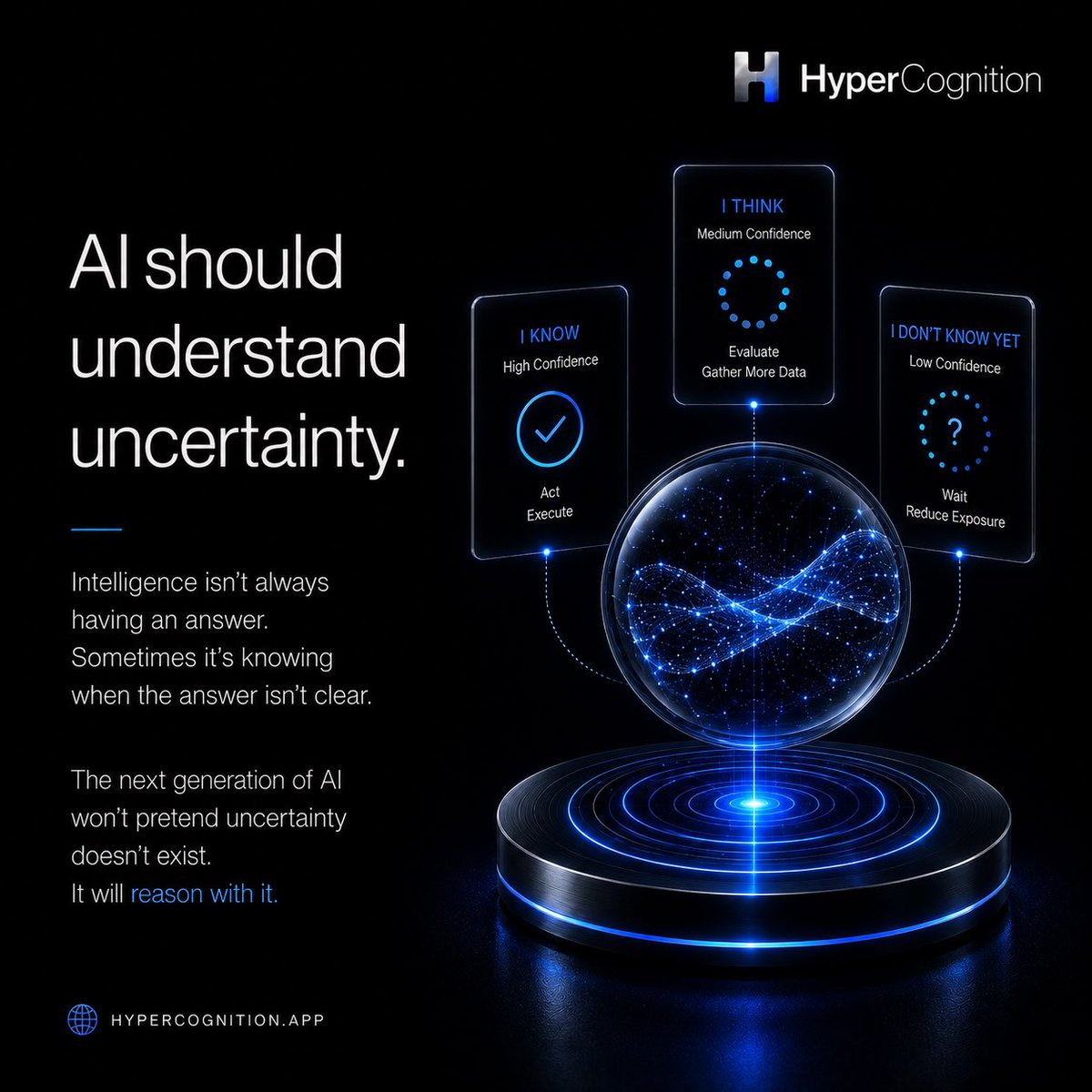
Intelligence isn’t always having an answer.
Sometimes it’s knowing when the answer isn’t clear.
Most software is designed to produce certainty.
A result.
A recommendation.
A direction.
But the real world is rarely that clean.
Information can conflict.
Signals can weaken.
Conditions can change.
Confidence can fall.
An intelligent system should recognise that uncertainty, not hide it behind a confident response.
It should understand the difference between:
I know.
I think.
I don’t know yet.
And behave differently in each situation.
Higher uncertainty might mean gathering more information.
Reducing exposure.
Requesting confirmation.
Or simply waiting.
Because intelligence isn’t just the ability to reach conclusions.
It’s knowing how much confidence those conclusions deserve.
The next generation of AI won’t pretend uncertainty doesn’t exist.
It will reason with it.
That’s one of the principles behind HyperCognition.
AI should expand control, not remove it.
The most powerful AI systems won’t be the ones that make every choice for you.
They’ll be the ones that understand your preferences, respect your boundaries and remain transparent about how they operate.
Too many platforms treat autonomy as the end goal.
But autonomy without control creates a black box.
Users should be able to define:
What the system monitors.
Which sources it trusts.
What conditions matter.
Where the boundaries are.
And when human approval is required.
The future of intelligent software isn’t about surrendering control to machines.
It’s about giving people more precise control than they’ve ever had before.
That’s the philosophy behind HyperCognition.
Every intelligent system operates on assumptions.
About the user.
About the environment.
About what matters.
About what happens next.
The problem begins when those assumptions stop being true.
Markets change.
Behaviour changes.
Strategies evolve.
Relationships between signals break down.
An AI that continues operating from outdated assumptions isn’t intelligent.
It’s confidently following an obsolete model of reality.
The next generation of AI needs to continuously challenge its own understanding.
Is this assumption still valid?
Does the evidence still support it?
Has something fundamentally changed?
And when reality no longer matches the model…
The model should change.
Not the explanation.
Because intelligence isn’t defending what you believed yesterday.
It’s recognising when the world has given you a reason to believe something different today.
Great AI doesn’t just learn.
It knows when to unlearn.
That’s one of the principles behind HyperCognition.
Not every decision carries the same cost.
Some actions are easy to undo.
Others aren’t.
A recommendation can be changed.
A notification can be ignored.
But once capital is deployed, access is granted, data is deleted or a critical action is executed…
The consequences may be difficult to reverse.
Intelligent systems should understand that difference.
Before acting, AI should ask:
How reversible is this decision?
What happens if the assumption is wrong?
Can the user recover easily?
The less reversible the action, the higher the standard should become.
More evidence.
More confidence.
More safeguards.
More human oversight where necessary.
Because autonomy shouldn’t be determined by what AI can do.
It should be determined by what can safely be undone if it gets something wrong.
Good intelligence doesn’t treat every action equally.
It understands the cost of being wrong.
That’s one of the principles behind HyperCognition.
Not all information carries the same weight.
A verified source.
A second-hand report.
An anonymous account.
A model-generated summary.
A repeated claim with no original evidence.
They may all look similar once they enter a system.
But they shouldn’t be treated equally.
Intelligent systems need to understand provenance.
Where did this information originate?
How many times has it been repeated or transformed?
Has the original source been verified?
Has important context been lost along the way?
Because information becomes less reliable when its origin disappears.
And when AI begins reasoning on top of that information, small errors can quickly become confident conclusions.
The next generation of AI should preserve the chain between:
Source.
Evidence.
Interpretation.
Conclusion.
So users can understand not only what the system believes…
But why that belief deserves trust.
Good intelligence doesn’t just consume information.
It understands its lineage.
That’s one of the principles behind HyperCognition.
More information does not always create more certainty.
At some point, additional data stops improving the decision.
It only delays it.
The challenge for intelligent systems is knowing when they have enough evidence to act.
Not too early.
Not too late.
AI should be able to ask:
Is the evidence strong enough?
Are the important sources aligned?
What uncertainty still remains?
Would more information materially change the conclusion?
Because waiting for perfect certainty can be just as damaging as acting on weak evidence.
The next generation of AI needs to understand the difference between:
Incomplete information.
Insufficient evidence.
And enough confidence to proceed.
That distinction matters.
Especially when decisions are time-sensitive.
Good intelligence doesn’t collect information forever.
It knows when the evidence has crossed the threshold from interesting to actionable.
That’s one of the principles behind HyperCognition.
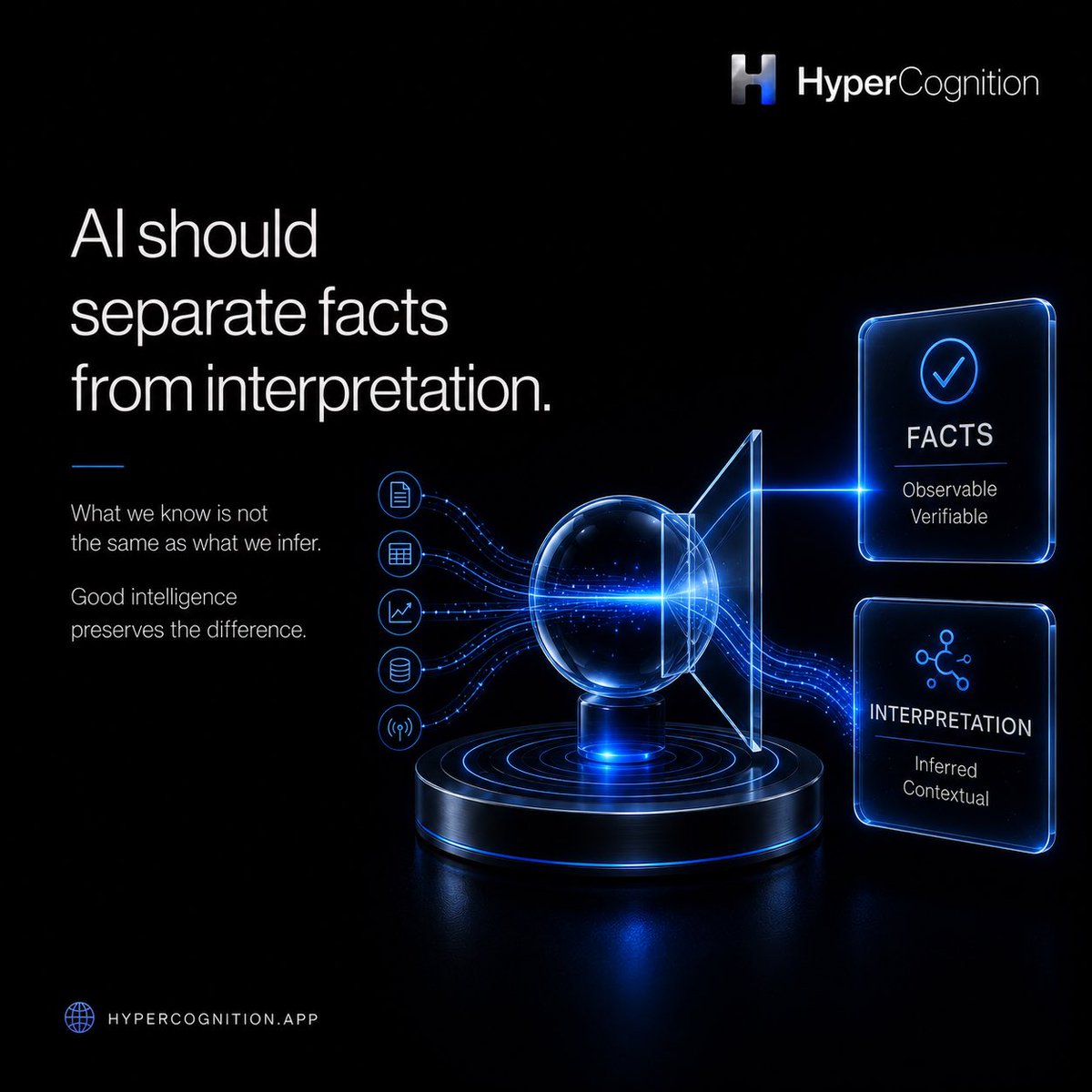
AI should separate facts from interpretation.
Not everything an intelligent system receives is equally reliable.
Some information is observable.
Some is inferred.
Some is opinion.
Some is speculation presented with confidence.
The danger begins when AI treats all four as the same thing.
A market moved.
That’s a fact.
Why it moved may still be an interpretation.
A founder made a statement.
That happened.
Whether the statement is credible requires judgement.
A signal appeared.
That’s observable.
Whether it matters depends on context.
The next generation of AI should preserve those distinctions.
It should understand:
What do we actually know?
What are we inferring?
What evidence supports that inference?
How confident should we be?
Because once assumptions are presented as facts, bad reasoning compounds quickly.
Good intelligence doesn’t just process information.
It understands the quality and nature of the information it is processing.
That’s one of the principles behind HyperCognition.
AI needs memory. Not just intelligence.
Most AI tools are surprisingly forgetful.
Every conversation starts from scratch.
Every workflow has to be explained again.
Every preference needs to be repeated.
That’s not intelligence.
That’s temporary computation.
The next generation of AI won’t simply generate better answers.
It will build context.
It will remember what matters.
It will understand how you work.
It will learn your priorities.
And it will improve over time without requiring constant retraining by the user.
Memory transforms AI from a tool…
…into an operating system for decision-making.
Intelligence without memory is useful.
Intelligence with memory becomes indispensable.
That’s the direction HyperCognition is being built to support.