Three demanding opportunities for serious study begin soon at the Lyceum Institute. Each offering requires sustained reading, careful listening, and disciplined discussion. These are not casual studies but meant for those who want to think more clearly and develop intellectual depth.
A thread:
1/4
Language is integral to being human. Discover with us this winter how language links up the intelligibility of nature and culture.
https://t.co/hKJRu6WofP
What does it take to build something truly new in this world of ours?
In a word: people. You could say “courage”, “luck”, “dedication”, “time”, “patience”, “vision”, “resources”, “the right tools”, and “faith” and you would not be wrong.
But instruments are always moved by someone’s hands, and, unless they beat with the human heart, virtues are only a mere abstraction.
People. Nothing worthwhile in this world—great or small—is accomplished without the effort of many. The individual succeeds only because he has a society around him, only because he succeeds with and for the sake of others.
All the greatest accomplishments of my own earthly life are due to the people I have been fortunate enough to have around me. Parents, siblings, professors, friends, colleagues, students—there is nothing I have done or can do that I do not owe to them.
I am now in the sixth year of building the Lyceum Institute. We now have, myself included, twelve faculty and over 200 members. Again, I find myself surrounded by great people—people who love learning, who thirst for wisdom and understanding, who care deeply for the truth. Our members bring an earnest desire to know into every class session.
But our faculty bring that knowledge to life. I am excited to introduce them to you over the next three months—with interviews and excerpts—and I hope you will see in them the same brilliance and dedication that I get to witness daily.
I also hope it is in your power to support them financially. Our people have virtue—but we need resources. Even if you can give only a little, even if you can only share this post, it means a great deal to me—you, too, are among the people that the Lyceum Institute needs.
The Lyceum Institute community demonstrates an approach to education unconstrained by the limits and outmoded approach to learning which has become the norm. We believe ourselves establishing a new paradigm for education, beyond the university. Support our cause: https://t.co/lWlF4k7kJo
“The modern mathematical logician certainly has a strong support in his calculus, but all too frequently that same calculus leads him to dispense with thought just where it may be most required.”
- J.M. Bochenski, OP
LAST CHANCE!
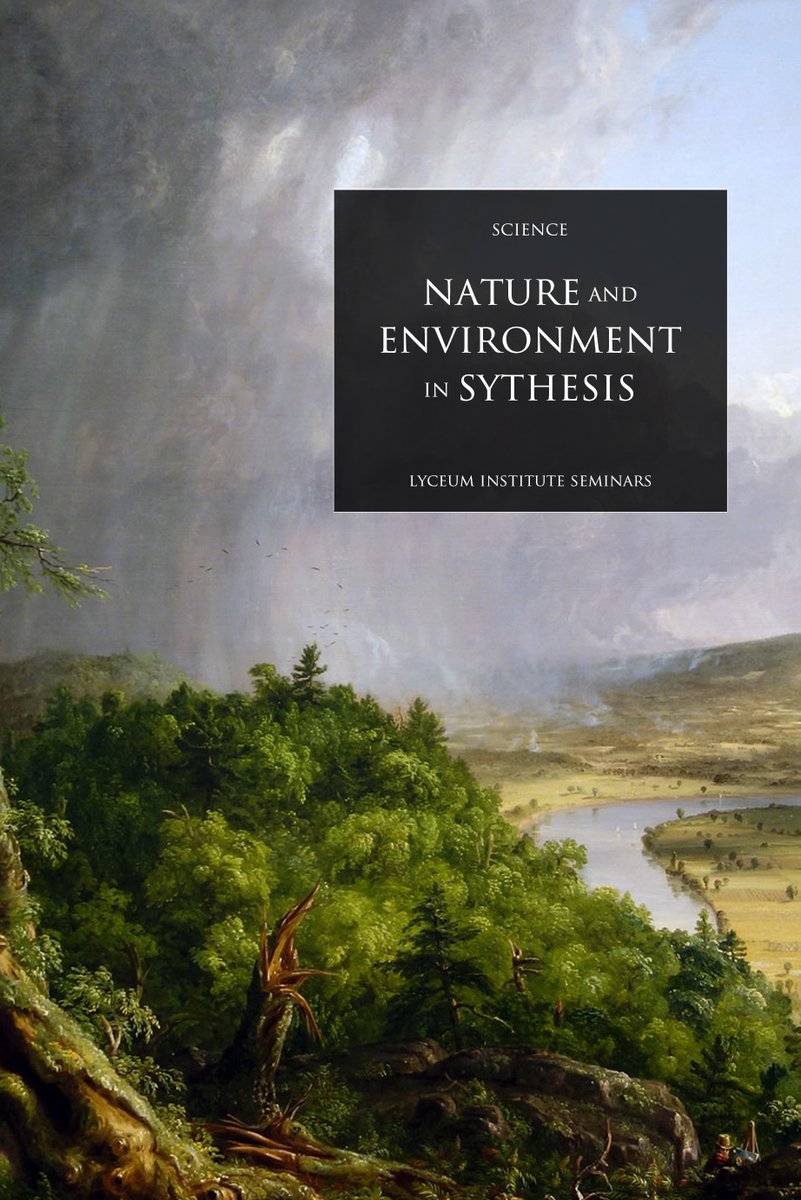
What does Thomism have to say about environmental philosophy? How should we truly understand nature? Join our Summer Seminar to see how Thomistic metaphysics should inform our treatment of the natural world.
Learn more at the link below. Deadline extended to June 5 – sign up now!
1/2
LAST CHANCE!
Is there a tenable plan for a postliberal future? Join our Summer Seminar to inquire into the thought of leading postliberal thinkers.
We have extended registration until tomorrow, June 5—so sign up now! Learn more at the link below.
1/2
Are the answers not to be found in Grecian antiquity or modern therapy, but, perhaps, the cosmological vision of St. Thomas Aquinas?
https://t.co/cMzL1K5ji0
New on Reality: @realbriankemple responds to @SpencerKlavan’s article in @AntigoneJournal concerning “All the Small Things: Epicureanism Then and Now” by asking what really guarantees the meaningfulness of our lives?
Link below.
🏛️ What comes after liberalism? As confidence in the liberal political order wanes, many sense the need for a deeper grounding of the common good—one rooted not in procedure, but in truth. The Lyceum Institute’s upcoming seminar, Proposal for a Postliberal Politics, provides a philosophical foundation for thinking beyond the impasse.
Taught by Dr. Francisco Plaza, this seminar draws on the philosophical tradition of Aristotle and St. Thomas Aquinas to reexamine the very nature of political life: What is authority? What distinguishes power from justice? What role do persons, families, and communities play in the political whole? And must a good politics be open to the transcendent?
The primary focus of the course, however, will be through some of the leading critics of liberalism—D.C. Schindler, Patrick Deneen, and Adrian Vermeule—and consider both the appeal and the limitations of their proposed alternatives.
This seminar is not a partisan manifesto but an invitation to rethink seriously the telos of politics and to rediscover what it means to order human life toward the true, the good, and the just.
🗓 Registration: Open Now!
🕚 Discussion sessions: Saturdays at 11:15am ET
🔗 Enroll: https://t.co/UvFezZE2Vd
🌿 Can we care for the environment if we no longer understand what “nature” is? The Lyceum Institute’s upcoming seminar, Philosophy of Nature and Environmental Philosophy, tackles this foundational question—beginning not with policies or politics, but with principles.
Taught by Dr. Daniel C. Wagner, this course reclaims a classical vision of nature rooted in Aristotle and St. Thomas Aquinas: exploring form and matter, change and finality, artifice and substance. From there, we examine the human person not as a detached observer, but as an ethical agent within a created order—called to justice, stewardship, and contemplation.
Alongside this metaphysical foundation, the seminar brings classical thought into dialogue with modern ecological voices like Aldo Leopold and Deep Ecology, highlighting where the traditions conflict—and where they might be reconciled.
If environmental concerns are to be addressed seriously, they must be grounded in a true understanding of what nature is and how we belong to it.
🗓 Registration: Open Now!
🕐 Time: Saturdays at 1:15pm ET
🔗 Enroll here: https://t.co/J5tpDQJZYt