Pink paint is ePink paint is easy. The US Surgeon General's January 2025 advisory named alcohol as a known cause of breast cancer, and noted fewer than half of Americans know that. Putting that on a pink label would be real awareness.asy. The US Surgeon General's January 2025 advisory named alcohol as a known cause of breast cancer, and noted fewer than half of Americans know that. Putting that on a pink label would be real awareness.
@LongevityTech Glad this is being framed as an aging question. ACOG has said since 2018 that postpartum care should be ongoing, with contact within 3 weeks and a full visit by 12 weeks, not one check at 6 weeks. Curious whether the review looks at sleep loss in that window.
@caloriesproper2 And that's before the label problem. A 2023 JAMA study of 25 melatonin gummy products found actual content ranged from 74% to 347% of the label. Hard to judge dose-response when nobody knows the dose.
@LiveAncestral Recovery is when protein needs go up, not down. The PROT-AGE expert group recommends 1.2–1.5 g/kg a day for older adults with acute or chronic illness, and a cereal-and-toast tray makes that much harder to reach. Eggs or yogurt would be a cheap fix.
Menopause is one day: 12 months after your last period.
Most of us aren't told that the transition before it can take years, or that sleep is often where it shows up.
I'm 41. I've lived the "tired all day, wired at night" loop. I wake up around 3 AM, and my sleep tracker records it. I don't know what's behind it for me. So I went looking for the map.
1. The timeline is longer than most of us were told.
Perimenopause usually starts in the mid-to-late 40s, and some women notice symptoms in their late 30s. It lasts about 4 years on average, up to 10 (US Office on Women's Health). The average age of the last period in the US is 51 (ACOG).
2. The first clue is usually your cycle, not a hot flash.
The STRAW+10 staging criteria define the early transition as consecutive cycles that differ in length by 7+ days, again and again. The late transition is a gap of 60+ days without a period. You can only see that pattern if you write it down.
3. Sleep can change even without night sweats.
In SWAN, a long-running US study, about half of women reported sleep problems in perimenopause, vs 30% before it. The most common problem was staying asleep. Even women without hot flashes reported worse sleep. One likely reason: the brain is more active during sleep, so sleep gets lighter.
4. Symptoms can last much longer than people expect.
In SWAN, frequent hot flashes and night sweats lasted a median 7.4 years. For women whose symptoms began while periods were still regular or in early perimenopause: more than 11.8 years.
5. A single blood test usually won't settle it.
Clinicians usually identify perimenopause from age, symptoms and cycle changes. Blood hormone tests usually aren't needed (OWH). Hormones swing a lot in these years, so one reading is one snapshot.
6. Brain fog is common, and usually not what you fear.
The Menopause Society says 40–60% of midlife women report forgetfulness or fog in the transition. It's usually mild and within normal limits, and dementia at midlife is very rare.
A simple log to bring to your doctor:
• First day of each period, plus anything unusual about it
• Bad nights: when you woke, hot or sweaty or not, how you felt the next day
• Hot flashes, mood, headaches, brain fog: a quick daily yes/no
• Snoring or waking up gasping (SWAN notes sleep apnea risk rises in this phase)
• Your tracker's trend over weeks, not one night's score
I don't know where I am on that map yet, and I don't get my evenings right every night. But I'd rather learn it now than in the middle of it.
When did anyone first explain perimenopause to you? Or are you still waiting?
I've taken melatonin. And since we started building Zenthya's evening drink, a lot of people have asked me the same thing: why no melatonin?
Here's my honest answer, and the research I read before making that call.
1) Melatonin is a timing signal, not a sedative.
NIH's NCCIH describes it as a hormone your brain makes in response to darkness that helps time your 24-hour clock. Light at night can block it. The clearest evidence for supplements is in timing problems: jet lag and delayed sleep-wake phase disorder.
2) For chronic insomnia, the guidelines are lukewarm.
The American Academy of Sleep Medicine's 2017 guideline suggests clinicians not use melatonin for trouble falling or staying asleep in adults. It's a weak recommendation, based on trials of 2 mg. The American College of Physicians recommends CBT-I as the first treatment for insomnia.
3) The bottle may not match the label.
A 2023 JAMA study tested 25 US melatonin gummy products. 22 were mislabeled. One had no detectable melatonin; the rest ranged from 74% to 347% of the labeled amount. An earlier study of 31 supplements found most didn't match their label, and 26% contained serotonin.
4) Use grew faster than the long-term data.
US adult use rose from 0.4% in 1999–2000 to 2.1% in 2017–2018 (JAMA 2022). NCCIH's summary: short-term use appears safe for most people; information on long-term safety is lacking.
5) The headline you may have seen.
"Melatonin linked to ~90% higher heart-failure risk" came from an AHA 2025 conference abstract (TriNetX records, adults with insomnia, a year or more of use). It's observational and was a conference abstract, not a peer-reviewed paper. A 2026 NHANES analysis in Open Heart found no significant association with heart failure. Neither proves harm or safety.
Why this matters this week: clocks fall back Sunday, and it's the time of year many of us reach for a sleep aid. A one-hour shift is usually handled with light and timing. I'll share the plan Thursday.
And it's Halloween week. CDC estimated about 11,000 ER visits from 2019 to 2022 for kids 5 and under who got into melatonin unsupervised, often flavored gummies. They look like candy. Store them like medicine.
So why no melatonin in Deep Restore No.21? Not because melatonin is "bad." Because it's a hormone that can shift your clock, and I wanted an evening ritual for the hour you already keep, with every dose on the label. Whether any formula improves your sleep is a separate question, and we don't claim that it does.
If you take melatonin, talk with your clinician about dose and timing, especially if you take other medications, are pregnant, or are thinking of giving it to a child.
*These statements have not been evaluated by the FDA. This product is not intended to diagnose, treat, cure, or prevent any disease.
Do you take melatonin, or did you stop? What made you decide?
A couple of fascinating take-home points here with a possible connection between taking melatonin and higher risk of heart failure.
Article take home points:
Among adults with insomnia, people with documented long-term melatonin use (12 months or more) had about a 90% higher chance of developing heart failure during the following five years compared with matched nonusers.
Heart failure occurred in 4.6% of the melatonin group compared with 2.7% of the comparison group.
When they limited the analysis to people who had filled at least two melatonin prescriptions at least 90 days apart, the association remained. That group had an 82% higher risk of heart failure. (Melatonin is only available by prescription in the United Kingdom.)
People in the melatonin group were nearly 3.5 times as likely to be hospitalized for heart failure as those in the comparison group.
The hospitalization rates were 19.0% and 6.6%, respectively.
Deaths from any cause were also more common among people with documented melatonin use.
During the five-year period, 7.8% of participants in the melatonin group died compared with 4.3% of those in the non-melatonin group, making the risk nearly twice as high.
I think the first main question I have it, do people take melatonin because they struggle with insomnia which then increases their risk of CHF?
What dose are we talking here? 1 mg?
Still, it changed how I think about taking care of myself.
Don't wait until it gets serious. That's why I'm building Zenthya around daily body signals, not one score.
Would you want to know your organ ages? reply below.
https://t.co/wOExgxzoIV
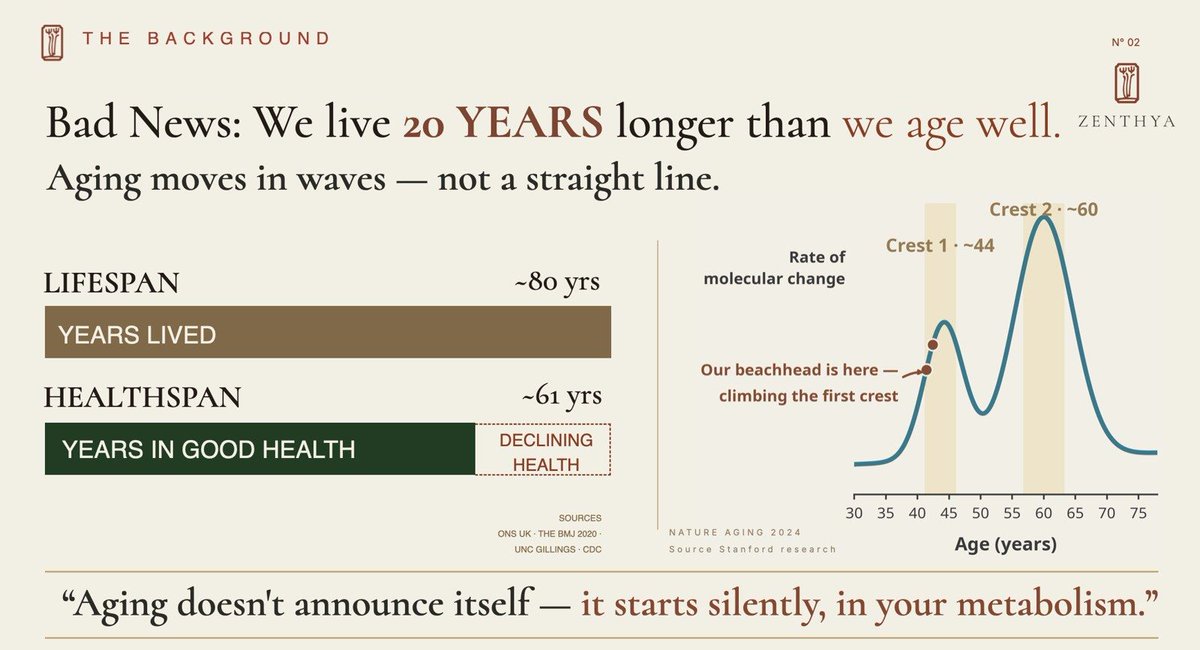
My overall biological age came back 40.2. I'm 41.4.
Then I looked underneath.
Heart: 35.5. Nervous system: 47.6.
Same body. A 12-year spread. The average was hiding it. 🧵
Honest caveats, because I'm a data person:
• My test (methylation) ≠ the Stanford method (blood proteins)
• These are associations, not diagnoses
• My report says scores can shift between tests without biology changing
Signal, not verdict.
The part that got me:
Among people with no active disease and normal labs at baseline, ~4 extra years of heart age meant almost 2.5x heart failure risk over 15 years.
"Normal labs" and "young organ" aren't the same thing.
I was shocked. But it also made a lot of sense.
And it matches the research. Stanford (Nature, 2023), 5,676 adults: nearly 20% showed strongly accelerated aging in one organ. Same overall age gap, very different organ profiles.
These are my own results: a test that estimates 21 organ-system ages from DNA methylation.
I took it to understand my sub-health state. I knew I had some risk factors.
14 of my 21 systems tested older than my calendar age.
Notes on Mark Hyman's skin episode (and what I'd double-check)
Mark Hyman put out an episode on October 7 with Dr. Mamina Turegano, a triple board-certified dermatologist. It's the first time he's had a dermatologist on the show. She's 43, her mom is Japanese, and she grew up around Eastern medicine, which is part of why she started looking past creams.
Her basic argument is that a lot of skin problems start somewhere else in the body. Creams and drugs can calm things down, but if the cause is in your gut, your hormones or your blood sugar, it comes back when you stop. I listened to the whole thing, checked a few of the claims, and wrote up what seemed worth keeping.
Why chronic skin problems come back
Acne, eczema, psoriasis and rosacea are usually treated with topicals, oral steroids or biologics. Biologics work by turning down the immune system. They're safer than steroids, but they still raise the risk of infections and some cancers. Turegano isn't against any of this. These drugs help people get through their day. Her point is that they don't explain why the problem started, and the question she gets most from patients is why it comes right back when they stop.
The two causes she runs into most are the gut and hormones.
Rosacea patients have higher rates of SIBO (bacterial overgrowth in the small intestine) and H. pylori, and she sees fungal overgrowth in them too.
With acne, she tests fasting insulin and compares it to fasting glucose, which she says tells her more about insulin sensitivity than glucose alone. In women, high insulin can push testosterone up, and that drives breakouts.
Psoriasis usually comes with other problems: metabolic syndrome, prediabetes, low thyroid, low vitamin D, poor sleep. She sees a lot of flares in night-shift workers.
Stress matters too. Cortisol makes skin more inflamed and makes oil stickier, which means more acne. She also asks patients how much caffeine they drink, since too much can crank up the stress response.
She's also seeing more adult acne. A colleague who's practiced for 40 years told her teenage acne has always been around, but adult acne has gone up over the last few decades, along with thyroid problems, hair loss and infertility. Her guess is endocrine-disrupting chemicals plus more stress, and she's upfront that it's a guess.
Food
For general skin health, she points to a Mediterranean-style diet: enough protein and healthy fat, not much sugar, a lot of fiber, and plenty of colorful fruit and vegetables. She tries not to put people on strict diets because they usually don't stick.
For acne, the best evidence is for sugar and dairy. Skim milk is actually linked to acne more strongly than whole milk. Low fiber and irregular bowel movements also show up in the data.
When someone already has a chronic condition, she often starts with a short elimination diet: no gluten, dairy, sugar or processed food for two or three weeks, then see what happens. Psoriasis patients who test positive for gluten antibodies stay off gluten for good. Hyman thinks it's worth trying even if the test is negative, because part of the immune system reacts to gluten without making antibodies, so a blood test won't catch it.
For supplements she sticks to omega-3s and vitamin D. Hyman says omega-3s are the one nutrient he's seen help skin, hair and nails most reliably, and he wants people's omega-3 index above 8%.
Menopause
Estrogen drops hard in the first five years after menopause, and skin shows it. The cells that make collagen slow down. Hyaluronic acid and skin oils go down, so skin gets drier and the barrier gets weaker. The top layer thins out, which is where crepey skin comes from. Lower testosterone means less oil too.
Low thyroid causes dry skin, brittle nails, hair loss and slow healing. She checks thyroid on everyone who comes in with hair loss.
She's a fan of hormone replacement therapy for skin, but she admits there aren't many good studies on HRT and skin specifically. Mostly it's something doctors notice in patients who are on it.
How skin ages
She compares skin to a mattress. The epidermis is the cover, the dermis is the springs, and bone is the frame. All three wear out.
Skin cells turn over every two weeks or so in babies and about every four weeks in adults, and it keeps slowing down, so skin looks duller and more uneven. Pigment cells get unpredictable and you get more sun spots. Oil production falls and skin dries out. Collagen breaks down and gets disorganized, and that's where wrinkles come from. Underneath, fat thins and bone gets reabsorbed.
What speeds it up, roughly from biggest to smallest:
Sun. She puts UV at about 80% of skin aging. In studies of identical twins, the one who's out in the sun and smokes looks much older.
Smoking.
Sugar. Extra sugar sticks to collagen and forms what are called advanced glycation end products (AGEs), which make collagen stiff and harder to repair. Insulin resistance adds inflammation on top of that.
Alcohol. While your liver is busy with alcohol, other toxins build up, oxidative stress goes up, and you make less collagen and break it down faster. Hyman's take was that most people don't know this one.
Bad sleep, an irregular schedule, stress, pollution and sitting all day. There's data on all of these.
Mitochondria
Sun, insulin resistance and ongoing inflammation all damage mitochondria. When the mitochondria in collagen-making cells stop working well, those cells make less collagen and produce more oxidative stress, which damages more mitochondria. The body has a way of clearing out the damaged ones, called mitophagy. Things that help: eating less processed food, not spending hours in the sun, sleeping enough, keeping stress down, and exercising, which also gets your cells to build more mitochondria. Polyphenols (like EGCG in green tea, and cocoa flavanols) and carotenoids (astaxanthin, lycopene, beta-carotene) help too.
She also recommends urolithin A. Gut bacteria make it from polyphenols in foods like pomegranates and walnuts, but only about 40% of people make a meaningful amount. There's a sponsor issue here, which I get to at the end.
Lifting weights
She cited a 2023 study from Japan, published in Scientific Reports. Sixty-one sedentary middle-aged women did 16 weeks of either cardio or weight training. Both groups ended up with more elastic skin, but only the weight training group got a thicker dermis, the layer where collagen lives. The researchers linked it to lower levels of inflammatory markers in the blood. It's a small study, but if you're in your 40s or 50s, it's one more reason to lift.
Collagen supplements
She's in favor, with two caveats. A lot of the good-looking studies are paid for by the industry. And the collagen you swallow doesn't go to your face. The peptides seem to signal your body to make more of its own. She'd rather people sort out sleep, sun, stress and strength training first. Hyman put it more bluntly: you can't eat junk, skip sleep, stay stressed and fix it with collagen powder.
What to put on your skin, in order
She was very specific here.
Start with three things: a cleanser, a moisturizer and sunscreen. She thinks washing your face is underrated, because the pollution that builds up during the day damages skin on its own.
Next, add vitamin C in the morning and a retinoid at night. Vitamin C helps sunscreen deal with sun and pollution damage. Retinoids work overnight and have decades of research behind them. After sunscreen, nothing for aging is better supported. If your skin is sensitive, start with over-the-counter retinol. Prescription tretinoin works faster but is more irritating. Don't use retinoids if you're pregnant.
After that, a serum with peptides or growth factors:
Copper peptides (GHK-Cu) applied to the skin have decent evidence for helping collagen. The injectable GHK-Cu that's popular right now doesn't have enough evidence or safety data yet, and she doesn't recommend it.
Growth factors are big molecules, so putting them on your skin doesn't mean they get in. Some products are better than others.
PDRN, which comes from salmon sperm and got popular through Korean skincare, has better evidence as an injection than as a cream.
Niacinamide has good data for the skin barrier and wrinkles. Hyaluronic acid and ceramides are good for hydration.
She's more skeptical of exosome and stem-cell products. Exosomes have to be kept frozen, so it's hard to know if anything active survives in a jar at room temperature, and there isn't much safety data.
Her own routine: vitamin C and sunscreen in the morning, a retinoid at night, and serums and moisturizers with peptides, growth factors, PDRN and copper peptides. She also uses a serum with a neuromodulating peptide, which people call "Botox in a bottle," though she says it's nowhere close to actual Botox. She didn't wear sunscreen for most of her 20s and only started during residency.
Sun
Try to stay out of the strongest sun between 10 a.m. and 2 p.m., wear a hat, and think about UPF clothing. Normal clothes block some UV, but UPF fabric blocks a lot more.
Melanoma is linked more to occasional heavy exposure, like a beach vacation where your back gets burned. That's why it shows up most on the back in men and the legs in women, places that don't get sun every day. The more common basal cell and squamous cell cancers come from years of everyday exposure.
But low vitamin D is also linked to a higher melanoma risk, so she's not telling anyone to avoid the sun. Morning sun is good for vitamin D and for your body clock. Just don't lie out for hours.
On chemical versus mineral sunscreen: chemical filters get into the bloodstream more. The FDA classifies the two mineral filters, zinc oxide and titanium dioxide, as "generally recognized as safe and effective." Most of the older chemical filters are in a category where the FDA wants more data, which isn't the same as being found unsafe. In June the FDA added bemotrizinol, a newer chemical filter, to the approved list. It's the first new sunscreen ingredient in the US in more than 20 years. Her view is that chemical sunscreens work and are safe overall, and if the absorption bothers you, use a mineral one.
Where they disagreed
Hyman's rule is that if you wouldn't eat it, you shouldn't put it on your skin. Turegano pushed back. Skin is a good barrier and most ingredients don't get past the top layer. And plenty of things you can eat are bad for your skin, like lemon juice. They ended up agreeing that lower-toxicity products are better when you have the choice, but it's not something to panic over.
She's not a big fan of EWG's Skin Deep ratings either. A lot of them are based on animal studies with doses far higher than anyone would actually use.
Her pick for the most overrated trend is beef tallow. It doesn't protect you from the sun, it's an ordinary moisturizer, and it clogs pores. Coconut oil can be a decent moisturizer but also clogs pores, so be careful if you get acne.
At the end Hyman ran through some quick questions. The biggest cause of early skin aging is UV. Aged skin can get better. If you want to live longer, exercise matters more than skincare; if you want smoother skin, it's the other way around. And she rated mitochondria at least a 9 out of 10 for importance.
What I'd double-check
Most of this holds up, but a few things need context.
The title says 99% of skin conditions don't heal. Nobody says that in the episode.
Timeline, which sells a urolithin A product called Mitopure, is a sponsor. Turegano says Mitopure is the only brand with a properly studied dose, and Hyman does disclose the sponsorship. Urolithin A has some human research, including a 2022 study on muscle endurance in JAMA Network Open, but nothing like that was presented for skin. There are also five other ads in the episode, for probiotics, magnesium, a sauna, matcha and amino acids.
Hyman says over 90% of Americans have some degree of insulin resistance. That's his number. He also says 65% of Function Health members have high insulin, but that's internal data from a company he co-founded, and nobody outside has checked it.
He also describes a Cleveland Clinic study where functional medicine patients supposedly did better than rheumatology patients while "not using drugs." I looked it up. It was a 12-week retrospective study, functional medicine was added on top of standard treatment, and it measured how patients rated their own health and pain. So the finding is that patients who added functional medicine said they felt better. It doesn't show they did better without medication.
And the patient with psoriatic arthritis who got off all her meds in six weeks is a great story, but it's one patient.
If I sort the episode by how good the evidence is:
Strong: sunscreen, retinoids, vitamin C, not smoking, eating less sugar, and the link between sugar, dairy and acne.
Some evidence, but small studies or industry money involved: lifting for thicker skin, collagen, urolithin A, copper peptides, niacinamide.
Mostly doctors' clinical experience: gut testing and treatment for skin, elimination diets, HRT for skin.
Not enough evidence yet: injectable GHK-Cu, exosomes, stem-cell products.
If you only take one thing from this: sunscreen, a retinoid, vitamin C, sleep, less sugar and some strength training will do more than anything else on the list. And if you have a skin condition that keeps coming back, it's worth finding a doctor who'll look at your gut and hormones, as long as you keep track of which parts are proven and which aren't yet.
Summarized from The Dr. Hyman Show, October 7, 2026. I fact-checked a few claims. This isn't medical advice.
Original episode: https://t.co/fFTRyhXM8O
Most people use melatonin in megadoses (3- 10 mg) as a blunt sedative instead of a circadian micro-signal (0.3mg), causing receptor desensitization. I'm building Zenthya as a melatonin-free evening powder to calm the nervous system without hormones. Nature product and nature way of healing is hopefully useful for more poeple.