98% of companies have Shadow AI.
78% of AI users bring their own tools.
And when it leaks, it adds $670K to a breach.
The scary part: your executives are the heaviest users.
New piece on the hidden maze almost every company is already lost in 👇
https://t.co/ujfe23WDef
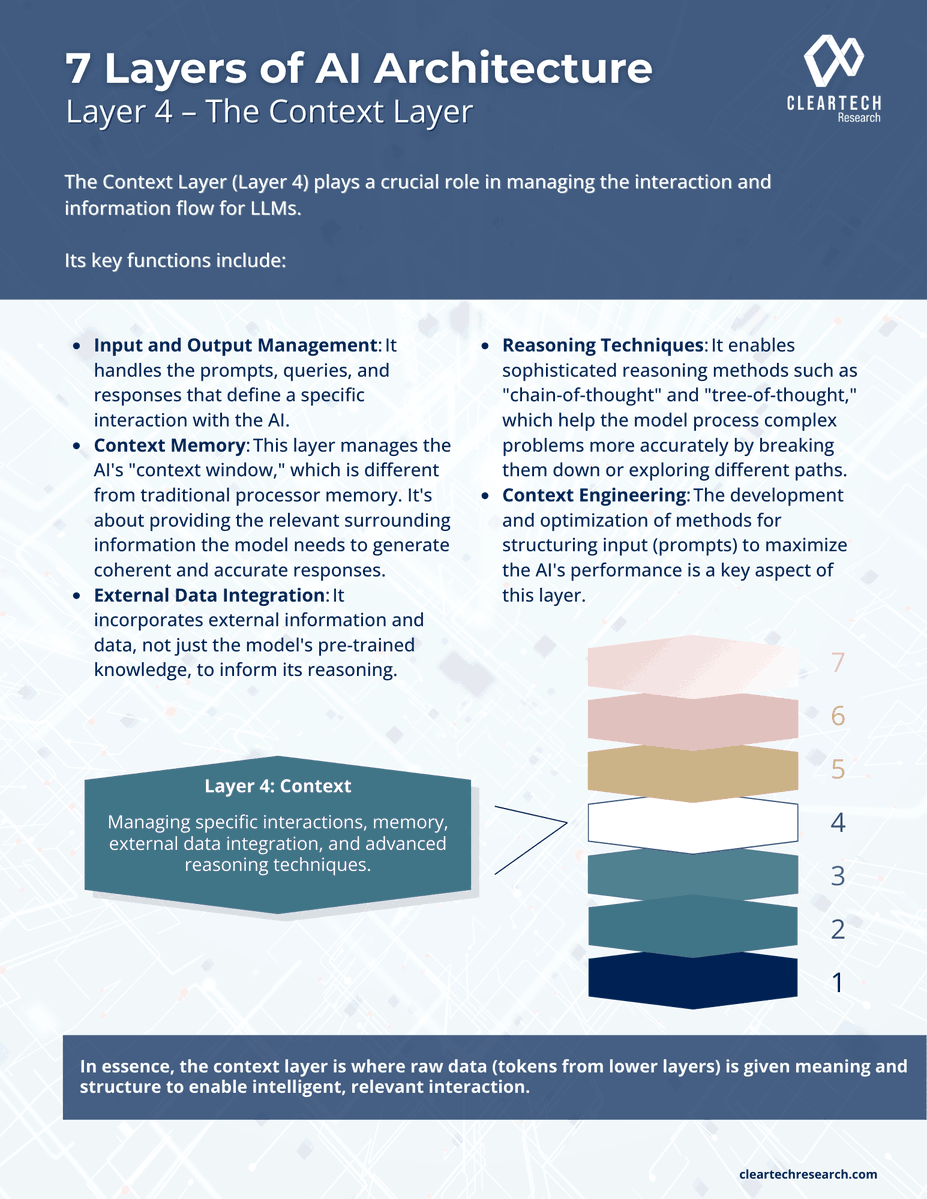
📌 Q: So how would the OSI model look at layer 4 if it were built for AI?
A: If the OSI model were reimagined as an "AI Stack," Layer 4 (traditionally the Transport Layer) would handle Inference Transport and Payload Optimization.
Instead of managing network packets (TCP/UDP), this layer ensures the reliable, efficient, and orderly delivery of data chunks between the user and the AI model.
What functions would be supported?
⭐ Context Window Segmentation: Splitting massive prompts into optimal token chunks.
⭐ Stream Assembly: Managing real-time token delivery to prevent stuttering outputs.
⭐ Payload Routing: Directing traffic between CPUs, GPUs, and specialized TPUs.
⭐ Reliability Control: Retrying dropped requests when an AI node times out.
⭐ Token Flow Control: Throttling requests to prevent overloading the model's memory.
So what's the Real-World Parallel?
Traditional Layer 4: TCP ensures all bytes of a downloaded image arrive in the correct order.
AI Layer 4: Ensures the first 500 words of a story generate and stream smoothly before the next 500 words begin.
#AIInfra #AI
The future of emergency response is secure, real-time, data-heavy, and always-on. The network has to keep up, or people may pay the price.
See how T-Priority can use network slicing and prioritized access to help: https://t.co/1E3qEnepiy
@T_Priority Partner
I just built a Claude Code stack that writes, approves, and publishes your LinkedIn posts from a single Sunday session every week.
Feed it your profile context, your hook library, and a topic or script → it studies your voice, your best-performing formats, and your photo folder → generates three draft options matched to the right image and scheduled to LinkedIn while you pick the best angle.
All inside Claude Code and Playwright MCP.
Perfect for GTM engineers and founders who are still writing posts from scratch every week, spending an hour editing AI drafts that sound nothing like them, and manually uploading content to LinkedIn one post at a time.
If you're posting on LinkedIn in 2026, you already know the math - the accounts that build pipeline aren't the ones with the best single post, they're the ones publishing consistently in a voice that sounds genuinely human every week. Most people ship two posts a week if they're lucky.
This stack solves it:
→ profile.md gives Claude permanent context about your voice, your stories, your professional background, and your ICP so every post reads like you wrote it from session one
→ hooks.md gives Claude a curated library of proven formats, specific concrete examples, and a no-go list of overused openers so Claude never produces the lines saturating your space
→ Three draft options generated per topic so you pick the best angle not the only one - posts come out at 70-80% quality out of the box and 5 minutes of editing gets them to publishable
→ Descriptive photo filenames let Claude read the folder, match each post to the right image by feeling and vibe, and recommend the photo without reading the actual image
→ Playwright MCP opens LinkedIn, pastes the post, uploads the photo, handles resizing if the file is too large, and schedules at your default posting time without you touching the platform
→ One hour on Sunday produces and schedules a full week of posts so Monday through Friday runs without you opening LinkedIn once
No writing posts from scratch every week.
No spending an hour editing AI drafts that sound nothing like you.
No manually uploading and scheduling content one post at a time.
What you get:
- profile.md template: the exact structure that gives Claude permanent voice and professional context so every session starts already knowing who you are
- hooks.md file: proven format library, concrete examples, and no-go list built for your specific space
- Full skill file: three draft generation, review and approval flow, and photo matching in one run
- Playwright MCP setup: the exact configuration that publishes and schedules directly to LinkedIn without you touching the platform
- One skill you install once and run every week forever
Built 100% in Claude Code and Playwright MCP.
I put together a full playbook with the skill file, the profile.md template, the hooks.md structure, and the exact Playwright MCP configuration to get a full week of posts written, approved, and scheduled from one Sunday session.
Want it for free?
> Like this post
> Comment "SKILL"
And I'll send it over (must be following so I can DM)
R.I.P expensive video editors.
AI is redefining how high-quality content is created
With Claude Opus 4.7 + Kling 3.0, you can produce high-quality YouTube videos in minutes
No large production team
No excessive budget
Want the full guide?
Comment “Need” — I’ll send everything
after scaling a B2B saas from 0 to $515,700/year with a linkedin inbound funnel…
i’m giving away a 30-page breakdown on ALL we did to pull it off:
- content flywheel
- CAV framework
- DM funnels
- A/B testing
- profile setup
- lead magnet launches
like + comment “Li” and i’ll send EVERYTHING over
(must be following + RT for priority access)
We booked 107 meetings in 30 days using two channels and no paid ads.
We used outbound and content only.
The 8-step system behind it:
1. LinkedIn Content: 44 total posts as a team, 1.6M impressions, Claude Code drafts copy with Pinecone, Scripe for ideation and Figma for design
2. Optimized LinkedIn Profiles: featured section and CTA links consistent across all team members
3. Website Positioning: copy tailored to ICP with social proof, Tally and Cal(.)com for application routing, partial submissions routed to Clay then Slack
4. Track Website Visitors: 7,000 monthly visitors, Warmly tracks those who don't convert, accounts pushed to Clay
5. Track LinkedIn Engagement: Teamfluence for profile visitors, Jungler for post engagement, periodic connection exports to Clay
6. AI Account Research: accounts auto-qualified in Clay, Apollo for decision makers, Findymail validates 90% of emails, BetterContact for phone numbers
7. Multi-Channel Outreach: daily Slack alerts with warm leads, HeyReach for LinkedIn, InstantlyAI for email, Nooks for cold calling
8. 107 meetings booked.
Outbound and content are the two channels we keep doubling down on.
PS
I wrote TWO different step-by-step guides...
1. A full outbound masterclass
2. A full LinkedIn content masterclass
Comment “107” and I’ll send you both.
📌 Did you miss the Cloud Security Alliance's AI Bytes Webcast on Vibe Hacking?
Click the link to watch the replay: 👇 https://t.co/qNtgMAaLrK
The rise of "vibe hacking" and autonomous, AI-driven attacks in 2026 represents a critical, paradigm-shifting evolution in cybersecurity, moving from AI-assisted phishing to fully automated, end-to-end intrusion and extortion campaigns.
This shift means hackers no longer need high technical expertise to execute complex, multi-stage attacks; instead, they use agentic AI to "vibe check" and run operations, focusing on the speed and "tone" of the attack rather than manual code writing
During this power packed session we discussed
⭐ Key Trends in Autonomous Attacks
⭐ Why This Matters
⭐ The "Vibe" Shift - Defensive Strategies Enterprises Can Deploy Today
Shout out to a great panel--Chris Wysopal| Ed Gaile| @marklynd
#AISecurity
we just helped a SaaS company generate $400,000+ in 3 months
all powered by our playbook for ranking in ChatGPT, which we’re now releasing to the public
while most marketers are treating AI search like it’s some future trend,
the transition has already happened:
• 40% of people under 35 now search ChatGPT before Google
• Claude now has 10M+ weekly users
• Gemini is now preinstalled on Android devices
and these AI models don't automatically recommend the brand with the best SEO
they recommend the brands that appear in the sources they pull from
most companies still have no strategy for appearing there
meanwhile, here’s what this approach recently generated for our clients:
→ 1,517 users acquired from AI citations in a 3-month period
→ 1,120 net-new visitors who had never visited the site before
→ Visitors from ChatGPT averaged 2m 16s on site and 2.24 sessions per user
→ 26,687 total events generated from LLM-referred sessions
all of this was high-intent traffic instead of random clicks
I created a FREE playbook to show exactly how this works
want it?
1. like + follow
2. comment “PLAYBOOK”
and I’ll DM it to you
📌 Join Us! The Rise of "Vibe Hacking" & Autonomous Attacks
Moderating a new series for @cloudsa
called AI Bytes with 3 super knowledgeable panelists: Chris Wysopal| Ed Gaile| Mark Lynd
📅 When: 4/15
⏰ Time: 1PM EST
Register Here: https://t.co/qNtgMAaLrK
The rise of "vibe hacking" and autonomous, AI-driven attacks in 2026 represents a critical, paradigm-shifting evolution in cybersecurity, moving from AI-assisted phishing to fully automated, end-to-end intrusion and extortion campaigns. This shift means hackers no longer need high technical expertise to execute complex, multi-stage attacks; instead, they use agentic AI to "vibe check" and run operations, focusing on the speed and "tone" of the attack rather than manual code writing
During this power packed session we'll discuss:
- Key Trends in Autonomous Attacks
- Why This Matters - The "Vibe" Shift
- Defensive Strategies Enterprises Can Deploy Today
#AISecurity