MIT engineers developed a way to generate 3D photonic devices with nanoscale features, by shrinking them after fabrication. In their new study, they created devices in a variety of shapes, including helices and a shape inspired by the wing of a butterfly. https://t.co/2mmNme1OKL
@lcMenci 这种 web fetch 的服务挺多的。我自己给 pi 配置的 provider 就有 https://t.co/aXwrGn70K7, https://t.co/tD4SW9rbEV, defuddle.md 还有 ollama cloud 也提供 web fetch 服务。
但是这些服务都是国外 IP 访问的,有些国内网站是不给国外 IP 访问的
Canonical now considers the Steam Snap for ARM64 stable.
• Steam on Ubuntu ARM64
• Uses FEX to run x86 / x86_64 Steam games
• Stable Snap channel now available
• Edge channel still exists for experimental work
• Tested on NVIDIA DGX Spark / GB10 devices
• Also working on Snapdragon X laptops
• Works on devices like Dell Pro Max GB10 and Radxa Orion O6
• Great timing with NVIDIA RTX Spark
ARM PCs are not going to matter for gaming unless Steam, Proton, FEX, drivers and game compatibility keep improving together.
This does not mean every game suddenly works perfectly.
But Steam on ARM64 getting stable support what is needed for Windows-on-Arm and Linux ARM gaming need.
Recently, CETC 48th Institute has developed its 1st high power diamond MPCVD prototype which has entered customer validation period.
MPCVD is dominant production method for electronic-grade synthetic diamond.
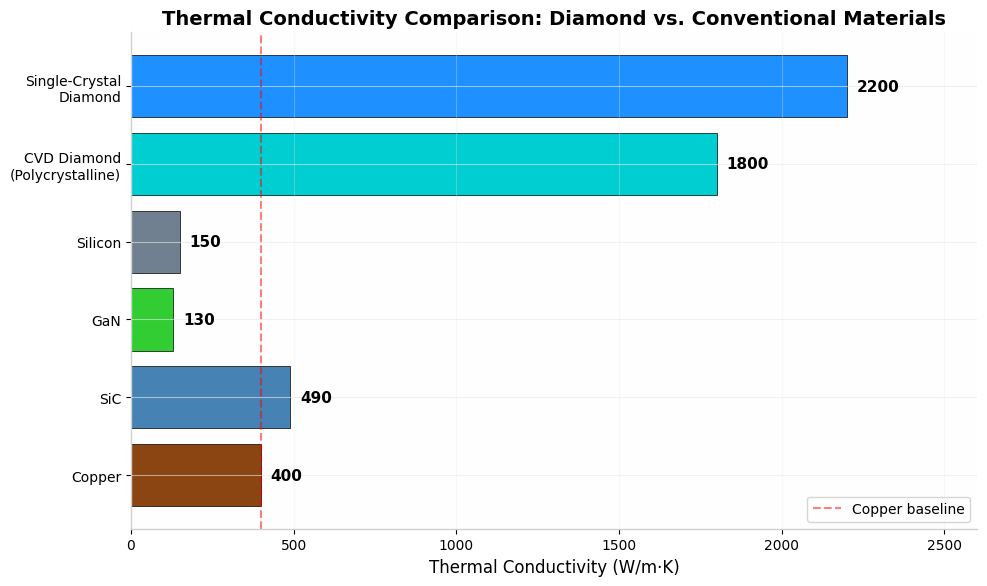
Single crystal diamond has thermal conductivity of 2200 W/m·K, significantly higher than conventional Copper (400) or Copper-Diamond (600 to 1000+). The latter is now entering service on consumer electronics device, EVs & AI-chips.
Single crystal diamond with its even higher thermal conductivity is the ultimately substrate of GaN RF chips, photoconductive switches, Power Electronics & laser diodes.
There are many huge players in diamond industry in China from 惠丰钻石 to 超晶热导 to 国机精工 & CAS, producing equipments, tools, wafers & diamond powder.
AI is just one of many industries where 4th generation semiconductor material is necessary.
I had the opportunity to see and test @arduino's new Ventuno Q board at Embedded World 2026 in Nuremberg. In the article you will find benchmarks, specs and all questions answered including @Qualcomm_Dev mainline Linux support status
https://t.co/q0dzkgK3Jz
the bottleneck in humanoid robots isn’t just ai.
it’s the actuator stack.
everyone talks about models, policies, imitation learning, and robot brains.
but the body has its own brutal bottlenecks:
• magnets → high-torque motors need rare-earth magnets, and that supply chain is heavily concentrated in china
• gearboxes → harmonic drives, cycloidal reducers, precision transmission. tiny errors become shaky motion
• sensors → encoders, force sensors, torque sensing, imu data. without feedback, the robot is blind inside its own body
• thermal limits → compact joints heat up fast when you ask them to move like muscles
• manufacturability → one actuator is hard. building thousands reliably is a different universe
this is what people miss.
humanoid robots are not just “ai with legs.”
they are supply chains with software attached.
china already dominates large parts of the rare-earth, magnet, motor, sensor, and precision manufacturing base.
so the real race is not only who builds the best model.
it’s who can build the best body, at scale, with control over the components inside every joint.
the future of humanoids won’t be decided only in neural networks.
it will be decided in magnets, gearboxes, sensors, factories, and supply chains.
Had a chance to check out this cute little robot in Shenzhen when I visited @ShuoYangAIR (founder of @mondorobotics, formerly of DJI and Tesla).
Super impressed by its mobility and toughness. Looking forward to the official release!
Hardware engineers spend 80% of their time reading datasheets and 20% actually building.
We're flipping that.
Introducing https://t.co/cX95N85xfV, Claude Code but for Hardware.