We are pleased to share the release of a major open data resource on Harvard Dataverse:
Indian Census Data Collection, 1901–2026: Digitised Subnational Population and Administrative Datasets
DOI: https://t.co/zsSOTCGyuD
#OpenData#India#Census#SocialScience
What’s included?
• Population time series (1901–2011)- Census A02 (cleaned and strcutured)
• first time digitization of Primary Census Abstract tables (state & district level)-1961, 1971, and 1981
• 2026 subdistrict-level administrative directory linked to census data (2011)
#DataInfrastructure #ResearchData
I’m sharing my slide deck on the demographic future of humanity,
🔗 Slides: https://t.co/geZQFXwN8h
prepared for the keynote address I will give tomorrow to the 7th EBRD and CEPR Research Symposium on “The Economics of Demographic Change”:
🔗 Symposium: https://t.co/L9Hn1fKA8A
Here are a few key ideas I’ll be discussing tomorrow, some of which even economists tracking population trends may not fully appreciate:
1️⃣ Fertility is falling everywhere: rich and poor countries alike, booming and stagnating economies, secular and religious societies. The decline is happening far faster than anyone anticipated, even me, ten years ago!
2️⃣ For example, Colombia’s fertility rate is 1.06, Iran’s is 1.44, and Turkey’s is 1.48, all of which are below the U.S.
3️⃣ The decline accelerated around 2014, well before the COVID pandemic.
4️⃣ As a result, humanity’s fertility is likely already below the replacement rate.
5️⃣ Many assume the replacement rate is 2.1 children per woman. That’s true for rich, advanced economies. But not for emerging economies, where selective abortion and higher young female mortality push the replacement rate higher. Thus, for humanity, the replacement rate is closer to 2.2.
6️⃣ The 2024 UN World Population Prospects are riddled with data and forecasts that, frankly, make little sense to my coauthor Patrick Norrick (at @AEI) and me.
7️⃣ Most of the differences in economic growth among advanced economies over the past 35 years can be attributed to demographic factors. Once adjusted for this, Japan’s economic performance is roughly on par with the U.S. (See my paper with Gustavo Ventura, @King_ofSweden, and Wen Yao, The Wealth of Working Nations):
🔗https://t.co/lm2iigVk7E
There are many other ideas (I could talk about this for hours!), but here’s the punchline: the world’s fertility crisis is worse than you thought, even after considering you already thought it was bad.
🏆Congratulations to our Student Paper Competition Finalists! The awards will be presented Sept. 20 at #TPRC53. Great work to all the students who submitted papers this year! @nintendongwook@RedhaChaba@soyunahny
New WP w/@PikettyWIL !
We build a database of World Historical BoP (https://t.co/M68n43AUIA) and study +200 years of economic transactions
Key takeaway: power plays a key role in global imbalances.
Collective rules are needed to correct them.
Check this thread 👇
Version 2.0 of the National Elections Database is online! https://t.co/oUEuqrcnqz
We now cover presidential and parliamentary elections 1789–2023, extending the post-1945 data of Electoral Turnovers @RevEconStudies (https://t.co/eTrHnV49tX).
w/ @benjaminmarx and @vincent_rollet
NEW 🧵
A quick thread of charts showing how Trump’s economic agenda is going so far:
1) Trump has had the same impact on economic uncertainty as a global pandemic.
Can AI-powered chatbots strengthen democracy?
We test BallotBot, an AI chatbot providing official information to California voters on key ballot measures ahead of the Nov 24 elections. 🧵👇
📄 Paper: https://t.co/LRNWN5Nnv1
w/ @ellliottt@sergallet#EconTwitter
Urban–rural cleavages are seen as a defining political divide. But does this polarization hold worldwide? My new working paper tests this question using an original dataset of granular, geocoded election returns from 106 countries (polling station-level in 70). (1/8)
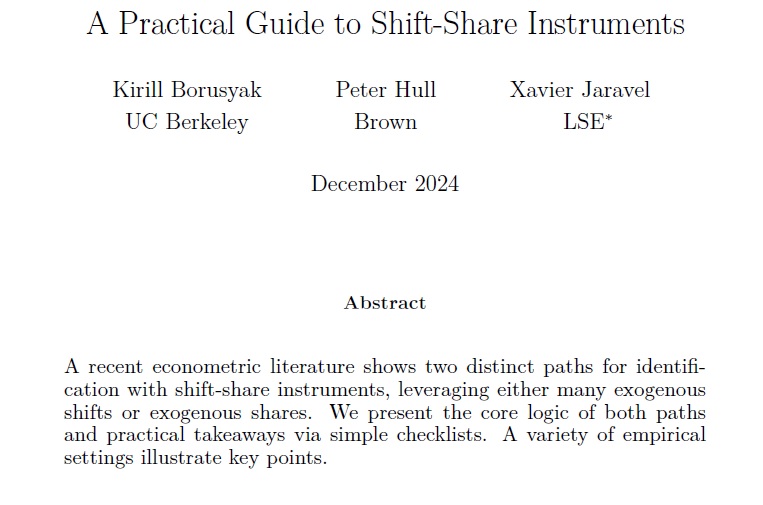
1/5 Looking for a clear and gentle intro to shift-share instruments?
I'm excited to release today our "practice guide to shift-share instruments" with @borusyak and @instrumenthull, forthcoming at the Journal of Economic Perspectives @AEAjournals 👇👇👇👇👇
Check out the new OECD Local Data Portal.
Visualise and compare municipal data across 41 countries, >100 indicators on demography, climate, environment, transport and economy - including average distance to closest pharmacy!
https://t.co/nXqwxmUeIy
Our paper on "Electoral Turnovers" with @benjaminmarx and @vincent_rollet is now forthcoming at @RevEconStudies !
Full thread on what we do and find here: https://t.co/2MNr1aB4Mv
Bloomberg cited our study in the @cjip_journal: “polls show younger Chinese have a more negative image of America than their parents, with the telling exception of those who’ve studied in the US.” #uschina Read the paper for free at: https://t.co/5G7Ki5GZeq
"There's so much wisdom in political science, anthropology, history & sociology about the world. Don't stay in your silo. There's just so many ideas and insights out there."
James A. Robinson joined @timsvengali in today's #podcast - listen here: https://t.co/nmq8N7HWTm
In the coming months the European Union must launch the reforms needed to integrate Ukraine and the Balkans in a few years' time. This will be done in a politically fraught atmosphere, with an economy weighed down by Germany's recession.https://t.co/VWiAUBErWK
The US is engaged in a rapidly-escalating semiconductor trade war with China—sanctions have caused US-manufactured chip exports to China to fall by 60% and exports of chipmaking equipment to fall by 40%
Yet the US needs cooperation and industrial policy success to win it's war🧵
❓Quelles seront les catégories les plus touchées le relèvement de l’âge minimum légal ?
📝Nouvel article de décryptage de la #ReformeDesRetraites par @P__Aubert
▶️https://t.co/gGtOumoWcH
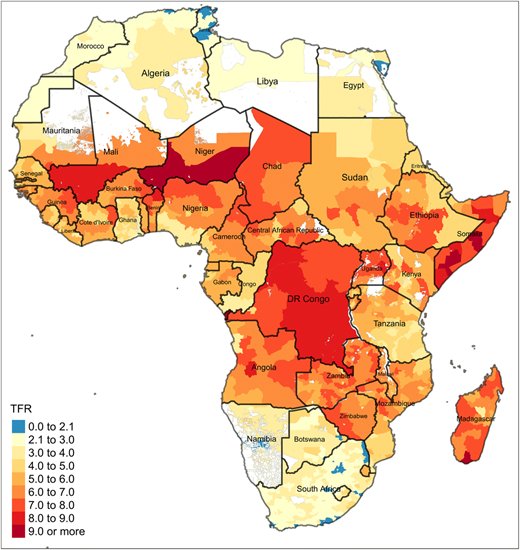
Why Africa’s total fertility rate (TFR) shows greater variation at the subnational level? As shown in the below plot from @whyvert, the highest fertility zones are depicted within certain provinces.
Based on @DHSprogram on 27 countries & > 70,000 women, here are some thoughts: