Fintech Climate Startup bridging Nature Financing gaps (model w/ROI)=🌳 a source of food, water & income for the poorest & most affected by climate change.
CLIMATE ACTION: We help firms reach net zero by planting fruit trees in developing nations. A win-win for all stakeholders.
Making sustainability a business investment instead of aid or just a cost.
Our prototype application: https://t.co/6SQJIm3k24
𝐉𝐎𝐈𝐍𝐓 𝐒𝐓𝐀𝐓𝐄𝐌𝐄𝐍𝐓 | 𝐀𝐟𝐃𝐁 𝐀𝐧𝐧𝐮𝐚𝐥 𝐌𝐞𝐞𝐭𝐢𝐧𝐠𝐬 𝟐𝟎𝟐𝟔 — 𝐁𝐫𝐚𝐳𝐳𝐚𝐯𝐢𝐥𝐥𝐞
"𝘼𝙛𝙧𝙞𝙘𝙖 𝙙𝙤𝙚𝙨 𝙣𝙤𝙩 𝙨𝙪𝙛𝙛𝙚𝙧 𝙛𝙧𝙤𝙢 𝙖 𝙨𝙝𝙤𝙧𝙩𝙖𝙜𝙚 𝙤𝙛 𝙘𝙖𝙥𝙞𝙩𝙖𝙡. 𝙄𝙩 𝙨𝙪𝙛𝙛𝙚𝙧𝙨 𝙛𝙧𝙤𝙢 𝙖 𝙨𝙝𝙤𝙧𝙩𝙖𝙜𝙚 𝙤𝙛 𝙙𝙚𝙢𝙤𝙘𝙧𝙖𝙩𝙞𝙘 𝙘𝙤𝙣𝙩𝙧𝙤𝙡 𝙤𝙫𝙚𝙧 𝙬𝙝𝙚𝙧𝙚 𝙩𝙝𝙖𝙩 𝙘𝙖𝙥𝙞𝙩𝙖𝙡 𝙜𝙤𝙚𝙨."
AFSA and Stop Financing Factory Farming (S3F) have issued a joint statement on the New African Financial Architecture for Development (NAFAD) — released at the AfDB's 2026 Annual Meetings in Brazzaville.
The case for African capital financing African development is sound. But NAFAD fails to answer the question that follows: capital for what? There is no agroecology commitment. No exclusion of corporate monoculture expansion. No protection for smallholder food systems. No land rights conditionality. AFSA's assessment of 20 AfDB agricultural projects found that none achieved high agroecological alignment. The African Economic Outlook 2026 — 260 pages — does not contain the word agroecology.
Without a binding investment mandate, NAFAD will not build a new financial architecture. It will capitalise the existing extractivist one with African savings — while farmer organisations, land rights movements, and affected communities remain locked out of the room where decisions are made.
African pension funds, sovereign wealth, and diaspora capital could finance an agroecological transition at scale. That is the financial architecture Africa's food producers need. We are calling for the political will to make that happen — before the window closes.
📄 Read the full joint statement: 🔗 https://t.co/JiXKxW2I0S
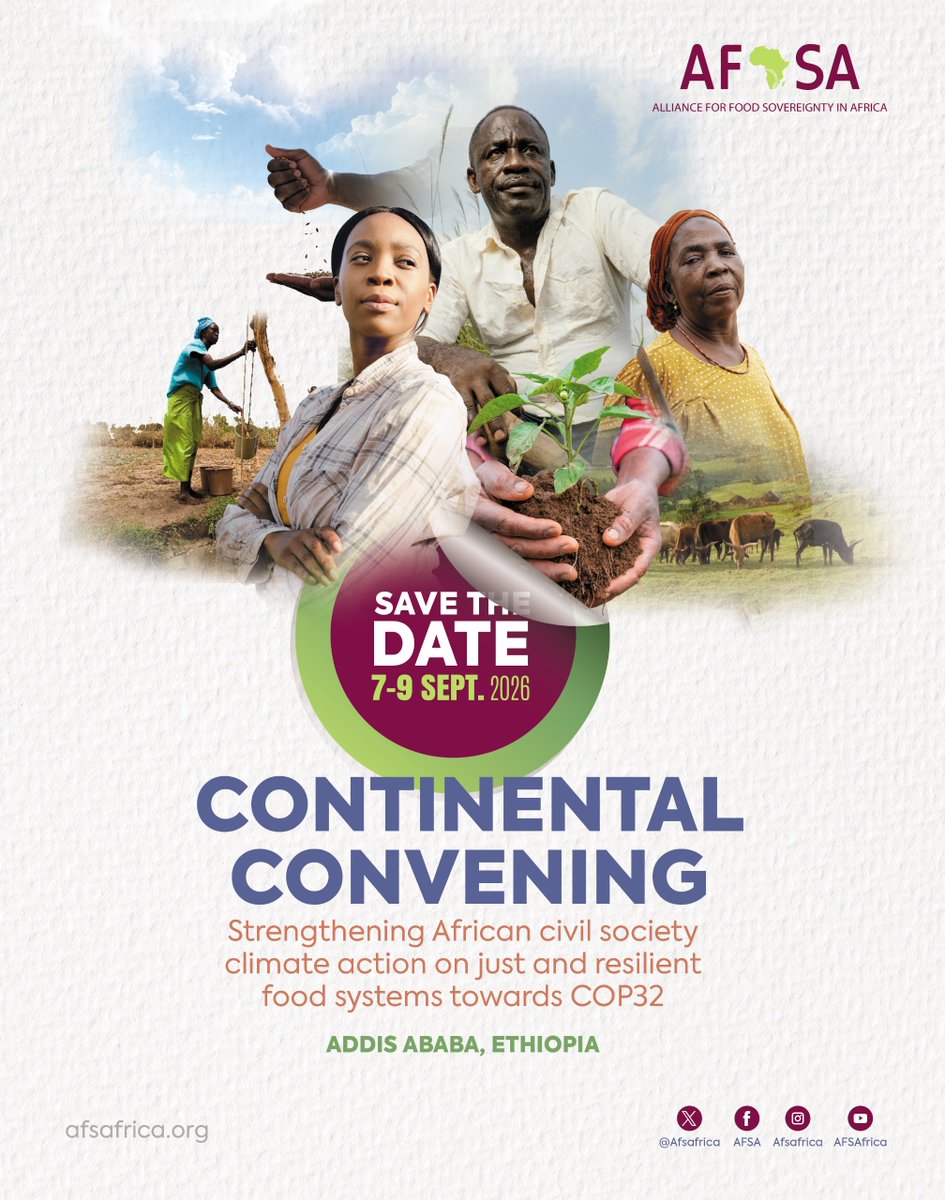
🌍 𝐒𝐀𝐕𝐄 𝐓𝐇𝐄 𝐃𝐀𝐓𝐄 | 𝟕–𝟗 𝐒𝐞𝐩𝐭𝐞𝐦𝐛𝐞𝐫 𝟐𝟎𝟐𝟔 | 𝐀𝐝𝐝𝐢𝐬 𝐀𝐛𝐚𝐛𝐚, 𝐄𝐭𝐡𝐢𝐨𝐩𝐢𝐚
AFSA is convening African civil society for a landmark 𝘾𝙤𝙣𝙩𝙞𝙣𝙚𝙣𝙩𝙖𝙡 𝘾𝙤𝙣𝙫𝙚𝙣𝙞𝙣𝙜 𝙤𝙣 𝙨𝙩𝙧𝙚𝙣𝙜𝙩𝙝𝙚𝙣𝙞𝙣𝙜 𝘼𝙛𝙧𝙞𝙘𝙖𝙣 𝙘𝙞𝙫𝙞𝙡 𝙨𝙤𝙘𝙞𝙚𝙩𝙮 𝙘𝙡𝙞𝙢𝙖𝙩𝙚 𝙖𝙘𝙩𝙞𝙤𝙣 𝙤𝙣 𝙛𝙤𝙤𝙙 𝙨𝙮𝙨𝙩𝙚𝙢𝙨 𝙖𝙣𝙙 𝙖𝙜𝙧𝙞𝙘𝙪𝙡𝙩𝙪𝙧𝙚 𝙩𝙤𝙬𝙖𝙧𝙙𝙨 𝘾𝙊𝙋32. With the world's eyes soon turning to #Ethiopia as the host of #COP32, there has never been a more urgent, or more powerful, moment for African voices on food and agriculture to speak with one, coordinated voice. This is that moment.
Africa's smallholder farmers, pastoralists, women, youth, and indigenous communities are on the frontlines of a climate crisis they did not create, yet they hold some of the most transformative solutions the world needs. Too often, however, African civil society has entered global climate negotiations fragmented, with parallel agendas and diluted influence. This convening is a direct response to that challenge, bringing together approximately 100 participants from across the continent, including CSOs, farmer groups, women-led movements, youth networks, researchers, and policy actors, to build a unified position, a shared roadmap, and a coordinated strategy for #COP31 and #COP32.
Over three days of structured, participatory dialogue, participants will move from shared understanding of the climate policy landscape to deep thematic engagement on just transition, adaptation, and climate finance in food systems, culminating in an endorsed African civil society position statement and a clear roadmap of collective action toward COP32.
If you work at the intersection of #foodsovereignty, #agroecology, and #climatejustice, this is the space for you. Mark your calendars, spread the word, and stay tuned for registration details
Our mission consists of connecting indigenous rural communities to global private climate finance (both groups are looking for each others but are siloed).
Indigenous Peoples are on the forefront of climate solutions, yet their access to climate finance remains limited.
Helen Biangalen-Magata of @Tebtebba breaks down the needs of Indigenous Peoples on the road to #COP31, including stronger delivery on finance commitments.
Calling all founders in Home & Commercial Services 📢
A strategic acquirer actively looking to buy in this space. If you’ve ever wondered what your business is worth—or want a clean exit strategy—let’s talk.
looking for:
✅ Home services (HVAC, plumbing, electrical) $30M rev
A 23-year-old self-made American millionaire, James Dumoulin, who interviews billionaires on the street, visited Nigeria 🇳🇬 for the first time and interviewed the richest Black man on earth, Aliko Dangote, at his Ikoyi home.
Making sense of the chaos of sustainability, climate finance and actors who complement each others but are totally disconnected (global private sector AND global south rural communities)…their common denominator: food forests…
Jordan Peterson explained how you can become dangerously articulate:
1. Articulate does not just mean well spoken. It means differentiated. A joint that is articulated can move with precision and grace. A person who is articulated can move through the world the same way. Vague people are one solid useless mass. Articulate people have range.
2. Peterson calls articulate people the most dangerous people in the world. Not dangerous in a destructive way. Dangerous in the sense that they cannot be ignored, dismissed, or pushed around. The word is the most powerful tool a human being can carry.
3. It does not matter what you do for a living. A plumber who is articulate can negotiate better contracts, manage employees, advertise services, and think through complex problems. Articulation is not a luxury for intellectuals. It is a practical weapon available to everyone.
4. Jocko Willink is one of the most decorated special operations soldiers alive. Peterson uses him as his primary example of why articulation matters even in the most physically demanding environments. Jocko succeeded not just because he was tough. He succeeded because he could communicate clearly with the men under his command, explain situations to his superiors, and make the case for soldiers who deserved promotion. Toughness without articulation leaves half your power on the table.
5. Becoming articulate starts with paying attention to what you say. Peterson uses the image of crossing a swamp on a hidden stone path. You cannot see the path. You feel for it with each step. You test the ground before you commit your weight. That is exactly what you do with words. You feel whether what you are about to say is solid or whether it will make you dissolve.
6. He noticed 40 years ago that most of what he said made him feel weak. Not all of it. About five percent felt solid. The rest was instrumental language. Words used to win arguments, appear smart, gain small victories. That kind of language is hollow and people can feel it. The goal is to increase the percentage of what you say that actually feels true.
7. Stop filling silence with noise. The ums, the likes, the you knows, the ahs. These are not harmless verbal habits. They are signals that your thinking has not caught up with your speaking. Take the time to craft the word. Silence while thinking is not weakness. It is precision.
8. Peterson calls the pause a prayerful pause. When someone asks you a question, instead of immediately answering with what you think you should say, ask yourself what you actually think. Make it a real question. One you genuinely do not know the answer to yet. Then wait. The answer will come. And when you speak it, people will find you immediately interesting because you are saying something real.
9. Joe Rogan is one of the most successful communicators alive and his entire method is the opposite of instrumental language. He is not trying to appear smart. He is not trying to get something from his guests. He just genuinely wants to know more than he knows. That honesty makes every conversation magnetic. People can feel the difference between someone performing and someone actually thinking.
10. Read great writers. Write about the problems that obsess you. Practice saying only what you believe to be true. These are not quick fixes. They are a lifetime practice. But Peterson's promise is direct. If every word you say reflects what you genuinely believe, the path you walk becomes a golden path. Not because it sounds good. Because it is real. And real is the only thing that actually works.
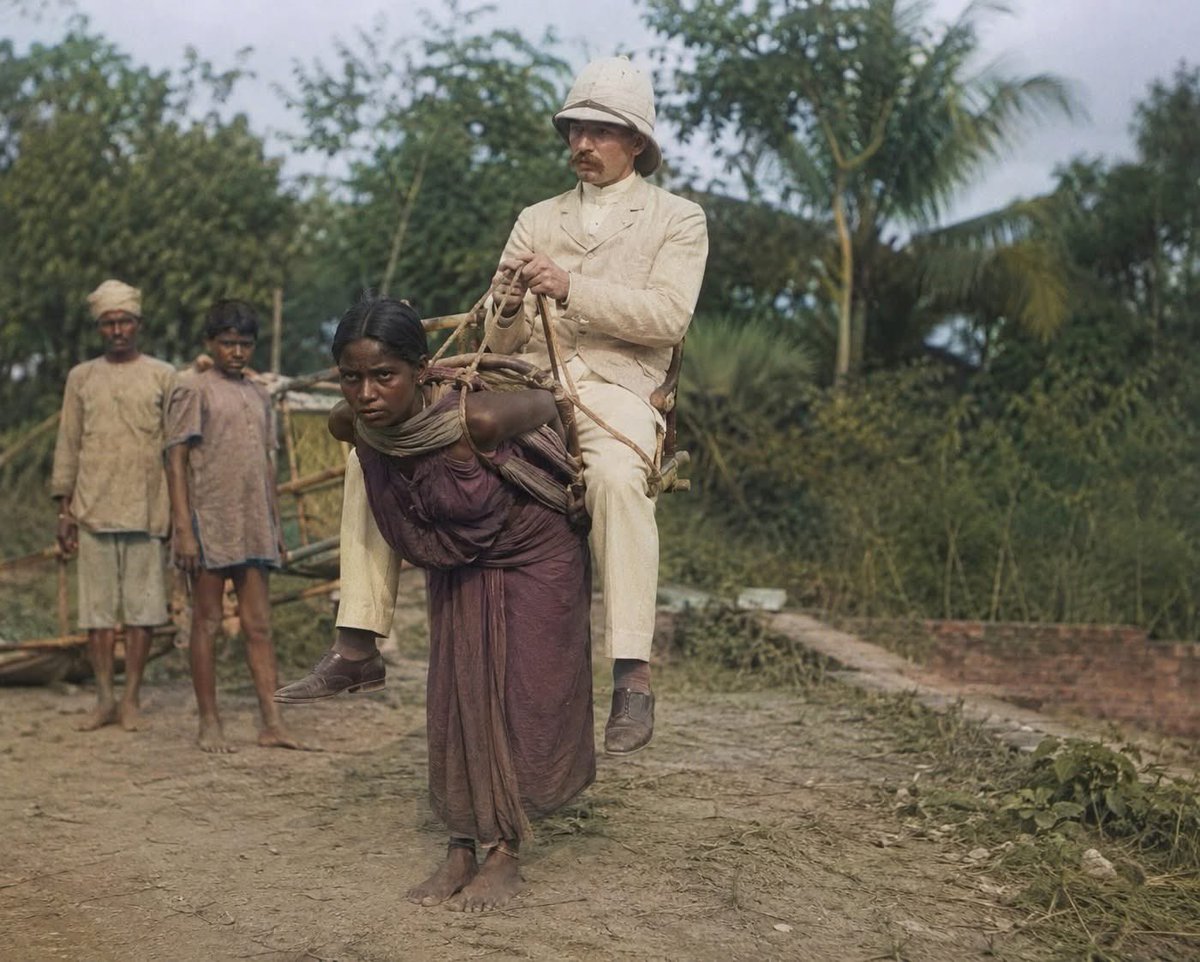
امرأة بنغالية تحمل تاجرًا بريطانيًا على ظهرها…
📸 الصورة التُقطت سنة 1903م
في عزّ الاستعمار البريطاني لشبه القارة الهندية.
ليست فقط صورة… بل صفعة في وجه كل من يتغنى بـ"حضارة الغرب"،
فهذا هو الوجه الحقيقي للاستعمار الذي لا يزال يُجمّلونه في كتب التاريخ.
إنها عبودية وإذلال للبشر، وسحق لكرامة الإنسان، فقط لأنه لا ينتمي إلى العرق الأبيض!
ويسألونك عن الإرهاب...
تاريخ الاستعمار الغربي مليء بالمجازر، العبودية، النهب، والتجويع...
لكنهم يختزلون الإرهاب في شعوب مستضعفة تناضل من أجل كرامتها!
🩸 ما فعله الاستعمار البريطاني في الهند، من قتل وتجويع ونهب واحتقار للإنسان، لا تزال آثاره ماثلة إلى اليوم.
ملايين قُتلوا، وثروات سُرقت، وأجيال شُرّدت... تحت راية "التنوير" الكاذب!
@FahadAmirN He better sell the business asap and go back home…you can’t argue with folks who want your head on a stick…if the business is not sold, then cash out your bank account and go back. Life is more precious, you can always build a new business in your homeland.