@NicJ_27 For me, three of the panel and the VAR, the Bogle challenge has a red card point of contact but lacks the speed, intensity and force to be a red card. Two members of the panel think it did have those elements. It's a judgement and impossible to design more exact wording than that
@NicJ_27 To try and get consistent human judgement there are criteria that can be used to help work out if something has crossed that threshold or not. https://t.co/CF9vtNAIii
But humans will still come to different conclusions within that.
@NicJ_27 Careless is no card, reckless is a yellow card, excessive force is a red card.
Serious foul play (a red card) also has a definition in the laws.
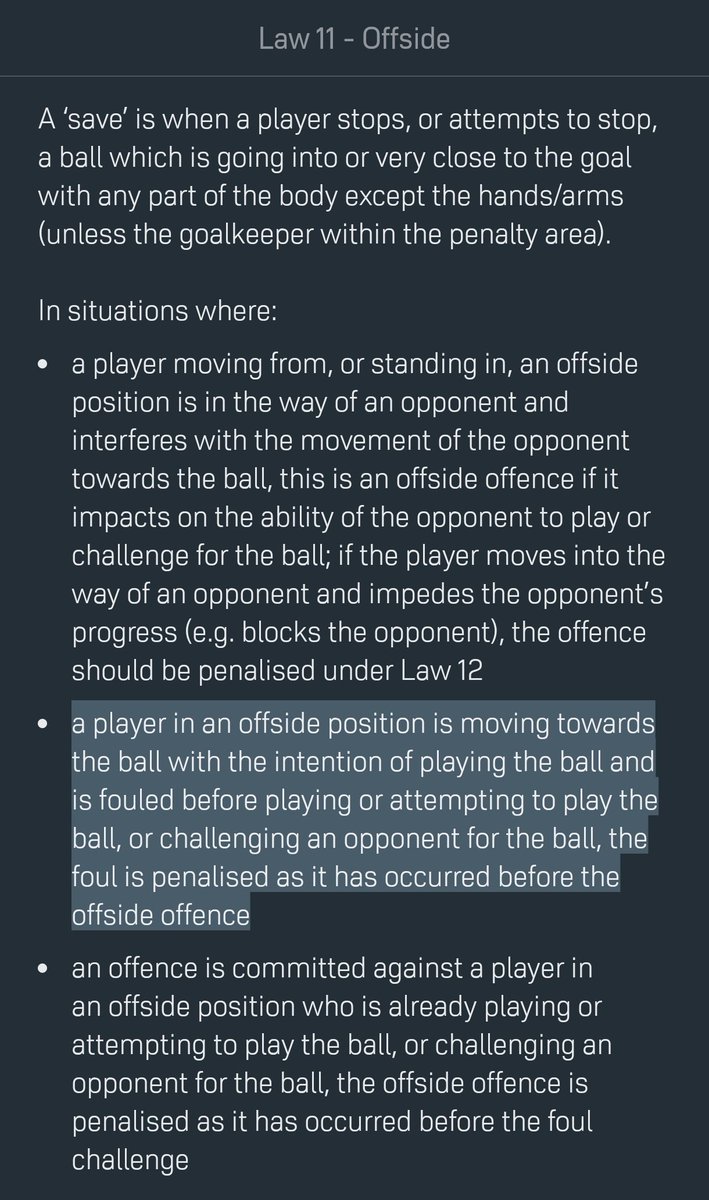
The shirt pull on Havertz occurs before he commits an offside offence as listed in law 11, so the shirt pull occurs first and is the offence that should be penalised.
Law 11 actually details this scenario for extra clarity.
Explanation of Havertz penalty appeal v Hull.
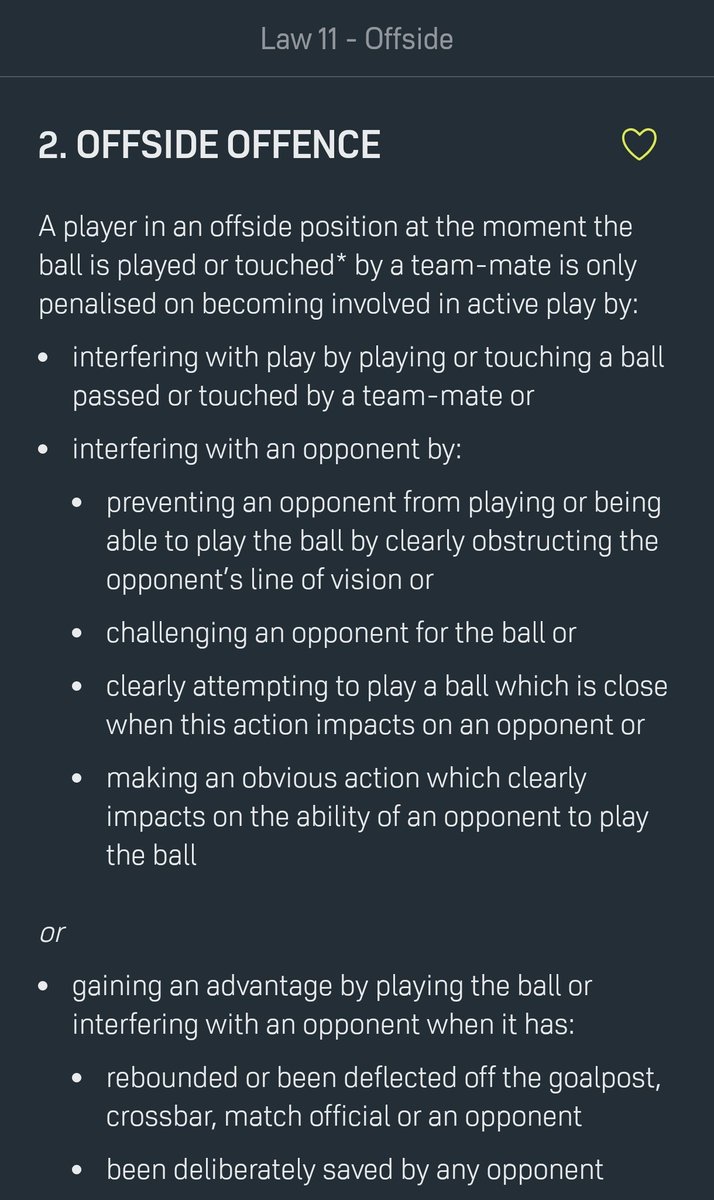
Offences are punished in the order they occur. Whilst the point at which your offside position is judged is when the ball is played by your teammate, you don't commit an offside offence until you do one of the actions listed in law 11
This man thinks that it's bullshit that footballers have a responsibility not to commit serious foul play. Be careful when you play football with this man.
Apparently stating that it's the onus of a footballer to not launch themselves into a foul tackle is hilarious. These are the knots football fans will twist themselves into when they don't like decisions going against their team.
@RefDecisionExp "Make sure you don't them launch yourself into a straight legged tackle"
What? 🤣🤣🤣🤣🤣
That says everything about you and these rules - You're a clown, clearly never played football - enjoy the rest of your day sir lmao 👍
@DF93k Approaching a challenge at speed on its own is not wrong. Ifyou then execute other elements of that challenge reasonably or decide not to challenge at all, that's fine. But if you're approaching an opponent at speed the onus is on you not to use that force into a dangerous tackle
@DF93k If you're running and pressing your opponent, you have to make sure you don't then launch yourself into a straight legged tackle where you put the full weight of your body through a straight leg into your opponent's Achilles.
@DF93k@Ash_Howard@nickty61 You've missed all the words after and there. You don't just stop reading a sentence at the word and. "Simons runs at pace and..." Now read the rest.
Those adult illiteracy courses could really help you know.
@DF93k There are pretty of clear indicators that can be used to judge the force used:
The speed in which you approach the challenge.
Straight leg v bent leg.
Step v lunge/jump.
Use of the tackling leg with full body weight being put through it v contact with the trailing leg.
@DF93k@Ash_Howard@nickty61 I've explained it to you once.
https://t.co/h0PO577LCI
I apologise if you're unable to read. There are courses you can go on for adult illiteracy.
@DF93k@nickty61 Simons runs at pace and makes contact with a straight leg which is the one he's attempting to make the tackle with so he's put the full force into that.
Bogle's is a step with a bent leg that he hasn't put any force into because it's not the leg he's trying to tackle with.
@Ash_Howard@DF93k@nickty61 They're different in the crucial things that determine whether they're a red or yellow card. https://t.co/h0PO577LCI
Rather than crying about inconsistency, expecting the same outcome from similar but different situations, fans should learn the laws and how they're implemented.
@DF93k@nickty61 Simons runs at pace and makes contact with a straight leg which is the one he's attempting to make the tackle with so he's put the full force into that.
Bogle's is a step with a bent leg that he hasn't put any force into because it's not the leg he's trying to tackle with.
@DF93k@Ash_Howard@nickty61 No because the Simons and Bogle situations had notable differences, that I've already explained to you, that means different outcomes were correct.