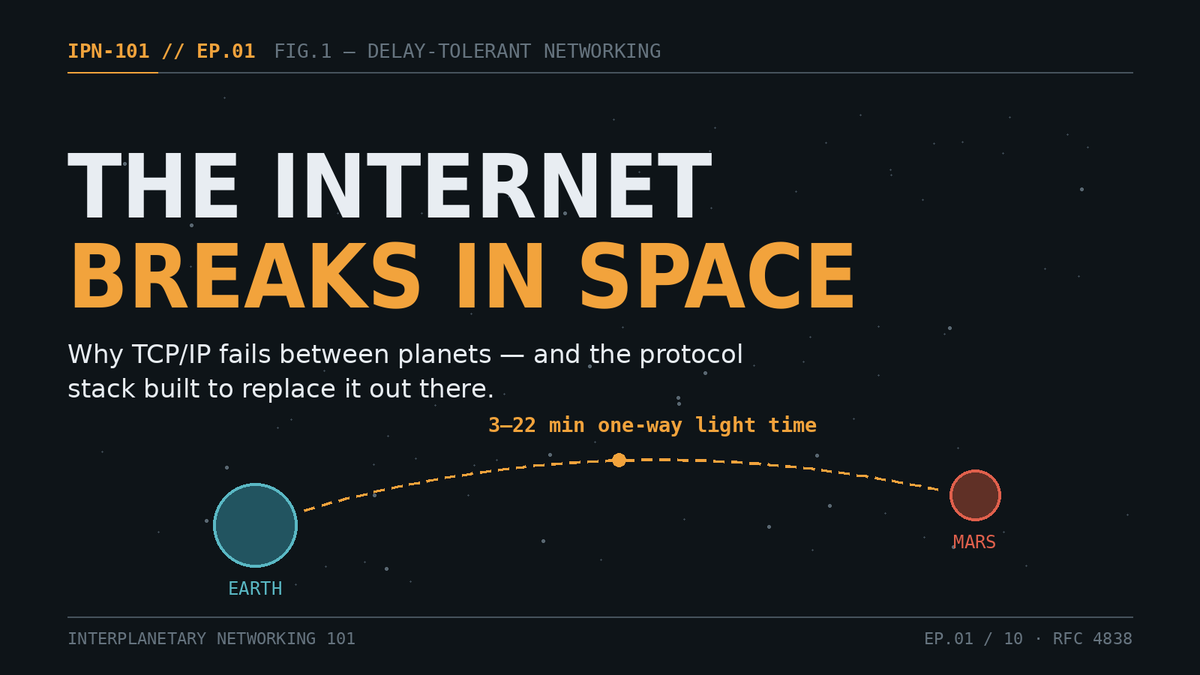
Interplanetary Networking 101
(IPN-101) - Episode 1: The Internet Breaks in Space
TCP assumes the other end answers in milliseconds. Earth and Mars assume 3–22 minutes one way—and that's only when a planet isn't blocking the line.
The Internet, as built, works on a fundamental bet: if you send a packet and don't hear back quickly, something is wrong. Retransmit. Maybe the packet was dropped. Maybe the link went down. Either way, the answer is the same: try again, sooner rather than later.
That bet doesn't survive space.
Here's the problem: the speed of light is constant. You can't negotiate with it. When you're separated by 200 million kilometers of vacuum, the fastest message is also the slowest. A command from Earth to Mars doesn't arrive instantly. It doesn't arrive in a second, or a minute. It arrives 3 to 22 minutes later, depending on where both planets are in their orbits. And the reply? Another 3 to 22 minutes after that.
This thread is about what happens when you try to network the solar system—how engineers rethought communication from first principles when the Internet's assumptions broke. The answer: Delay-Tolerant Networking, the Bundle Protocol, and the counterintuitive insight that disconnection, not connection, is the default state you design around.
Over the next 8 posts, we're building from "why does IP fail?" all the way to the actual protocols flying to Mars right now—bundle routing, CBOR encoding, security without handshakes. By the end, you'll understand a networking stack that assumes disruption the way your phone assumes WiFi.
Ready? 1/8
@Elshayib Then it needs regulated immediately. This WILL cause issues, the least of which being social stratification, the worst being then having more power than any government.
That's exactly what the paper I'm writing says. No light, no magnetism, no gravity. Then everything.
The hard part to explain is that light is unaffected by time, but we are. The universe begins and ends in an instant, a literal flash of light.
We're essentially in a time dilation bubble.