🔶 𝗧𝗵𝗲 𝘃𝗮𝘀𝘁 𝗺𝗮𝗷𝗼𝗿𝗶𝘁𝘆 𝗼𝗳 𝗱𝗶𝗴𝗶𝘁𝗮𝗹 𝘁𝗼𝗸𝗲𝗻𝘀 𝗶𝗻 𝟮𝟬𝟮𝟲 𝗹𝗮𝗰𝗸 𝗮𝗻𝘆 𝘁𝗮𝗻𝗴𝗶𝗯𝗹𝗲 𝗯𝗮𝗰𝗸𝗶𝗻𝗴.
Meanwhile, premium real estate has become a closed club for multi-millionaires.
Inflation erodes capital, while high-yield properties require massive down payments and bureaucratic hurdles.
𝗥𝗘𝗜𝗧𝗗𝗔𝗢 𝗰𝗵𝗮𝗻𝗴𝗲𝘀 𝘁𝗵𝗶𝘀 𝗽𝗮𝗿𝗮𝗱𝗶𝗴𝗺. 🧵👇
🚨 $88.6M STOLEN: Coldcard hardware wallet RNG exploit!
A critical firmware flaw in Coldcard seed-phrase generation compromised 4,500+ addresses, draining 1,400+ BTC.
The core lesson: A single hardware wallet creates a single point of failure. 1 device = 1 vulnerability.
⚡ How @REITDAOapp solves this:
Our Treasury & smart contracts rely on distributed Safe multi-signatures + community DAO Governance. No single seed phrase or physical device can ever compromise global treasury assets.
Single-device security is broken. Multi-sig DAO architecture is the standard.
ℹ️ Read our full security framework: https://t.co/YNVXguG6iW
⚡ ANNOUNCEMENT: Vietnam RWA & Tokenization Business Meeting 2026!
On August 6, @REITDAOapp & @sabaiecoverse are co-hosting a private business summit in Ho Chi Minh City.
Key Highlights:
🔸 Practical RWA tokenization models & legal frameworks
🔸 Keynotes by Dim Ilin (REITDAO Founder) & Julia Filobokova (Sabai Protocol CEO)
🔸 Case studies & project reviews for developers & asset owners
🔸 Deep dive into Southeast Asia’s booming RWA market
Access is private and by application only.
ℹ️ Read full article & apply here: https://t.co/pE5sYXMRil
@haydenzadams Public title registries are broken for the modern era. Nobody's home address should sit on a searchable target list
Transitioning real estate into on-chain DAO pools decouples identity from physical deeds while maintaining full asset exposure
@nic_carter 100% — linking home addresses to net worth in a public database creates massive wrench attack risks
On-chain DAO treasuries (like a REITDAO model) insulate personal identities from physical title deeds while keeping asset exposure transparent
@mert Spot on — centralized searchable registries literally hand bad actors a target list
Structuring real estate exposure through DAO/SPV models (REITDAO approach) keeps personal names off public rolls while retaining full asset liquidity
📊 RWA market cap just surged 3.5x this year — scaling from $2.1B to $7.58B, according to new data from @CryptoRank_io
The breakdown reveals a massive structural gap:
🔸 80% of current RWA cap is locked in tokenized gold (XAUT, PAXG) and U.S. Treasuries.
🔸 Gold market cap: ~$15 Trillion.
🔸 Real Estate market cap: $330+ Trillion (the largest asset class on Earth!).
Real estate is 22x bigger than gold, yet mass-market users remain locked out due to high entry barriers and platform fragmentation.
This is why @REITDAOapp is building the first unified Web3 infrastructure layer — bringing global tokenized real estate to everyone via the IXRA index token.
Gold was just Phase 1 of RWA. Real Estate is the main event.
ℹ️ Explore our model: https://t.co/Qtg6PBuJZU
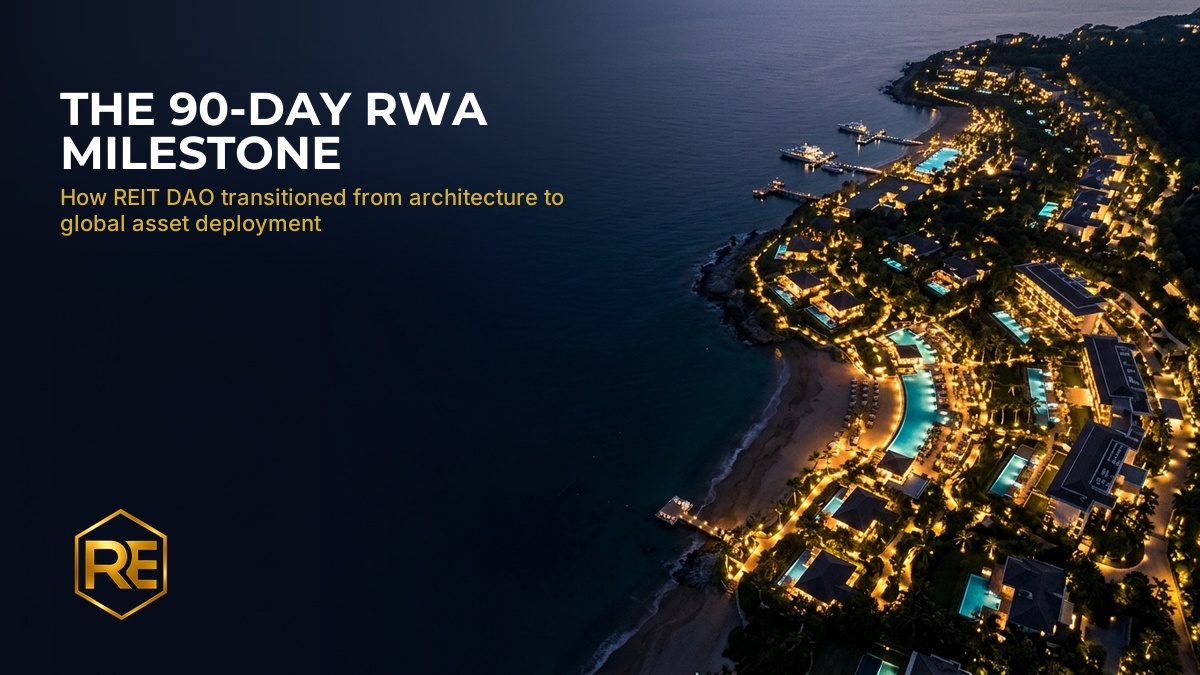
ℹ️ While others spend years making promises, we spent 90 days building live Web3 infrastructure.
In just one quarter, @REITDAOapp executed Stage 1 of its roadmap:
🔹 Live IXRA index token portal (https://t.co/ubs513pZ9O)
🔹 Multi-region portfolio: Phuket, Bali, Montenegro & the US
🔹 Hybrid AI + local expert property scoring
🔹 Operational Aragon governance on Arbitrum
We are now accelerating into Stage 2:
Scaling to 8+ global locations, 20+ tokenized assets, $1M+ in property value, and onboarding the first 100 DAO Contributors.
🔸 Read our full 90-day milestone report: https://t.co/4A9VZksG48
🚨 Another $24M lost on Arbitrum due to compromised off-chain validator signing keys.
The AFX Trade exploit demonstrates the vulnerability of protocols that rely on centralized key holders. Hot key concentration creates a single point of failure regardless of smart contract code quality.
Architectural security requires strict de-risking:
🔹 Non-custodial Safe & Aragon governance
🔹 Multi-stage approval & delayed execution protocols
🔹 Multi-layer asset protection combining AI scoring with local regional experts
@REITDAOapp eliminates single-person and hot-key vulnerabilities over treasury assets.
📋 Read our security framework: https://t.co/YNVXguG6iW
The disconnect in the ASI discourse mirrors a fundamental flaw across traditional capital markets and real-world assets: reliance on centralized power concentration disguised as stability.
When critical infrastructure or high-value assets remain locked inside opaque, centralized gatekeeper systems, user sovereignty and oversight evaporate — whether in AI governance or real-world wealth distribution.
The naive assumption is that centralized custodians will prioritize collective resilience over systemic self-interest. The alternative isn't passive acceptance, but implementing practical d/acc principles:
- Verifiable On-Chain Governance: Replacing opaque intermediary discretion with transparent, community-led voting.
- Decentralized Treasury Execution: Utilizing smart contract frameworks (such as Aragon and Arbitrum) strictly as execution rails — keeping capital allocation decisions governed directly by the DAO.
- Sovereign RWA Infrastructure: Transitioning real-world asset exposure into open, audit-verifiable structures that eliminate single points of failure.
At @REITDAOapp, we apply this exact framework to real-world assets — moving capital allocation away from centralized black boxes and into open, on-chain governance where contributors retain oversight and control.
https://t.co/ubs513pZ9O
One thing I find striking in the discourse between AI 2040 and its detractors is that the two seem to be locked in to totally incompatible worldviews of how fast and how much of a big deal AI progress is:
* In AI 2040, every scenario sees superintelligence of some kind emerging by 2040, unless a herculean effort is made to completely stop it
* Detractors say things like "AI 2040 is naive about human coordination ability and a threat to freedom", but don't seem to see any naivety in assuming that the ASI transition will just go well by default, don't seem to see ASI itself as a massive power concentrator risk, and don't seem to feel fear of humanity's "hard power" dropping to zero if ASIs can do literally every task better than we can. This stance makes total sense in a "AI is normal technology" world, zero sense in a world where superintelligence is possible by 2030 and almost guaranteed by 2040
I think my beliefs are:
- If I was confident that (present-day-style) AI is normal technology, I would be in the detractor camp
- If I was confident that superintelligence is coming in 2030 by default, I would be closer to the AI 2040 camp - it's naive, but every other option is naive squared?
But my problem is that I feel great uncertainty and have no idea which of the two worlds (or some other third thing) we're living in?
Hence why I continue to be open-minded about slowdowns/pauses, but also I feel very uncomfortable with the "open source bad, the good outcome is the one where our guys have controlling global dominance" push coming from some major AI companies and intellectuals - in a "normal" world that's the sort of thing that triggers every political alarm bell at the same time.
A big reason why I have been advocating and trying my best to support the d/acc platform (rapid up-skilling in formal verification, cryptography, secure and open hardware, pandemic resistance and other defensive biotech, food and basic resource security, public epistemics, non-power-concentrating versions of physical security) is that these things are clearly worth doing in both worlds.
The 2040 plan is already much more open source friendly (even mandating it! yay). It also includes "mutually assured compute destruction" ideas which (if they work) effectively give one of 2-5 actors the ability to trigger a global compute winter - as opposed to giving 1-5 actors the ability to selectively disenfranchise people they consider baddies while exempting themselves. This is also a big improvement. So I can see the earnest attempts to improve along the dimensions detractors criticize on ("does this concentrate power in big AI labs and superpower governments?"), and I appreciate this. I think many people don't appreciate enough the differences between different "kinds" of pause buttons, and how some concentrate power far more than others. Probably we can think harder and improve even more here.
But on the "slowdown/pause or not" topic, there isn't a magic "escape the tradeoff" button.
The Hansonian in me says: the winning deal is a deal which, from the perspective of both sides' present-day beliefs and knowledge, both sides would accept, though for different reasons. If the crux is AI progress speed, then identify a set of pre-agreed triggers for "okay, serious shit is happening" [super-pandemics? >25% unemployment? something involving slaughterbots?], and pre-agree that we become much more open-minded to the slowdown or pause thing if enough triggers come to pass within some timeframe. 2040 detractors (who clearly implicitly think that we'll see amazing speedup of progress from AI but think that what I call the "serious shit" category is overhyped) will accept expecting that the triggers don't come to pass, and AI worriers will accept expecting that they will. Pre-agreeing on the specific triggers means that once the triggers either hit or don't hit, there is stronger legitimacy around the idea that one side's worldview turned out more correct and we should be more inclined toward their program.
If I were @elonmusk (or zuck, or...) I would re-tool twitter much more heavily into being a platform for helping to identify and make these kinds of grand win-win deals, so that we can bypass big-country governments and big-company CEOs and big nonprofit intellectuals and give more people a voice in the discussion. It's possibly one of the best things that social media _could_ do for humanity if it wanted to.
But again, maybe this is also naive. Actually, probably it's naive.
But currently, I see zero plans for how to deal with an ASI transition that are not naive. Perhaps humanity is stuck with a choice between naive and naive squared (or maybe even naive squared and naive cubed), so I feel inclined to cut some slack to people who are trying.
🔶 𝗧𝗵𝗲 𝗥𝗼𝗮𝗱 𝘁𝗼 𝗦𝗰𝗮𝗹𝗲
By Phase 4, we aim for a network of contributors, 270+ properties, and $500M+ in TVL, expanding our decentralized footprint.
Read more: https://t.co/JRqooqoB8k
🔶 𝗧𝗵𝗲 $𝟭𝟬 𝗧𝗿𝗶𝗹𝗹𝗶𝗼𝗻 𝗥𝗪𝗔 𝗪𝗮𝘃𝗲
Major financial analysts project the tokenized asset market to scale to $10 Trillion by 2030.
Real estate tokenization is a primary driver of this shift. Here is how we navigate it. 🧵👇
🔶 𝗣𝗵𝗮𝘀𝗲 𝟮: 𝗟𝗮𝘂𝗻𝗰𝗵 (𝗠𝗼𝗻𝘁𝗵𝘀 𝟲-𝟭𝟮)
We are executing Phase 2. Focus: public launch of the IXRA token, expanding the contributor layer to 100+ experts, and integrating 20+ properties to reach $10M+ in TVL.
🚨 Consensys (the creators of MetaMask) unknowingly outsourced software developer work to an individual linked to North Korea.
The consultant worked under an alias for a month. The company detected the threat, terminated access, and confirmed that user assets remained safe. However, this event highlights a key issue in Web3 — relying on third-party recruiting agencies without personal verification.
⚡ Why Audited Code Alone Cannot Secure Web3
In Web3, we focus on code-enforced rules. However, if unvetted individuals gain access to repository layers, pure technical protection is never enough. Recruitment platforms assess technical skills, but they cannot verify the real identities or motives of anonymous developers.
REIT DAO combines on-chain security with a closed professional community:
1️⃣ Vetted Access via DAO Governance
No contributor has unilateral access to the treasury or assets. Every operational change, technical upgrade, or capital allocation must pass through formal on-chain voting and consensus.
2️⃣ Closed Circle of Trust
We build REIT DAO as an exclusive network of verified professionals. Every participant enters either by direct invitation or after personal screening and community recommendations. Personal trust and reputation matter just as much as smart contract rules.
Web3 security should not rely on code alone. The strongest defense is combining audited algorithms with a reliable, real-world network of experts.
👉 See our community mechanics: https://t.co/YnzZ2yNmkm
📷
🛡️ 𝗪𝗵𝗼 𝗥𝗲𝗮𝗹𝗹𝘆 𝗛𝗼𝗹𝗱𝘀 𝗬𝗼𝘂𝗿 𝗔𝘀𝘀𝗲𝘁𝘀?
When FTX collapsed, billions in user funds vanished overnight. The reason? Custodial control — one entity held the keys, and users had no recourse.
Most tokenized real estate platforms follow the same model. A centralized company holds the property deeds, manages the funds, and gives you a receipt.
🔐 𝗡𝗼𝗻-𝗖𝘂𝘀𝘁𝗼𝗱𝗶𝗮𝗹 𝗥𝗪𝗔
REIT DAO operates differently. Treasury funds are secured by multi-sig contracts requiring broad DAO consensus to move. No single entity can unilaterally access the capital pool.
If the team disappears, the assets remain. That's the point.
✔️ Verify it yourself: https://t.co/YnzZ2yNU9U
���� 𝗗𝗶𝘃𝗲𝗿𝘀𝗶𝗳𝗶𝗰𝗮𝘁𝗶𝗼𝗻 + 𝗟𝗶𝗾𝘂𝗶𝗱𝗶𝘁𝘆
A diversified index model reduces single-point-of-failure risks. Our capital routing and treasury reserves are designed to support stability.
See how it works: https://t.co/vwPvn1SHmS
🔶 𝗦𝗶𝗻𝗴𝗹𝗲-𝗔𝘀𝘀𝗲𝘁 𝗥𝗪𝗔: 𝗔 𝗥𝗼𝗼𝗸𝗶𝗲 𝗠𝗶𝘀𝘁𝗮𝗸𝗲
Tokenizing a single apartment building sounds like a good idea. But allocating your resources into one physical asset introduces huge concentration risks.
What happens when that local market hits a downturn? 🧵👇
🔶 𝗘𝗻𝘁𝗲𝗿 𝘁𝗵𝗲 𝗜𝗫𝗥𝗔 𝗜𝗻𝗱𝗲𝘅
REIT DAO mitigates this through the IXRA Index token. Instead of single-asset exposure, IXRA provides access to a globally diversified portfolio of DAO-vetted, cash-flowing properties.