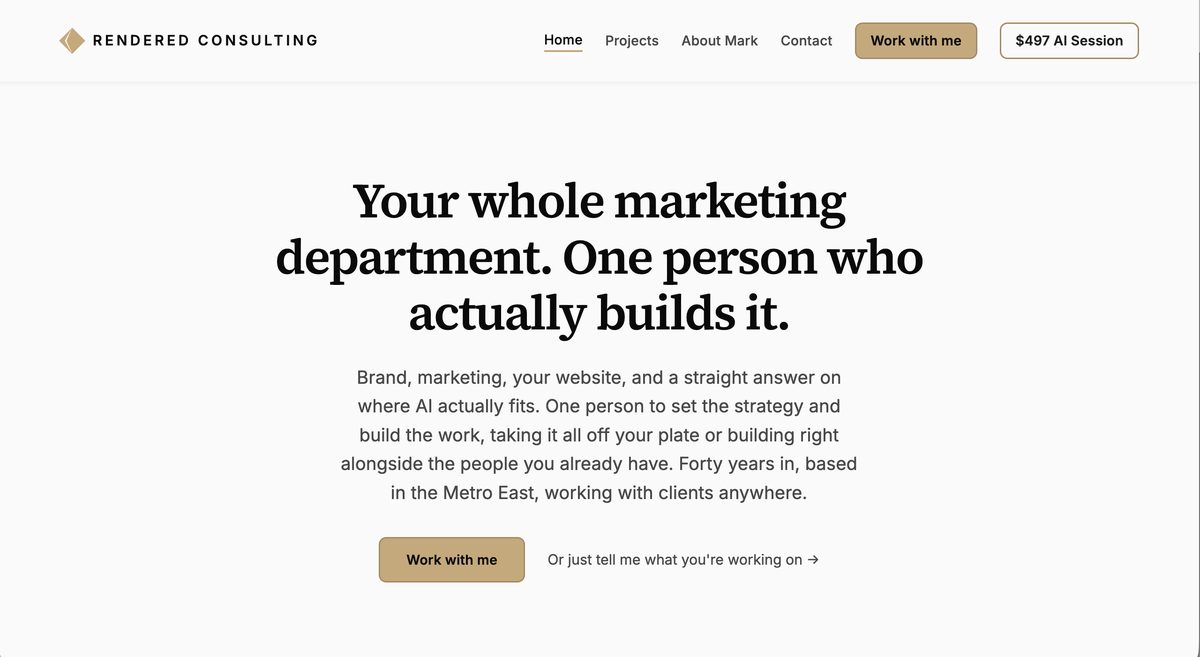
I’m actually trying to take the holiday off today. Been pretty busy over at @RenderedHQ lately, I realized as I was updating my Now page.
https://t.co/ao4q803XqE
I've been busy building websites for people — the kind that clearly say what each business does. My own 13 y.o. son reminded me that mine should do the same.
Version 2 is now live, and I think it's a site for sore eyes. ⬇️
I run my own business on AI tools I built myself. So it catches people off guard when they ask if they should use AI and there's a good chance I'll say: don't bother.
That's my AI Clarity Session: $497 flat, a straight written answer, "don't bother" included. Booking in bio.
Starting a business is hard and even a bit scary at times, but the Lord never leaves my side through it all. Couldn’t do this (or anything) apart from Christ.
BOOM? just learned to read the room!
Quiet hour says "Quiet on the wire." Active hour says "What's Happening." Mystery cracks and it flashes green for a moment. Live on the home page.
https://t.co/FJugTPJSKJ
Was last Thursday weirdly loud, or are you imagining things?
BOOM? just got a memory. 💥🧠
The map now goes back a full year, with a picker wheel on your phone for swiping through time.
https://t.co/YVO42FK76h
If you've ever tried to find a product image on a manufacturer's dealer portal, you know what I'm about to say.
I spent years working with about forty different manufacturers, many of which had their own dealer or "partner" portals, and none of them necessarily made my life easier. Every portal had its own login, its own password rules, its own expiration schedule, and its own completely unique idea of where to put things. Spec sheets under "Resources" on one. "Marketing Assets" on another. "Dealer Tools" on a third. One of them had a tab called "Literature" that hadn't been updated since what I can only assume was the early 2010s.
And the product photos. I could write a whole separate post about the product photos. If your product image looks like it was taken on a folding table in a warehouse with a fluorescent light buzzing overhead, your dealers are not excited to sell that product. And when the image is postage-stamped size, it's not super helpful when trying to make your product look good on screen or in print.
The real problem is that these portals were built for the manufacturer's internal workflow, not for the people actually trying to sell their products. And when your partners have to fight through dozens of different logins and treasure hunts just to find a brochure, some of them are going to quietly stop fighting. They'll just sell the product from the manufacturer whose portal doesn't make them want to throw their laptop out a window.
This is fixable from both sides. If you're a manufacturer, your portal is your partner's first impression of what it's like to work with you. It should be at least as good as your product. And if you're a dealer or distributor drowning in logins, something as simple as one organized page in your own system, with every portal bookmarked, labeled, and annotated with where things actually live, can save your team real time every single day.
I build both of these now. The bar is shockingly low.
@grok I used it to transcribe my latest video post so that I’d have the .srt file ready for YouTube and socials. Lightweight operation but so easy and accurate, and inexpensive!
I've been saying this for over twenty years.
Back in 2001, bands started abandoning their websites for MySpace. "Why do we need a dot com? We have MySpace." Then MySpace died and everything went with it.
Now I hear the same thing from small businesses about Facebook. "Our Facebook page is our website." No it isn't. It's someone else's website with your name on it.
Your website is the only place on the internet where the algorithm can't change on you, because you own it.
There's a special kind of dread that comes with hovering over the Send button on a marketing email. You've checked the links, proofread it over and over, previewed it on mobile and desktop and mobile again. Still terrified.
And honestly, the tools don't help. Mailchimp, Constant Contact, Brevo, doesn't matter which one. They all give you a drag-and-drop editor that looks great in the preview and then lets you accidentally break your formatting, stretch an image, or send a test draft to your whole list. The templates are supposed to keep things consistent, but they're fragile, especially when more than one person is touching them.
But let's say the email looks fine. You hold your breath and hit Send. Now some unsubscribes roll in, and your heart sinks watching each one come through. It took me a while to learn that's completely normal, and that most of those people just had a bad day and cleaned out their inbox. Think about how many times you've done that yourself. It's not personal. It's just human behavior.
Most email anxiety isn't about the message. It's about the tool and the metrics you're staring at. The fix is a system that only lets you change what you're supposed to change, and knowing which numbers actually matter.
For 25 years I Googled "random password generator" every time I needed a new password. One day I just built my own so I'd stop doing that. That became Boltkey.
Then I needed to practice songs in a different key, so I built SetKey.
Then I needed to track expenses without bloated software I'd never fully use, so I built Account Rendered.
Three problems, three tools, zero subscriptions. Sometimes the best app is the one that only does what you actually need.
What's the one thing you keep doing the hard way because the tools out there don't quite fit?