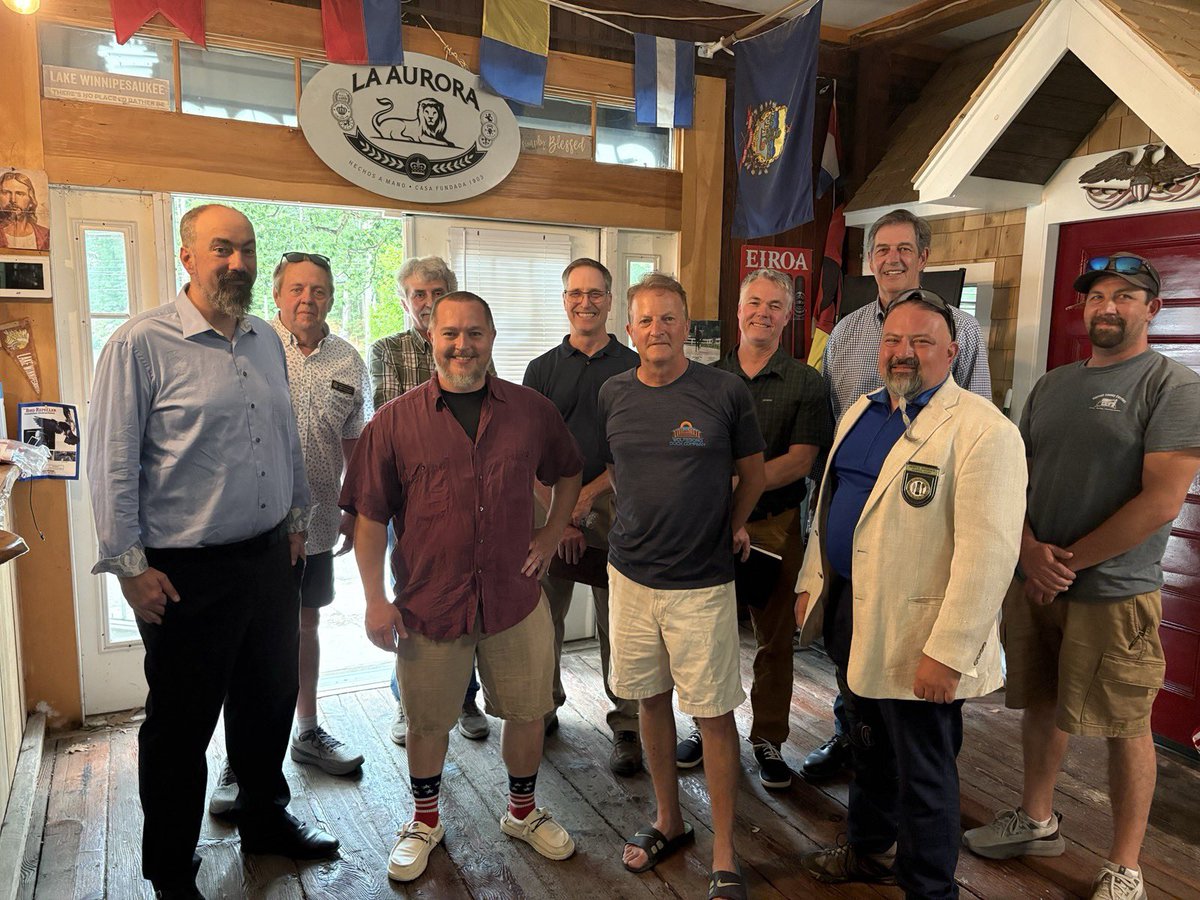
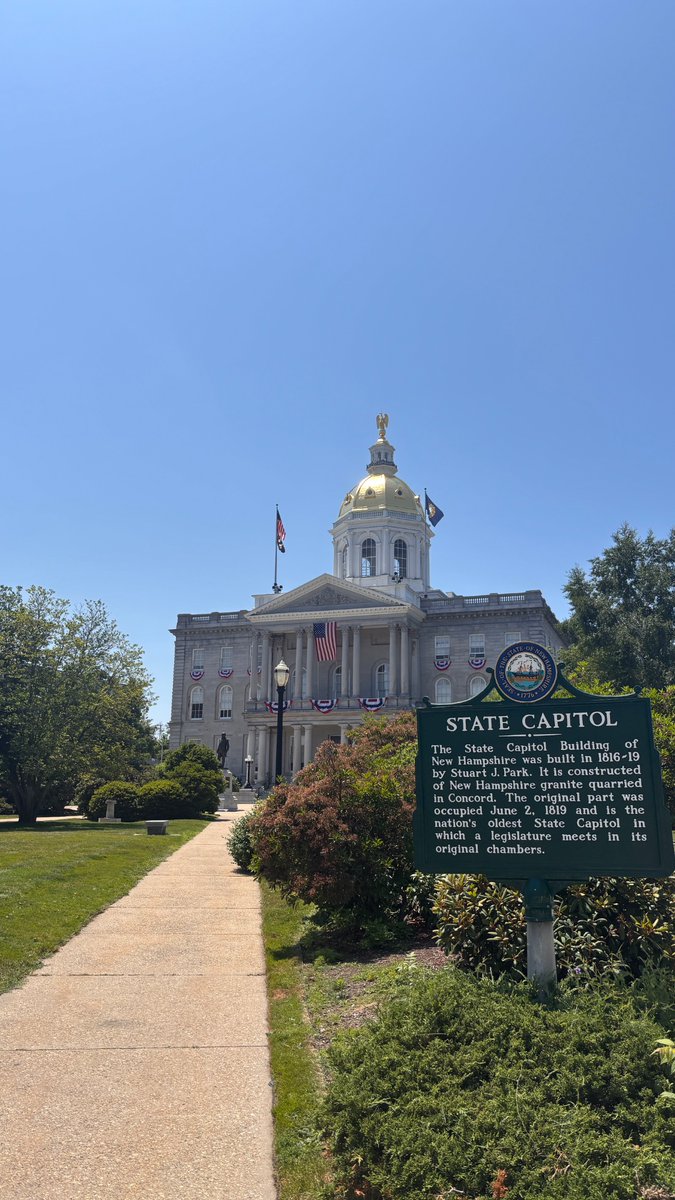
Today NH legislators can begin filing bills for 2027.
If you could repeal ONE New Hampshire law, tax or regulation, what would it be?
I want to hear them.
@nhliberty
Almost everyone is against Flock cameras and the AI surveillance state, right now.
But if we don't abolish them soon, in a few years most people won't care about them anymore.
A generation later, they'll think we'd have total chaos without them.
The time to end them is now.
Charlie St. Clair dedicated his life to serving Laconia and leading Motorcycle Week, riding with a passion that brought people together. I will miss you, my friend.
@Granger4NH Federally subsidized loans are the reason for the college money and expense crisis. If the fed stopped backing predatory loans tomorrow, every college would have to drop its price to become competitive in selling education as a business model again, and not as a novelty.
@Ross_Berry@UofNH Tax dollars advertising subversion of the legal process? This is why I said to defund or privatize the school. It isn’t non partisan, it’s not even pretending to represent all tax payers. This is patently a subversion of the legal process and using tax dollars to be accessory to
@WMUR9 Sincerely wishing the best for him. He’s been amazing to work with on the transportation committee and has offered mentorship from the other side of the aisle in my first term. Passionate biker, good man of his word, and became a friend quickly.
A lot of people are contacting me about Flock cameras.
Yes, I am working with a handful of other Republicans on getting rid of them, but in order to file we need to win re-election. Incumbents can file legislation for 2027 in September, and can vote on it as early as January next year.
On the legislative tour of Nh, when businesses were asked what we can do to help as the state, the prevailing response was to do less. Permitting, licensing, inspecting, long regulatory waits, red tape processes. They are hampering not helping.
Gordon-Darby should fire whatever corporate attorney is advising them to continue trying to force the state back into vehicle inspections. They will not win, and next term I'm introducing the "Gordon-Darby State Sovereignty Act" which will prohibit any future contracts to be awarded to any corporation that attempts to sue the state to force implementation of a law justly repealed.
We were nice, and allowed their contract with the state to expire according to its own terms. New Hampshire simply declined to renew it; the legal issue is not one of breach of contract. Since there was no contractual obligation to renew, the state exercised a right that existed under the agreement.
In that scenario:
The corporation generally cannot claim the state breached a contract that no longer existed.
The corporation likewise cannot ordinarily compel the state to enter into a new contract. Courts are generally reluctant to order "specific performance" requiring a government to execute a future contract, particularly where doing so would interfere with legislative or executive discretion.
The repeal of the underlying statute further reinforces that the state no longer has statutory authority or direction to continue the program as it previously existed.
The legal question then becomes not contract law, but federal preemption.
If Gordon-Darby is arguing that New Hampshire remains obligated under the federal Clean Air Act because its EPA-approved State Implementation Plan (SIP) still contains the inspection program, then the company's theory is effectively:
> The state cannot stop administering the program until federal law permits it to do so.
That is different from saying:
> The state breached its contract with Gordon-Darby.
The contract becomes largely incidental. The real dispute is whether federal environmental law requires continued implementation of the program despite the Legislature's repeal.
From New Hampshire's constitutional perspective, several arguments remain significant:
Legislative sovereignty: The Legislature has the exclusive authority to repeal state statutes.
Separation of powers: A court cannot enact legislation or require the Legislature to reenact a repealed law.
Executive authority: Executive officials cannot create statutory authority that the Legislature has withdrawn.
Federalism: If federal law requires a particular outcome, the remedy is ordinarily directed at compliance with federal law—not forcing a state into a private contractual relationship with a specific vendor.
If the state no longer has a contract with Gordon-Darby and no legal duty to renew one, it would be a remarkable remedy for a court to require New Hampshire to contract with that particular company. Even if a court concluded that the state must continue some form of inspection program under federal law, it does not automatically follow that Gordon-Darby would be entitled to operate that program. The state could potentially have other lawful means of complying, depending on the governing statutes, regulations, and procurement requirements.
The state continues to send record levels of funding to your town.
Democrats in your town continue to raise your property taxes.
Now they want a new statewide homeowner tax and an income tax.
Info: She was a plaintiff on the last lawsuit.
It's not about asthma, she just wants to help Gordon Darby and their foreign investors fleece Granite Staters with a return of the Sticker Scam.
We will kill all attempts to bring it back, but first Republicans have to win the election!
#NEWS: The New Hampshire Department of Safety’s Division of Motor Vehicles (DMV) announces the statewide rollout of the Blue Envelope Program.
https://t.co/AfkoX6Km6i
🚨 Governor Ayotte just signed HB1300, the school district tax cap law. What does this mean for you?
Short version: this November, you get to vote on capping your own school property taxes. Here's the long version.
What happens in November
At the 2026 general election, every town and city ward in New Hampshire will have a tax cap question on the ballot. Automatically. By operation of law. No warrant article, no citizen petition, no asking permission from your select board or school board. You show up to vote for governor and Congress, and the question is just there.
If ballot space runs out, it goes on the back of the ballot or a separate ballot at the same polls. Absentee ballots include it too. Nobody gets skipped.
What a YES vote does
Adoption requires a 3/5 majority of those voting on the question. If it passes in your district, two caps kick in:
📌 The levy cap. Your local school property tax levy can't grow beyond the prior year's amount, adjusted for inflation (CPI, Northeast region) and new construction. Market appreciation and revaluations don't count as growth, so a hot housing market can't be used as an excuse to raise the levy.
📌 The admin cap. SAU central office spending gets capped at 6% of total school district appropriations. That means superintendent services, HR, payroll, legal, PR, and district-level administrators who don't actually teach.
What's NOT capped
Classroom instruction. School-based staff. Special education. Transportation. Food service. Building maintenance. Bonded capital projects (new schools, renovations) are excluded from both caps entirely. This law is aimed at the administrative layer, not at teachers or kids.
Can it be overridden?
Yes. Your district can exceed the cap by the same 3/5 ballot vote that adopted it. The Department of Revenue Administration enforces compliance and won't set a tax rate above the cap without a valid override. Any taxpayer in the district has standing to enforce it in superior court. It has teeth.
Now the fine print, because you should always read the fine print
This is a pilot program, not a permanent fixture. The law only puts the question on the ballot twice: November 2026 and November 2028.
Adopt it this fall and the caps apply starting with FY2028 budgets. Adopt it in 2028 and they apply starting FY2030. And the entire law sunsets on January 1, 2032. Any caps adopted under it expire that day unless the legislature acts to renew them.
So this isn't Concord permanently rewriting your town's budget rules. It's a two-cycle experiment in letting voters answer a question school boards have never wanted to ask: should school taxes grow faster than your paycheck does?
If capped districts thrive and the sky doesn't fall, the case for making it permanent writes itself. If voters say no, that's their call too. Either way, the people paying the bills finally get a direct vote on the size of the bill.
That's RSA 32:5-i. See you in November 🗽