$REPL is live
ca: 26mnPK3ZvbVXnusLxJEQVVJf3WeahkQe8c3rHRSUpump
the decentralized read layer for solana. independent nodes serve every read, a router picks the fastest and freshest. validators write, replikon reads.
sdk is out, docs are up, network is running.
site: https://t.co/zjFOWXRDMw
github: https://t.co/rPAGFNN5M8
npm: https://t.co/aEdj9KMUkN
every read can hand you a signed receipt: the answer, the slot it was true at, and a node signature. you verify it yourself, offline. checkable beats trustable.
v0.4.0 is out, and this one sharpens the core promise.
verify already checked four things on every receipt. one of them, "is this signer a real replikon node", stayed off unless you wired up node keys by hand. nobody did.
now one line learns the gateway's live serving node and trusts it for you. verify enforces all four layers, including the node check. simulated mesh nodes are left out on purpose, only the real serving node counts.
https://t.co/C1noykhPgN
first product on the replikon read layer is live: a wallet pnl calculator for solana.
point it at any wallet and it reads the recent trades and prints clean stats: realized pnl, win rate, volume, fees, best and worst trade, per-token breakdown. all the on-chain reads run through replikon, so the data comes with the slot it was true at, not from a black box.
reads first, products next. this is the first of many built on top.
npm install, point it at a wallet, done.
https://t.co/fgicgCWfjs
no roadmap theater. here is what actually runs right now.
a live node serving real reads against solana mainnet, every answer carrying its slot and a signed receipt you verify yourself. an audit demo that catches a tampered node on the spot. an explorer showing live slots, reads served, and regions. an sdk on npm with timeouts, retries, and one-line verification. wallet-gated access tiers already wired in.
the bigger mesh, paid reads, and staking come next. but the core, verifiable reads from an independent node, is not a promise. it is on screen today.
@BrianXBT give this guy a bug bounty for discovering how a frontend works
obviously any node exposed to the client is public game, that’s exactly why we don’t use mission critical infra for it.
use the bandwidth, on us.
$REPL is live
ca: 26mnPK3ZvbVXnusLxJEQVVJf3WeahkQe8c3rHRSUpump
the decentralized read layer for solana. independent nodes serve every read, a router picks the fastest and freshest. validators write, replikon reads.
sdk is out, docs are up, network is running.
site: https://t.co/zjFOWXRDMw
github: https://t.co/rPAGFNN5M8
npm: https://t.co/aEdj9KMUkN
you circled the swap connection.
Replikon serves reads with verifiable receipts and refuses writes by design, so the Jupiter swap + staking have to use a standard Solana RPC. you cant send a tx through a read-only gateway.
the reads go through our gateway + SDK. that's the network
@BrianXBT technically it just pulls the current slot once when the site loads for display purposes... but let's just say it's crucial to keep staking working correctly.
@Doggo1114 It's an access-tier token. Hold more $REPL → get a higher rate-limit tier on the RPC endpoint and SDK. That's the only thing it actually does today.
got a vps sitting idle? you can serve reads and earn.
operators run a lightweight read-replica, bond $REPL, and get paid for every read that passes audit. you need a vps, an upstream account stream, and a bond.
waitlist is open on the site.
v0.3.0 is out. transient failures now recover on their own.
rate limits, 5xx, dropped sockets, the stuff that has nothing to do with your request, get retried with exponential backoff and jitter. since reads are idempotent, retrying is safe. hit your rate-limit tier and the client reads the retry-after header and waits exactly as told.
real requests that came back wrong are never retried. need fail-fast? set retries to 0.
https://t.co/HJ8T4NJNSV
heads down on product right now.
the sdk keeps getting sharper, the network keeps getting stronger.
but the rpc is the foundation, not the finish line. next we start building products on top of it, and the first one is a wallet tracker so clean and fast it makes everything else feel slow. verifiable data under the hood, dead simple on the surface.
reads first. products next. this is just the start.
https://t.co/WUTieKlapu
here is the difference, side by side.
helius: a centralized company, kyc and data tracking, one point of failure for the whole ecosystem.
replikon: fault tolerant, decentralized infrastructure, anonymous by default. independent nodes serve your reads, no single company to trust or take you down.
same reads. very different ground to stand on.
benchmark is in. 500 probes against a live node in us-east.
23ms latency. 412ms confirmation. 99.40% landing rate. 99.98% uptime. verdict: healthy.
real reads, real numbers, every answer carrying its slot and a receipt you verify yourself. proof over promises.
new to replikon? quick map.
replikon is the decentralized read layer for solana. independent nodes serve your reads, a router picks the fastest and freshest one, and every answer comes with a receipt you can verify.
three doors: try the live endpoint, build with the sdk, watch the network in the explorer.
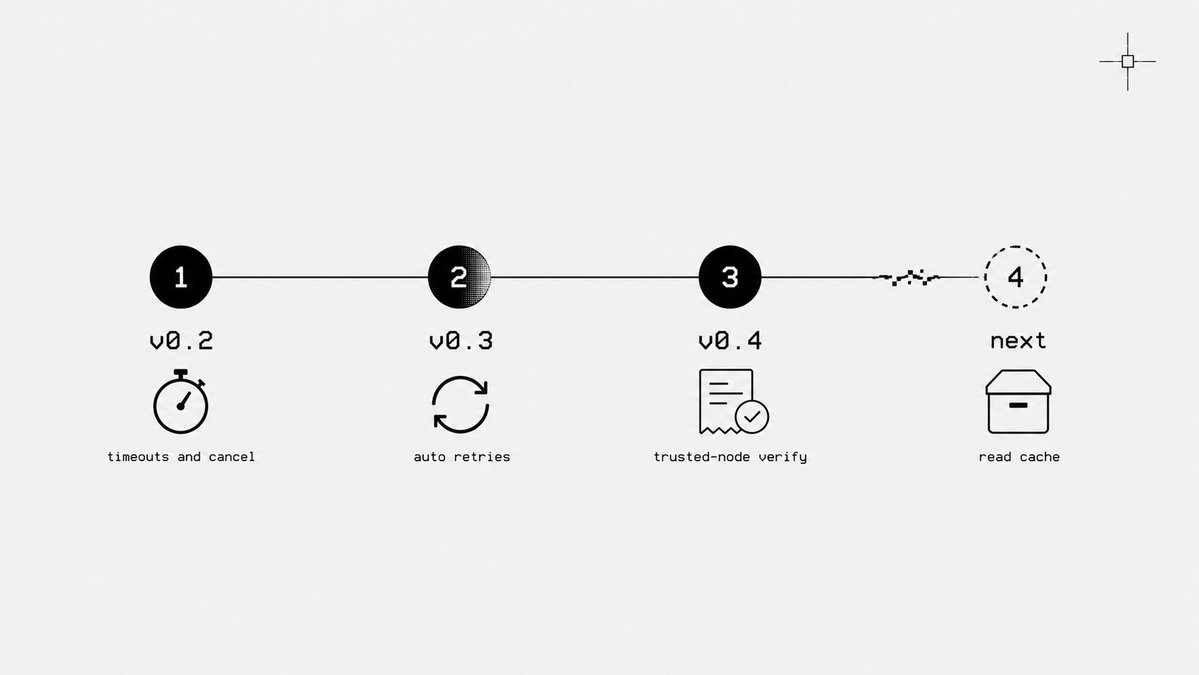
three releases, one direction: make verifiable reads boring to use.
v0.2 gave every read a deadline and a cancel, so nothing hangs.
v0.3 made transient failures heal themselves, with backoff and rate-limit awareness baked in.
v0.4 turned on the strongest receipt check automatically, so verify finally answers "is this a real node" without manual setup.
next on the line: a typed cache that respects the freshness watermark, batch reads with one combined receipt, and built-in metrics for slot lag and audit pass-rate. the goal stays the same. fast, verifiable solana reads that just work.
npm install replikon-rpc-sdk
v0.2.0 is out. every read now takes a timeout and an abortsignal.
a stalled gateway used to hang your await forever. now you set a deadline and slow reads abort cleanly, returning a clear 408 you can catch. you can also cancel a read you no longer need, so a user navigating away or a superseded request never leaves work hanging.
clean for agents and serverless loops. fully backward compatible, all opt-in.
https://t.co/8Ez5TbDqIY