Hello, Research Twitter.
I’m Michael Tomiwa Oyetade, a computer science researcher and software engineer working across machine learning, low-resource NLP, graph neural networks and explainable AI.
I’ll be sharing research insights, practical lessons and open questions. Let’s connect.
Most writing advice tells you what TO do. Prof. Bert Blocken, a journal editor and highly cited engineering researcher, flipped it around and listed the 10 things that will almost guarantee your paper gets rejected.
I find this approach more useful, because many of us learn faster from mistakes than from rules. And as an editor, he sees these mistakes all the time, especially from early career researchers under pressure to publish.
Over the next few posts, I’ll break down each of the 10 mistakes, explain why it matters, and share what you can do instead.
Whether you’re writing your first manuscript, turning a thesis into an article, or helping students publish, save this series. It could save you months of revisions and a painful rejection letter.
#AcademicTwitter #PhDLife #ResearchTips #AcademicWriting
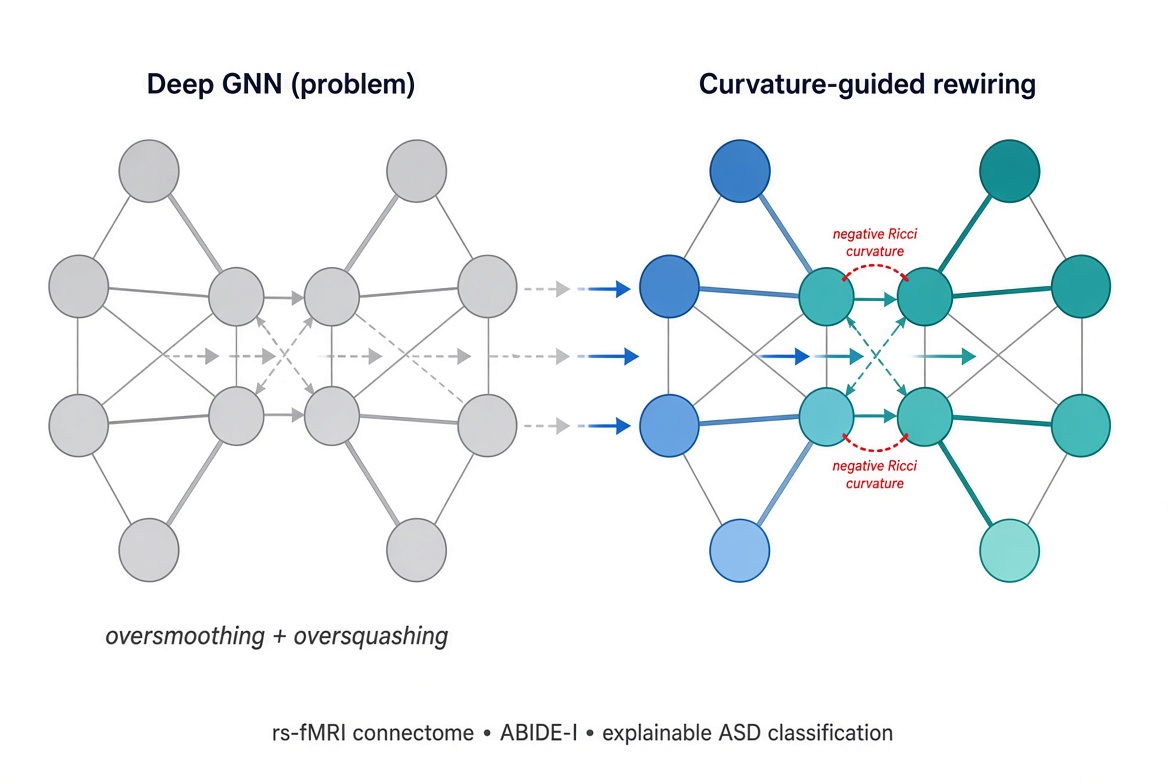
Deep GNNs go blind on brain networks.Stack enough layers and two things happen:
1. every region starts looking the same (oversmoothing)
2. distant signals get crushed in narrow bottlenecks (oversquashing)Geometry tells you where.
Negative Ricci curvature marks the edges that are “stretched thin.”I’m testing curvature-guided rewiring on real rs-fMRI connectomes (ABIDE-I) for autism classification and whether the model can show a clinician why it decided what it did.Accuracy alone is not enough in medicine.Anyone working on GNNs + neuroimaging: what broke first when you went deeper? 👇#GNN #GeometricDeepLearning #XAI #AcademicTwitter
I'm working on my first paper in geometric deep learning, using graph curvature to help Graph Neural Networks (GNNs) read brain connectivity data better and explain what they see.
Here's the idea 👇
GNNs learn by passing messages between connected nodes. Stack many layers and two things break:
• Oversmoothing: every node starts to look the same
• Oversquashing: info from far away gets crushed through narrow "bottlenecks"
Deep GNNs lose signal.
A key insight (Topping et al., ICLR 2022): bottlenecks show up as edges with negative Ricci curvature.
Curvature is a geometry tool that tells you where a graph is "stretched thin." That opened up a whole line of work on curvature-guided rewiring.
Since then: SDRF, FoSR, BORF, and faster Forman-curvature methods have all tried to rewire graphs so information flows better.
But most of them are tested on citation networks and molecule benchmarks, not on real, high-stakes data.
The gap I'm going after:
Brain connectomes from rs-fMRI (ABIDE-I) are graphs too. Can curvature-guided rewiring improve autism (ASD) classification, and can it make the model's decisions more interpretable to clinicians?
Accuracy alone isn't enough in medicine.
Why this matters to me: I care about explainable AI for mission-critical systems, where a wrong or unexplained prediction has real consequences.
Geometry gives us a principled way to ask where information is getting stuck and why the model decided what it did.
Status: experiments running, manuscript in draft. I'll share what works, what fails, and what I learn about publishing along the way.
If you work on GNNs, graph rewiring, or neuroimaging ML, I'd love to connect. 🤝
#GNN #GeometricDeepLearning #AcademicTwitter
🧵 THREAD
1/
Cybersecurity researchers: you do NOT need to pay $2,000+ in APCs to get into Scopus. 🔐
Here are 20+ Scopus-indexed journals where you can publish for FREE, plus bonus venues for AI, networks, IoT and forensics.
Bookmark this. 👇
2/
First, the secret most people miss:
"Hybrid" journals let you choose between two routes:
• Open Access = you pay
• Subscription route = you pay ₦0 / $0 / £0
Pick the subscription route and you're still Scopus-indexed. Same prestige, zero cost.
3/ Core cybersecurity (free route)
🔹 Computers & Security (Elsevier)
🔹 Journal of Information Security and Applications (Elsevier)
🔹 International Journal of Information Security (Springer)
🔹 Journal of Computer Security (IOS Press)
4/ More security venues
🔹 IEEE Transactions on Information Forensics & Security
🔹 IEEE Transactions on Dependable & Secure Computing
🔹 Information Security Journal: A Global Perspective (Taylor & Francis)
🔹 Int. Journal of Critical Infrastructure Protection (Elsevier)
5/ Cryptography & privacy (some fully free Diamond OA 💎)
🔹 Journal of Cryptology (Springer)
🔹 IACR Transactions on Cryptographic Hardware & Embedded Systems (TCHES) 💎
🔹 IACR Transactions on Symmetric Cryptology (ToSC) 💎
🔹 Proceedings on Privacy Enhancing Technologies (PoPETs) 💎
💎 = open access AND no fee. The dream.
6/ Digital forensics & cyber law
🔹 Forensic Science International: Digital Investigation (Elsevier)
🔹 Computer Law & Security Review (Elsevier)
Doing ransomware, incident response, or data protection law? These are your homes.
7/ Security + AI/ML 🤖
🔹 Journal of Machine Learning Research (JMLR) 💎
🔹 Journal of Artificial Intelligence Research (JAIR) 💎
🔹 Expert Systems with Applications (Elsevier)
🔹 Neurocomputing (Elsevier)
Intrusion detection, malware classification, phishing detection? Perfect fit.
8/ Networks, IoT & cloud security 🌐
🔹 Computer Networks (Elsevier)
🔹 Journal of Network and Computer Applications (Elsevier)
🔹 Ad Hoc Networks (Elsevier)
🔹 Internet of Things (Elsevier)
🔹 Future Generation Computer Systems (Elsevier)
🔹 Computer Communications (Elsevier)
9/ Before you submit, do this:
✅ Confirm indexing on Scopus Sources (https://t.co/bW1dG3ACAd)
✅ Check the journal's "Publishing options" page
✅ Select subscription, NOT open access, for hybrids
✅ Avoid "fast publication in 2 weeks" emails 🚩
✅ Cross-check against Beall's-style predatory lists
10/
Great research shouldn't be locked behind a paywall you can't afford to cross.
♻️ Repost to help a researcher in your network
🔖 Bookmark for your next submission
➕ Follow for more free publishing guides
Which journal would you add? 👇
A research question that continues to interest me:
How can we build language technologies for communities whose languages have little labelled data, limited digital resources and several dialectal variations?
Low-resource NLP is not merely a data problem. It is also an inclusion problem.
11.
0-dollar Scopus roadmap:
1. Scopus Sources or publisher matchers → Hybrid / Subscription only
2. Mine “Future work” in recent Q1 papers for real novelty
3. Write a reproducible methods section
4. Select Subscription at submission = $0 APC
Stop letting fees keep finished work in a drafts folder.
If this helped:
• RT the first tweet so another researcher sees it
• Follow for more publishing and research-workflow breakdowns
You don’t need $2,000 to publish in a Scopus-indexed journal.
Thousands of top-tier Q1 and Q2 Scopus journals charge exactly $0 in APCs.
Here’s the exact workflow: find no-fee journals in your field, engineer real novelty, and get accepted without paying a dime 🧵
10.
2. Formatting on submission.
- Download the journal’s official Word/LaTeX template
- Match their reference style exactly (APA, IEEE, Harvard, etc.)
- Cover letter: problem, core finding, why it fits *this* journal’s scope, no COI
3. The money screen: choose Subscription.
In Editorial Manager / ScholarOne you’ll get:
“Do you want Gold Open Access?”
Select: No / Traditional / Subscription.
The system should confirm: traditional model = no APC.
Sign the standard agreement. The paper still goes through normal double-blind review.