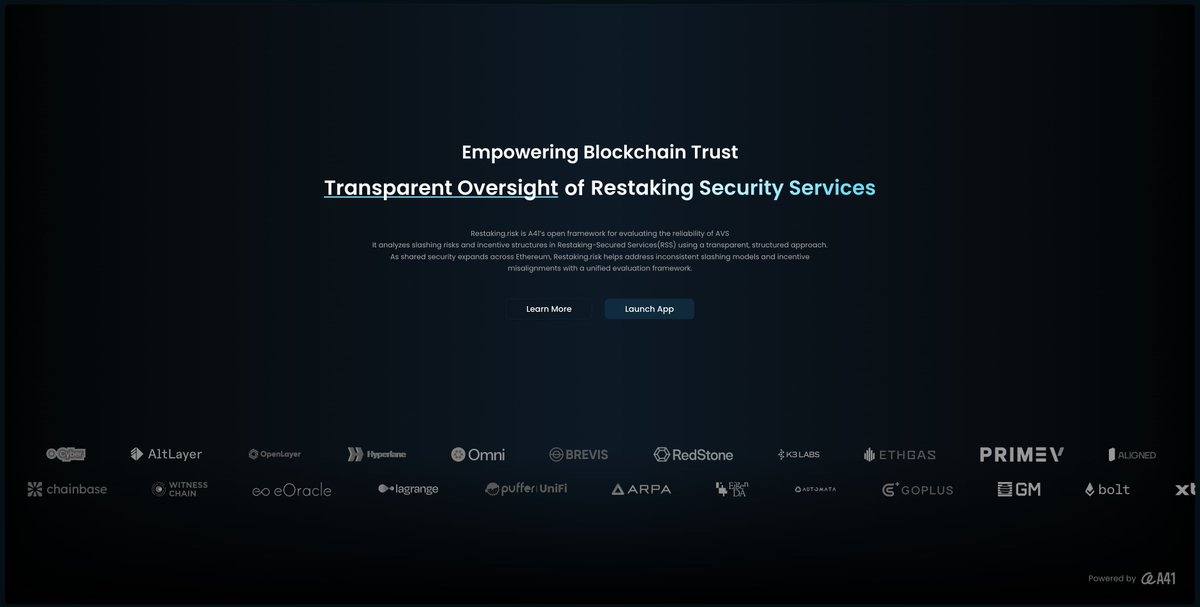
What is Restaking.risk?
https://t.co/cBqlxlagf2
Restaking has ushered in a new era of shared security. But with innovation comes hidden complexity and risk.
We asked ourselves a simple question:
“How secure are AVSs, really?" 👀
Here’s what we’re building to answer that 👇 1/
Restaking.risk evaluates AVSs by analyzing their slashing mechanism design. Each AVS is categorized into one of the following types:
⚙️ Deterministic
: Fully automated, rule-based enforcement.
👋 Challenge-Period
: Fraud detection within a time window; needs external intervention.
👥 Committee-Based
: Heavily relies on human judgment and off-chain governance.
These categories help determine the predictability and trustworthiness of slashing enforcement. 2/
https://t.co/6v4a6nFdyD
AVS evaluation continues with one critical question:
👉 What kind of slashing mechanism is implemented?
The structure of a slashing mechanism defines how reliably and fairly slashing is enforced. Some are fully automatic, while others rely on human judgment.
Restaking.risk classifies AVSs into three types based on their slashing logic:
⚙️ Deterministic
👋 Challenge-Period
👥 Committee-Based
🚨 Surprisingly, as of now, there are no AVSs with fully disclosed and verifiable slashing mechanisms that we can evaluate.
Your AVS type will directly influence its risk rating — and yes, it can be updated anytime.
Got questions? Missing data? Submit a PR.
Let’s make it accurate, together. 👇 1/
Restaking.risk begins by checking whether an AVS has clearly stated slashing and reward policies.
✅ Clear and documented → 🟢 Green (Low Risk)
❌ Missing or unclear → 🔴 Red (High Risk)
❔No information provided→ ⚪ Gray(unavailable)
This information can be updated anytime via a GitHub PR(https://t.co/0QjPSxeJ2C). We continuously reflect these updates in our evaluations.
This ecosystem is built collaboratively — with you. 🙏 2/
AVS evaluation starts with one simple question:
👉 Do slashing and reward policies exist? 🤔
Checking for slashing and reward policies is the starting point of AVS evaluation.If slashing exists, it should be transparent.
If not, that absence is the risk. Restaking.risk assigns a risk signal based on policy visibility. 🔴 Got a red light? Don’t panic — we’re just waiting for your PR. https://t.co/6v4a6nFdyD 👇 1/
Skate is live on @Restaking_risk dashboard.
With the Skate AMM launch, details regarding the reward policy and our adoption of ELIP-002 support coming soon.
🎯The mission is clear:
To build a secure and transparent restaking ecosystem where risk visibility is the norm.
We’re here to minimize risk, and maximize clarity. 🙏 4/
🔗 Learn more → https://t.co/MCgz7HeYnF
Restaking.risk addresses this gap by:
🔹Structuring slashing mechanism designs
🔹Proposing a unified risk classification
🔹Implementing a standardized metadata evaluation pipeline
➡️ Together, these create a quantifiable, comparable risk framework. 3/
🔍 Why Risk Analysis Matters for Restaking-Secured Services (ex. AVS…)?
Restaking extends Ethereum’s security assets to external services — a powerful model for shared security. But with this new model comes new and hidden risks. 👇1/
AVSs built on EigenLayer adopt varied slashing mechanisms:
✅ Most are not standardized
❌ Many are not transparently disclosed
Slashing design impacts AVS reliability, transparency, and staker protection. But today, there is no consistent framework for comparing these risks objectively.🤔 2/
🎉 Officially launched today (April 29)
Our official website is now live. 👉 https://t.co/cBqlxlagf2 We’re just getting started. To build a more transparent and secure restaking ecosystem, we welcome collaboration, feedback, and questions from the community.🙏
Whether you're a staker, investor, protocol operator, or researcher — we'd love to connect and explore how Restaking.risk can support your needs.
Let’s shape the future of restaking, together. 🫂 4/
What is Restaking.risk?
https://t.co/cBqlxlagf2
Restaking has ushered in a new era of shared security. But with innovation comes hidden complexity and risk.
We asked ourselves a simple question:
“How secure are AVSs, really?" 👀
Here’s what we’re building to answer that 👇 1/
💡 Who is it for?
🔹Stakers → to identify and mitigate risks.
🔹Protocol Developers → to assess and improve design.
🔹Infra Providers & Researchers → for structured AVS comparisons. 3/