Everyone posted his 5 day screenshot. Nobody posted the all time tab.
4 famous public wallets. $56.3B traded. Minus $222.1M combined.
Plus the 7 step check I run on every "he made millions" post. https://t.co/eEJ1xGMdE5
A WHALE JUST BET $70.9 MILLION THAT ANTHROPIC, THE COMPANY BEHIND CLAUDE, FLOPS ON NASDAQ. THE STOCK DOESN'T TRADE YET. HE'S ALREADY UP $3.82 MILLION.
Nasdaq opens in under 20 hours.
IPO range: $70 to $78.
Hyperliquid pre-IPO price: $97.99.
His entry: $102.68. Still adding at 19:40 Berlin.
Public on-chain data, not a signal.
IPOs can pop, and his liquidation sits at $144.
Smart fade, or the most expensive IPO short of the year?
Everyone posted his 5 day screenshot. Nobody posted the all time tab.
4 famous public wallets. $56.3B traded. Minus $222.1M combined.
Plus the 7 step check I run on every "he made millions" post. https://t.co/eEJ1xGMdE5
@Cointelegraph The other side of that $1.7T: one Hyperliquid wallet is $70.9M short Anthropic pre-IPO, entry $102.68, up $3.82M. Still adding tonight. Public data, not a signal. Who is right at the open?
@StockMKTNewz The other side of that $1.7T: one Hyperliquid wallet is $70.9M short Anthropic pre-IPO, entry $102.68, up $3.82M. Still adding tonight. Public data, not a signal. Who is right at the open?
@Polymarket Son calls passing on Anthropic a mistake. A Hyperliquid whale thinks the mistake is buying at $97.99 when the IPO range is $70 to $78. $70.9M short, +$3.82M. Public data, not a signal. Who regrets it tomorrow?
@Reuters Wall Street is preparing for a frenzy. One whale is preparing for the opposite: $70.9M short Anthropic on Hyperliquid, liquidation at $144. Public on-chain data, not a signal. Frenzy or fade?
FEAR & GREED IS AT 12 AND BITCOIN IS 49.7% BELOW ITS $126,272 HIGH. THE BIGGEST WALLETS ON HYPERLIQUID ARE 1.97X MORE SHORT THAN LONG.
BTC $63,520 at 17:55 Berlin.
Top 500 accounts:
$463.6M short vs $235.4M long
Shorts up $70.9M, longs down $28.3M
$67.8M of those shorts get liquidated if BTC hits $75K
$73.4M of those longs get liquidated if BTC hits $50K
Past cycles from the top: 2017 fell 84.1%, 2021 fell 77.6%.
A 2021 repeat from $126K would mean about $28,300.
The caveat: three cycles is not a law, and no chart knows a date.
Public data, not a signal.
Whales early, or a crowded short waiting for a squeeze?
Everyone posted his 5 day screenshot. Nobody posted the all time tab.
4 famous public wallets. $56.3B traded. Minus $222.1M combined.
Plus the 7 step check I run on every "he made millions" post. https://t.co/eEJ1xGMdE5
WALLET 0x152E IS UP $20.7 MILLION ON HYPERLIQUID. LAST NIGHT IT WENT $32.6 MILLION LONG WITH FEAR & GREED AT 12.
Between 18:29 and 01:18 Berlin it opened:
$18.0M BTC at $64,698.8, 20x $11.0M
ETH at $1,821, 20x $3.6M
ZEC at $886.69, 10x Around it, the 500 biggest accounts hold $421M in BTC shorts vs $227M in longs.
This wallet has traded $5.9 billion since October 2025.
The caveat: it peaked at +$36.1M in September and has given back $15.3M since.
Public data, not a signal.
Buying the fear, or catching a falling knife with $32.6M?
Everyone posted his 5 day screenshot. Nobody posted the all time tab.
4 famous public wallets. $56.3B traded. Minus $222.1M combined.
Plus the 7 step check I run on every "he made millions" post. https://t.co/eEJ1xGMdE5
A $10K DEPOSIT AND ONE LEAKED API KEY DRAINED $15.5 MILLION FROM ABRAXAS CAPITAL ON LIGHTER.
No smart contract bug. Lighter says its contracts are fine.
The attacker used the stolen key to close the positions, open a 0% fee pool from the victim's own account, buy 99.99% of it with about $10K and pull the USDC out in $1M chunks.
Now the wild part.
The same fund's Hyperliquid wallets show +$530.7M all time. In the last 24 hours they pulled over $160M out.
Caveat: Abraxas hasn't confirmed it. Lighter only says one trader's key leaked.
The API key on your trading bot right now: trade only, or full access?
Everyone posted his 5 day screenshot. Nobody posted the all time tab.
4 famous public wallets. $56.3B traded. Minus $222.1M combined.
Plus the 7 step check I run on every "he made millions" post. https://t.co/eEJ1xGMdE5
Everyone posted his 5 day screenshot. Nobody posted the all time tab.
4 famous public wallets. $56.3B traded. Minus $222.1M combined.
Plus the 7 step check I run on every "he made millions" post. https://t.co/eEJ1xGMdE5
ELON MUSK CAN EARN UP TO ABOUT $1 TRILLION IN TESLA STOCK. ONE OF THE CONDITIONS: 1,000,000 OPTIMUS ROBOTS DELIVERED.
On Nov 6, 2025, Tesla shareholders approved Elon Musk's pay plan worth up to about $1 trillion, after proxy advisers ISS and Glass Lewis told them to vote no.
At that moment, there was no Optimus robot on the market.
In the video below, at the same meeting, Musk says: "I think it's going to be the biggest product of all time, by far. Like, bigger than cell phones, bigger than anything."
Then he promises "a million-unit production line in Fremont" and ends with: "Optimus is kind of like an infinite money glitch."
The plan pays out in 12 tranches over 10 years. For all of it, Tesla's value has to reach $8.5 trillion, up from $1.54 trillion on the day of the vote. Other goals: 20 million vehicles, 1 million robotaxis, 1 million Optimus bots delivered. Musk's stake would grow from about 13% to 25%.
A year later, on Oct 21, 2026, Tesla started Optimus production in Fremont. Musk called it "early production" and said the ramp would be "somewhat bumpy." The same quarter, Tesla's profit fell 43%.
Deliveries to outside companies are likely toward the end of 2027, he said.
The other side: Reuters reported Musk could collect more than $50 billion by hitting only a handful of the more attainable goals.
One side sees a robot that will pay for everything. The other sees a pay plan that can pay out before the robots do.
So should a CEO get paid for the robot he promises, or only for the robot customers can actually buy?
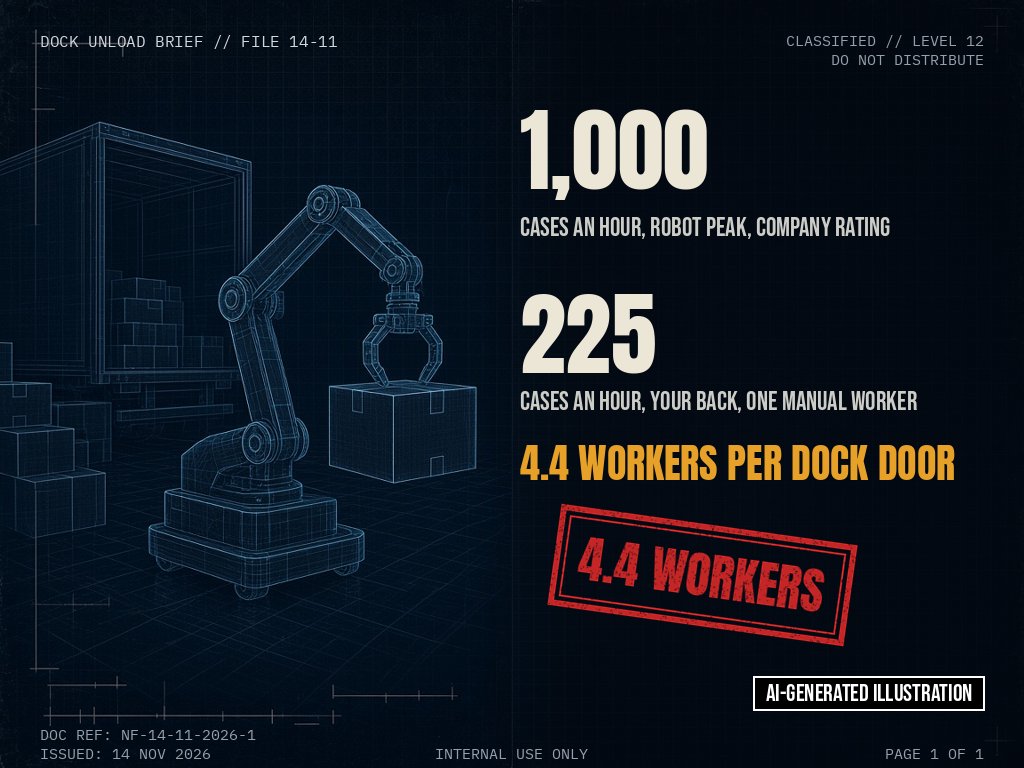
YOUR BACK LIFTS ABOUT 225 BOXES AN HOUR OFF A TRUCK. BOSTON DYNAMICS SAYS ITS NEW ROBOT LIFTS 1,000. AT $19.35 AN HOUR, YOU'RE NOW THE SLOW ONE.
Nov 3: Boston Dynamics launched Stretch Gen 2, its trailer-unloading robot. Company rating: up to 1,000 cases an hour. One battery lasts two shifts.
Manual unload, 2 workers: about 450 cases an hour (Gorbel industry guide) = 225 cases per worker 1,000 / 225 = 4.4 workers per dock door 4.4 x $19.35 (BLS median pay, hand freight movers) = about $85 an hour of human labor Two 8-hour shifts at peak: 16,000 boxes. By hand: 71 worker-hours.
Honest caveat: 1,000 is the company's own peak. It drops with heavy or messy loads. The old Stretch did 500 to 600 in a Lidl trial. No price published, so no payback math yet.
Would YOU rather lift 225 boxes an hour for $19.35, or get paid to watch the robot lift 1,000?
YOU'RE AFRAID A ROBOT WILL TAKE YOUR JOB. FIGURE WILL PAY YOU UP TO $93,600 A YEAR TO BABYSIT ITS ROBOTS ALL NIGHT.
Figure AI, last valued at $39 billion, posted the job: Shift Coordinator, Humanoid Robot Operations (Night). Santa Clara, California.
Hours: 10:30 PM to 7:00 AM. Five nights a week, one on a weekend. Pay: $40 to $45 an hour. Contract-to-hire.
The work: lead the human robot operators, triage robot failures and safety calls, step in and run the robots yourself, lift up to 50 lbs of "humanoid hardware."
40 hours x 52 weeks = 2,080 hours $40 x 2,080 = $83,200 a year $45 x 2,080 = $93,600 a year Median US full-time pay: $1,232 a week x 52 = $64,064 (BLS, Q3 2026) $93,600 / $64,064 = about 1.46x
The company building robots to do human jobs will pay a human up to 46% above the US median to keep them running at 3 AM.
Figure's own website: "humans could leave the loop altogether." The job ad: "You'll be the one making the calls."
Honest caveat: this is one opening, not a hiring wave. It asks for 3+ years as a shift lead, Bay Area rent eats a big part of that pay, and contract-to-hire means full time is a goal, not a promise.
Would YOU take the robot night shift for $45 an hour: yes or no?
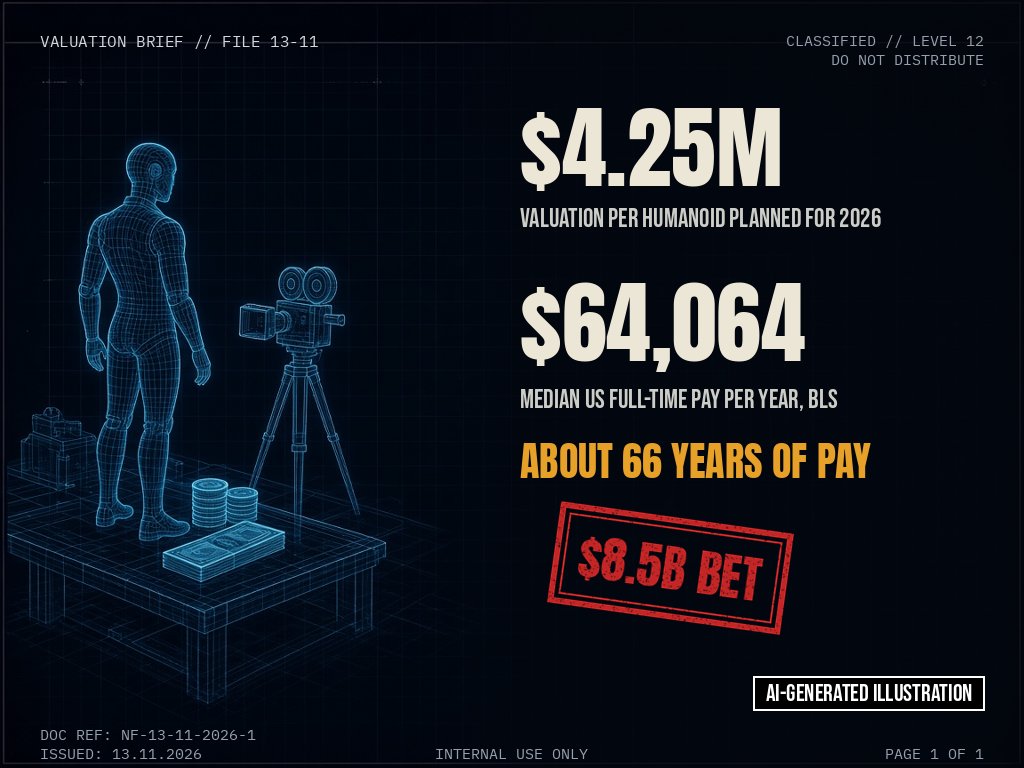
INVESTORS JUST VALUED A ROBOT MAKER AT $4.25 MILLION FOR EVERY HUMANOID IT BUILDS THIS YEAR. THAT'S 66 YEARS OF YOUR PAYCHECK.
Agile Robots, Munich. SoftBank led a $500M round. Nvidia and Hitachi joined. New valuation: $8.5 billion.
Its factory near Munich aims to build about 2,000 humanoids in 2026, per Bloomberg. Capacity: up to 10,000 a year.
How does it train them? By filming workers doing the tasks, its CEO said in October.
$8.5B / 2,000 humanoids = $4.25M per robot Median US full-time pay: $1,232 a week (BLS, Q3 2026) $1,232 x 52 = $64,064 a year $4.25M / $64,064 = about 66 years
A 40-year career is not enough. You would need more than one and a half of them.
Only the new cash? $500M / 2,000 = $250,000 per robot. Still 3.9 years of your pay.
Honest caveat: a valuation is not a price tag. It also pays for 20,000+ robot systems already installed, robot arms, software and companies it bought, plus a bet that output grows 2 to 3x in 2027. Divide by the full 10,000 a year capacity instead and it is $850,000 per robot. Still about 13 years of your pay.
The money is betting on the robot. The footage came from the worker.
Would YOU rather own a piece of the robot, or be the worker it learned from on camera?
YOUR NEXT CAR SALESMAN HAS SILICONE SKIN AND NEVER ASKS FOR COMMISSION. IT COSTS ABOUT $25,000 ONCE. THE HUMAN COSTS $44,680 A YEAR.
On Nov 11, robot maker UBTECH signed a deal with Yongda, a Hong Kong-listed luxury car dealer with 203 outlets in China.
Yongda will buy 400 U1 Pro "ultra-bionic" humanoids. Human-sized. Lifelike faces. Male and female versions.
Their job: product demos, sales promotion and customer service. On the showroom floor.
U1 Pro list price: RMB 169,800, about $25,000 400 robots at list: RMB 67.92M, about $10.1M Median pay of a US car dealership salesperson: $44,680 a year (BLS, May 2025) 400 human salespeople for one year: 400 x $44,680 = $17.87M
$10.1M / $17.87M = 57%
One robot costs less than 7 months of one salesperson's pay. Then it shows up for month 8, month 9, month 30. No commission check. Ever.
BLS counts 225,610 salespeople at US car dealers.
Honest caveat: no contract value was disclosed, so $10.1M is a list-price estimate. These are China showrooms, not US ones. And greeting you is not closing the deal: financing, paperwork and haggling still need a human. Upkeep and software costs are not public.
Would YOU haggle with a robot that never gets tired, or walk out of the showroom?