Installing open source projects is the easy part. Wiring 20 of them together so they actually talk to each other in production without breaking at 2 AM is where platform teams spend 80% of their time. 🛠️
Here are some hard-won lessons on navigating the Kubernetes "integration tax" with tools like Prometheus, Cilium, and Cluster API: https://t.co/ypRLvNiNYe
Do you understand Cassandra DB ?
Cassandra was built for systems where downtime is unacceptable and traffic grows unpredictably across multiple regions. Instead of relying on one powerful server, Cassandra distributes data across many nodes and scales horizontally almost infinitely by simply adding more machines to the cluster.
The core idea behind Cassandra scaling is decentralization. There is no master node controlling the cluster. Every node is equal and capable of handling reads and writes independently. This removes single points of failure and allows the database to continue operating even if multiple nodes crash simultaneously.
Internally, Cassandra uses consistent hashing to distribute data across nodes. Each piece of data is assigned a partition key, and a hash function determines which node should store that data. In the hash ring architecture, nodes are responsible for specific token ranges.
As traffic increases, new nodes can simply join the ring and take ownership of some token ranges. Existing nodes automatically rebalance data to the new node. This is one of the reasons Cassandra scales smoothly without major downtime.
Data is not stored on only one machine. Multiple replicas are maintained across different nodes and even across regions. If one node goes down, another replica can immediately serve requests.
This replication model also improves read scalability because read traffic can be distributed across replicas instead of overloading a single machine.
One interesting thing about Cassandra is tunable consistency. Applications can decide how many replicas must acknowledge reads or writes before an operation is considered successful.
This flexibility allows Cassandra to optimize differently for different workloads.
Scaling writes is where Cassandra becomes extremely powerful. Cassandra is optimized for high write throughput because writes are append-heavy and sequential internally. Incoming writes first go to a commit log for durability and then into an in-memory structure called a memtable. Later, memtables are flushed to immutable SSTables on disk.
Because Cassandra avoids random disk updates frequently, it handles massive write workloads efficiently. This is why companies handling IoT data, messaging systems, logs, analytics streams, and time series workloads often use Cassandra.
But scaling Cassandra also introduces tradeoffs.
One major challenge is eventual consistency. Since replicas synchronize asynchronously in many configurations, different nodes may temporarily return slightly different versions of data. Cassandra prioritizes availability and partition tolerance heavily, especially under network failures.
Data modeling is also very different compared to relational databases. Cassandra queries must usually be designed around access patterns beforehand because joins and complex aggregations are limited.
Compaction is another operational challenge. Since Cassandra stores immutable SSTables, background compaction processes merge files continuously. Poor compaction tuning can create performance problems at large scale.
Despite these tradeoffs, Cassandra remains one of the most powerful databases for horizontally scalable distributed workloads. It was originally developed at Facebook to handle inbox search and messaging workloads where massive scalability and availability were more important than strict transactional consistency.
Happy designing ❤️
🧭Curious how engineering teams are really handling software delivery today:
We’re doing a bit of market research for a project, and I’d love to hear from people working in software delivery, DevOps, or platform engineering.
If you have 3–4 minutes, we’d really appreciate your honest thoughts in this short, anonymous survey.
No sales pitch, no follow-ups just curiosity.
As a small thank you, we’ll share the overall findings with everyone who leaves their email at the end.
Here’s the link:
https://t.co/XDLt67KKGg
Thanks so much your input genuinely helps.
🧭Curious how engineering teams are really handling software delivery today:
We’re doing a bit of market research for a project, and I’d love to hear from people working in software delivery, DevOps, or platform engineering.
If you have 3–4 minutes, we’d really appreciate your honest thoughts in this short, anonymous survey.
No sales pitch, no follow-ups just curiosity.
As a small thank you, we’ll share the overall findings with everyone who leaves their email at the end.
Here’s the link:
https://t.co/XDLt67KKGg
Thanks so much your input genuinely helps.
🧭Curious how engineering teams are really handling software delivery today:
We’re doing a bit of market research for a project, and I’d love to hear from people working in software delivery, DevOps, or platform engineering.
If you have 3–4 minutes, we’d really appreciate your honest thoughts in this short, anonymous survey.
No sales pitch, no follow-ups just curiosity.
As a small thank you, we’ll share the overall findings with everyone who leaves their email at the end.
Here’s the link:
https://t.co/XDLt67KKGg
Thanks so much your input genuinely helps.
🧭Curious how engineering teams are really handling software delivery today:
We’re doing a bit of market research for a project, and I’d love to hear from people working in software delivery, DevOps, or platform engineering.
If you have 3–4 minutes, we’d really appreciate your honest thoughts in this short, anonymous survey.
No sales pitch, no follow-ups just curiosity.
As a small thank you, we’ll share the overall findings with everyone who leaves their email at the end.
Here’s the link:
https://t.co/XDLt67KKGg
Thanks so much your input genuinely helps.
🧭Curious how engineering teams are really handling software delivery today:
We’re doing a bit of market research for a project, and I’d love to hear from people working in software delivery, DevOps, or platform engineering.
If you have 3–4 minutes, we’d really appreciate your honest thoughts in this short, anonymous survey.
No sales pitch, no follow-ups just curiosity.
As a small thank you, we’ll share the overall findings with everyone who leaves their email at the end.
Here’s the link:
https://t.co/XDLt67KKGg
Thanks so much your input genuinely helps.
🧭Curious how engineering teams are really handling software delivery today:
We’re doing a bit of market research for a project, and I’d love to hear from people working in software delivery, DevOps, or platform engineering.
If you have 3–4 minutes, we’d really appreciate your honest thoughts in this short, anonymous survey.
No sales pitch, no follow-ups just curiosity.
As a small thank you, we’ll share the overall findings with everyone who leaves their email at the end.
Here’s the link:
https://t.co/XDLt67KKGg
Thanks so much your input genuinely helps.
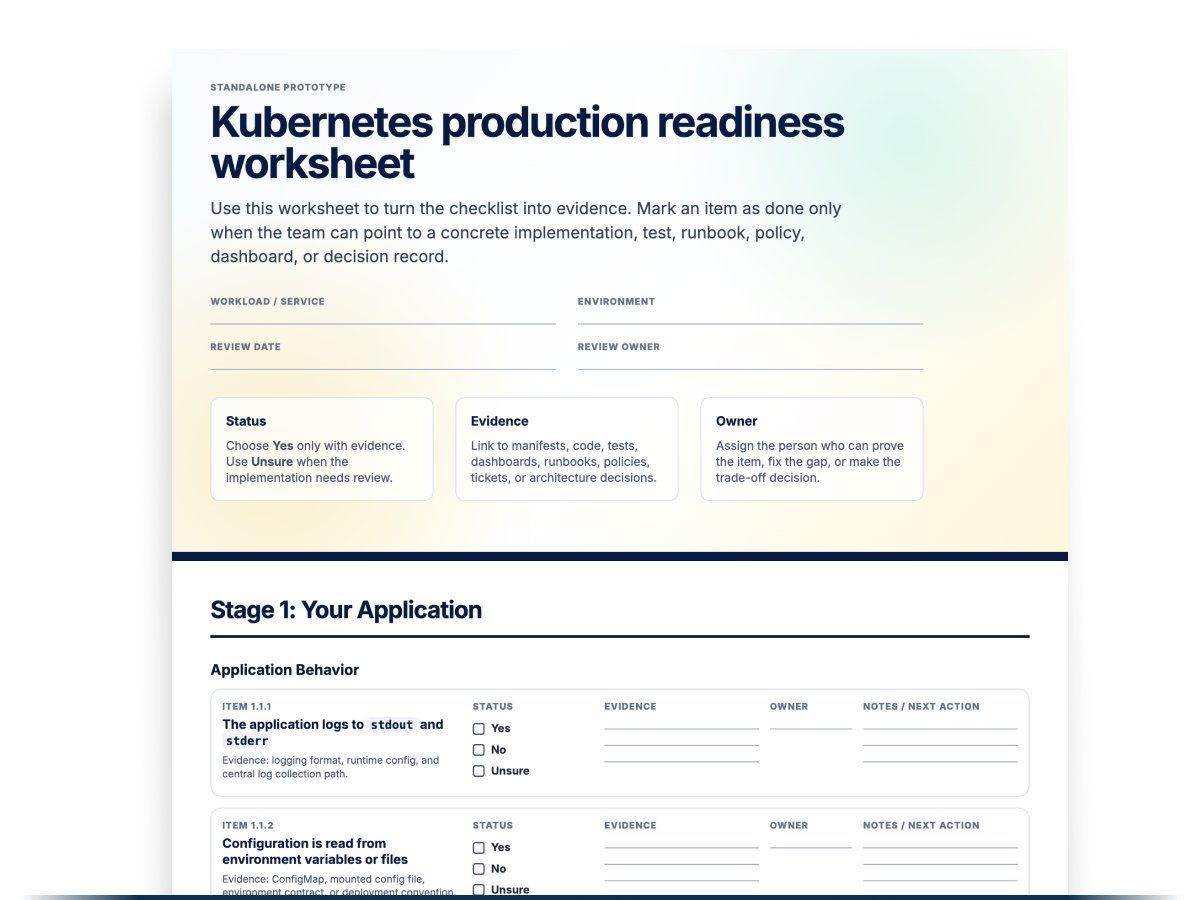
Most Kubernetes production failures are contract failures between the app and Kubernetes.
Gulcan and I made an interactive readiness checklist and PDF worksheet for the app behavior that Kubernetes will test before go-live.
https://t.co/uAuv5Vcu53
How Elastic Search Actually work ?
Elasticsearch feels like a very fast database for searching text. But internally, it works very differently from traditional databases. Instead of scanning rows one by one like SQL systems often do, Elasticsearch builds highly optimized search indexes that allow it to find matching documents almost instantly, even among billions of records.
The core idea behind Elasticsearch is the inverted index. In a normal database, data is stored document by document. But Elasticsearch flips this structure. Instead of storing “document → words,” it stores “word → documents.” This is why it is called an inverted index.
For example, imagine three documents:
“Distributed systems are hard
System design is important
Distributed databases scale horizontal
Elasticsearch breaks sentences into tokens (words), processes them, and creates an index like:
distributed → doc1, doc3
system → doc2
systems → doc1
databases → doc3
Now when a user searches for “distributed,” Elasticsearch directly jumps to the matching documents instead of scanning every record. This is what makes searches extremely fast.
The process starts with indexing. When data enters Elasticsearch, it first goes through analyzers. These analyzers tokenize text, remove stop words, normalize casing, and sometimes apply stemming. For example, “Running,” “runs,” and “run” may all become “run.” This preprocessing improves search quality.
Once analyzed, the document is stored inside an index. An index in Elasticsearch is similar to a database in SQL terminology. But internally, indexes are split into shards. Shards are smaller partitions of data distributed across multiple nodes in a cluster. This is how Elasticsearch scales horizontally.
Suppose an index contains 1 billion documents. Instead of storing everything on one machine, Elasticsearch divides the index into shards and spreads them across servers. Queries are executed in parallel on multiple shards, making searches much faster. Replicas are also created for fault tolerance. If one node goes down, another replica shard can continue serving requests.
The search flow itself is interesting. When a query arrives, Elasticsearch sends the query to relevant shards. Each shard independently computes the best matches and returns results. Then Elasticsearch combines these partial results, ranks them using relevance scoring algorithms like TF-IDF or BM25, and returns the final ordered response.
This relevance scoring is why Elasticsearch is powerful for full-text search. It does not just check if a word exists and it calculates how important that word is inside the document relative to all other documents. A document containing the searched term multiple times may rank higher than others.
But Elasticsearch is not meant to replace primary databases entirely. It is optimized for search and analytics, not for strict ACID transactions. This is why many systems use it alongside relational databases. Data is stored in the main database and then synchronized into Elasticsearch for fast querying.
Happy designing ❤️
Iranians urgently need help.
We understand that enabling domain fronting in @Cloudflare may introduce security and operational risks for your services. However, allowing a limited set of verified domains could make a huge difference for people in Iran. We are also open to paying for our usage if needed.
currently only few SNI of TLS connection of websites hosted in @Google , @awscloud , and @Cloudflare are opened. By using domain fronting it will provide Internet for Iranians.
In Iran, access to just 100 GB of internet can cost nearly the equivalent of a full month’s salary for many workers in Iran.
Your support could help millions of people maintain access to information and communication.
We sincerely ask you to consider this request.
@realDonaldTrump@JDVance@VP@POTUS@FoxNews@BBC