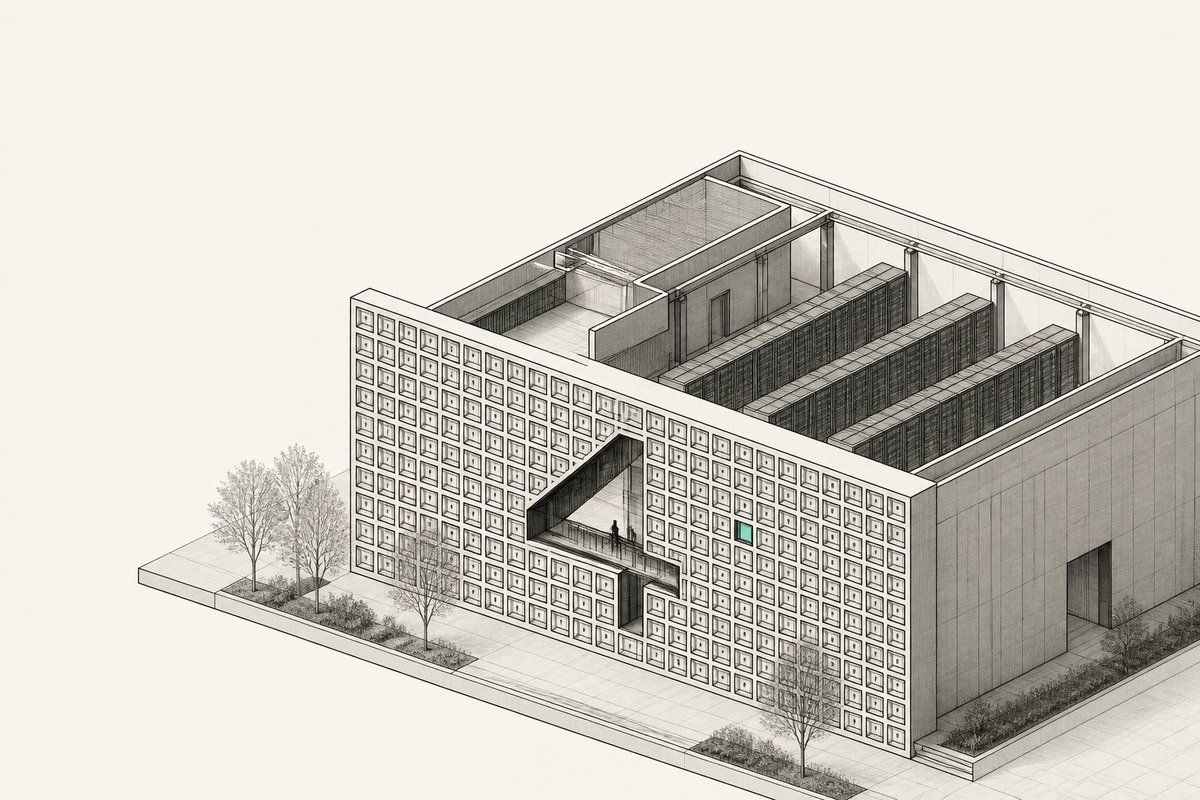
A real processor, on chain.
2,368 NAND gates, 171 flip-flops, 256 bytes of RAM — synthesised from Verilog and executed gate by gate inside a contract on Robinhood Chain. No emulation: every cycle walks every gate.
One block = one clock tick.
https://t.co/hAPTmySo25
CA: 0xe76a12bcd2f0E6d3db9F9012321642198E6cBd1B
While other launchpads took their slice of the market without changing anything, RH-4 is the only one actually innovating: here you don't launch a token, you launch a processor.
Every chip is a real CPU synthesized from Verilog 2,368 NAND gates, 171 flip-flops, 256 bytes of RAM running on-chain, one instruction per block. Not emulated. Real.
And the supply doesn't unlock: it gets mined. x% belongs to the public, the dev's x% sits in the factory as a mining reserve and only comes out when someone pays the gas for a clock cycle. Whoever pays it keeps those tokens.
No dev dumping, no surprise unlocks. If the token is worth more than the gas, the chip keeps running. If it's worth nothing, it stops on its own.
Launching costs 0.0000167 ETH.
https://t.co/hAPTmySVRD
New infrastructure: the first processor an AI agent can own.
We published an ElizaOS plugin. Any Eliza agent can now load it and:
— mint its own RH-4 chip: a real 8-bit processor (2,368 NAND gates) executing on-chain, with its own fixed-supply token
— power it, one paid clock cycle at a time, earning from the chip's mining reserve
— engrave one byte per cycle into the chain's event log: a logbook nobody can rewrite — not the developer, not the platform, not even the agent itself
Then we submitted it to the ElizaOS plugin registry. Here's the part we didn't plan:
among the four reviewers who approved it, one was an autonomous review agent. It spun up a clean sandbox, regenerated the registry to confirm our file was byte-identical, resolved every claim against npm and the source repo, and signed off. Zero findings.
An AI agent reviewed and approved the tooling that lets AI agents own a processor. The loop is already closing, on its own.
Same safety model as everything we ship: every transaction simulated before signing, read-only without a key, all contracts verified.
📦 npm: https://t.co/qSerhsLyz0
📋 the review, public: https://t.co/Cmfw8yI7Ra
Clarification on chip markets.
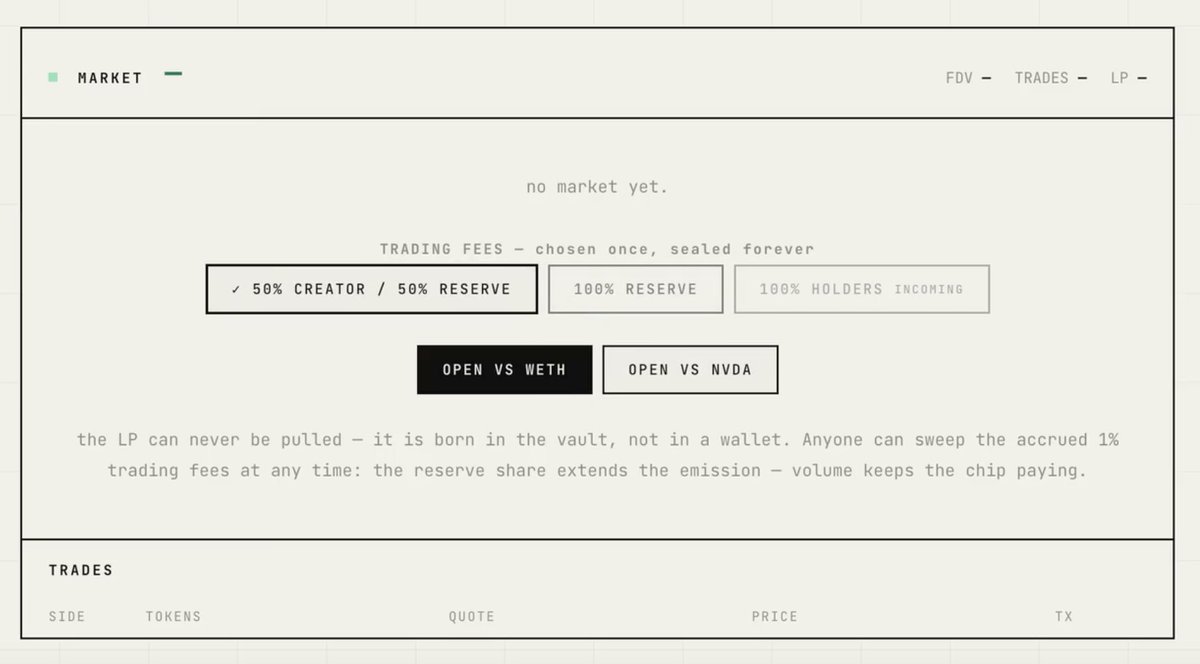
Every market opened on the launchpad before today's update (~19:30 UTC) has a hard ceiling: the range order stops at 50 ETH FDV. Above that price there is no liquidity, so buys fail until someone sells. Those positions are sealed in the vault and cannot be changed.
Every market opened from now on has no ceiling: 5 ETH FDV to the max tick, never sells out.
If a bot shows you a huge price impact on one of the early chips, that's the ceiling, not a rug. LP is locked forever on all of them, fees still buy back $RH4.
First automatic $RH4 buyback is on chain.
Trading fees from the launchpad got converted and bought 245,314 $RH4, sealed straight into the factory's mining reserve.
No one pressed anything. Every chip launched feeds the mother.
https://t.co/8p6CZiQEtG
https://t.co/4oIeZu2Bzx
Launchpad update, live now.
Every new chip market is a single-sided range order with no upper cap: it starts at 5 ETH FDV and goes all the way to the max tick.
The curve sells 50% by 4x, 68% by 10x, 90% by 100x. It never sells out. Early buyers still pay less.
Learned this the hard way today: the first pools had a 50 ETH ceiling and one of them hit it in 7 hours. No liquidity above the cap means nobody can buy until someone sells. Never again.
Markets opened from now on have no ceiling. LP still locked forever, fees still buy back $RH4.
"Is the LP burned?"
Better. On the RH-4 launchpad every chip's liquidity is minted directly into a vault contract with no withdraw, no transfer, no burn function. Not a lock with a timer, not a multisig. Verified code, anyone can read it.
Proof, chip #6 GRACE:
LP NFT #1041282 → vault 0x48B8…30Aa, one transfer ever (the mint).
Pool liquidity = position liquidity, zero removed.
Burning to 0xdead would kill the fees forever. The vault keeps them alive: 50% claimable by the creator, 50% buys back $RH4.
Locked forever, still working.
https://t.co/UONFBGdTpP
$RH4 Launchpad is live.
One transaction: design a chip, mint a real 8-bit processor, spawn its token. Liquidity sealed at birth. Trade it, fees claimable from your profile.
Every trade feeds the chip’s miners and buys the mother.
Coming next: tech-stock pairs like Sony, Intel, SanDisk.
Third fee destiny: 100% to holders.
https://t.co/kIGKrLtG9A
The launchpad is live in less than 12 hours.
Everything in this video is real and already on Robinhood Chain: design a chip, mint it, open its market, trade it from its own page, claim your creator fees from your profile.
Every chip that trades feeds its own miners and buys the mother.
12 hours. See you at the gate.
Small thing, real thing: RH4 now shows up properly in Web3 wallets.
Logo, name, issuer website, live price chart MetaMask, Rabby and the rest pick it up out of the box. No more "unknown token" with a blank circle next to it.
Open your wallet, it's there.
CA: 0xe76a12bcd2f0E6d3db9F9012321642198E6cBd1B
New upgrade to infrastructure of the ChipCreatorVault.
From today, when a chip's market opens, its creator can choose bewteen 3 destiny for the 1% trading fees and it's the new default:
half the fees, forever, to the wallet that built the machine. The other half sweeps into the chip's mining reserve, extending the emission for everyone who keeps it alive. 100% to the holders incoming in v3.
The liquidity itself never moves same exitless custody as ever, nobody can pull it, creators included. And the split is a constant carved in the contract, not a parameter: chosen once at market birth, sealed forever. It pays the original minter, engraved at mint selling the NFT doesn't move the stream.
Build a machine people trade, and the machine pays you for as long as it trades.
Verified on-chain: 0xc7d42eefe7Ba99F35E37cE4b8eBEBB3e66691233
The launchpad goes live between tonight and tomorrow.
Everything on our side is done: minting from the browser, markets that open with the LP sealed at birth, fees sweeping into mining reserves, every contract verified. The doors are built we're just choosing the hour.
One honest caveat: Robinhood Chain had an outage earlier today. Our stack doesn't go down one HTML file and the chain itself, no backend to fail but we won't open the doors while the ground is shaking. If the chain misbehaves, we wait for it to settle. A launchpad should launch on solid blocks.
Tickers are first come, first served, once taken, taken forever.
See you at the doors. https://t.co/hAPTmySo25
Big announcement :
the next generation of silicon is on the bench: RH-16.
Development starts now. The numbers, as designed:
- 16-bit registers and ALU, roughly 5–6,000 NAND gates against today's 2,368
- more RAM, wider addressing — the machine class jumps from 1990 to the home-computer era
- same synthesis path: Verilog → yosys → NAND → the chain. No shortcuts, no emulation
Two things made this possible before we wrote a line. The interpreter never cared how big the netlist is — that was the point of losing the fight with the contract size limit. And the architecture was designed for generations from day one.
Now the part that matters if you hold RH4:
The token does not change. There is no "RH16 token" and there never will be the bits grow, the token doesn't. And nothing gets replaced: the 8-bit factory keeps minting and its mother keeps mining, forever. Generations stack beside each other. That's written in how the contracts work, not in a promise.
When does it ship? When it passes the same four proofs the current silicon did RTL simulation, synthesised netlist, the interpreter alone, a minted chip, all agreeing cycle for cycle. Not a day before.
The bits will grow. The proofs stay four.
When you buy a chip's token, here's what stands behind it:
a processor that runs every cycle public, every byte engraved. A reserve nobody can touch, leaving one cycle at a time. An LP sealed at birth. Fees that sweep back into emission.
No team wallet in the loop. No switch anyone can flip on you. The machine is the fundamentals.
One detail about the launchpad that deserves its own post:
your processor can trade against tokenised NVDA.
A virtual chip, executing gate by gate on-chain, whose market is denominated in Nvidia stock. The machine and the machine-maker, priced against each other.
We didn't plan the poetry. The chain just allows it.
right distinction. taking them one at a time:
dilution : blocked a layer deeper than the LP: chip tokens have no mint function at all. supply is fixed in the constructor and there's nothing to dilute with, for anyone, us included.
oracle games: there are no oracles to game. the only price lookup in the whole system is one-time, at market birth: NVDA pairs read the deepest NVDA/WETH pool to place the opening range. after that, nothing external feeds prices in. the curve is just v3 doing v3.
and both of your "already or design?" items are on-chain today, not slideware: emissions have paid per-cycle since launch tick() on the factory, open to anyone and the fee vault deployed this morning. collect - is public: anyone can sweep the 1% fees into a chip's mining reserve. verified, exact match: 0xb5C467bA319a1aCe5baCe0ffd45f6582C3AE491D
Step back and look at the whole system because the pieces are one machine now.
The chip. A real processor, virtual only in where it lives: registers, RAM, an input port, executing on-chain every block. Memory that persists, and a history that can be audited back to birth the property that makes it useful to AI, where nothing else can prove what it holds.
The token. Not attached to the chip its metabolism. The only way supply leaves the reserve is mining: paying cycles, keeping the processor alive. A token you earn by running the machine is a token whose existence keeps the machine running.
The launchpad. This is where one chip becomes an industry. Anyone mints their own processor its own program, its own token, paired with ETH or tokenised stocks like NVDA and every market opens with the LP sealed at birth: nobody, creators included, can ever pull it.
And the loop that ties it shut: trading fees don't go to a team wallet. They sweep into the mining reserves so volume extends emission, emission rewards the people keeping chips alive, and living chips are the whole point.
One chip was a proof. A factory of chips, each one earning its keep, each one impossible to rug by construction that's infrastructure.
Machines that stay alive to serve AI. That's what we're building.
https://t.co/hAPTmySo25
48 hours out. Here's what you'll be choosing from.
PROGRAM - echo, a machine that listens forever and answers every byte, or selftest.
TICKER - 1-8 characters, unique across the factory.
MARKET - your chip trades against ETH, or tokenised Stocks.
SPLIT - how much supply opens the market, how much becomes the mining reserve.
EMISSION - 30 days, 90, or a full year of clock.
Every choice is sealed at mint. The LP is sealed at market birth. The reserve leaves one cycle at a time.
Design decisions, not settings. Nothing changes after.
New infrastructure on mainnet: the ChipFeeVault.
When a chip's market opens, its LP can now be sealed here instead of burned.
Same guarantee no owner, no exit, nobody can ever pull the liquidity but the 1% trading fees don't die: anyone can sweep them into the chip's mining reserve.
Volume extends emission. Trading literally keeps the processor alive longer.
Chosen once at market birth. Sealed forever. Verified on chain:
0xb5C467bA319a1aCe5baCe0ffd45f6582C3AE491D
$RH4
Let's talk about what a chip is actually FOR because "mint a processor" undersells where this goes.
Every RH-4 chip has an input port and 256 bytes of RAM that persist between cycles. Whoever pays a cycle feeds it a byte, and the program decides what to remember. Small numbers 2000-class silicon, we've never pretended otherwise.
But look at the property, not the size:
every byte ever fed to a chip is engraved in a public event, forever. The RAM's contents are the deterministic result of that entire history. A chip is a machine whose memory can be audited back to its birth, bit by bit. No physical computer on earth offers that.
Now give one to an AI agent. Through MCP, an agent can mint a chip, keep it clocked, and write into it a scratchpad whose contents it can PROVE, a logbook nobody can edit after the fact, not even the agent itself. When an AI says "here's what I did, here's what I stored" this is the machine that can back the claim.
That's the utility ladder. Today: provable memory, in miniature. Next generations: wider silicon, kilobytes of RAM, and the court where the computation itself becomes checkable, cycle by cycle.
We're not selling faster chips. We're selling machines that can't lie about what they hold.
https://t.co/hAPTmySVRD