Congratulations to Dr Abi Peake for successfully defending her thesis titled ‘Off-Axis and Model-Independent: Near-to-Far Neutrino Interaction Extrapolation with DUNE-PRISM’.
Wishing you all the best! 😊
Interested in a Physics or Astronomy PhD? 🔭
Join our online PhD Open Event - Wed 2 Dec 2026. Meet staff, explore research areas & ask about applications.
📩 [email protected]#PhD#Physics#Astronomy#RHUL
Congratulations to Dr Asim Aslam for successfully defending his thesis titled ‘Time Integrated and Dependent Charge Parity Violation Measurements in Bottom Quark Hadron Decays from tt ̅ Events using the ATLAS Detector at the Large Hadron Collider’.
Wishing you all the best! 😊
Our students used clear skies to capture the Sun sweeping through a telescope, so they can study solar limb darkening: why the Sun’s centre looks brighter than its edges.
Can you spot the sunspots?
Congratulations to Prof. Véronique Boisvert who has been awarded a prestigious ATLAS Outstanding Achievement Award at CERN in Geneva!
More information can be found here: https://t.co/BKiAgnVuKX and here: https://t.co/8yqlqr7HoJ.
Congratulations to Dr Rosie Hasan for successfully defending her thesis titled ‘Tracks to New Physics: Search for Quantum Black Holes in the Lepton+Jet Channel and Phase-II Tracking with ATLAS’.
Wishing you all the best! 😊
Thank you once again to @baader_astro for the fabulous kit.
And thank you to 7th Heaven Egham Bakery for a delicious Telescope Birthday Cake that disappeared way too quickly.
Our telescope has just turned 1!!! 🎉
Over this past year it has been an absolute delight to work with this brilliant piece of equipment - our students love it.
Let us hope that the terrible 2's don't apply to telescopes though. 😂
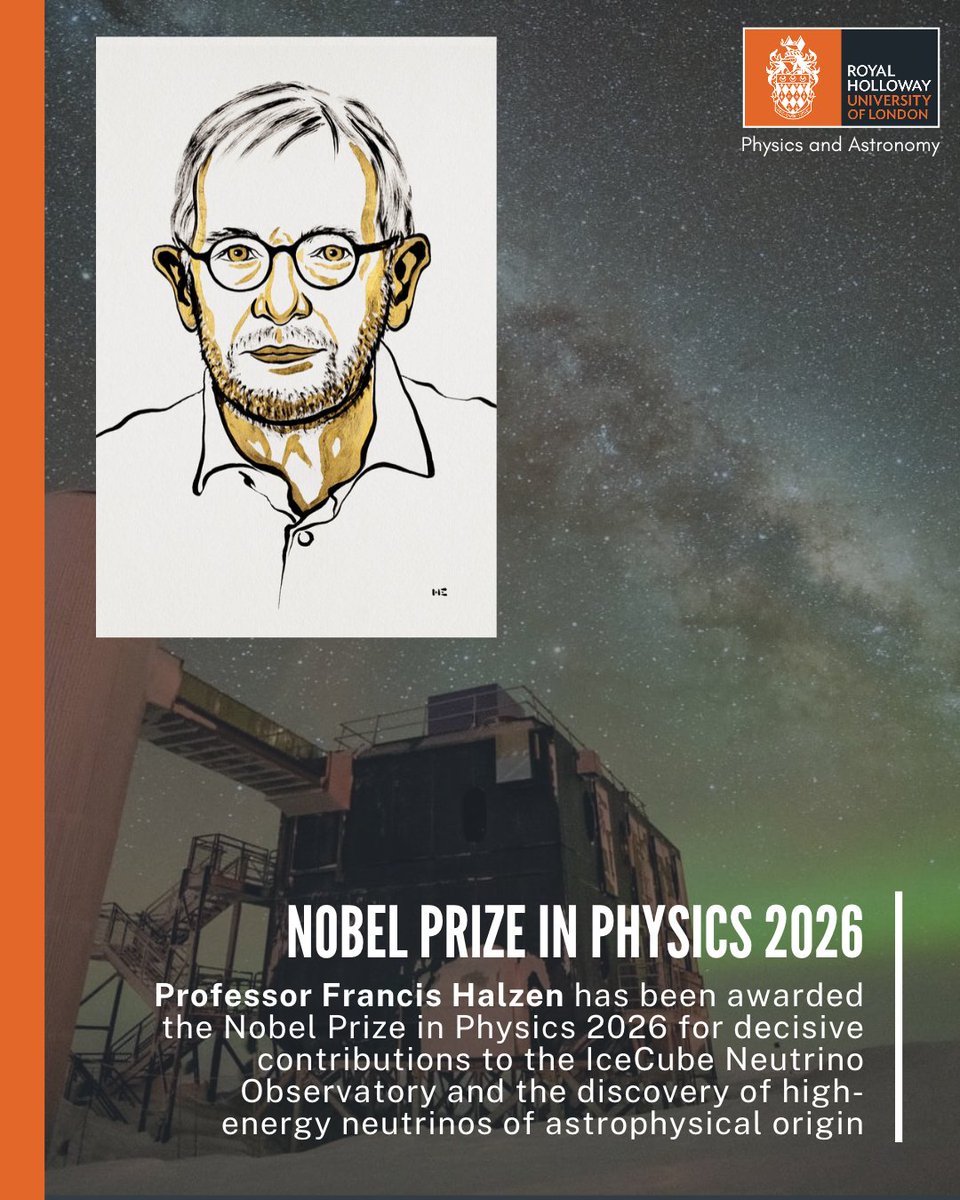
IceCube, located in the South Pole, is the first gigaton neutrino detector ever built and was primarily designed to observe neutrinos from the most violent astrophysical sources in our universe.
Congratulations to Professor Francis Halzen and to the IceCube collaboration!
The Nobel Prize in Physics 2026 has just been announced!
This year, Professor Francis Halzen has been awarded the Nobel Prize in Physics 2026 "for decisive contributions to the IceCube Neutrino Observatory and the discovery of high-energy neutrinos of astrophysical origin".
World Space Week is being celebrated from 4th to 10th October 2026 to recognise the contributions of space science and technology to the betterment of human life.
This year, why not see what space-related events are happening near you?
The 16th High-Luminosity LHC Collaboration Meeting is currently taking place at Royal Holloway, bringing almost 200 experts in accelerator physics and advanced engineering to our lovely campus!
The conference has already given updates from CERN and many of HL LHC's international collaborators: the US Accelerator Upgrade Programme, KEK, INFN, CIEMAT, the Institute of High Energy Physics (IHEP), TRIUMF, and STFC.
Scientists working on the LUX-ZEPLIN (LZ) experiment in South Dakota have detected a single particle interaction that’s difficult to explain with known background sources. It could potentially be the signature of a WIMP, which is a leading dark matter candidate.
The result is LZ’s most intriguing hint yet, and especially exciting for Physics & Astronomy at Royal Holloway. Our Neutrino and Dark Matter group is directly involved in the LZ experiment by contributing to accidental background characterisation and statistics.
Did you get to see the fabulous Solar Eclipse yesterday?
Sadly, it was not possible to see it from our beautiful campus, as the treeline obscured the view.
Instead, two of our lab technicians captured the eclipse from their own gardens at home, with a telescope (First video, positioned on a very old tripod!) and a camera (Second video).