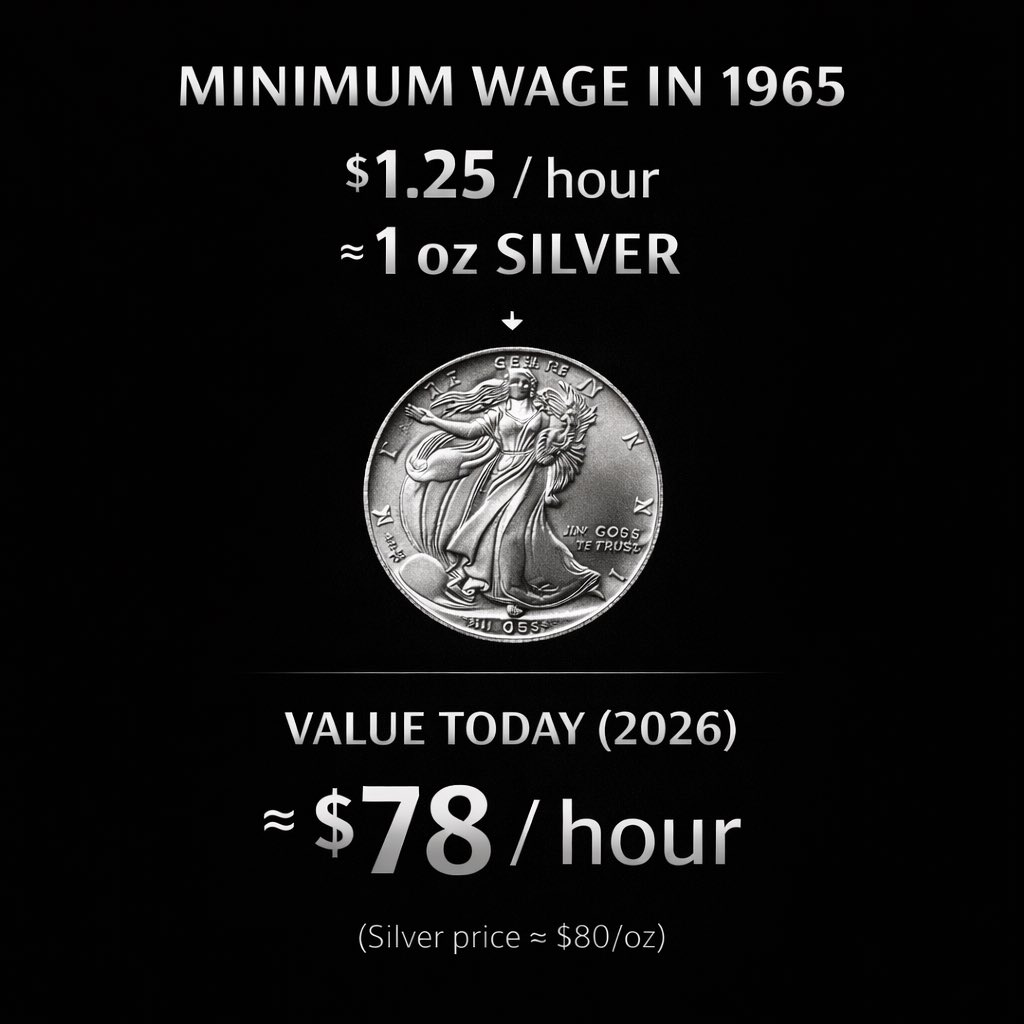
Short-term price movements often tell us more about currency markets than they do about the intrinsic value of precious metals.
As explained in this discussion, silver's recent decline is largely a function of a stronger U.S. dollar rather than a sudden deterioration in the metal's long-term fundamentals. Because silver is priced in U.S. dollars, a stronger dollar generally results in lower nominal silver prices, even when the underlying supply and demand dynamics remain unchanged.
Silver also occupies a unique position in global markets. It serves as both a monetary metal and a critical industrial commodity. During periods when markets anticipate higher interest rates or slower economic growth, silver can experience pressure from both sides simultaneously, often resulting in greater volatility than gold.
For long-term investors, understanding the distinction between price and value is critical. Temporary movements driven by currency strength or macroeconomic expectations do not necessarily change the long-term investment thesis for precious metals or the royalty assets leveraged to them.
Royalties Inc. continues to view silver through the lens of long-term fundamentals, recognizing that commodity cycles are influenced by both monetary policy and structural supply and demand.
$RI $ROYIF
#Royalties #Silver #Gold #CaptialMarkets #Mining
Fiscal policy and precious metals have historically been closely linked.
In this discussion, the focus is not on short-term price movements, but on the long-term impact of persistent government deficits, expanding debt levels, and ongoing currency dilution. As long as governments continue increasing spending without corresponding fiscal discipline, investors will continue searching for assets that can preserve purchasing power over time.
This is one of the reasons gold and silver remain relevant. Unlike fiat currencies, precious metals cannot be created through monetary policy and have historically served as stores of value during periods of inflation and currency debasement.
For Royalties Inc., exposure to precious metals is achieved through royalty interests rather than direct mine ownership. The royalty model provides participation in commodity upside while avoiding many of the operating and capital risks associated with production.
As monetary uncertainty continues to drive interest toward hard assets, royalty structures offer a differentiated way to participate in the long-term value of gold and silver.
$RI $ROYIF
#Royalties #Silver #Gold #CaptialMarkets #Mining
One of the most compelling aspects of the royalty model is its asymmetry.
Once a royalty is acquired, the royalty holder does not fund mine construction, pay for expansion projects, absorb rising labor costs, or manage day-to-day operations. Those responsibilities remain with the operator.
If additional discoveries are made, resources are expanded, or throughput increases, the royalty can benefit without requiring additional capital investment. The royalty holder participates in the upside while avoiding many of the costs and execution risks associated with operating a mine.
This dynamic becomes particularly important in inflationary environments. As labor, fuel, and development costs continue to rise across the mining industry, royalty companies maintain exposure to production and commodity prices without the same direct cost pressures.
It is one of the reasons royalty businesses have historically commanded premium valuations and why the model continues to attract long-term investors seeking scalable cash flow and commodity exposure.
$RI $ROYIF
#Royalties #Silver #Gold #CaptialMarkets #Mining
The discussion around inflation is increasingly shifting from temporary price pressure to long-term confidence in fiat systems.
The broader concern outlined is the accelerating loss of confidence in sovereign debt, currencies, and central bank policy as fiscal deficits continue to expand globally
Historically, periods of monetary instability have driven capital toward hard assets, particularly gold and silver, as investors seek protection from currency debasement and the “inflation tax.”
For royalty companies with direct exposure to precious metals, this environment can become highly significant. Rising metal prices not only impact underlying project economics, but can materially expand royalty cash flow and asset valuations over time.
The broader thesis is not simply higher inflation.
It is the repricing of real assets relative to weakening purchasing power.
$RI $ROYIF
#Royalties #Silver #Gold #CaptialMarkets #Mining
Mexican Courts Rule That Capstone Copper Owes Unpaid Royalties Since 2019 on the Cozamin Mine-Pending Amparo
https://t.co/zg5bLrZ7Xa
$RI $ROYIF
#Royalties#Silver#Gold#CaptialMarkets#Mining
The discussion around silver is increasingly shifting from whether the metal moves higher to how quickly a repricing event could occur.
In this interview, the point was made that once silver exits its current consolidation structure, the move could be both rapid and violent, potentially creating an entirely new market environment at materially higher price levels.
For royalty-based companies, this creates a unique setup.
Higher silver prices flow directly into project economics and royalty cash flow, particularly for assets originally evaluated under much lower pricing assumptions. The result can be a significant expansion in margins, cash flow potential, and underlying asset value.
Markets often underestimate how quickly commodity repricing can impact valuation frameworks.
That is especially true in silver.
$RI $ROYIF
#Royalties #Silver #CaptialMarkets #Mining #MusicRoyalties
Since inception, our private company, @Music_Royalties, has distributed 74 monthly dividends totaling approximately $15 million, supported by recurring royalty cash flows generated from streaming and digital consumption
The underlying market remains substantial. In the last 20 years alone, YouTube and Spotify have paid out more than $100 billion to rights holders globally
As streaming continues to scale worldwide, music royalties represent a differentiated asset class tied to long-duration intellectual property and recurring digital revenue.
$RI $ROYIF
#Royalties #Silver #CaptialMarkets #Mining #MusicRoyalties
A key theme from CEO, Tim Gallagher’s Hamburg Mining Conference presentation was the expansion of the royalty model beyond traditional mining assets and into long-duration cash flow streams such as music copyrights.
Unlike resource royalties, where asset life is tied to a mine plan, music royalties are governed by copyright law and can extend for the life of the creator plus 70 years. In practical terms, this can translate into cash flow streams lasting 100 to 150 years
These rights function as a form of protected economic interest, where revenue is generated from global streaming, licensing, and usage across digital platforms. The underlying content is widely distributed, yet the revenue is concentrated to rights holders.
Since launching Music Royalties Inc. in 2018, the company has generated and distributed approximately $15 million in dividends, supported by billions of dollars in annual global streaming revenue flowing through the ecosystem.
This represents a different category of asset. Long-duration, globally monetized, and structurally protected.
$RI $ROYIF
#Royalties #Silver #CaptialMarkets #Mining #MusicRoyalties
The royalty model offers a unique structure within the resource sector that is often overlooked. It is not an operating business in the traditional sense, but rather an investment platform built around owning a percentage of revenue from producing assets.
This distinction matters. Instead of relying on a single project outcome, investors gain exposure across multiple assets through a diversified portfolio. The model allows participation in revenue generation at the asset level while avoiding direct exposure to operating and capital risks
Across public markets, royalty companies span multiple industries, reinforcing the idea that this is a broader investment category rather than a single sector.
For investors, the opportunity lies in accessing commodity-driven cash flow through a structure designed for scalability and diversification.
$RI $ROYIF
#Royalties #Silver #CaptialMarkets #CSE #Mining
Most mining companies chase production. Royalties Inc. is positioned to capture cash flow.
• Silver exposure as prices reprice higher • Legal wins moving toward royalty enforcement and recovery • No operating risk, no capex burden
And the key dynamic:
In royalty markets, cash flow is what gets valued.
At a 1% yield: Every $1M in distributable cash flow can support ~$100M in market value
“It’s really just a portfolio. Highly diversified. Pure cash flow.”
#Royalties #Silver #CaptialMarkets #CSE #Mining
"You have to be a trophy property. Something that's going to be around for generations to come."
White Christmas: 1941. Still generates royalties 84 years later. The Mona Lisa: 1500s. Still culturally relevant. That's the concept of evergreen cash flow.
Music royalties backed by 100-year copyright law don't deplete like mines or expire like patents. They pay through recessions, commodity cycles, technological shifts. Music Royalties Inc. has paid $13M in dividends across 70+ months since 2019.
Royalties Inc. combines both models: music royalties ($181,800/year through 5% MRI stake) for stability, mining royalties (Cozamin 2% NSR, Bilbao 20M oz Ag) for commodity leverage. Uncorrelated cash flows across asset classes.
$RI.CSE | $ROYIF.OTC
@Music_Royalties
#MusicRoyalties #RoyaltiesInc #MusicIndustry #MusicCopyright #Streaming
Paid music streaming has scaled from approximately 50 million users to over 700 million globally.
That shift transformed music from a one-time purchase model into a recurring revenue system.
More users means more streams. More streams means more royalty flow.
As adoption continues globally, the underlying revenue base continues to expand.
Does subscriber growth peak? If so, what do you see coming next?
$RI $ROYIF
#MusicRoyalties #RoyaltiesInc #MusicIndustry #MusicCopyright #Streaming
@Music_Royalties
What if you could own something that pays you for 100+ years?
Music royalties are structured differently than most assets.
When a song is created, the underlying rights can generate income for decades through streaming, licensing, and commercial use. In some cases, that income can extend well beyond the typical investment horizon.
This is why royalties are often compared to long-duration cash flow assets.
Own the asset once.
Participate in the revenue forever.
$RI $ROYIF
#MusicRoyalties #RoyaltiesInc #MusicIndustry #MusicCopyright #Streaming
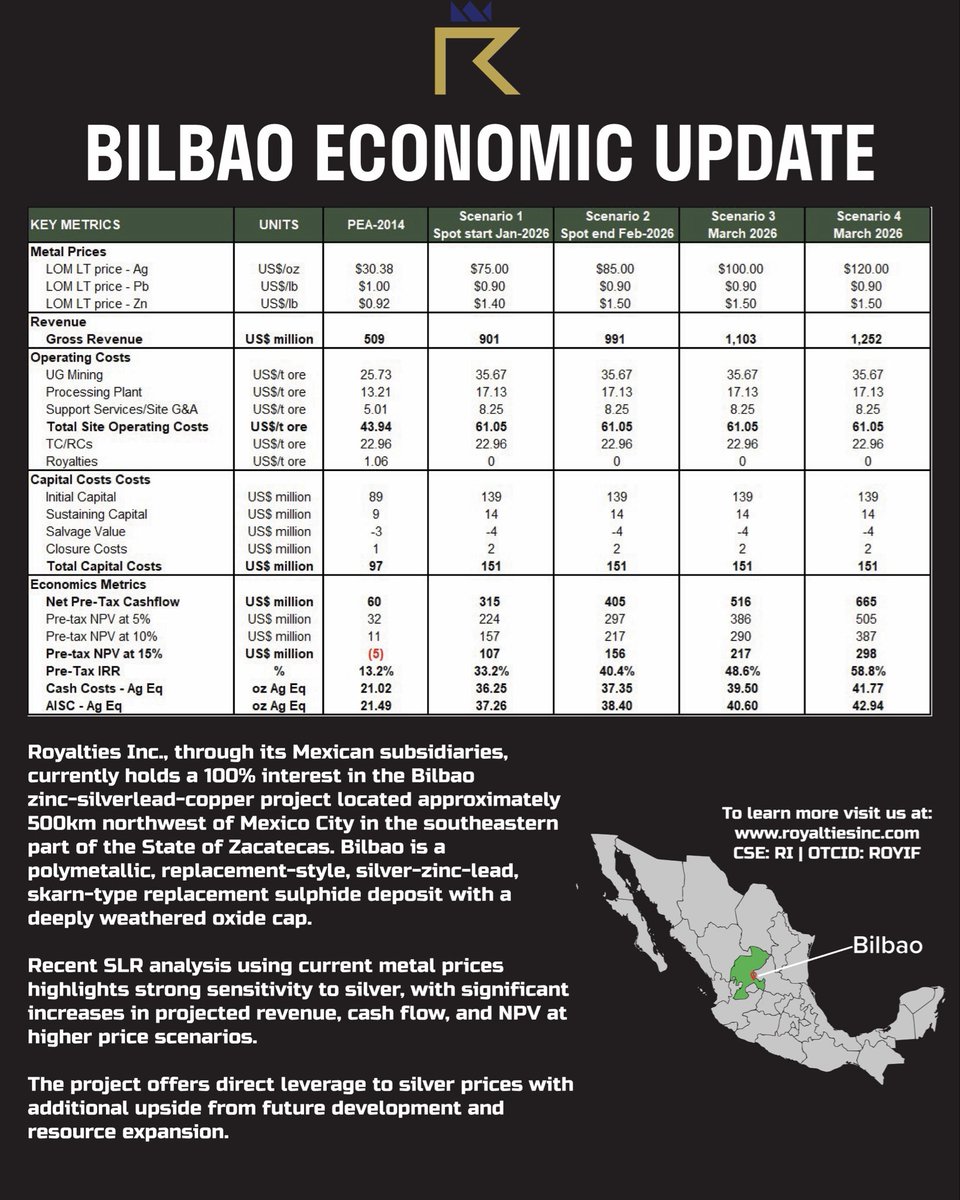
Bilbao Project – Economic Sensitivity Update
The updated economic sensitivity prepared by SLR highlights a material shift in the projected economics of the Bilbao project under current silver price assumptions.
At the base case outlined in the 2014 PEA (~$30/oz silver), the project generated limited economic returns, including a negative NPV (15%) and approximately $60 million in pre-tax cash flow.
Under revised pricing scenarios, the impact is significant:
At $75/oz silver: • Revenue: $901 million • Pre-tax cash flow: $315 million • NPV (15%): $107 million
At $100/oz silver: • Revenue: $1.10 billion • Pre-tax cash flow: $516 million • NPV (15%): $217 million
At $120/oz silver: • Revenue: $1.25 billion • Pre-tax cash flow: $665 million • NPV (15%): $298 million
These outcomes are derived from a model that carries forward the production profile and assumptions from the 2014 PEA, adjusted primarily for updated cost inputs and current metal prices. The analysis does not incorporate an updated mine plan, revised cut-off grades, or potential resource expansion.
SLR notes that the Bilbao project remains highly sensitive to silver prices and identifies considerable upside potential in the current pricing environment. The observed increase in projected revenue and cash flow is driven largely by higher realized metal prices, with operating cost assumptions remaining relatively stable on a per-tonne basis.
The results underscore the degree of leverage inherent in the Bilbao asset to silver price movements, and highlight the potential for further value enhancement through future technical updates and exploration programs.
$RI $ROYIF
#RoyaltiesInc #Silver #MiningRoyalties #PreciousMetals #Investing
Royalties in Action
Major brands continue to license timeless music.
The newest @BurgerKing commercial features Baba O'Riley by The Who.
Through its royalty interests, Music Royalties Inc. participates in the ongoing performance and licensing revenue generated by this record.