#AVCT
How to crystallise a serious message into a short interview, delivered with panache.
“What if we could take the most effective anti-cancer therapy and drop it right in the tumour? And that’s exactly what the pre|CISION platform is aiming to do.”
“That one [AVA6103] really could put a huge dent in cancer.”
Chris Coughlin, June 2026, following her winning five-minute pitch at Venture Road UK.
Biopsy data expected shortly, and exatecan is an exceptionally potent payload…
https://t.co/YIB9XL8M4Z
Deal comes via one/all of the below:
AVA6000 (all indications)
preCISION to third party warhead
AVA6207 (tight deal with Merck K) - big strategic/value question for #AVCT is if AVA6103 delivers as designed, will they be independent before AVA6207 makes its way into arm?)
Happy the person making those strategic calls is the same person who designed and delivered AVA6103.
Biopsies all important. Can’t wait to watch it unfold over the coming weeks!
Validation of a platform doesn’t come much clearer (or more independent) than from the FDA.
The next howls will naturally be “but but but where is #AVCT’s commercial validation?”
That will come. Like buses.
But it’s worth bearing in mind just how little ‘commercial validation’ an asset requires before the big money flows.
FortySeven traded at $6 in October 2019
In March 2020 they were sold to Gilead for $95 ($4.9Bn).
$6 > $95 in 5 months.
Did FortySeven partner any drugs before
Gilead's $4.9Bn takeover in March 2020?
Yes. Small amounts across x2 deals and x2 non monetary collabs.
🤝 Ono Pharma (July 2019): $15.8m upfront
🤝 LLS (August 2019): received $6m in funding from The Leukemia & Lymphoma Society
🤝 Bluebird bio (Nov 2019): research collab
🤝Rocket (Mar 2020): research collab
Point being, small deals (even non-monetary collabs) predate big moves and huge takeovers.
There were just 9 months between the $15.8m upfront deal with Ono Pharma and the $4.9Bn takeover by Gilead.
That’s £11m in upfront payment and £4.3 from a not-for-profit.
Most (who pay attention) have always been confident Coughlin’s low-key strategy has been the right one. It has been executed perfectly amidst a serious amount of noise.
Avacta has now cracked it. Coughlin knows it. Hence the strut.
If you are in any doubt about that, ask
the FDA how many Phase 1 drugs they have removed this limit for since 1930.
Avacta is building Moats #AVCT
One step at a time Avacta is creating the moats required to enable oncology market dominance in the future.
The key to this is creating competitive advantages which competitors will be unable to compete directly or overcome.
Meet the containerised green hydrogen plant pushing the boundaries of an entire industry.
Meet the most-compact and most-competitive 5MW electrolyser on the market.
Meet NEPTUNE V: https://t.co/eRCAZ8kWZC
#hydrogen#greentech#energy
#AVCT’s AVA6103 seeks to harness exatecan.
🧬 Exatecan is an extremely potent topoisomerase I inhibitor (why the CEO nicknames AVA6103 ‘the beast’) that shows extreme promise in cancer treatment, but its clinical use has been limited.
Doxorubicin is a Top 2 inhibitor. It blocks the enzyme topoisomerase 2 (Top2). These drugs prevent cancer cells from dividing properly, leading to cell death.
Exatecan is a Top 1 inhibitor: This blocks the enzyme topoisomerase I (Top1), which also helps manage DNA structure but works differently to Top1 inhibitors by cutting and rejoining DNA strands.
Both these drugs work. They kill cancer kills. But exatecan is far more powerful than doxorubicin and has far wider usage (think TAM).
1️⃣ Why Half-Life Matters
Exatecan’s ~10hr half-life drives the need to frequently dose the drug to maintain therapeutic levels.
However, clearance from the body risks high peak concentrations, causing toxicity (neutropenia, thrombocytopenia).
Recall how good preCISION has been at limiting these toxicities in AVA6000.
Doxorubicin’s half-life in contrast is 1-2 days. This means it only required a ‘simple’ Generation 1 PDC as it didn’t need extra tweaking to ensure it hung around in the body (to have impact) before excretion.
Exatecan has typically required small, successive dosing over continuous days because of how the body ejects it.
2️⃣ Dosing & Efficacy
This short half-life means it’s hard to cause continuous Top 1 I inhibition in cancer cells.
Half-life optimisation (i.e. keeping it in the body for longer) is key if you want exatecan to work.
3️⃣ Toxicity Management
Exatecan’s short half-life has led to dose-limiting toxicities in trials, halting its solo development.
Conjugation (I.e. placing it in an ADC format) reduces peak toxicity, but challenges remain in balancing efficacy & safety for clinical success.
This is where conjugating the drug via preCISION (a PDC) vs ADC will shine.
4️⃣ Why Pharma Struggled
Exatecan’s trials failed due to severe side effects & short half-life, limiting sustained tumor exposure.
They simply couldn’t get it to sustain itself in the body for long enough to have impact.
Lack of tumour specificity caused systemic toxicity and competition with irinotecan/topotecan overshadowed it.
5️⃣ ADC Challenges
Exatecan-based ADCs typically face issues like neutropenia, & linker instability, risking premature payload release.
High potency = high toxicity if not targeted precisely.
6️⃣ Pharmacokinetics
Even in ADCs, exatecan’s short half-life limits sustained action.
Variable clearance from the body complicates dosing.
Tumours with low HER2 expression (where an ADC seeks to target HER2, like Enhertu) further reduces efficacy, narrowing patient scope.
Despite all this, Enhertu is projected to become a $10Bn pa drug.
preCISION however targets FAP. This is Avacta’s USP.
7️⃣ Manufacturing Hurdles
ADC production is complex & expensive, requiring stable linkers & uniform drug-to-antibody ratios.
Scaling for clinical/commercial use is tough, impacting accessibility.
preCISION is cheap and easy to replicate (if you own the IP!)
If you can overcome toxicity, optimise half-life and refine PDC design to unlock exatecan’s power… you’ve got a true blockbuster.
That was one hell of an R&D Spotlight episode published this week by @avacta #AVCT. A must-watch for holders.
I thought I’d provide a recap of the investment case on here, as the Company sits on the cusp of a major news period that could prove transformational.
The pre | CISION platform has evolved at a dazzling pace over the past couple of years, opening up almost limitless possibilities for improving the delivery of potent therapeutics intended to target FAP-rich solid tumours (which is to say, approximately three quarters of all cancer cases worldwide).
The foundation of the platform, and which lies at the heart of the IP suite, is the peptide sequence (or ‘substrate’), “D-Ala-Pro” (highlighted in red on the slide at 2:40 in the video). In the simplest of terms, the substrate “blocks” any molecule that it is a component of, from entering into cells; and is cleaved away from the molecule to which it is attached, by the enzyme FAP (which is only found in abundance in most solid tumour micro-environments). With the peptide having been removed, the warhead component of the molecule becomes ‘active’ at the site of the tumour – and can start killing cancer cells.
The pre | CISION substrate was created by the renowned William Bachovchin of Tufts University: Avacta obtained the worldwide exclusive license to the technology in 2018 (as well as co-inventing and co-patenting with Tufts, the 1st generation of pre | CISION-powered affimer or antibody-drug conjugates). With the license in place, Avacta developed the first pre | CISION prodrug – which is now known as a “peptide-drug conjugate”.
This 1st generation pre | CISION-powered PDC is the doxorubicin-based #AVA6000. Everyone knows the story there. The Phase 1a trial has obliterated all prior expectations. It has been running for 37 months now, with approximately 50 patients (spanning 10 cohorts) having been dosed.
The results have been spectacular. Active doxorubicin in the tumour micro-environment compared to in the bloodstream is trending at a ratio of around 100:1. This has enabled the trial clinicians to drastically increase the cumulative lifetime dose (compared to standard doxorubicin) for patients in the trial. They have done so in three interlinked ways:
- increasing the size of the individual dose of AVA6000, compared to the recommended dose of standard doxorubicin;
- increasing the frequency of dosing of AVA6000, compared to standard doxorubicin (currently from three weeks down to two weeks);
- increasing the total number of treatment cycles of AVA6000 for the patient (going well beyond the usual maximum number of six cycles for doxorubicin).
These dramatically increased cumulative doses are resulting in very encouraging efficacy data already – which is in itself very unusual for a Phase 1a trial. For example, one heavily pre-treated patient with a type of sarcoma has experienced a near-complete response.
That was several months ago, and that patient is still on drug. I’m expecting a bit more new data this weekend (Avacta is presenting at major cancer conference ESMO tomorrow – so I expect there’ll be an RNS on Monday), with a much more comprehensive data release before Christmas (hopefully the entirety of Phase 1a data).
To reiterate: AVA6000 is only a 1st generation pre | CISION PDC. Yet by the looks of things, it already appears (highly) probable that it will, in time, steadily displace doxorubicin across the board (well, at least for treating tumours that are high in FAP – which accounts for well over 60% of global doxorubicin sales (currently at circa $1.2bn pa)).
……
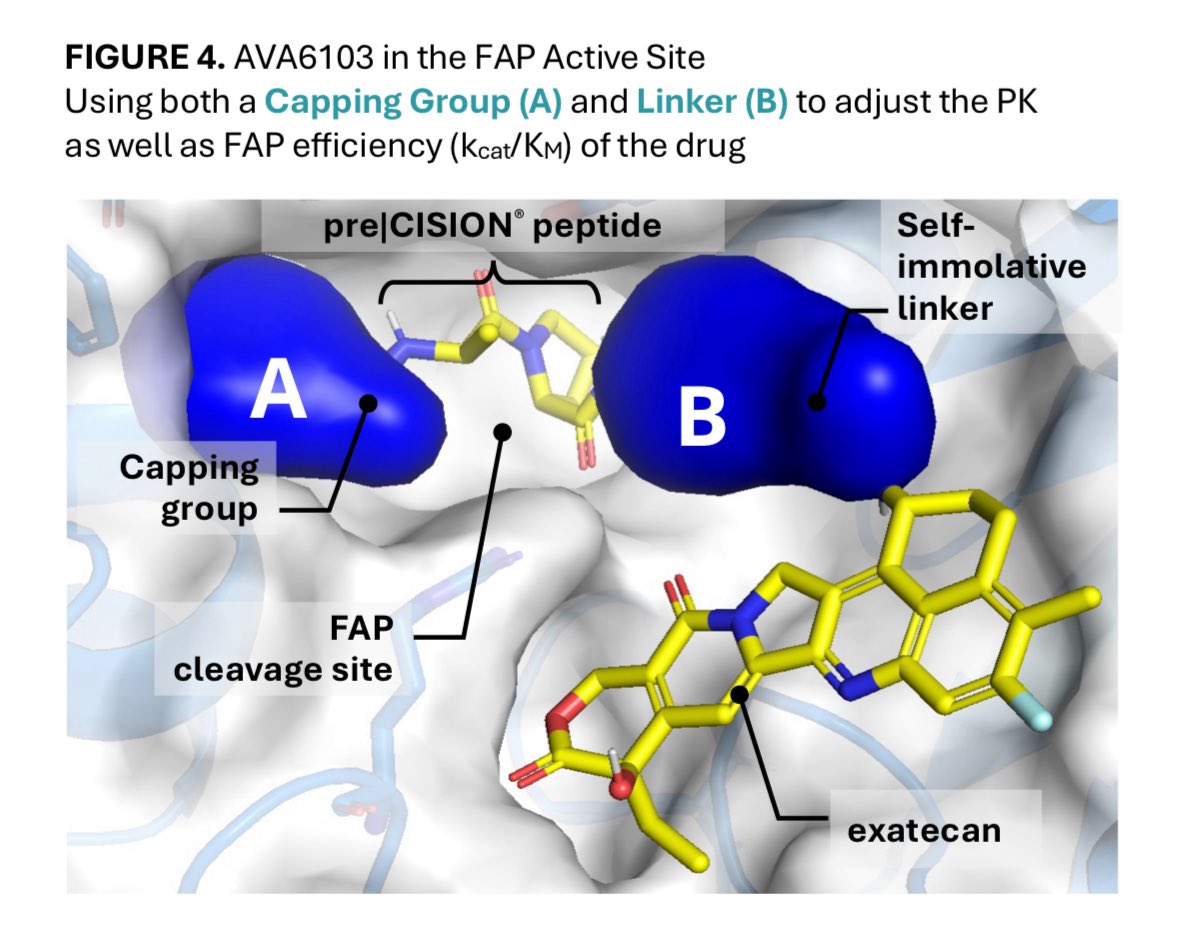
The 2nd generation PDC platform that Avacta has developed (watch video from 6:36 to 8:37) enables the pre | CISION peptide to be linked to a massively expanded range of warheads, that it would not have otherwise been able to be linked to under the 1st generation format. This has been made possible by the in-house development of a range of linkers (circa 20 of them), as well as the in-house development of range of capping groups (over 40 of them).
Together, not only do they substantially expand the range of payloads that can be linked to the pre | CISION peptide, but they also enable the fine-tuning of the molecule, i.e. modulating the speed of warhead release; altering plasma protein binding; altering half-life of drug, etc.
As an educated guess on my part, I believe that this may have generated significant new IP for the platform, that Avacta may now wholly own (i.e. separate from the license with Tufts / Bach Biosciences (William Bachovchin’s vehicle)). Whilst that in itself would be a significant positive on the commercial front, an even more important result of this would be that the clock counting down the patent protection over the platform would have just been reset.
So, whilst in 2033/34 (approximately when the family of patents expire for the D-Ala-Pro substrate), other companies may start to use the 1stgeneration format for developing PDCs, they could not develop 2nd generation PDCs (unless under license from Avacta or whoever owns the technology then). And why bother attempting to develop a 1st generation PDC in the mid-2030s, when the owner of the 2nd generation technology (which would be on-patent for another decade at that point) could simply develop a superior molecule?
To reiterate – the prospect of new IP is all conjecture, purely on my part. But to me, it makes sense – especially as the Company itself has alluded to filing important new IP over the past year (which to date it has refused to provide any detail on).
……
I explained in an thread earlier this week how there's a reasonable possibility (in my view, probability) that one of Avacta's new pre | CISION peptide-drug conjugates, #AVA6103, could be armed with one of the novel TOP1 inhibitor warheads, SN-38 or deruxtecan (the latter being owned by Japan's Daiichi Sankyo and used in the world's best-selling antibody-drug conjugate, Enhertu).
Now in this latest video, we see that the Company uses MMAE as the example warhead incorporated into pre | CISION PDCs and BDCs, across all of the deck's slides.
For those unfamiliar with it, MMAE is a synthetic antineoplastic agent that acts as a microtubule inhibitor (in short, a class of chemotherapy agent that disrupts the microtubule dynamics required for cell division). To put its potency into context: MMAE is 100-1,000 more potent than doxorubicin. It is far too potent to be used as a free drug, as a monotherapy; rather, to date is has only been used as a warhead in ADCs.
Now: it may be that Avacta decided to use MMAE as the example warhead in its slides in the video this week, for the simple reason that it is probably the most well-known of the novel cytotoxins – it is the warhead used in 4 of the 14 ADCs that are currently approved and marketed across the world.
That said, management will have been acutely aware that many hundreds of pairs of eyes from both the investment community, and from the pharma industry, will be very keenly scrutinizing every scrap of info that the Company puts out into the public domain.
To me at least, it would seem rather daft for Avacta to use MMAE as the example warhead in a presentation that is designed to demonstrate the versatility of the 2nd generation PDC platform – only to later on inform investors (and much more importantly, potential licensees / partners / acquirors) that MMAE could not in fact be linked to the pre | CISION peptide.
This is one of the key reasons why I personally believe that a pre | CISION-powered MMAE-PDC has already been created by Avacta, and put through successful pre-clinical testing.
It is important to note that MMAE as a standalone compound is no longer under patent. Of the four marketed ADCs that do use it as their warhead, three are owned by Seagen (itself acquired by Pfizer last year); and the fourth by Genentech/Roche (which licensed linker technology from Seagen in order to develop its ADC). Seagen itself does not own patents over MMAE as a standalone compound, but rather specific linker technologies that attach it to an antibody.
Now, I’ve got absolutely no experience in patent law(!) – but with regards to Avacta’s 2nd generation pre | CISION PDCs, my reading of the situation is that it would not require a license from Pfizer to use MMAE. My rationale? Avacta is not linking MMAE to a biologic (a monoclonal antibody); but rather to an inert peptide.
To go even further: we learn in this week’s video that the 2nd generation PDC platform also places a (proprietary?) self-immolative linker between the MMAE warhead and the pre | CISION peptide. Given that Avacta’s scientists state that they have developed a range of ~20 of these linkers, and given that the Company is openly portraying them in public material, it would seem inconceivable that these are Seagen’s proprietary linkers.
In short, Avacta could own 100% of a pre | CISION-powered, MMAE-based PDC.
An MMAE-based PDC compared to the existing MMAE-based ADCs might enjoy the same advantages as I described in my Tweet earlier this week, with regards to a pre | CISION TOP1 inhibitor-based PDC versus the existing TOP1 inhibitor-based ADCs:
- much cheaper to manufacture (as no biologic);
- superior efficiency (extracellular release via FAP-cleavage is a much faster process than internalisation – the mechanism of action employed by the ADCs);
- superior tissue penetration (monoclonal antibodies are substantially larger than the pre | CISION peptide);
- superior targeting?! (TBD!)
……
The video also touches briefly on the 3rd generation of molecules derived from the pre | CISION platform: biologic drug conjugates (‘BDC’). This is essentially an extension of the 2ndgeneration PDC molecule, but with the capping group replaced by a second type of linker that joins a biologic to the overall molecule. The biologic could be a monoclonal antibody; an affimer; an Fc region., etc.
The key differences between pre | CISION BDCs and existing ADCs on the market are:
1) extracellular release of warhead by BDCs, versus the necessary internalization (prior to warhead release) for standard ADCs;
2) BDCs have a “double lock” versus the “single lock” of ADCs. Explanation: the warheads of pre | CISION BDCs would only (generally) activate once the biologic component of the molecule has bound to its target antigen on the cancer cell, and once FAP has cleaved the warhead from the D-Ala-Pro peptide. The warheads of standard ADCs are only kept in check by the “biologic lock”, as it were.
This should result in (likely significantly) superior targeting by pre | CISION BDCs compared to existing ADCs.
There is also the possibility of utilizing the biologic component of the pre | CISION BDC to generate an immunotherapeutic effect (given that the primary targeting mechanism is the peptide, thus freeing up the role of the biologic / enabling it to do other things besides just being a secondary targeting mechanism). In short, a pre | CISION BDC could have the potential to be an immunotherapy and chemotherapy in a single molecule. Beyond a gamechanger.
[Again, note that MMAE is once more used as the warhead in the example pre | CISION biologic-drug conjugate. And again, I would suggest it would be bizarre for Avacta to portray this in public documents, without having successfully developed and tested the molecule in the lab first.]
……
Pre | CISION is a highly diverse, highly tuneable delivery platform – both for next-generation, uber-potent cytotoxins, and for well-known, long-used drugs on the market such as doxorubicin. It is a toolbox that has the real potential to one day be licensed out to dozens of biotech / pharma companies, to be used in dozens of cancer therapeutics.
[On that note, the video and slide between 4:05 and 5:25 contain extremely important info: Avacta has developed a pre | CISION computational design algorithm – which of course will be hugely useful to anyone looking to license the platform to enhance their own in-house drug development programmes.]
The improvements to the platform over the past few years – as evidenced by this video – have been dramatic; but the heart of the pre | CISION platform remains the D-Ala-Pro peptide sequence, that no one the world over has come close to replicating. FAP is upregulated in ~80% of solid tumours. Solid tumours comprise ~90% of global cancer cases. The D-Ala-Pro peptide sequence can prevent incredibly toxic warheads from entering into healthy cells of a patient, and then enable those warheads to activate only at the site of the tumour(s). And this is achieved without the need for a bulky (and expensive) biologic.
The AVA6000 Phase 1a trialhas proved just how targeted the delivery platform is; and in this week’s video, the Company has explained how it has drastically expanded the range of potential molecules (both synthetic small molecules, as well biologics) to which the pre | CISION substrate can be conjugated. Indeed – in the video, Avacta states that it has created ten new molecules in the 2nd and 3rd generation formats.
I’ve come to the realization that attempting to calculate a fair valuation range for Avacta is practically impossible. I also now think putting out pie-in-the-sky numbers on social media does more harm than good, at least in management’s eyes.
What I am more than happy to state over and over is my strong belief – after doing more than a little research into the Company and the oncology industry(!) – that pre | CISION has very real potential to revolutionise the treatability of solid tumours.
And those also just happen to be Avacta’s very own words…!
The pre | CISION platform – both its 2nd generation peptide-drug conjugates, and its 3rd generation biologic-drug conjugates – represents a direct challenge to the ADC class, which happens to be the drug class in oncology that has received by far the most funding and attention in recent years from Big Pharma.
I don’t think it’s too tricky to work out where Avacta is headed.
[As always: do your own research, arrive at your own conclusions... and take responsibility of your own buying and selling of shares!]
We are very excited to be heading to San Diego for the data release for @Avacta. Full updated data from the Phase 1 trial of AVA6000. Looking to Tuesday's session at #AACR2024
Check our next chapter at https://t.co/cMNWHpN28b
See you Tuesday!
#PeptidesCreateHope#LetsDoThis
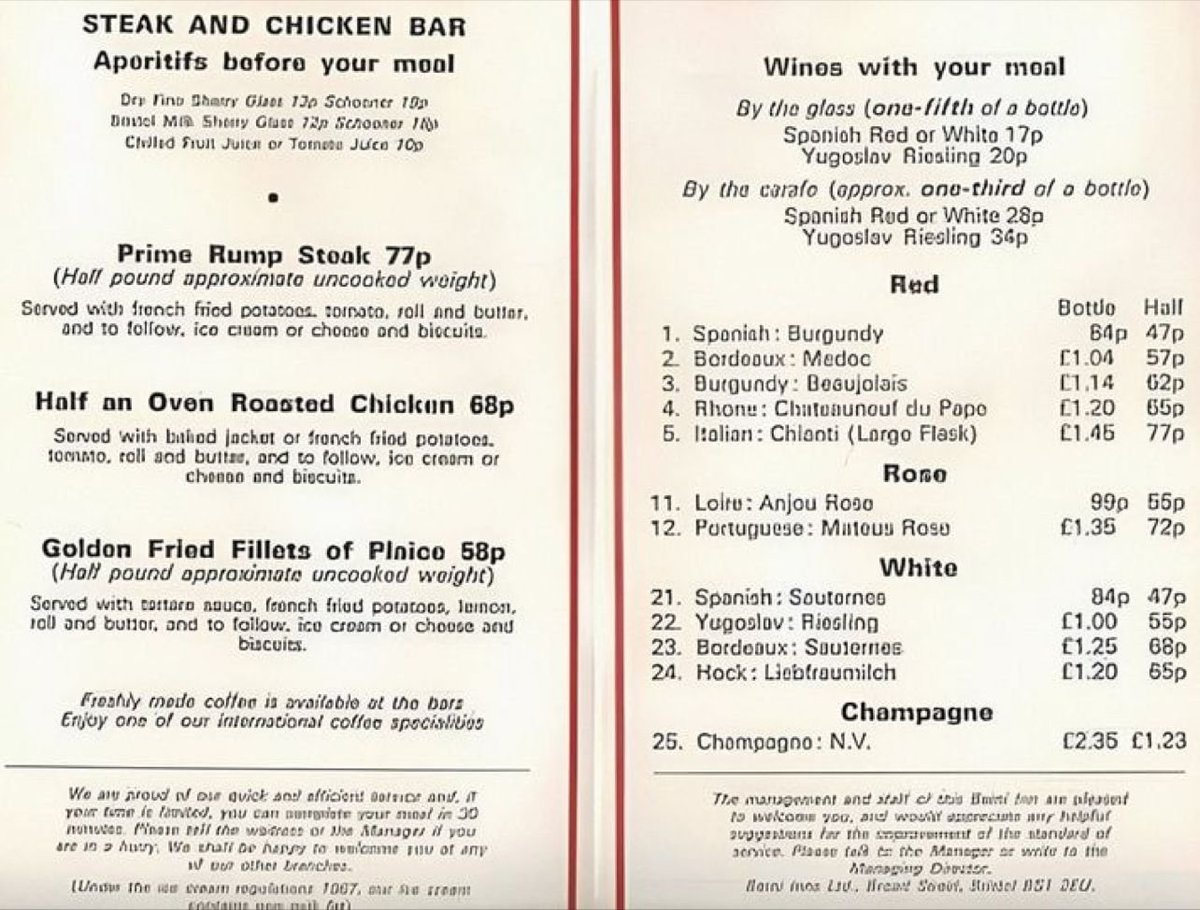
Anyone fancy a quick bite down memory lane at a Berni Inn (see menu)?
Literally 'cheap as chips'
In fact the 'Chateauneuf du Pape' was apparently the go to bottle of plonk.
Albeit elsewhere, the Yugoslavian Riesling was probably an acquired taste.
#AVCT
Wow.
All the news here, after today's extremely positive Phase 1a clinical trial data from @avacta .
Ie relating to its novel 1st-of-a-kind, targeted cancer busting chemotherapy (Re AVA6000).
@MylesMcNulty
https://t.co/uVbjdQ6VzB
#VRCI
Confident & positive FY22 results & outlook from immunodiagnostics pioneer @VericiDx today.
All the details here.
https://t.co/35LlZh07Du
The global proteasome inhibitors market is expected to reach nearly $2.3 billion by 2026. Severe, dose limiting toxicities have prevented application to a broader range of cancers, in particular to solid tumours.
Read more:
https://t.co/3ULaWPaldy
"Validation of the pre | CISION Platform - an Impending Revolution in Cancer Treatment?"
New note on @avacta.
Think 2023 will be quite the glorious year for #AVCT. Already +40% YTD and only just getting started.
As always: all my own opinion, and DYOR.
https://t.co/DLSMddr2Ey