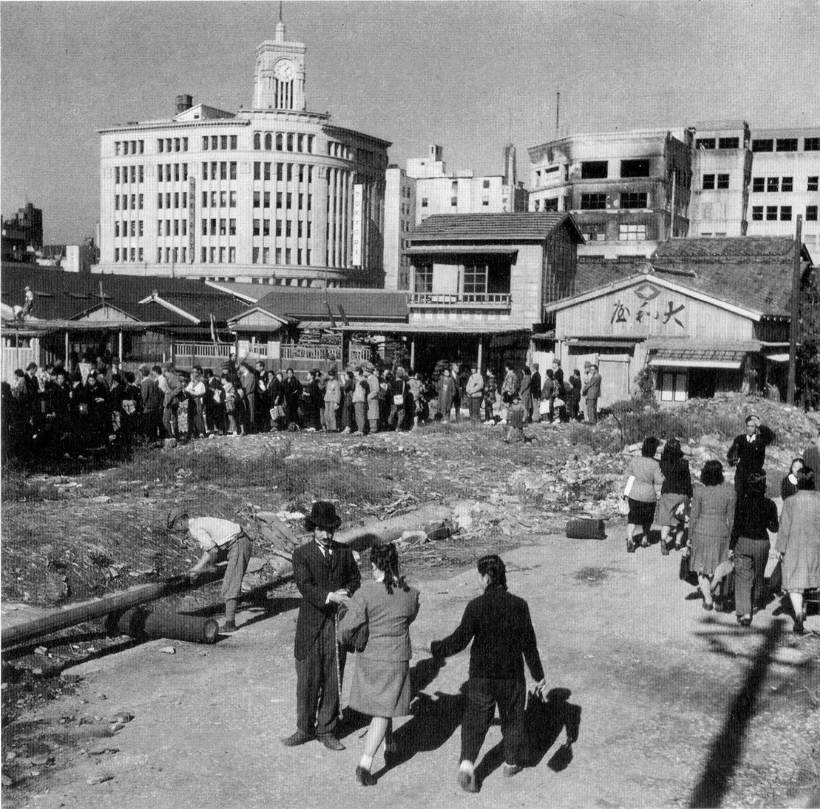
General Douglas MacArthur sat at his desk in the Dai-Ichi Seimei Building in ruined Tokyo in early 1946, staring at an agricultural report that predicted eleven million Japanese men, women, and children would starve to death before autumn.
Japan's worst rice harvest since 1910 had collided with total wartime devastation, leaving mothers in Tokyo and Osaka boiling weeds and acorns to keep their babies alive.
A cold bureaucratic wall in Washington blocked every relief ship. Under Allied occupation directives, food imports for the defeated Japanese population were strictly restricted, and lawmakers in Washington argued that not a single sack of American wheat should go to a former enemy while Europe was still hungry.
MacArthur decided he would rather lose his five-star command than watch Japanese children die of hunger under an American flag.
Bypassing diplomatic niceties, he fired off a historic, icy telegram straight to the United States Congress: "Give me bread or give me bullets."
He told Washington flatly that if they refused to send food, millions of starving Japanese parents would riot for their children's lives, and he would never order American soldiers to shoot starving mothers in the streets.
Backed by former President Herbert Hoover's famine mission and public health chief Brigadier General Crawford Sams, MacArthur shattered the blockade. America shipped 3.5 million tons of emergency food across the Pacific, launched hot school lunches of bread and milk for 3.2 million Japanese schoolchildren, and saved an estimated eleven million Japanese lives from famine.
Conquerors throughout history took bread from the defeated to feed their armies, while America took bread from its own table to keep a defeated nation's children alive.
In Japan, climbing 12,388-foot Mount Fuji is a once-in-a-lifetime test of spirit.
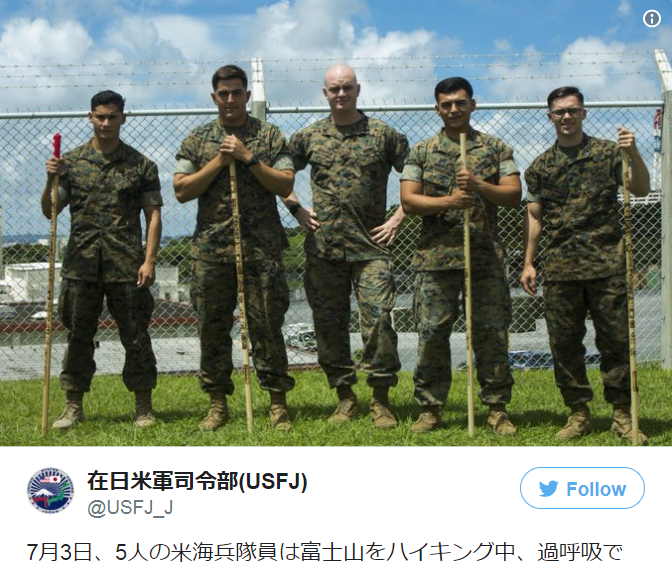
Five off-duty U.S. Marines treated it like a pleasant afternoon hike, and then carried an unconscious Japanese woman two miles down a volcano by hand.
On July 3, 2017, right at the opening of climbing season, five young Marines were making their way up Mount Fuji carrying those classic wooden souvenir walking sticks they stamp at each mountain station.
High on the steep volcanic gravel trail, where the air grows thin and every step slides backward in loose cinders, they came across a Japanese woman who had collapsed unconscious from severe hyperventilation.
An ambulance cannot drive up the side of Mount Fuji. Even walking down empty-handed wrecks your knees.
Those five Marines did not wait around hoping somebody else would figure it out. Right there on the mountain, they put their heads together, built a simple improvised stretcher out of what they had, lifted her gently onto it, and started walking down.
Not for two hundred yards. For two full miles.
Three point two kilometers of steep, ankle-twisting volcanic rock in thin mountain air, trading corners of that handmade litter until they delivered her safely into medical hands.
When U.S. Forces Japan shared a photo of the five Marines smiling in their boots with their wooden Fuji sticks, Japanese comments flooded in with gratitude, plus one observation that made our whole country smile:
Only U.S. Marines could carry a human being down Japan's tallest volcano and casually call their day off "hiking."
Thank you, gentlemen. Japan still remembers.
June 1942. Midway. Admiral Raymond Spruance, the quiet American commander, has just sunk four Imperial Japanese Navy aircraft carriers in a single afternoon: Akagi, Kaga, Soryu, and Hiryu. It is the most catastrophic naval defeat in modern Japanese history.
Thousands of Japanese sailors are now in the water, clinging to debris, three thousand miles from home.
By the ruthless mathematics of total war, the correct American move is to let them drown. Sailors in the water are sailors who will not reinforce the enemy. The U.S. Navy's own cruisers are in range of a Japanese counterstrike.
Spruance refuses.
He orders his destroyers to stop and look for survivors. For hours. Among Japanese sailors who, days earlier, had been preparing to invade American islands.
His chief of staff objected on operational grounds. Spruance answered, in his usual quiet voice, "We have no quarrel with men in the water."
American destroyers pulled thirty-five Japanese sailors out of the Pacific after Midway. One of them later wrote a memoir describing, in careful detail, the American sailor who gave him the blanket off his own back.
Years after the war, Admiral Spruance, by then U.S. Ambassador to the Philippines, hosted a small private dinner at his residence. At the table were three former Imperial Japanese Navy officers.
One of them was Mitsuo Fuchida, the man who had led Pearl Harbor.
Another was Minoru Genda, Yamamoto's air staff officer who had designed the Pearl Harbor strike plan.
The third was a surviving Japanese destroyer captain who had fought at Midway.
Spruance, the quiet Indianan, poured tea for them himself. He talked about carrier operations. He talked about the Pacific weather patterns that had decided Midway. He did not talk about victory.
When he said goodbye at the door, he bowed to them in the Japanese fashion.
Fuchida said later, through tears, that it was the moment he understood the American naval officer class had considered them peers, not animals, even in the middle of the worst war.
Spruance died in 1969. At his memorial, letters arrived from the Japanese Navy veterans' association, in Japanese. They called him sensei. Teacher.
Because the American admiral who sank your carriers also made sure to pull your sailors out of the water. And bowed to your officers at his dinner table. And treated your war as what it was — a fight between warriors, not a verdict on your worth as human beings.
That is what distinguishes a great power from a brutal one.
America is a lot of things. At Midway, on that afternoon, she was Spruance saying, "We have no quarrel with men in the water."
Japan should say his name too.
The first time my friend from Colorado went skiing with me in Nagano, he stopped outside the mountain cafeteria and fumbled inside his jacket pocket for a steel cable lock.
Then he looked up at the snow racks and froze.
Standing in the snow outside the lodge were over 400 pairs of custom skis and snowboards worth $1,000 to $1,500 each. Over half a million dollars of high-end winter gear was sitting out in the open.
Not a single lock on any of them.
Inside the lodge, people did not even carry their backpacks around to find a table. They walked in, set their wallets, expensive goggles, and helmets down on an empty table to reserve their seats, and walked 30 yards away to stand in the hot curry line.
When you grow up in a society where people are taught from childhood that taking something that is not yours disgraces your own name, you do not need steel cables to enjoy lunch.
My neighbor, Mr. Shimada, has worked customs at Narita Airport for thirty-one years.
He says he can always tell when a kid is coming home from a year with an American host family.
It's the suitcase.
They never bring home souvenirs.
They bring home a family.
He let me write down a few.
A suitcase that would not close. Inside: eleven boxes of macaroni and cheese. Her host mom had heard her say once, in September, that she liked it. (Kaho, 16, Wisconsin)
A gallon Ziploc bag of red dirt. On it, in marker: "OKLAHOMA. In case you miss it." Soil is not allowed into Japan. Mr. Shimada had to take it. She cried. He says he has thought about that dirt for nine years. (Hinata, 17, Oklahoma)
One jar of Grandma's homemade pickles. Wrapped in a football jersey. Wrapped in a Texas flag. Wrapped in a second football jersey. Mr. Shimada says it was the most heavily protected object he has ever inspected, including diplomatic mail. (Kota, 16, Texas)
A Christmas ornament with her name hand-painted on it. A note taped to the box: "For our tree. We're leaving your hook empty till you come back." (Rena, 17, Kansas)
Four pounds of gas station beef jerky, "for the plane." The flight is thirteen hours. He had not eaten a single piece. He said his host dad bought it for him, so he couldn't. (Tomoki, 16, Montana)
A church directory. On page 12, her photo. Under it, not "Exchange Student." Just the family's last name. Like it was hers. (Airi, 17, Michigan)
A phone charger with a strip of tape on it: "MOM'S. DON'T LOSE IT." At the airport, her host mom had pulled her own charger out of the wall and pushed it into her hand. (Yua, 16, Georgia)
A camo hat. He has never hunted. He will never hunt. He would not take it off during the inspection. (Sosuke, 17, Arkansas)
And on the customs form, under "Items to declare," a girl had written one word in English and then crossed it out because she thought it was against the rules.
"Family." (Saki, 16, Iowa)
And then there are the kids who come through with almost nothing.
Last summer, a boy came to Mr. Shimada's counter with one small bag. Clothes. A toothbrush. That was it. Hayate. Seventeen. Alabama.
He was crying. Not a little. The kind of crying a seventeen-year-old boy tries very hard to hide and can't.
Mr. Shimada asked if he was all right.
The boy said his host dad couldn't come to the airport. He worked double shifts at the plant. They had said goodbye at five that morning, in the kitchen, fast, the way men do. The boy said he hadn't said it right. He hadn't said thank you the way he meant to.
Then his phone buzzed on the inspection table.
A photo.
A big man in work coveralls, standing at the chain-link fence at the far end of the runway at the Atlanta airport. Holding up a piece of cardboard from a pizza box. In black marker:
"THAT'S MY KID UP THERE."
He had left the plant on his break, driven to the airport, found the end of the runway, and stood at the fence in the heat until a plane with that boy on it went over his head.
Then he drove back and finished his shift.
Mr. Shimada says he is not supposed to look at people's phones.
He asked if he could see it again.
He has opened thousands of bags in thirty-one years. From every country in the world.
He says only the kids from America come home carrying a whole family. And never once has the important thing been something anybody bought.
So, America.
You think you're just packing a snack for the plane.
You're a bag of red dirt we had to take away. You're an empty hook on a tree in Kansas. You're a man in work clothes at a fence in Georgia, holding a pizza box at the sky.
You never declared any of it.
It got through anyway.
(Wisconsin: the macaroni got through. We are not monsters.)
Last spring, my wife spent two weeks in Wisconsin on a teacher exchange. Her host family had a nine-year-old son. On her last night, they took her to his school's spring concert.
My wife has watched Japanese school performances for twenty years. She knows exactly how they go. Polite applause. Silent filming. Parents bowing to other parents.
She came home with one page of notes. At the top she'd written: "What American parents do at a school concert."
It's my favorite thing she has ever written.
1. When the second-graders walked out, a father stood up and yelled, "THAT'S MY TREE!"
His son was Tree #3. He had no lines. He was a tree. His father filmed the entire song from the aisle, on one knee, like a war photographer.
2. A grandmother brought a sign. Poster board. Glitter. "GO MADISON."
Madison had one line. The line was "Look, it's spring!"
When Madison said it, the grandmother rose to her feet, and the people around her clapped like Madison had just hit a walk-off home run.
3. One boy sang every song half a second behind everyone else and twice as loud.
In Japan, a teacher would quietly ask him to sing a little softer.
In Wisconsin, he got the biggest cheer of the night.
4. Three fathers came straight from work, still in their reflective safety vests. They stood at the back. Watched one song. Waved at somebody. Left.
My wife wrote: "The waving was the important part."
5. About three hundred phones in the air. And one grandfather with a camcorder from the 1990s, roughly the size of a toaster, which he held steady above his head for forty-one minutes.
Nobody asked him to put it down. During the last song, the man next to him quietly offered to hold it for him.
6. A little brother, maybe four years old, waved at his big sister onstage with both arms. The entire concert. Nonstop.
In the middle of a song, she waved back. Once.
The whole gym said "awww" at the exact same moment, like they had rehearsed it.
7. A girl stepped forward to say her line and froze. Three seconds of silence. Then a man in the back called out, "YOU GOT THIS, SWEETHEART."
He was not her father. My wife is sure of it.
The gym started clapping. Slowly. Steadily. Until she remembered.
Then there was the one that made my wife stop writing for a while.
A girl in the fourth grade had a solo. My wife's host mother leaned over and whispered that the girl's dad hadn't been around in a long time. Nobody from her family had come.
When the girl stepped up to the microphone, three fathers in the front row stood up.
None of them were hers. They hadn't planned it. My wife watched them notice each other. They just stood. Big men in folding chairs, standing for a ten-year-old they barely knew.
She sang the whole song looking at them.
When she finished, they cheered for her like she was theirs.
For four minutes, she was.
At the bottom of the page, my wife wrote one more line.
"In Japan, we clap for the performance. In Wisconsin, they clap for the child."
Last month, at the culture festival at her school in Tokyo, the student band played. In the middle of the drum solo, a teacher in the back of the gym yelled the drummer's name and "YOU GOT THIS!"
The other teachers pretended not to know her.
It was my wife.
Doing laundry at a neighborhood laundromat in Japan feels like stepping twenty years into the future.
First, you don't bring soap, and you don't sit on a plastic chair for forty minutes waiting to move wet clothes from a washer into a dryer so nobody touches your laundry.
You toss your dirty clothes into a single heavy-duty drum, tap a 4-digit PIN code onto the touchscreen to lock the glass door, and pay about $6 (900 yen).
The machine injects its own detergent, washes everything, and immediately switches into a high-powered gas dryer inside the exact same drum. You walk away for an hour to eat ramen and come back to hot, fluffy clothes locked safely behind your PIN.
Even better? Right in the corner sits a dedicated $1.30 (200 yen) sneaker washing machine with soft spiral nylon brushes inside the tub, paired with a twin-nozzle shoe dryer right above it.
Eighty-one years ago, Americans and Japanese fought to the death on the black volcanic sands of Iwo Jima.
Late on the night of May 7, 2026, on that same island, a U.S. Navy Sailor went into heart failure.
He was unconscious, and he had no pulse.
He was on temporary duty from Marine Corps Air Station Iwakuni, supporting Field Carrier Landing Practice on Iwo To.
Hajime Mitsui, a fire inspector from Naval Air Facility Atsugi, was off duty after a long day of training. He was cleaning up after dinner when an emergency call came over his radio.
He was not on duty. He went anyway.
He grabbed an AED and ran to the scene.
U.S. Sailors were already giving aid to the unconscious Sailor. Mitsui and the Sailors took turns on chest compressions and AED shocks until Japan Maritime Self-Defense Force medical personnel arrived.
The more highly trained Japanese team took charge and gave instructions to the Americans.
No one else on scene spoke both languages.
So Mitsui volunteered to translate, while still giving chest compressions.
"It was difficult to translate while focusing on giving chest compressions but there was no one else to do it. I had to do both at the same time."
Then the Sailor's pulse came back.
The new team of Americans and Japanese moved him to the small clinic nearby. On a tiny island far out in the Pacific, the call was made fast: fly him to Iwakuni.
Japanese sailors and airmen rushed to get a P-1 patrol aircraft ready while the responders carried him to the flightline.
In the middle of the night, crews from Japan's Air Patrol Squadron 1 and Flight Squadron 21, alongside a U.S. Carrier Air Wing 5 medical team, loaded the patient and launched into the dark. They flew nearly three hours to MCAS Iwakuni.
The Sailor lived. He is recovering and back on limited duty.
When Atsugi's public affairs team later asked Mitsui why he answered the call while off duty, he said ten words:
"I am a firefighter, I need to do my job."
From mortal enemies to brothers who refuse to let each other die.
Thank you, America, and thank you to the men and women who guard the Pacific together.
Nobody warned my wife's cousin Tsuchiya that Americans mean it.
In Japan, polite sentences are decoration. "Please drop by anytime" means please don't. "If there's anything I can do" means there isn't.
So when his company sent him to Alabama for a year, Tsuchiya made a decision. To be safe, he would treat every polite thing an American said to him as an official instruction.
This was a mistake.
A beautiful one.
WEEK 1. "Did you find everything okay?"
The cashier at the grocery store asked him this. Tsuchiya answered honestly. He had not. He could not find mirin, a rice paddle, or aisle 7.
The cashier picked up the phone. "Need some help up front."
A stock boy came. Then the manager. Then Miss Loretta, the 79-year-old greeter. Then a man in a camo hat who had just been standing in line.
For twenty minutes, five Alabamians and one Japanese man moved through that store like a search party.
They found the mirin. They did not find a rice paddle. The manager went into the back, came out with a wooden spoon, and said, "Keep it, buddy."
The line behind him applauded.
To this day, Tsuchiya answers "Yes, thank you" to that question even if he has found nothing. He cannot risk another search party.
WEEK 3. "Holler if you need anything."
His neighbor Royce said this on move-in day. Tsuchiya did not know the word "holler." He looked it up.
To shout. Loudly.
That night at 11 p.m., the pipe under his kitchen sink burst.
In Japan, you do not shout at night. You do not really shout at all. But he had been instructed.
So he opened his window and, in his clearest English, shouted:
"ROYCE. I AM HOLLERING."
Royce came across the yard in forty seconds. Boxer shorts. Headlamp. Wrench. His wife right behind him with a flashlight and, for reasons nobody has ever explained, a whole pecan pie.
He fixed the pipe in ten minutes. Then he clapped Tsuchiya on the back so hard his glasses moved and said:
"Now THAT'S how you holler."
WEEK 6. "Make yourself at home."
A coworker invited him to Sunday supper. At the door, his mother, Darlene, said, "Come on in, sweetie. Make yourself at home."
So he did.
He took off his shoes. He bowed to the house. He washed every dish in the sink, including several from Friday. He folded a basket of laundry. He found the vacuum.
About forty minutes in, Darlene walked into her living room and found a Japanese man she had met less than an hour earlier, fluffing her couch cushions.
She stood there for a long time.
Then she went into the kitchen, called her sister, and said:
"Faye. I think I got a new son."
WEEK 10. "Come by anytime."
He came by at 7 a.m. on a Saturday. They made pancakes. They were thrilled.
He came by the next Saturday.
And the next.
By the time he left Alabama, Tsuchiya had eaten pancakes at that house 38 Saturdays in a row. Nobody ever once asked him to call first. There was a stool at the counter with his name on it. Spelled wrong. He never told them.
Somewhere around Week 20, he figured it out. He explained it to me like a scientist.
"In Japan, polite words are a wall. A very beautiful wall. You admire it from outside."
"In Alabama, polite words are a door. And it is already open. They just say it so casually, you don't notice you're allowed to walk in."
He came home in March.
In April, an elderly woman moved into the apartment under his. Mrs. Yoshino. 83. She lives alone.
On moving day, Tsuchiya stood at her door, bowed, and said in Japanese: "If you ever need anything, please holler."
She looked at him like he had lost his mind.
Last month, at 11 p.m., her power went out.
She opened her window.
And very quietly, the way only an 83-year-old Japanese woman can, she hollered.
He was down the stairs in forty seconds. Headlamp on.
Holding, for reasons he still cannot explain, a pie.
For nine years, almost nobody in Japan has looked at my neighbor's daughter.
Not because they're cruel. Because they're polite.
Sana is nine. She uses a wheelchair. In Japan, when people see a child like her, they do the kind thing. The thing we're taught. They look away. They don't stare. They give her space.
So for nine years, Sana has gone everywhere being carefully not seen.
And her mother, Megumi, learned to help. At school events, at festivals, at the park, she always sat them in the same place. The very edge. The very back. Where they wouldn't be in anyone's way.
Last summer, Megumi's husband had to work for two weeks at a plant in a small town in Iowa. The whole family went. Megumi told me she dreaded it. New country. New stares. Or worse, new ways of not being looked at.
On the first morning, they went to a diner.
The waitress came over, looked at the table, and did something nobody in Japan had ever done.
She crouched down next to the wheelchair, eye level with Sana, and asked her what she wanted.
Not her mother. Her.
In Japan, waiters ask Megumi what Sana wants. Sana is nine. She knows what she wants. She wanted pancakes.
The waitress said, "Pancakes for the boss," and wrote it down. When the pancakes came, there was a mountain of whipped cream on top. The waitress pointed at the wheelchair and winked. "Extra for the driver."
Sana laughed so hard she got syrup in her hair.
Megumi tried to pay. An old man at the counter had already paid. She tried to pay the next day. A different old man. By the third day, she was sneaking up to the register before they even sat down, and the waitress just shook her head and said, "Honey, you're not gonna win this one."
A lady from the church down the road showed up at the motel with a whole pie. Megumi asked why. The lady said, "Y'all looked tired." They had been in town for three days. Nobody had told her they existed.
And then there was Tucker.
Tucker was seven. He lived next to the motel. On the fourth day, he walked straight up to Sana in the parking lot, looked at the wheelchair, and said, loudly:
"Why do you have wheels?"
Megumi froze. In Japan, a parent would have grabbed that boy and apologized for ten minutes.
Sana looked at him and said, in the English she'd learned at school, "My legs don't work."
Tucker thought about this for one second.
"Cool. Can I push?"
And then they were gone. Down the sidewalk. Way too fast. Tucker's mom was yelling, "TUCKER, SLOW DOWN!" Tucker was yelling, "SHE SAID FASTER!" Sana was screaming in Japanese, "もっと速く! もっと速く!" Faster. Faster.
Tucker didn't speak a word of Japanese.
He understood perfectly.
That night, after Sana fell asleep, Megumi locked herself in the motel bathroom and cried for an hour.
She told me it took her a long time to understand why.
It was because for nine years, without ever deciding to, she had been apologizing. For the wheelchair. For the ramp. For the space they took up. For being there at all.
And in four days, a whole town had made it very clear that nobody needed her to.
On the Fourth of July, there was a parade down Main Street.
Out of habit, Megumi found them a spot at the very edge. At the very back. Behind everybody.
A fire truck came down the street. Red, shining, lights going, kids running alongside it.
It stopped.
Right in front of them.
A firefighter climbed down. A huge man with a gray mustache and forearms like fence posts. Everyone in town called him Bud. Nobody, possibly including Bud, knew his real name.
He walked over, knelt down on the asphalt in front of Sana, and said:
"Ma'am, we're short a co-pilot today. You interested?"
Sana looked at her mother.
Megumi couldn't say a word. She just nodded.
Bud lifted Sana into the front seat like she weighed nothing. Two other firefighters lifted her chair onto the back of the truck. Bud took off his own helmet and put it on her head. It came down over her whole face. She pushed it up with both hands so she could see.
Then he leaned out the window and asked her name.
And he shouted it.
"EVERYBODY SAY HI TO SANA!"
And they did.
All the way down Main Street. People on both sides. Grandmas in lawn chairs. Teenagers on the curb. Men holding babies on their shoulders. Strangers who had never seen her before in their lives.
"HI, SANA!"
"HI, SANA!"
Sana waved with both arms. The helmet kept falling down. She kept pushing it back up. She did not stop waving for one second.
And running next to the truck, the entire length of Main Street, red in the face, out of breath, was a seven-year-old boy screaming at the top of his lungs:
"THAT'S MY FRIEND! THAT'S MY FRIEND!"
Megumi was standing at the back of the crowd, crying so hard she couldn't see.
An old woman next to her, a complete stranger, handed her a tissue. Then she squeezed her arm and said:
"Honey. That girl belongs up there."
They've been home in Japan for over a year now.
Some things changed.
This fall, at Sana's school sports day, Megumi did something she had never done in nine years. She pushed Sana's chair all the way to the very front row.
A few parents looked away, the polite way.
Sana waved at them anyway. With both arms.
Megumi told me something I keep thinking about.
"In Japan, I was taught that kindness means not looking. A little town in Iowa taught my daughter that kindness means looking right at her, and saying her name."
On a shelf in Sana's room, there's a plastic firefighter helmet. The kind you get at a dollar store. Bud sent it a week after they got home.
On the back, in black marker, it says:
"CO-PILOT. ANYTIME."
In my wife's desk at the high school where she teaches in Tokyo, there is a notebook.
Every exchange student reads it before they fly to America.
Twenty years ago, a boy came home from a year in Kansas, handed my wife a cheap spiral notebook, and said, "For the next kid." On the first page, he had written one piece of advice.
Every student since has added one line when they came home.
Sixty-one kids. One notebook. Title on the cover in marker:
"THINGS NOBODY TELLS YOU ABOUT AMERICAN FAMILIES"
My wife let me copy some of it.
"Your host mom will ask if you're hungry. 'No' is not an answer. 'No' means 'make me a smaller sandwich.'"
— Kenta, Kansas, 2007
"There is a second refrigerator in the garage. It contains only drinks, and one casserole nobody will claim."
— Rei, Michigan, 2011
"Every house has a junk drawer. Dead batteries. Forty rubber bands. A key to nothing. Soy sauce packets from 2015. Do not organize it. A girl tried in 2016. The family held a meeting."
— Emiri, Wisconsin, 2016
"Ranch dressing goes on everything. Do not fight ranch. Ranch will win."
— Kosuke, Iowa, 2012
"When they say 'We're leaving in five minutes,' sit down. Have a snack. You have forty minutes."
— Misaki, Texas, 2018
"In Texas, 'y'all' is one person. 'All y'all' is everyone. 'All y'all' can include the dog."
— Takumi, Texas, 2010
"In Ohio, you will be assigned a football team before you unpack. Do not ask about Michigan. Do not even say the word."
— Sho, Ohio, 2015
"Your host dad will teach you to drive in an empty church parking lot. You are not allowed to drive. He knows. He does it anyway, 'just so you know how.' He will hold the door handle and say 'You're doing great' in the voice of a man who is not doing great."
— Yusuke, Nebraska, 2009
"Grandpa will call you 'kiddo' and secretly hand you twenty dollars 'for gas.' You do not have a car. Take the twenty dollars. It's not about gas."
— Chihiro, Kentucky, 2014
"At Friday night football, the band moms will adopt you. You will not be consulted."
— Asuka, Georgia, 2019
"Your host brother will fight with you like an enemy. If anyone at school is mean to you, he will fight them like a soldier. Both are love."
— Jun, Michigan, 2017
"If the dog sleeps in your bed on the second night, you're in. It is more official than your visa."
— Momo, Minnesota, 2021
"Your host mom will tell you she isn't going to cry at the airport. She is lying. Pack tissues for two."
— Natsuki, Missouri, 2022
Two years ago, a girl named Mina borrowed the notebook to read on the plane to Ohio.
She forgot to give it back. It spent a whole year in Ohio with her.
Her host mom, Carla, found it on Mina's desk. She couldn't read Japanese. So she typed every single line into a translation app, one by one, at the kitchen table. All sixty-one.
When Mina flew home, the notebook came back in the mail. With a note: "Sorry, I added something."
On the last page, in neat American handwriting:
"To the next kid,
I read all of these. I laughed until I cried, and then I just cried.
Here's what nobody wrote down, because none of you could know it.
We were scared too.
Before you came, we cleaned your room three times. We practiced your name in the car. Your host dad watched YouTube videos on how to make rice. He still can't.
We worried you'd be lonely. We worried you wouldn't like us. We worried you'd like us, and then leave.
You will leave. That's the deal. We know it the day we sign up, and we sign up anyway.
So eat the second sandwich. Let the dog in. Text me when you get there.
You're not a guest.
You're just family we haven't met yet.
— Carla. Mina's American mom. Ohio."
My wife made a copy of that page and taped it inside the front cover. Now it's the first thing every kid reads.
This spring, a sixteen-year-old boy flew to a farm in Iowa. He was so nervous he couldn't eat for a week.
The night before he left, he read the notebook cover to cover. Then, under Carla's letter, in pencil, he wrote the sixty-second line. Before he'd even gone.
"Okay. I'm a little less scared now."
To every family who ever cleaned a room three times for a kid they had never met:
Sixty-one of them wrote about you.
They're still writing.
My brother-in-law Shun is 36. An engineer. The quietest man in our family.
For nine years, he has taken the same train in Tokyo for 70 minutes every morning. In nine years, not one stranger has spoken to him.
Last month, his company sent him to a factory in a small town in Ohio. One week. His first time outside Japan.
His boss gave him a notebook and one instruction:
"Write down everything strange. So you don't make mistakes."
On his second day, Shun filled eleven pages.
He showed me the notebook. Here is one ordinary Tuesday in America, exactly as he wrote it.
6:51 a.m.
Hotel breakfast. A man I have never seen said "Mornin'." Not "Good morning." Just "Mornin'." Like we have known each other for twenty years and he is a little tired of me.
7:04 a.m.
I could not operate the waffle machine. An old man said "Here, buddy," and flipped it. He did not ask if I needed help. Then he told me about his knee surgery. His name is Gary. I now know more about Gary's knee than my father's.
7:48 a.m.
Two cars reached a four-way stop at the same time. Both drivers waved. Nobody moved. Eleven seconds. Then both went. Then both stopped. Then both waved again. A small war of kindness. Nobody won. I believe this is the national sport.
8:10 a.m.
On a country road, every pickup truck lifted one finger off the steering wheel at me. I did not know what it meant. I lifted one finger back. My heart was pounding. I have never felt so American.
9:15 a.m.
A coworker walked past and said, "How are you?" I prepared a full answer. He was already gone. I told the hallway I was fine.
11:52 a.m.
Drive-thru. The cashier said, "The car ahead of you got it." I tried to follow the car to say thank you. My coworker grabbed my arm. "Nah, man. You just get the next guy." So I paid for the car behind me. My hands were shaking. It is the most dangerous thing I have ever done.
12:40 p.m.
Diner. In one meal, the waitress called me "hon," then "sweetie," then "baby." I have been married six years. My wife has never called me baby. Brenda did it in forty minutes. Brenda also refilled my coffee four times without asking. I think Brenda loves me.
1:30 p.m.
Grocery store. A very tiny old woman pointed at the top shelf. "Can you grab that for me, sweetheart?" In Japan, we do not ask strangers. We wait for the shelf to come down. I grabbed it. She patted my arm and said, "You're a doll." I looked it up tonight. I am keeping it forever.
3:12 p.m.
A school bus stopped. A little red sign came out. Every car stopped. Both directions. Even the big truck on the other side of the road. Nobody told them to. Nobody had to.
3:40 p.m.
A girl, maybe seven, selling lemonade on the corner. Fifty cents. A man in a suit paid with a twenty and said, "Keep it, boss." She did not understand the math. She understood him.
5:55 p.m.
A man mowing his lawn went about two feet into his neighbor's yard, then turned around. I asked if it was a mistake. My coworker said, "Nah. You go a little over. That's how you say hi."
7:20 p.m.
Little league game. A man in the stands gave me half his sunflower seeds and explained baseball to me for two innings. I did not tell him I have watched baseball my entire life. I did not want him to stop.
A boy struck out. The whole crowd clapped anyway. The man next to me stood up and yelled, "That's okay, buddy! Good swing!"
Then he sat down and said, very quietly, "That's my boy."
In Japan, we clap when you hit the ball. Here, they clap because you swung.
9:48 p.m.
Back at the hotel. The woman at the front desk looked at me and said, "Long day?" I said yes. She said, "Well. You made it, hon."
I do not know why I cried in the elevator.
Wednesday morning, Shun asked his coworker Dale how his evening was.
Dale shrugged.
"Eh. Nothing happened."
Shun wrote that down too. Last line on page eleven. Underlined twice.
Next to it, in Japanese, he wrote: "That's a lie."
Shun has been back in Tokyo for three weeks now.
Every morning, on the same train, he says "Mornin'" to the man who sits across from him.
The man has not answered yet.
Shun says that's okay.
"In America, you go a little over."
America, every night you go to bed and say nothing happened.
Something happened.
Forty times. Before dinner. In one small town.
You waved the finger. You paid for the stranger. You stopped for the bus. You clapped for the boy who missed.
You don't remember a single one.
A quiet man in Tokyo remembers all of them.
You haven't lost a thing, America.
You just stopped writing it down.
So we did.
My wife's college friend Naoko spent three years in Kansas as an agricultural researcher.
She came home with 3,000 photos.
Four of them are the Grand Canyon.
Two thousand one hundred are handwritten signs.
I asked her why.
"In Japan, signs tell you what you can't do. No parking. No entry. No food. No talking.
In America, people take a piece of cardboard and a marker, and they write something kind to a stranger they will never meet. Then they tape it to a mailbox. I couldn't stop taking pictures."
She let me go through them. These are her favorites, with her notes.
"FRESH EGGS $3. HONOR SYSTEM. CASH BOX BELOW."
(Ohio. No camera. No lock. There was $46 in the box. I counted. I put in $5 and felt watched by God.)
"LOST CAT. His name is Moose. He is fat and mean. We love him. Please call."
(I did not find Moose. I think about Moose often.)
"FREE FIREWOOD. STAY WARM."
(Vermont. Two words from a stranger. In Japan, a sign has never once told me to stay warm.)
"CH__CH. WHAT'S MISSING? U R."
(I read it three times. Then I understood. Then I went in.)
"SNOW SHOVELING. FREE FOR SENIORS AND VETERANS. CALL TYLER (AGE 13)."
(Tyler is 13. Tyler is in business. Tyler is not making any money. Tyler is a great businessman.)
"SLOW DOWN. GRANDKIDS PLAYING. GRANDMA HAS YOUR LICENSE PLATE."
(I drove 9 miles per hour. Grandma was on the porch. She waved. I do not think it was a friendly wave.)
"WELCOME HOME DADDY. 287 DAYS."
(Painted on a bedsheet, hanging from a garage in Kansas. Three different handwritings. One of them very small. I don't know this family. I pulled over and cried for a man I will never meet.)
"FREE COFFEE FOR TRUCKERS. YOU KEEP THIS COUNTRY RUNNING."
(A rest stop in Iowa. Two old men behind a folding table. One of them told me I was not a trucker. Then he gave me coffee anyway.)
"CAN'T AFFORD TO WASH YOUR CLOTHES? ASK FOR LINDA. NO QUESTIONS."
(A laundromat in Missouri. I didn't need Linda. I just stood there and loved her for a minute.)
And then there's one photo that isn't very good. It's dark. It's blurry. She took it with shaking hands.
A paper taped to the door of a closed gas station on a two-lane road in western Kansas.
"CLOSED. IF YOU'RE STUCK, CALL EARL. I'M JUST UP THE ROAD."
It was 11:40 at night. Naoko had a flat tire. No signal for most of the drive. One bar, right there by the door.
She called.
Earl was 81. He came in his truck in slippers and a bathrobe. His wife June came too, because, as Earl explained, "She don't let me go out at night alone anymore."
Earl changed the tire with a flashlight in his mouth.
June sat in the truck with the heater running, poured coffee from a thermos, and handed it through the window. "You're shaking, honey. Drink this."
When it was done, Naoko tried to give him money. He wouldn't touch it.
She said, "In Japan, I could never repay something like this."
Earl said, "Then don't."
"Just leave your porch light on for somebody."
Naoko has been back in Japan for two years.
In front of her house, there is a wooden box. Every week she fills it with tangerines from her garden. On the box is a handwritten sign, in Japanese and English.
"FREE. TAKE WHAT YOU NEED."
The first week, nobody touched it. The neighbors thought it was a trap.
The second week, an old man took two and left a note. "Thank you."
The third week, someone she has never met left a bag of persimmons.
It has been two years. That box has never once been empty.
America, the world watches your news and thinks it knows you.
It doesn't.
You're not in the headlines.
You're on a piece of cardboard. In marker. Taped to a mailbox. Leaning on a fence post in the rain.
"Stay warm."
"Take what you need."
"I'm just up the road."
If you've been wondering where your country went, it didn't go anywhere.
Go for a drive.
It's still taped to the mailboxes.
Once every ten days, a bright canary-yellow bullet train glides into Tokyo Station at full speed, yet not a single passenger is allowed to step on board.
Its windows are mostly covered from the inside, its timetable is never published for the public, and there are no ticketed seats in any of its seven cars.
In Japan, every child and every commuter knows this train by two English words: Doctor Yellow.
Since the Tokaido Shinkansen began running between Tokyo and Osaka in October 1964, Japanese bullet trains have carried more than seven billion passengers at speeds up to one hundred and eighty-five miles per hour with zero passenger fatalities from derailments or collisions.
Critics sometimes assume that kind of sixty-year safety record is a miracle of luck.
It is not luck; it is what happens when a nation builds a high-speed hospital train whose only patient is the steel track itself.
Why does Japan run a seven-car bullet train painted bright yellow with zero paying customers on board?
In the early days of high-speed rail, engineers realized that checking hundreds of miles of track on foot at night with hand gauges was too slow, and that tracks behave differently when a three-hundred-ton train slams over them at one hundred and sixty-eight miles per hour.
So Japanese railway engineers took a seven-car Class 923 Shinkansen trainset and packed every car from nose to tail with laser-optical sensors, gyroscopes, accelerometers, and high-speed cameras.
Running in the middle of the regular passenger schedule at a full one hundred and sixty-eight miles per hour, Doctor Yellow fires laser beams onto the left and right rails to measure track width, vertical dip, and curvature alignment down to one-tenth of a millimeter, about the thickness of a single human hair.
At the same time, two special observation domes built into the roof and laser pantographs check the overhead high-voltage copper wire for microscopic wear before a single spark can cause a power outage.
The instant Doctor Yellow detects a rail that has shifted by even a fraction of an inch, it beams the exact GPS coordinates to maintenance crews waiting along the line so they can fix the spot that very night after the last passenger train goes to sleep.
Because its schedule is kept secret so crowds do not pack the platforms, Japanese commuters treat spotting Doctor Yellow by chance as a genuine good-luck charm that brings happiness for the rest of the week.
Safety is never an accident when engineers check their work down to the width of a hair.
(Note: Every photograph-style illustration on my feed is created by AI.)
A tower controller in Columbus watched her plane disappear into the sky and muttered into his radio: "Well, I guess that's the last we'll hear from her." It was March 19, 1964, and Jerrie Mock, a 38-year-old housewife with 750 hours of flight time, was attempting something that had killed Amelia Earhart. Nobody expected her to come back alive.
But Geraldine "Jerrie" Mock did come back. Twenty-nine days later, she touched down in Columbus in her Cessna 180, becoming the first woman to fly solo around the world. The crowd that greeted her numbered 5,000. The governor was there. She had done what Earhart could not.
What makes this story even more remarkable is how completely she vanished from history. While Earhart's name is spoken in reverence, Mock's achievement was swallowed by time. The press called her "the flying housewife," a diminishing title that somehow made her extraordinary feat seem ordinary. She never sought the spotlight anyway. "The kind of person who can sit in an airplane alone is not the type of person who likes to be continually with other people," she once said.
Mock was seven years old when she first flew and knew instantly what she wanted to do with her life. At Ohio State, she was the only woman in aeronautical engineering, and she silenced her male classmates by acing a chemistry exam they all failed. But this was 1945, and a woman's place was not in the sky. She dropped out, married, raised three children, and waited. When boredom finally drove her to mention the idea to her husband, he joked: "Maybe you should just fly around the world." She took him seriously.
The flight nearly killed her more than once. She landed at a secret Egyptian military base and was surrounded by armed soldiers. An antenna wire caught fire over the Libyan desert, burning dangerously close to her fuel tank. In Saudi Arabia, a crowd of men refused to believe a woman had piloted the plane until someone climbed up to look in the cockpit and confirm there was no man hiding inside.
Jerrie Mock passed away in 2014 at 88, never quite believing her own legend. She had simply wanted, as she said, "to have a little fun in my airplane" and to see the world's oceans, jungles, deserts, and people. She did that. And in doing so, she proved that sometimes the greatest achievements belong to those history forgets.
Note there has never been a feature film, biopic, or major documentary about Jerrie Mock or her 1964 flight.
Just Saying?
🚨WOW!!!
A college student is being praised as a HERO after she saw 3 little girls drowning in Lake Washington, jumped in, and saved ALL THREE GIRLS.
The last one was UNCONSCIOUS, underwater, tangled in a rope, only her hair was still floating.
All 3 SURVIVED!!!! ❤️
Her name is Lillie Vehling.
She is an engineering student at UC Davis and an attacker on the women's water polo team.
She was in Seattle for a summer internship and went to Seafair for the very first time, sitting at Genesee Park waiting on the Blue Angels with a book in her hands.
Then she scanned the water.
Three girls were out past the buoy line, bobbing, screaming, going under. She is a certified lifeguard who started her own swim lesson program, so she knew exactly what she was looking at.
One of the girls was pushing the other two under just to get a breath.
That is when she went in.
She grabbed that girl first, to stop her from taking the other two down with her. Got her to shallow water. Went back for the second one.
Then she went back a third time.
By then the third girl was already gone under.
Lillie: "I just saw her black hair in the water barely floating."
The child was unconscious AND tangled in the rope of a buoy she had been clawing at to save her own life.
Lillie got an arm under her, lifted her head out of the water, and hauled her to shore.
The little girl coughed up the lake and came back.
Seattle Fire paramedics met them on the beach. One girl went to Seattle Children's Hospital in stable condition.
All three lived.
Seafair's president found her that same day. Her first question was whether Lillie was okay. Her second was whether she could give her a hug.
That night they brought her to the gala and knighted her "Lady Guardian of Lake Washington."
Admirals lined up to meet her.
And Lillie? She is chasing a career in the nuclear Navy.
Seafair's president says she hopes the next time Lillie comes back to that lake, it is in a Blue Angels cockpit.
"To save three people, I didn't think twice about myself."
GOD BLESS Lillie Vehling, and GOD BLESS the firefighter who raised her.
THIS IS THE AMERICA I KNOW!!! 🇺🇸🇺🇸🇺🇸
Every person living in a western nation needs to listen to every word of this
Katherine Berbalsingh went to the University of Oxford and is Headmaster at Michaela Community School in London, UK
She PERFECTLY explains the mass indoctrination into the narrative of oppressor and oppressed, and of hating White People
I will write only some of this out because it’s very important, however you should listen to it so you can hear the passion:
“The culture shift comes from what children learn at school and online. Ask any young person what history they learned at school, and they’ll tell you, Hitler. Ask them what else? Slavery. Ask them what else? American civil rights.
In fact, what little they know of history will be all about Black and brown people fighting for equality against the white man, women fighting men for the vote, gay and trans people fighting for various rights. Our young people have been taught that history is simply one long story about various groups struggling under the oppressive dead white man.
— History is taught through an oppressor lens. The triangular slave trade, white men held the power. What about Britain ending the slave trade? More than a quick mention, if at all? Mm, no.
What of the Arab slave trade that lasted 3 times as long as the triangular slave trade? Mm, no.
Okay, so GCSE history in Britain is often taught as migration through time, so the idea that Britain has always been a land of immigrants is embedded in our children’s heads. Most schools would prefer to concentrate learning about the tiny number of Black people who existed in Tudor England over a thorough analysis of England’s break from Rome.
— Not to mention weeks on King Mansa Musa of Mali because he was a Black Muslim. His bearing on British institutions, laws, and faith is nonexistent. And the fact that he is said to have been the richest man in history, thanks in part to his massive slave-owning society, is a detail somehow that teachers rarely ever teach.
But it isn’t just our schools. It’s our general culture too. Take your kids to a museum or an art gallery in any Western country, and you’ll find the same narrative.
As an example, when learning about aviation in London’s Science Museum and the extraordinary feat that is man making massive machines move in the sky, a write-up on the wall explains that women and Black people were historically barred from aviation schools and the military. Similarly, James Watt, the man who invented the steam engine and is considered the founder of the Industrial Revolution, has a write-up on the wall explaining that his early career involved slave trafficking, with a bonus analysis of the whole of Britain’s complicity in the slave trade.
They flatten the entire human story and all of its complexities into the narrative of oppressor and oppressed, leaving young people unable to see the world in any other terms.”
We have to end the mass indoctrination
The water main that broke in West Hollywood was MORE THAN 100 YEARS OLD
The water caused significant damage to cars, roads, apartments and businesses nearby
Mayor Karen Bass says it’s a challenge to repair and maintain infrastructure like pipes when they are over 100 years old
A water and power worker says they will need to pump out the water from locations
Let me remind you, Karen Bass recently admitted that Democrats haven’t invested in infrastructure in decades, she literally said this on camera
So yet again, this is a problem caused by Democrat neglect. Yet California has record taxes and gets nothing for it