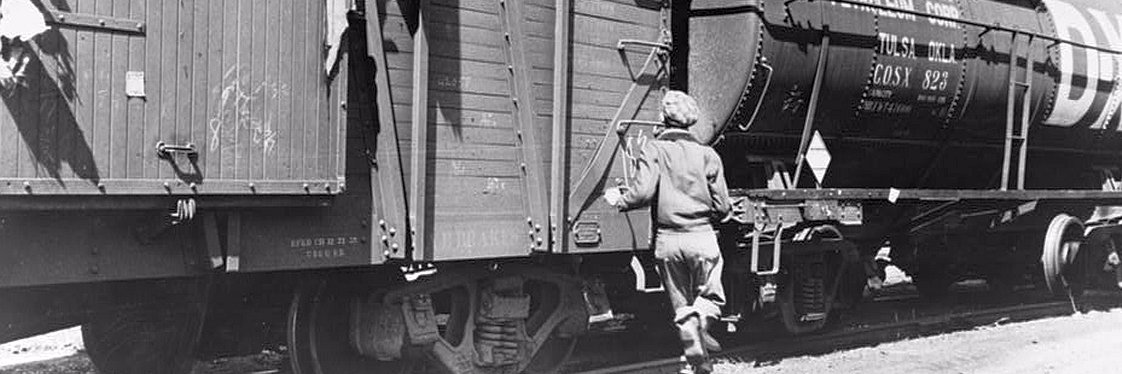
“𝐘𝐨𝐮’𝐫𝐞 𝐲𝐨𝐮𝐧𝐠 𝐚𝐧𝐝 𝐟𝐨𝐨𝐥𝐢𝐬𝐡 𝐚𝐧𝐝 𝐝𝐨𝐧’𝐭 𝐠𝐨 𝐡𝐨𝐦𝐞 𝐜𝐫𝐲𝐢𝐧𝐠.”
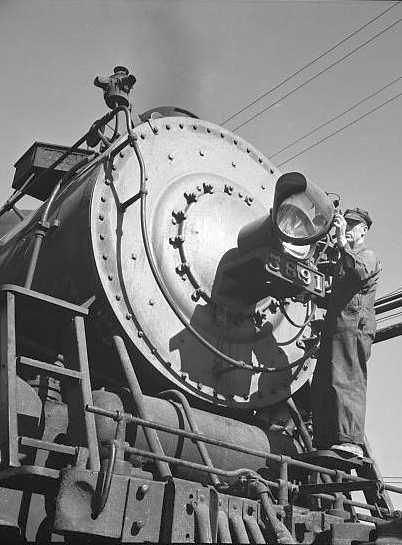
“The damp smell of steam mixed with the acrid odor of hot oil drifted through the morning air. The train gained speed. My buddy Poke and I moved at precisely the same moment. Poke grabbed the handrail of the tender and leapt on.
I followed without missing a beat,” said Jim Mitchell, recalling how he caught his freight when he ran away from home in 1933.
“Oh, hell, I don’t think I was twenty miles down the road when I knew I’d made a mistake. But you’re young and foolish and you don’t go home crying.”
The road kids’ first weeks away from home could be euphoric. “I experienced a feeling of freedom, such as I’d never felt before,“ wrote Earnest L. Best.
Boys who’d never left the town of their birth logged thousands of miles on the railroads and highways of America. They crossed the Continental Divide and thrilled at their first sight of the Rockies; they roared through the Sacramento Valley and down to the coast, many who’d never seen the sea coming to gaze in wonder at the Pacific.
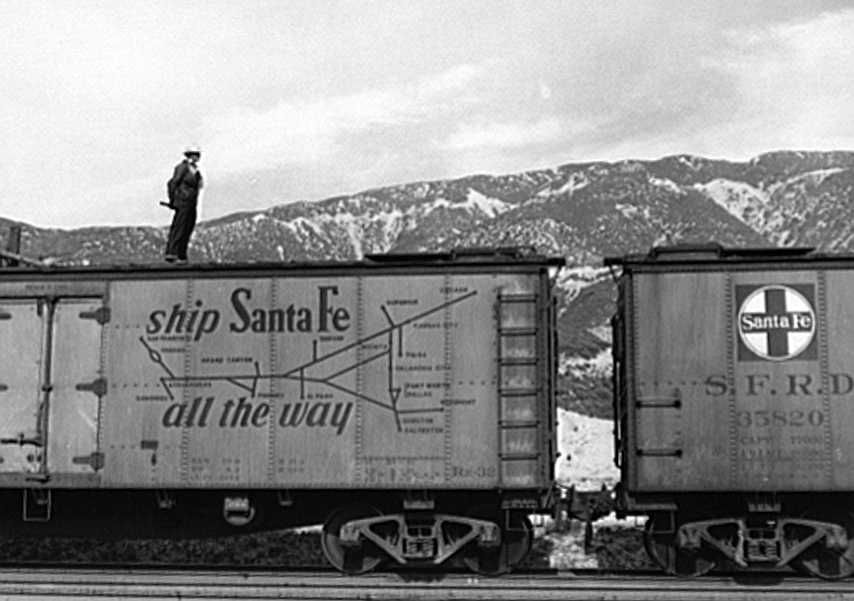
George Phillips rode the rails from the age of eleven until he reached seventeen, first catching local freights out of his home town of Princeton, Missouri, and later traveling by boxcar throughout the West.
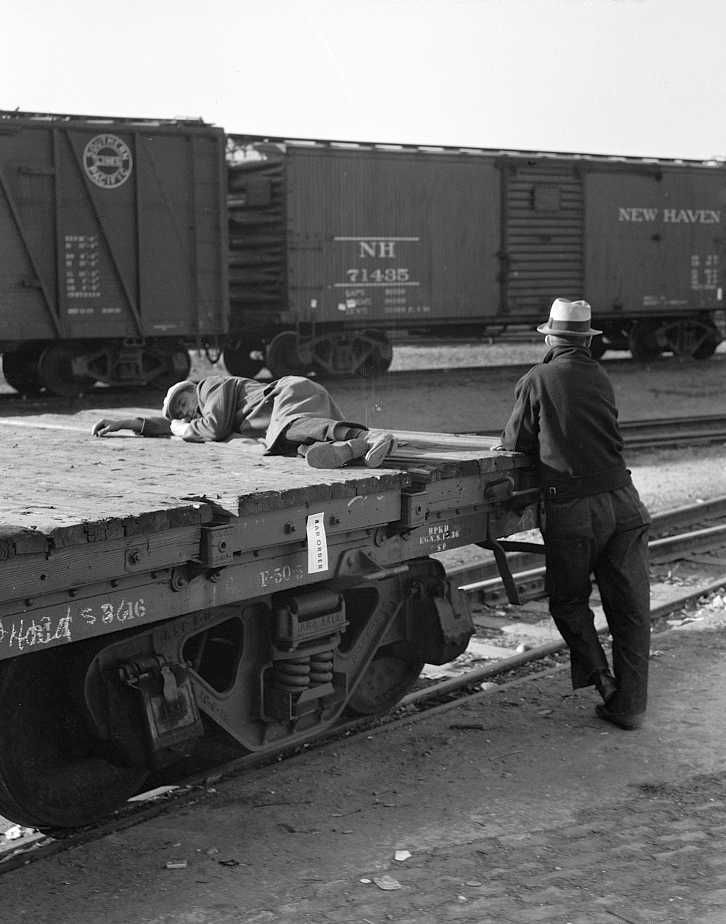
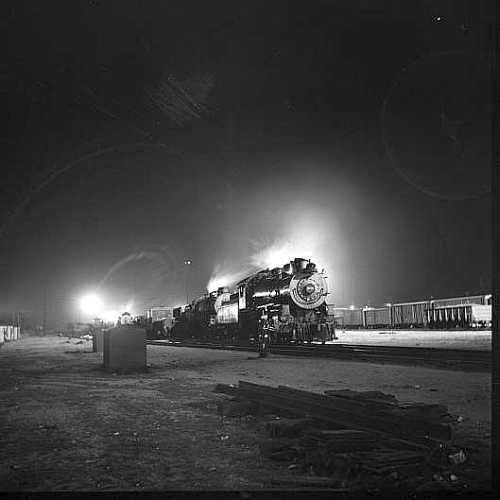
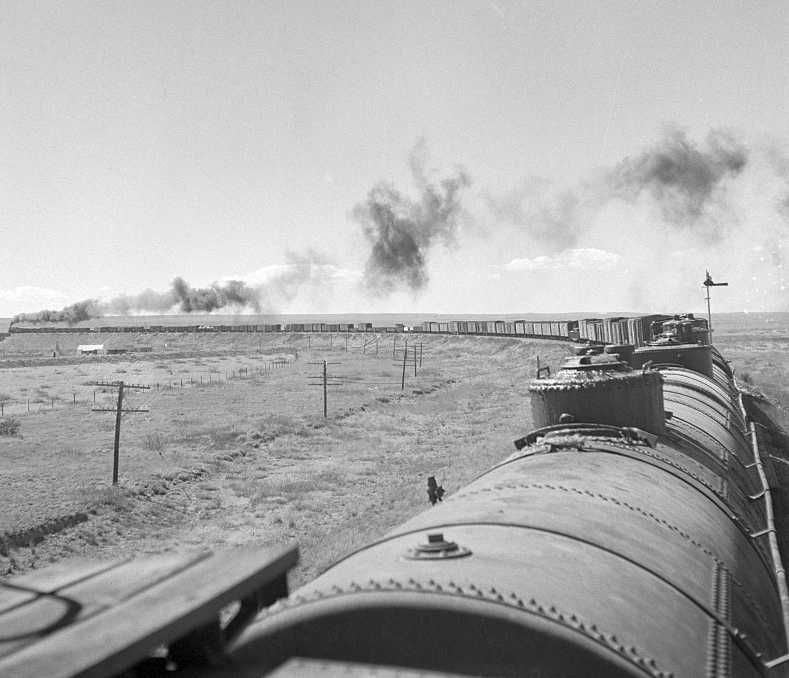
“There is no feeling in the world like sitting in a side-door Pullman and watching the world go by, listening to the clickety-clack of the wheels, hearing that old steam whistle blowing for crossings and towns,” Phillips reminisces. Riding at night, in the pitch dark, he’d see the lights of farmhouses. “I’d imagine those lucky people sitting down to supper. I might have nothing but some dry doughnuts. It was no big deal because I was going somewhere. Wanderlust really had me.”
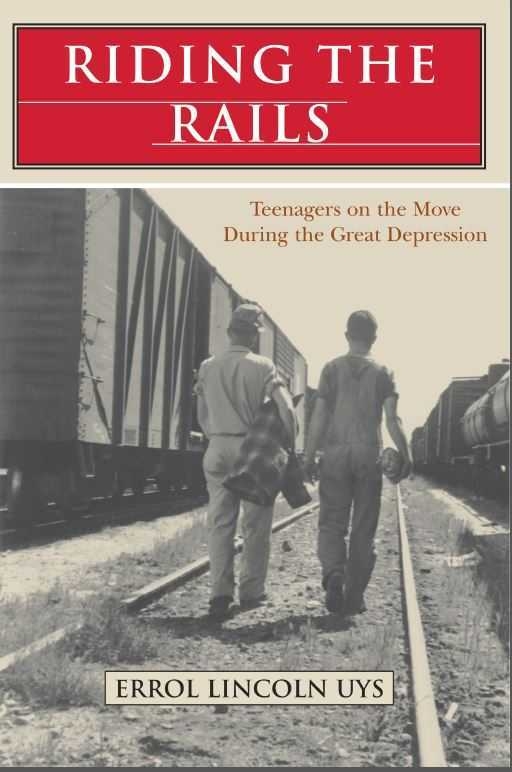
Excerpt from my book 𝑅𝑖𝑑𝑖𝑛𝑔 𝑡ℎ𝑒 𝑅𝑎𝑖𝑙𝑠: 𝑇𝑒𝑒𝑛𝑎𝑔𝑒𝑟𝑠 𝑜𝑛 𝑡ℎ𝑒 𝑀𝑜𝑣𝑒 𝐷𝑢𝑟𝑖𝑛𝑔 𝑡ℎ𝑒 𝐺𝑟𝑒𝑎𝑡 𝐷𝑒𝑝𝑟𝑒𝑠𝑠𝑖𝑜𝑛 by Errol Lincoln Uys https://t.co/x9qoW87gup
I am the author of Brazil and Golden City Boy: Born in South Africa *(Coming 2027)
#GreatDepression #1930s #AmericanHistory #RidingTheRails #LibraryOfCongress #Trains #HistoryInColor #VintageRailroad #Railroads #Trains
"The lonesome wail at every whistle stop..."
Critics from the Chicago Tribune to the Boston Globe have called it "gripping," "riveting," and "remarkable."
Riding the Rails dispels the myths of the hobo existence and reveals the true story of a daring generation that survived the hardest times in our nation's history.
🚂 Start the journey: Amazon -- https://t.co/klqA4UCRX7
#GreatDepression #HistoryMatters #Boxcar #TrueStory #Americana
"There is a place inside my chest that still hurts."
That is how one rider recalled the search for the things they had lost during the 1930s. I spent years holding these handwritten letters in my hands, feeling a direct connection to lonely teenagers standing beside the railroad tracks 60 years ago.
Riding the Rails is more than just history—it's a testament to the pluck, courage, and enduring faith of ordinary Americans. These teens learned lessons in self-reliance and compassion that stayed with them for 40 years.
📖 Discover this unforgettable narrative: Amazon --ow.ly/WKVH3086f7R
#OralHistory #Americana #HoboLife #Books #1930s #HistoryMatters
They grew up fast in speeding boxcars and hobo jungles.
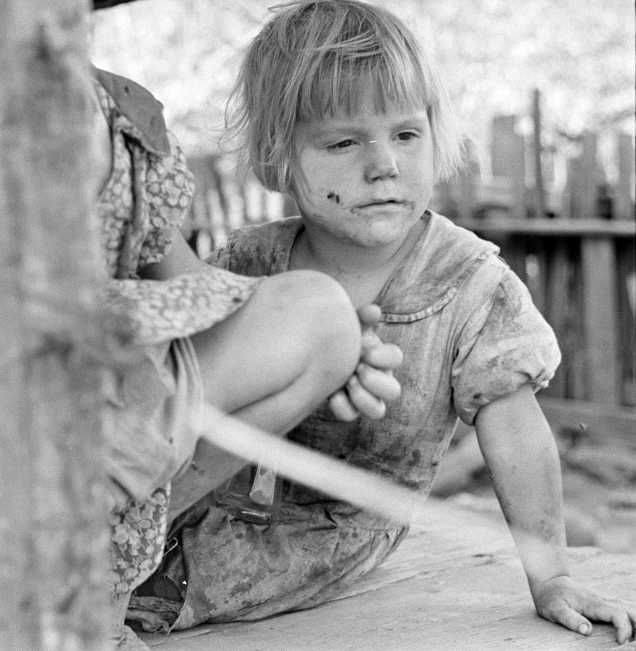
During the height of the Great Depression, a quarter of a million teenagers—the "boxcar boys and girls"—left their homes to hop freight trains. They weren't just looking for adventure; they were looking for a way to survive a country that was "dying by inches."
Drawing on 3,000 personal letters and 40 hours of filmed interviews, Riding the Rails brings this neglected saga to life. These are honest-to-God stories of "gaycats" and "dingbats" who saw a landscape of ruin and still held onto hope.
🚂 Witness America’s bleakest era through the eyes of the young men and women who lived it: https://t.co/klqA4UCRX7
#GreatDepression #AmericanHistory #RidingTheRails #TrueStories #1930s #OralHistory #Resilience
They grew up fast in speeding boxcars and hobo jungles."
At the height of the Great Depression, 250,000 teenagers left home to hop freight trains, searching for a better life farther down the line. They were "gaycats" and "dingbats" surviving on breadlines and dodging railroad guards in a country "dying by inches."
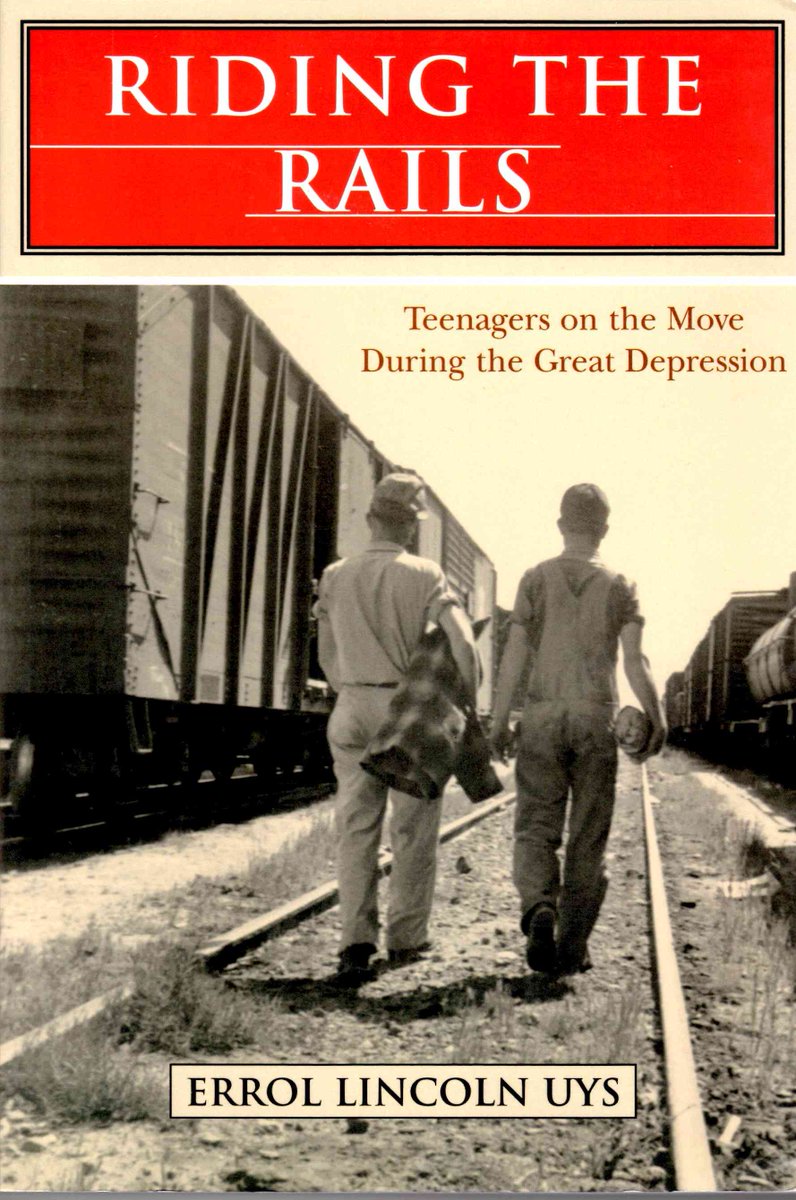
Riding the Rails: Teenagers on the Move During the Great Depression by Errol Lincoln Uys
"A riveting document of hope and hardship... a remarkable story." — The Boston Globe
Witness the 1930s entirely through the eyes of the young men and women who lived it, drawn from 3,000 oral histories and rare archival photos.
Buy now on Amazon https://t.co/klqA4UCRX7
#GreatDepression #AmericanHistory #RidingTheRails #OralHistory #DustBowl #ArchivePhotography #HoboLife #Boxcar #Trains #Americana #TheRoad #LostGeneration #NonFiction #MustRead
#HistFic #SocialHistory #TrueStories #EduTwitter #BookDeal #AmazonBooks #KindleDeals #HistoryMatters
A daring generation of America's children
They grew up fast in speeding boxcars and hobo jungles. Witness the Great Depression entirely through the eyes of the young men and women who lived it.
During the Great Depression, more than a quarter of a million teenagers left their homes and hopped freight trains looking for work or adventure. This is their story.
In Riding the Rails: Teenagers on the Move During the Great Depression I draw on 3,000 letters from boxcar boys and girls sent to the documentary makers. I had access to 40 hours of filmed interviews with 20 men and women chosen as potential candidates for the film.
Many letters are handwritten, as from old friends sharing honest-to-God stories. Time and again, I held a letter in my hand and felt a connection to a lonely boy or girl standing beside the railroad tracks 60 years ago. It left me with a deep sense of the inner strength and faith of ordinary Americans and their belief in this land.
We learn of their struggle to survive on the streets of America and know their bitter disappointments, their sense of loss of childhood, their frustrations at the lack of opportunity. “When I think of all this traveling across the land, searching for the things we had lost, there is a place inside my chest that still hurts,” recalls one rider.
When they left the rails and got a hold on their lives, they never let go. Many tell of keeping the jobs they found for 30 or 40 years. And the girls they met, too: many write joyously of their enduring devotion to the sweethearts they married when they settled down. Their stories told in their own words resonate with the pluck and courage they showed in going to seek a better life.
Illustrated with rare archival photos and drawing primarily on letters and oral histories of three thousand men and women who hopped freight trains, Riding the Rails brings to life a neglected saga of America in the 1930s. Self-reliance, compassion, frugality, and a love of freedom and country are at the heart of the lessons these teens learned.
This unforgettable narrative of a daring generation of America's children who rode the rails in search of a better life is a powerful reminder of what might turn up around the next curve. They are an inspiration to all who share a nostalgia for the road and the freedoms sought there.
https://t.co/x9qoW87OjX
#GreatDepression #1930s #AmericanHistory #OralHistory #DustBowl #ArchivePhotography #HoboLife #Boxcar #Trains #Americana #TheRoad #LostGeneration #NonFiction #MustRead
#HistFic #SocialHistory #TrueStories #EduTwitter #BookDeal #AmazonBooks #KindleDeals #HistoryMatters
Brazil -- In Search of Green Gold
"A masterpiece! 𝑩𝒓𝒂𝒛𝒊𝒍 has the look and feel of an enchanted virgin forest, a totally new and original world for the reader-explorer to discover. Who can resist such an invitation?"
A review of my book, 𝑩𝒓𝒂𝒛𝒊𝒍, (published in France as 𝐿𝑎 𝐹𝑜𝑟𝑡𝑒𝑟𝑒𝑠𝑠𝑒 𝑉𝑒𝑟𝑡𝑒) by Olivier Mauraisin, 𝐿’𝐸𝑥𝑝𝑟𝑒𝑠𝑠:
"With its eight and a half million square kilometers and five centuries of history, Brazil was certainly worthy of a saga commensurate with its scale. Errol Lincoln Uys tackled this task with admirable tenacity. This American of South African origin is making his literary debut in the heavyweight category, and he comes by the title honestly. A former journalist, he served for two years as the assistant to James Michener, the emperor of the epic novel. Uys is now flying solo, single-handedly exploring the depths of Brazilian history. It is no small feat.
Faithful to the tried-and-tested methods of his spiritual father, Errol Lincoln Uys spent five years scouring American and Portuguese libraries and crisscrossing the Brazilian interior. There is nothing like a 20,000-kilometer trek to fire the imagination. While Brazil meticulously retraces the great moments of Brazilian history as taught in schools, the heroes summoned by Uys possess all the charm of grand, old-fashioned fiction.
Beyond the Postcard
Two families share the spotlight for generations: the Cavalcantis and the da Silvas. A shared ambition drives them to carve out a place for themselves in this gigantic country where everything is yet to be invented. The Brazil seen by Uys thankfully has nothing to do with the postcards from travel agencies. To hell with the endless carnival, the beaches of Copacabana, and other tourist traps! Far from the festivities and the sun, this Brazilian epic is steeped in sweat and blood—colonization being exactly what it is.
When the Portuguese landed at the dawn of the 16th century, following in the footsteps of Pedro Álvares Cabral, the unknown was heavy with both promise and threat. The first pioneers, led by Nicolau Cavalcanti, risked their lives to forge a path through this untouched land. If nature was not easily tamed, the indigenous peoples were not exactly known for their goodwill either. Too bad for them; it was primarily on their backs that Brazil would be built. Over the centuries, the Tupiniquins, Tupinambas, Caetés, and so many other tribes of the "Green Fortress" would be written off as both winners and losers. The march of history shows no mercy.
The Compressor of History
On this land, more fertile than any other, discord and hatred flourish easily: between the Portuguese and the mazombos (whites born in Brazil); between colonists and Jesuits—those "black robes" who came to convert the pagans. "They are no longer content with harvesting souls," Uys writes, "and seek to establish a Jesuit paradise on earth." By wielding the sword as often as the aspergillum, they would eventually be banished from this "second Eden." Added to this were the Dutch ambitions and the age-old rivalry with Spain.
To conquer this gigantic, terrible country—the object of every nation's desire—required a massive dose of courage and tenacity. For the lucky few, the results were commensurate with the effort. Sugar cane and coffee plantations, immense cattle ranches, gold and diamond mines—fortune smiled on the bold. They almost forgot the population of some four million enslaved Africans imported to the land—ten times more than were brought to the English colonies in North America.
Uys unfolds this history with a wealth of detail and great mastery. Brazilis a "crypto-encyclopedic" work that resembles the virgin forest itself: it demands the temperament of an explorer from its reader. And if El Dorado is not found at the end of the journey, the change of scenery is total. Who could resist such an invitation?
Review of Brazil (La Forteresse Verte) by Olivier Mauraisin, L’Express (August 21, 1987)
https://t.co/v220FktNra
#Brazil #HistoryMatters #history #brazil #southamerica #epic #FamilyDrama #histfic #BookTok #historicalfiction #bookrecommendations #greatreads #EpicSaga #LatinAmericanHistory #amazonfinds #amazondeals #kindle
𝐓𝐡𝐞 𝐁𝐫𝐚𝐳𝐢𝐥𝐢𝐚𝐧 𝐄𝐩𝐢𝐜
"The first outsider to see Brazil with total honesty and sympathy and full empathy with the decisive moments in our history and their spiritual meaning."
A review of my historical novel, Brazil by Professor WIlson Martins, who was one of Brazil's most formidable critics, known for his "encyclopedic" memory and rigorous standards. Translated from the Portuguese.
"Just as the definitive novel of Canudos was written not by a Brazilian but by a Peruvian (referring to Mario Vargas Llosa), it has fallen to a South African to pen the great epic of our nation. This extraordinary story begins with indigenous tribes in the tropical rainforest and unfolds through hundreds of generations—symbolized by the recurring "Cavalcantis" and "Silvas"—who built Brazil. It culminates in the metaphorical crowning of Brasília: a transfiguration of the El Dorado myth we chased for five centuries, now transformed into an urban reality that is at once psychological, social, and political.
From José de Alencar to João Ubaldo Ribeiro—including Bernardo Guimarães, Jorge Amado, Haroldo Maranhão, and Herberto Sales—this has always been our most ambitious literary project. Yet, until now, it was only realized in fragments. Whatever the reasons for our previous failures to capture the "Brazilian essence" in its total organic form, the answer to why a foreigner succeeded where we struggled is found in a simple truth:
Errol Lincoln Uys possessed the necessary talent and the unique advantage of the outsider. He was able to view us "from the outside" while maintaining a deep, empathetic connection to the material. He "understood" Brazil as an imaginary creation—coherent despite its apparent inconsistencies, organic in its historical growth, and unified through its very contradictions. He captured that "will to be a nation" which philosopher Julien Benda once described as the hidden engine of history.
𝐅𝐫𝐨𝐦 𝐄𝐥 𝐃𝐨𝐫𝐚𝐝𝐨 𝐭𝐨 𝐁𝐫𝐚𝐬𝐢́𝐥𝐢𝐚
The Imperial era, the Paraguayan War, the Abolition of slavery, and the birth of the Republic—all these events converge like the segments of a rose window toward the myth of a reborn El Dorado: Brasília. The city stands as a symbol of territorial integration, the final destination of those early expeditions that pushed south and west under the "pretext" of hunting Indians while actually searching for a New World "Golden Fleece."
The publishers claim this book is destined to sit alongside the sweeping bestsellers of James Clavell and James Michener. On that point, there is no doubt. It is easy to envision the film or television series this book will almost certainly inspire.
If one were to offer a strictly literary critique, it would be that the author occasionally relies on the mechanical tropes of popular fiction—melodramatic "last-minute" happy endings or slightly simplified character archetypes.
𝐀 𝐌𝐚𝐬𝐭𝐞𝐫𝐩𝐢𝐞𝐜𝐞 𝐨𝐟 𝐍𝐚𝐫𝐫𝐚𝐭𝐢𝐯𝐞 𝐅𝐨𝐫𝐜𝐞
However, these minor flaws dissolve in the heat of Uys’s vigorous narrative art. He is an author perfectly at home within the massive historical mural he has created. His descriptions of the Paraguayan War—specifically the Battle of Tuiuti—find no rival in our own literature. These scenes evoke the grandeur of War and Peace rather than a standard commercial bestseller.
Throughout the book, from 1491 onward, Uys demonstrates a profound empathy for the turning points of our history. Whether writing of the indigenous peoples, the Portuguese, the mamelucos, or the pioneers from Pernambuco and São Paulo, he identifies the "Brazilian" as a figure that is not just historical, but psychological and sentimental. As one character notes in the 18th century, the past served as the "affective inspiration" for the bandeirantes as they ventured into the wilderness, seeking both gold and the future of a nation.
JORNAL DO BRASIL Book Review by Wilson Martins, 𝑩𝒓𝒂𝒛𝒊𝒍 by Errol Lincoln Uys (July 1987)
https://t.co/v220FktNra
#Brazil #HistoryMatters #history #brazil #southamerica #epic #FamilyDrama #histfic #BookTok #historicalfiction #bookrecommendations #greatreads #EpicSaga #LatinAmericanHistory #amazonfinds #amazondeals
#Amazon #histfic #Brasilia #LatinAmericaHistory #kindle
See less
During the Great Depression our nation was, in the words of President Franklin D. Roosevelt, “dying by inches.” From these times emerged 250,000 young people known as “boxcar boys and girls,” teenagers who shed their youth for a life on the rails. -- BOSTON GLOBE
“Riding the Rails” is a remarkable story, a riveting document of hope and hardship during one of the nation’s bleakest eras. For all that has been written about. the Depression, the travails of those under the age of 18 have been sorely underrepresented." -- KANSAS CITY STAR
"Go fend for yourself," Lee's father said. "I can't afford to have you around any longer." Like hundreds of thousands of youth across the country during the Great Depression, the 16-year-old left home, hopped a freight train, and started riding the rails. With more than 500 interviews, Uys so thoroughly re-creates the wretched conditions the boxcar boys and girls endured that the reader can all but hear the cadence of the trains on the tracks and the lonesome wail at every whistle-stop." -- DENVER POST
"One of the most poignant memories of the wandering youth of the Great Depression. They were among 4 million people to taste the bitterness of hobo life. A remarkable story, as gripping as it is well-researched." -- CHICAGO TRIBUNE
Errol Lincoln Uys (pronounced "Ace") has collected thousands of letters written by boxcar boys and girls about their experiences, and peppers his chapters on the various aspects of hobo life with lengthy quotations, allowing the riders to speak for themselves. Whether you're a "gaycat" (novice rider) or a "dingbat" (seasoned hobo), Riding the Rails is entertaining and inspiring, recapturing a time when the country was "dying by inches." -- Sunny Delaney, AMAZON History Editor
https://t.co/klqA4UCRX7
#USHistory #railroad #train #teenagers #kindle #books #booklovers #America #boxcar #GreatDepression #kids