What makes the #FusionRollup different, and why should institutions pay attention?
In this video, hear from Luke Riley, Head of Innovation at Quant, on why this is a genuine step change for institutions operating across multiple #blockchain networks, and what it means in practice.
Learn more about the Fusion Rollup in our recent announcement: https://t.co/GZrO5x1l9H
#QuantFusion #BlockchainInfrastructure
Crypto brought the first 1% of finance on-chain. #QuantFusion is built for the other 99%.
The technology has been proven for years. What was missing was infrastructure that regulated institutions could actually use.
That changes now: https://t.co/Geyvto1xA3
#Tokenisation #BlockchainInteroperability
Fusion's rollup capability is patent-protected in Japan.
The IP covers processing instructions across two or more DLTs and writing verification of that update back to the network. Enterprise-grade interoperability, built on protected foundations.
Learn more: https://t.co/1oQ0sL3mYn
#QuantFusion #DLT #Interoperability
Crypto brought 1% of finance on-chain. Fusion brings the other 99%.
Not a tagline. A real gap between what #publicblockchains have proved is possible and what regulated #financialservices actually needs to operate.
In this article, we unpack why both public L1s and private permissioned networks fall short for institutions, how Fusion's multi-ledger rollup connects existing ledgers without bridges, and where it sits relative to every major initiative already in market.
The first 1% proved the technology. The next 99% starts here: https://t.co/QvwllATbSj
#QuantFusion #Blockchain
Three shifts are defining the next generation of #financialinfrastructure: settlement moving from batch to continuous, siloed systems becoming interoperable, and manual processes becoming programmable.
2026 is when it stops being a roadmap and starts being operational: https://t.co/126YaEbRLa
#Programmability #Settlement #Interoperability
Most assets don't live on one chain. They exist as duplicate, incompatible tokens across Ethereum, Polygon, Solana and beyond - splitting liquidity and forcing institutions to bridge just to move value.
Fusion ends that. One asset. One unified pool of liquidity. Regardless of which chain it came from.
Learn more: https://t.co/GZrO5x1l9H
#QuantFusion
The financial system has managed #settlement risk for decades through margin and pre-funding. Atomic settlement doesn't reduce that risk. It eliminates the gap that creates it.
Central banks and major financial market infrastructures across the globe are already moving.
Read this article to understand what it means for your institution's infrastructure: https://t.co/xljupgPOnW
#AtomicSettlement #DvP #TokenisedDeposits
Most #retailfinance teams aren't dealing with a strategy problem. They're dealing with #reconciliation that compounds with every channel added, #forecasting that stops at insight and never reaches execution, and #cashvisibility that gets harder as the business grows.
Quant Flow is built for exactly that. Learn more in this article: https://t.co/VSsKKQDkra
#QuantFlow #Programmability
Quant Connect is getting a refresh.
Head to https://t.co/bmUjr7Y2gQ for a redesigned interface that makes it easier to manage credentials, run workflows, and move assets across chains.
A clearer split between #Overledger's connectivity and the Fusion Rollup's cross-chain execution environment.
#QuantConnect #QuantFusion
The countdown is on.
On 25 June, we're sponsoring @UKFtweets's Digital Innovation Summit in London.
@gverdian takes the stage for 'Tokenisation and GBTD showcase: the art of the possible' alongside Ryan Hayward (Barclays) and Peter Left (Lloyds Banking Group).
The session will include a live video demo of @GBTD, insights from the pilot, and a look at what comes next, including how the initiative maps to the National Payments Vision.
Reserve your place: https://t.co/2xK5fL10s7
#Tokenisation #Payments
Where do #FlowApplications fit?
For enterprises and financial institutions, they're the layer that turns Overledger's unified control plane into secure, repeatable business workflows, a single execution environment instead of a growing web of independent contract deployments.
Learn more: https://t.co/g8vvc0R1iw
#QuantFusion
Most #blockchaininfrastructure forces a choice: commit to a single network, or stitch together fragmented solutions across chains with third-party bridges.
The #FusionRollup overcomes that trade-off. Rather than anchoring to one blockchain, it connects to many at once - moving assets, settling transactions, and sending messages across chains are built-in capabilities, not workarounds.
#QuantFusion
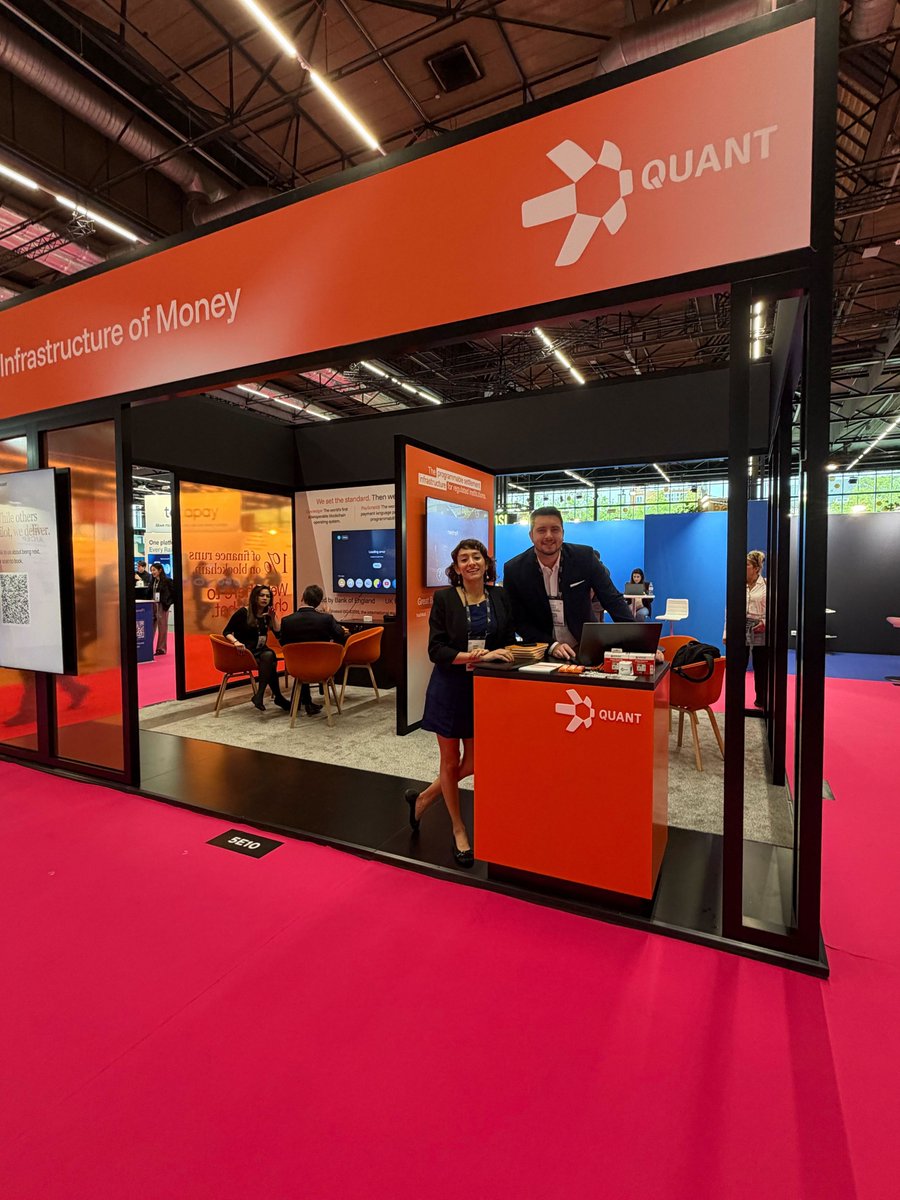
✅ Day 1 at @money2020 complete! We witnessed incredible conversations, great energy, and a happy hour that brought the industry together.
Day 2 is well underway. Find us at stand 5E10 - it's not too late to come and meet the team behind the international standards for blockchain and interoperability.
Here's what's waiting for you:
➡️ Live demo: watch a tokenised deposit settle in seconds on Quant rails
➡️ Walk-through: see how Quant connects to existing core banking systems and blockchain networks
➡️ Meet with our commercial team: map your pilot-to-production roadmap
We set the standard. Then we built the technology. Come and see what that looks like in practice.
#TokenisedDeposits #ProgrammableMoney #Money2020
6/ The part I'm most proud of: unified assets.
A example of a stablecoin like USDC or a tokenised fund like BUIDL scattered as 7 separate copies across 7 chains becomes one - uUSDC or uBUIDL. One asset. One pool of liquidity. Each still anchored to its origin chain, withdrawable anytime.
Institutions stop managing fragmentation and start using their assets.
5/ Most people write a standard, or build a product. We did both.
Fusion is that standard, live in production, 74 networks, public and permissioned, with assets, settlement and messaging moving across them natively. No insecure bridges. No wrapped tokens.
4/ I also believed interoperability couldn't be one company's product. It had to be a global standard the whole industry could trust.
So I took it to ISO in 2016, establishing #TC307 in 2017. Today, 10 years later that work is ISO 82098 the international standard for blockchain interoperability.
3/ I've spent my career on both sides of this problem securing institutions as a CISO, then building the interoperability the industry didn't have.
The industry and institutions kept hitting the same wall: pick one chain, or duct-tape bridges across many. Neither works at scale.
2/ Since my introduction to blockchain in 2008, I believed one thing: the future of finance can't run on a single blockchain. It has to connect all of them.
Today, that belief ships. The Fusion Rollup is live on mainnet, the world's first multi-ledger rollup. 🧵
8/ A decade of work. A global standard. Three patent families. And a team that has constantly solved the hard problems.
Fusion is live now:
→ https://t.co/of2vIVkuWJ
→ https://t.co/B4RgpNAUbm
7/ And it's accountable by design. Governance and compliance aren't bolted on, they're enforced at every layer, on the platform and on chain.
That's the difference between a demo and infrastructure a bank can actually run.