Build a custom private app with no code on Helius.
$FORGE is live.
CA: YCvCKaEddUZekjaWPvdiof2VQR3MB8JJQLjn5NZpump
Drop a Checkout page, Private transfer and Receipt on a canvas, wire them, press Publish. A private checkout, live at its own URL.
https://t.co/P69Ys0Hffh
Take your app with you. Export turns the graph into a standalone Vite and React app: graph.json, the blocks it uses, the runtime, a README and an .env.example for your RPC and Helius key. npm install, npm run dev. Private transfers run in the browser with the Privacy Rings SDK.
Every Ringforge app can be checked. At publish the owner signs a Memo with the SHA-256 of the app's graph. Fetch the graph from the public API, hash it, compare with the Memo on Solana. A live one: af33ba9b…, and it matches. Change one setting and it won't.
Two templates that never pull money. A tip jar: three suggested amounts or your own. A subscription: a monthly link members come back to. Every payment is signed by the visitor from their own Ring. No allowance, nothing charged without them.
Private bounty payout. Hunters submit a link through a form and connect a wallet. On payout day you split the pot equally between the winners and pay them in one proof, each to the Ring of the wallet that submitted. A receipt and a statement for your books.
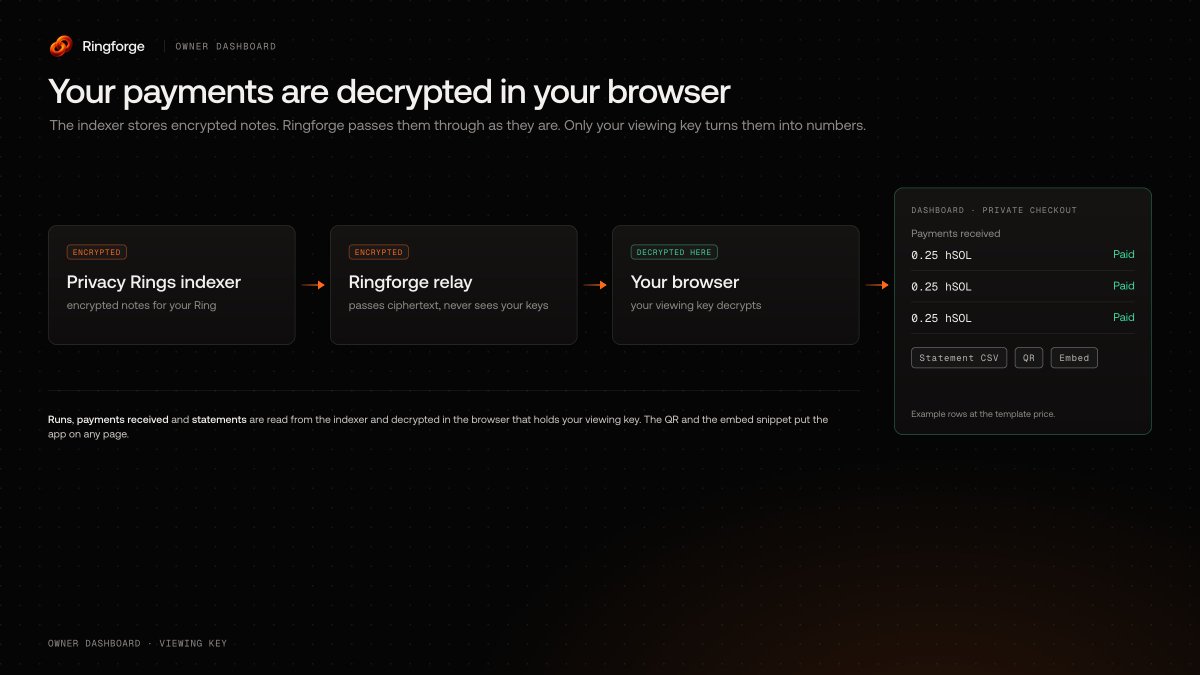
Your dashboard reads encrypted notes from the Privacy Rings indexer and decrypts them in your browser with your viewing key. Ringforge passes the ciphertext through and never sees your keys. Runs, payments, statements as CSV, plus a QR and an embed snippet.
Private invoice: a number and a total, paid from the client's Ring. The invoice number rides in the encrypted memo. The client gets a receipt link. Your auditor gets your viewing key, encrypted to their wallet: they can read the history and cannot move a coin.
Where the line sits. Public: wallet addresses, deposits, withdrawals, and a Jupiter swap when it executes. Encrypted: balances, assets and amounts inside the Default Ring. Convert to hSOL, Shield, then pay privately. Every Ringforge app draws this line in its Diagram view.
Treasury split: every payment that reaches your Ring is split by percent, 50/30/20 in the template, and paid to each partner in one private transfer. A quarterly statement decrypts in your browser. An observer sees the addresses. Not the payment, not the shares.
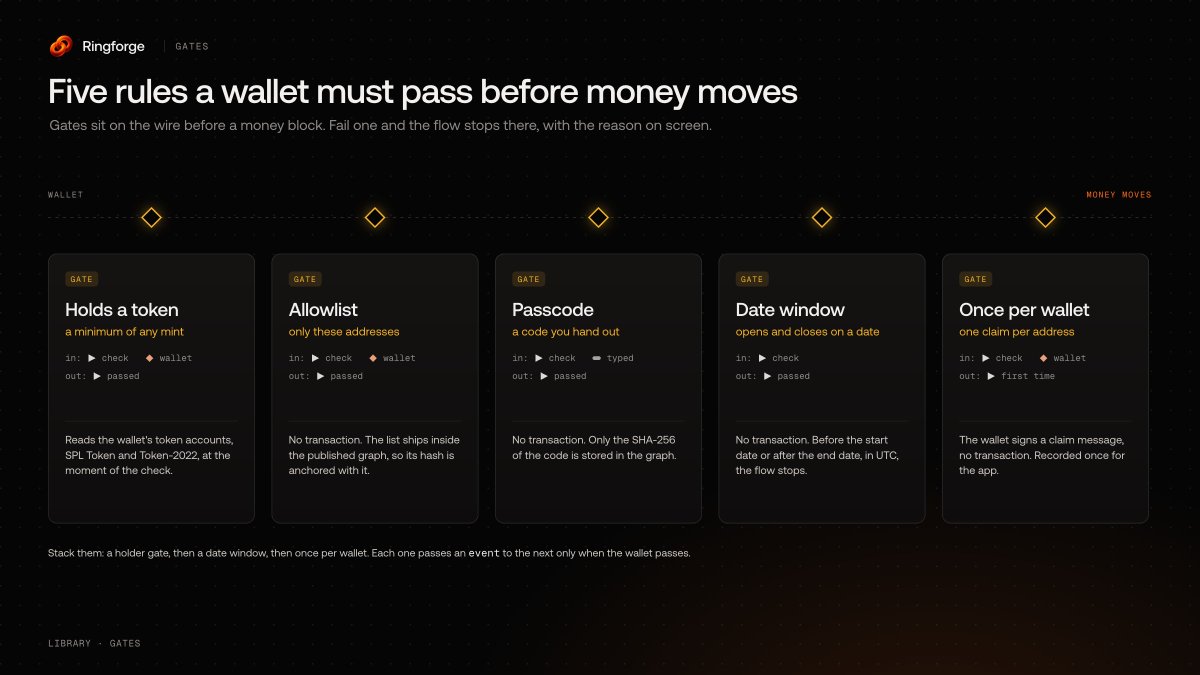
Five gates to put in front of any money block: Holds a token, Allowlist, Passcode, Date window, Once per wallet.
Stack them in any order. A wallet that fails one stops right there, with the reason on screen. A passcode is only ever stored as its SHA-256.
Gated claim: a holder connects, passes Holds a token and Once per wallet, and claims. You pay every approved claim from your dashboard, privately, up to 15 wallets per proof. Point the mint at your own token and it is a private airdrop for your holders.
Gated claim: a holder connects, passes Holds a token and Once per wallet, and claims. You pay every approved claim from your dashboard, privately, up to 15 wallets per proof. Point the mint at your own token and it is a private airdrop for your holders.
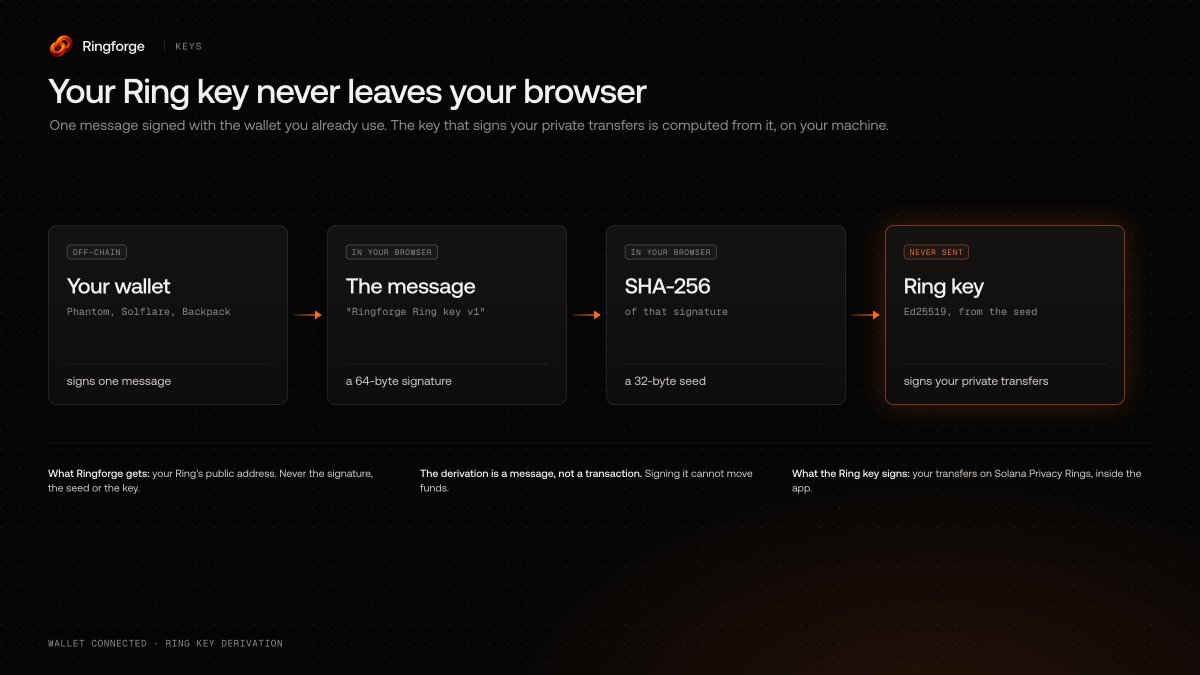
Your Ring key never leaves your browser. Your wallet signs one message, not a transaction. The SHA-256 of that signature seeds an Ed25519 key, computed on your machine. That key signs your private transfers. Ringforge only ever sees its public address.
Private payroll is a template. Drop in a CSV of addresses and amounts, pick the day, then open your dashboard and sign the run. One proof pays up to 15 people from your Ring. An observer sees the addresses. Not one salary.
The block that moves the money.
Private transfer takes a run event, an amount, a recipient, a list of up to 15 rows and a memo, and hands on sent and the transaction. On chain it is one Groth16 proof on the Default Ring, amount and memo encrypted.
One private sale on Ringforge, as the Diagram view draws it. The buyer signs one message and their Ring key is derived in the browser. Their Ring pays yours with one Groth16 proof. Anyone watching the chain sees two addresses and a time. Not the price, not the asset.
How a Ringforge app gets made.
Open a template or a blank canvas. Snap blocks: each port only takes its own type. Press Test: every money step is built with the Privacy Rings SDK and simulated on mainnet. Publish: a live app, its source code and a hash on Solana.
Every paid publish on Ringforge pays 0.05 hSOL. From launch, those fees buy $FORGE every hour, up to 0.05 SOL an hour, on the https://t.co/aODT2G037W curve first and Jupiter after, and every token bought is burned.
Hold 1,000,000 $FORGE and every app you publish on Ringforge is free.
The same wallet unlocks the Webhook block and custom themes for your apps. Ringforge reads your balance from chain at the moment you press Publish, nothing to stake.
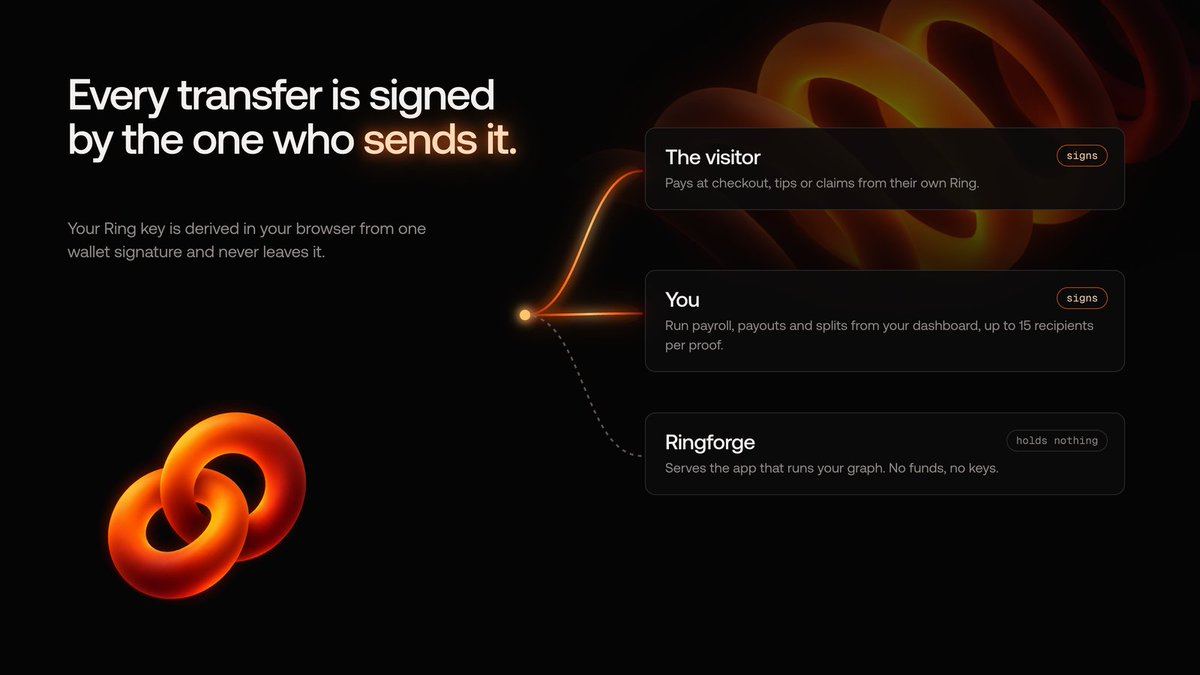
Ringforge holds no funds and no keys.
The visitor signs at checkout from their own Ring, derived in the browser from one wallet signature. You sign payroll, payouts and splits from your dashboard, up to 15 recipients per proof. The hosted app runs your graph and holds nothing.
Eight templates open as finished, editable diagrams: private checkout, payroll from a CSV, gated claim, subscription, tip jar, treasury split, invoice with receipt, bounty payout. Change any block, press Test, publish.