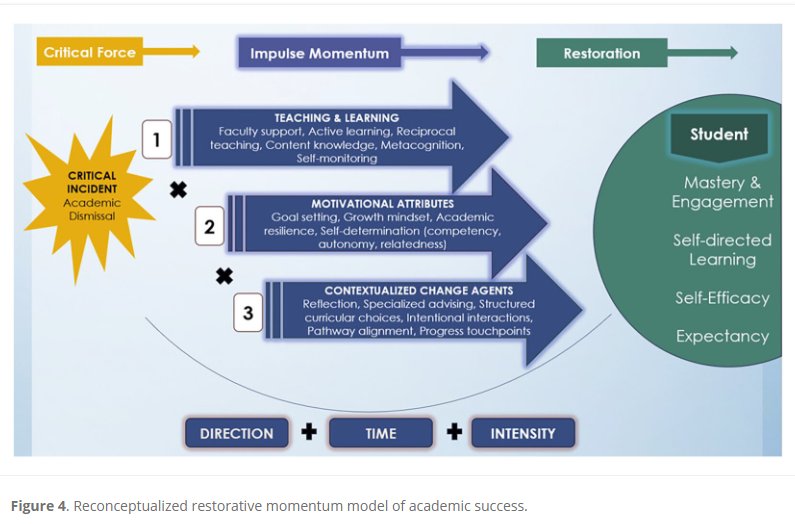
Thrilled to share my latest publication: From Setback to Success: A Restorative Momentum Model for Students Returning from Academic Dismissal.
🔸Key takeaway: Cultivating motivational habits and faculty support along with structured advising can help students bounce back stronger!
Read here: https://t.co/9IglBoQ0ay
@SageEducation@CCollegeReview@TXHigherEdBoard @XueliWang1 @crisp_gloria @krwickersham @MikeFloresPHD
Lilly Conf: "AI & the Future of Evidence-Based Teaching" — Presented Riff (AI reflection tool) to build clinical reasoning in DPT students via rich dialogue. LLM analysis of transcripts revealed progressive themes.
*AI as mediating structure for deep reflection
*Grappling with professional ambiguity
*Ethical LLM blueprint for qual analysis
@MegsterW
@SoLInTheWild This is a really important point. I get this question a lot at AI conf presentations I've done about studies where students were helped, supported by AI in writing, thinking & not trying to game anything.
Mark A Bassett writes: "Unsupervised written assessment, in isolation, has never provided a defensible evidentiary basis for student learning. GenAI has not created this problem, although it has removed the conditions that allowed institutions and academic staff to avoid confronting it." https://t.co/7kbU4LQYK1
How do we prepare students to WORK with AI rather than around it? Presenting this week at the TXST AI in Teaching & Learning Symposium:
*AI-Resilience in OTD capstone writing
*AI-Assisted qualitative analysis
Sharing pedagogy+methodology!
@txst@uiwcardinals
This is excellent because it is nuanced and realistic. You have hit on some of the most challenging aspects of ensuring assessment is truly giving you a snapshot of student learning starting from practice!
Transfer-appropriate processing vertelt ons welk soort denken het leren moet omvatten. Contextual interference zorgt ervoor dat het denken ook daadwerkelijk plaatsvindt. Als leren er op dat moment wat slechter uitziet, is dat misschien wat we willen. https://t.co/A5DmbLbPmq
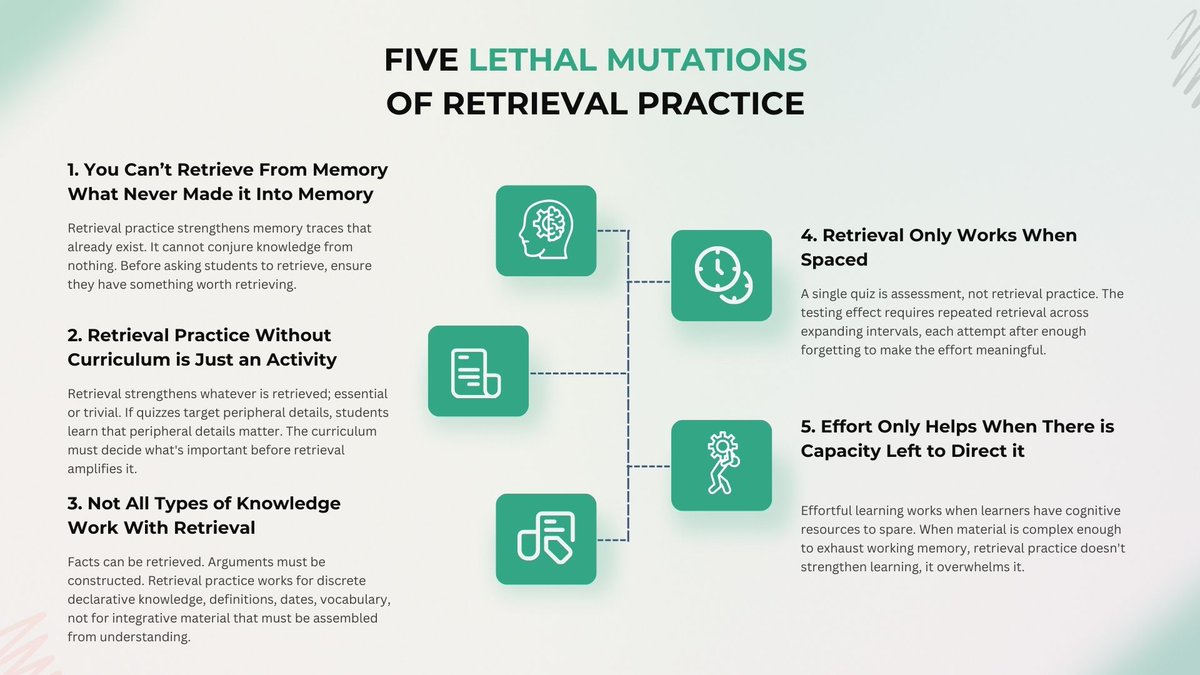
Number 2 is perhaps at the core of all of this not only because it establishes worth but also curriculum needs to afford intentional opportunities for retrieval and consolidation. Largely coverage dominates teaching and leaves little for much else!
Retrieval practice is a powerful tool but it's rapidly becoming a lethal mutation. Here are five principles to think about when trying to apply it more effectively.
One of the most balanced, deep dives of where we are headed w/ GenAI in education. An important point not talked about enough is we must understand/define learning and use it as both start and end point!
+1 for "context engineering" over "prompt engineering".
People associate prompts with short task descriptions you'd give an LLM in your day-to-day use. When in every industrial-strength LLM app, context engineering is the delicate art and science of filling the context window with just the right information for the next step. Science because doing this right involves task descriptions and explanations, few shot examples, RAG, related (possibly multimodal) data, tools, state and history, compacting... Too little or of the wrong form and the LLM doesn't have the right context for optimal performance. Too much or too irrelevant and the LLM costs might go up and performance might come down. Doing this well is highly non-trivial. And art because of the guiding intuition around LLM psychology of people spirits.
On top of context engineering itself, an LLM app has to:
- break up problems just right into control flows
- pack the context windows just right
- dispatch calls to LLMs of the right kind and capability
- handle generation-verification UIUX flows
- a lot more - guardrails, security, evals, parallelism, prefetching, ...
So context engineering is just one small piece of an emerging thick layer of non-trivial software that coordinates individual LLM calls (and a lot more) into full LLM apps. The term "ChatGPT wrapper" is tired and really, really wrong.
The zombie myth of learning styles that just won't go away! There is no evidence whatsoever that using or being taught with a """learning style""" produces better learning outcomes. Strategies, prior knowledge and the domain dictate far more. Stick to tech pls!
Biggest career accelerator in the next decade: get really, really good at learning
- figure out your learning style
- use AI to convert material into that format/style (podcasts, quizzes, etc.)
- apply knowledge
- repeat
Learn fast, grow fast
@karpathy Your list is why I have moved away from long threads and often start new conversations with different llms. I intentionally stopped the memory function when chatgpt first rolled it out because I found it stifled innovative responses and got stuck on a few knowledge pieces.
New randomized, controlled trial of students using GPT-4 as a tutor in Nigeria. 6 weeks of after-school AI tutoring = 2 years of typical learning gains, outperforming 80% of other educational interventions.
And it helped all students, especially girls who were initially behind
Have been sharing this research, along with attention residue, with my first year college students as I help them develop executive management skills. It has made a big difference as they understand why I build certain class norms for focused learning!
We have research showing that #attention-contagion is a thing in the psychology lab.
Turns out: newer research shows that it's also a thing in real classrooms.
Here's the story:
https://t.co/WpI0hpcRlL
Thrilled to share my latest publication: From Setback to Success: A Restorative Momentum Model for Students Returning from Academic Dismissal.
🔸Key takeaway: Cultivating motivational habits and faculty support along with structured advising can help students bounce back stronger!
Read here: https://t.co/9IglBoQ0ay
@SageEducation@CCollegeReview@TXHigherEdBoard @XueliWang1 @crisp_gloria @krwickersham @MikeFloresPHD
Absolutely! Features like this could remove the time consuming implementation for educators presented with endless guides and so many choosing not to allow use at all. It can also remove the need for external AI tools.
Stumper: why publish user guides instead of just changing your features to enable "student writing mode"?
Encode this stuff!
Then it's just a flip of a switch and students get the scaffolding they need to learn and write better with less risk of deskilling, demotivation, etc?
@emollick Absolutely. Code interpreter useful for qual research especially in ways that often limit its use. OpenAI's custom GPTs can be extremely useful for educators w ability to feed quality content and a means to scale up use in whole departments. But improvements much needed.