⚠️ 6 Fr (compared to 4.8) preoperative double j stent seems more hopeful to be able to plan a future RIRS session with an ureteral access sheath said one of our recent studies.
🚨NEW PAPER ALERT 🚨
Outcomes of retrograde intrarenal surgery in patients on anticoagulant or antiplatelet therapy : a multicenter matched case–control study by the @RIRSearch Study Group
Check out our most recent paper!
https://t.co/T7P9Xh2jgv…
Ureter is not for the stones passing, ureteroscopes or access sheats, it is solely for the urine, our most recent study said.
Non-virgin ureters were associated with higher periop. complication rate, longer hospital stays
and increased need for auxiliary treatments during RIRS.
Hot off the press!!
Can we predict post-RIRS fever?
Yes! Here are the risk factors;
👉 Longer operation times
👉 High BMI
👉 High preop. systemic immune-inflammation index (SII) (PxN/L)
👉High platelet/lymphocyte ratio (PLR), 👉Urine leukocyte positivity
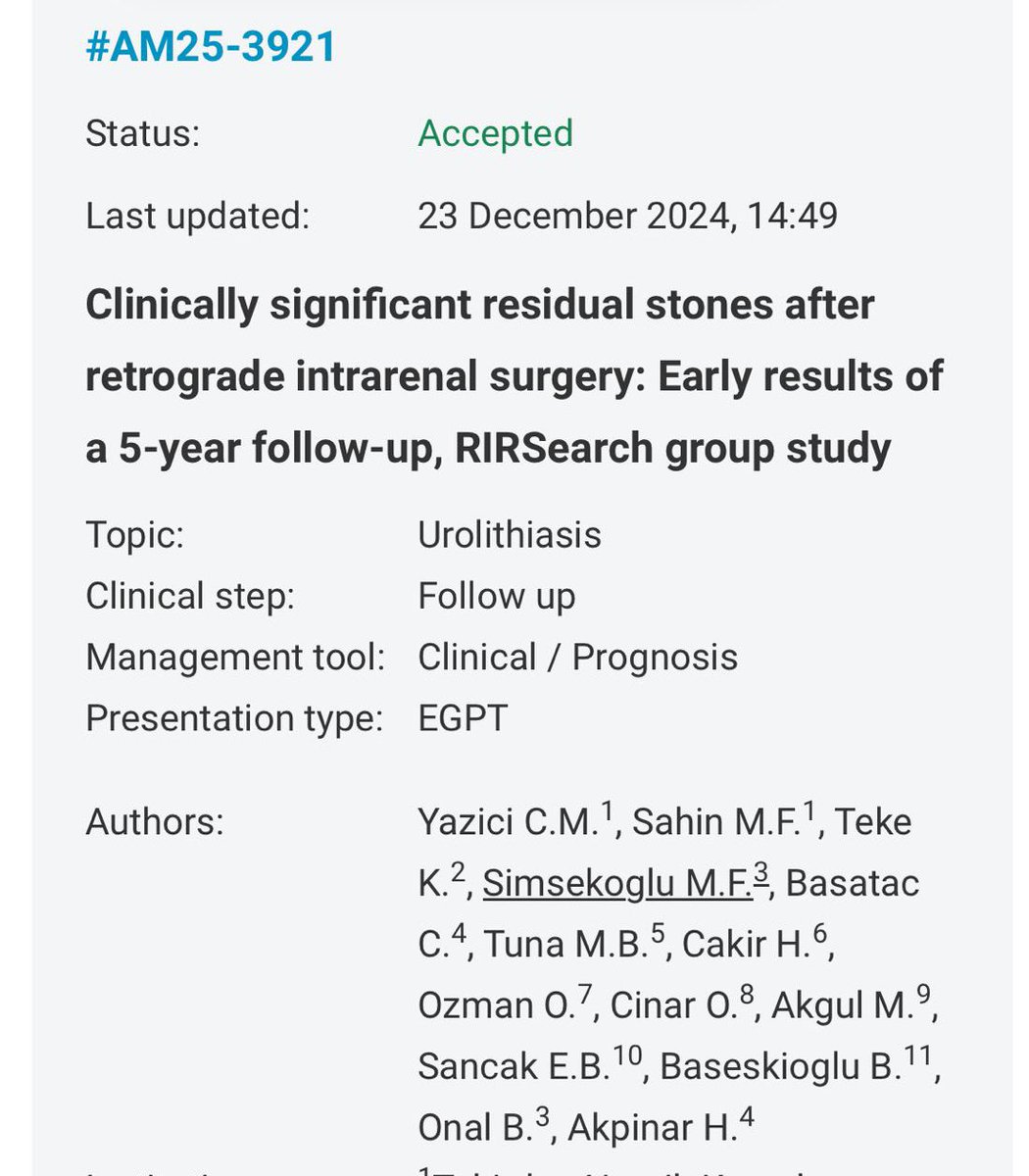
We will be present at the #EAU25 with studies pursuing the answers of questions that are still valid in daily #RIRS practice;
👉 What happens to residual stones?
👉 What is the ideal timing for preop. urine culture?
👉 What strategy should be adopted with blood thinners?
🚨NEW PAPER ALERT 🚨
Lower pole is lower #stonefreerate after #RIRS
Myth or fact?
Check out our most recent paper for the answer;
https://t.co/zpE7b0pdqp
🚨NEW PAPER ALERT 🚨
YES, prestented cases are easier with RIRS!
BUT, is jj stent harmful, how long should be kept, what if causes catheter-related UTI ???
Check out our latest paper; https://t.co/LuRJfkNQHz
Our latest paper showed that RIRS may take long in older patients (>65 years), but younger patients (18-29 years) suffer more from postoperative mild (Clavien I-II) complications.
https://t.co/l2W9TqNLp3
“No retirement for reusable flexible scopes, they should work till their death” said our latest study which comparing the early and late cases with the same scope.
All 5 scopes had been used around 100 cases (per scope) before they were completely broken.