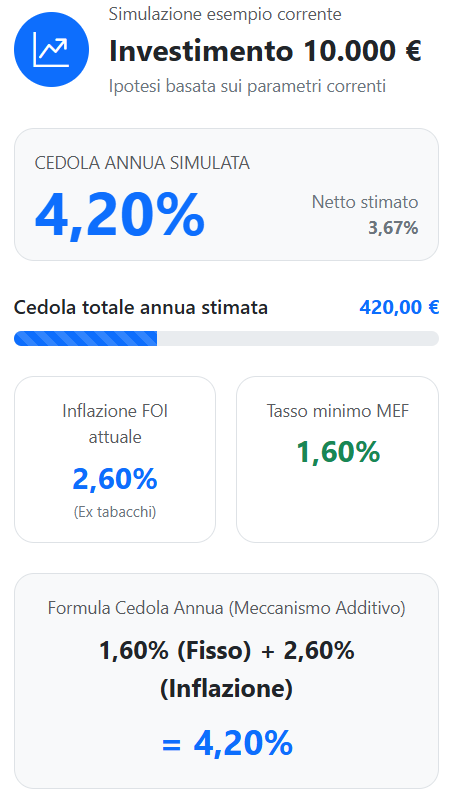
Simulatore BTP Italia Sì 2026: simulatore con tasso minimo garantito dell'1,60%.
Aggiornato al comunicato MEF del 12 giugno 2026 • Prima emissione con godimento e regolamento dal 23 giugno 2026 al 23 giugno 2031
https://t.co/h11Fe8VWZD
Qualcuno può spiegare ai "geni" della BCE che non ha senso alzare i tassi d'interesse per fermare l'inflazione in EUROPA? Loro sanno che stiamo già morendo di fame? Sanno che chi ha un mutuo casa già adesso fa fatica per pagare la rata? Hanno capito che la guerra non si ferma alzando i tassi d'interesse? La guerra si ferma con altro. Banchieri di "merda"
#BCE #Euribor #ChristineLagarde
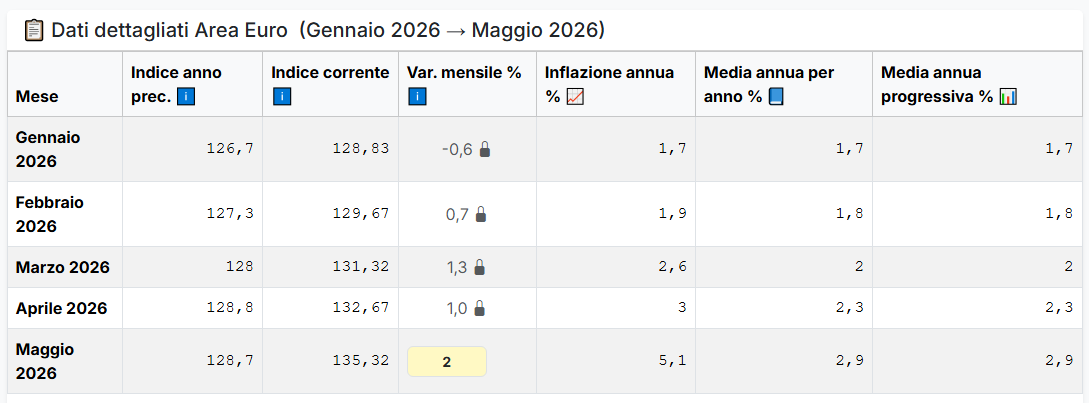
Domani Eurostat pubblicherà la stima flash dell'inflazione dell'Area Euro di maggio.
Abbiamo provato a simulare il dato utilizzando il modello basato sugli indici HICP.
Negli ultimi due mesi la variazione mensile è stata:
• Marzo: +1,3‰
• Aprile: +1,0‰
Per avere una forte accelerazione dell'inflazione annua servirebbe una variazione mensile di maggio decisamente superiore a quelle appena osservate.
Ad esempio, una crescita di circa +2,0 mensile porterebbe il tasso annuo fino al 5,1%.
La domanda quindi è semplice:
È realistico attendersi a maggio una variazione mensile doppia rispetto a quella registrata ad aprile?
In attesa del dato ufficiale di domani prova qui le tue previsioni https://t.co/VLPT1VbvRH
#inflazione #Eurostat #AreaEuro #BCE
Se Ciccone arriva all'attacco della salita quando mancheranno 5 km e se il suo distacco sarà 50'' dagli inseguitori e la sua potenza al 9,5% sarà intorno a 390 watt con una velocità di circa 18 km/h gli inseguitori per prenderlo a 1 km dall'arrivo devono salire a 423 Watt a 19,1 km/h.
Prova l'utilità in real-time!
https://t.co/KoPIWgJXGN
#giroDitalia
Ho progettato questa APP https://t.co/0nGq8plyDw
gratuita sperando che venga usata dai nostri telecronisti RAI così potranno informare puntualmente (già lo fanno) chi guarda il giro. Sapranno benissimo dopo quanto e a quale velocità dovrà andare il gruppo per riprendere la fuga e la velocità della fuga per non farsi riprendere dal gruppo. FACILE e GRATUITA. Fatemi sapere se vi piace ed è utile! Buon GIRO.
#Giroditalia
I largely agree with this. The general concept is physiologically sound and aligns well with current understanding of mitochondrial metabolism and lactate dynamics.
One important nuance though: Zone 2 is not “maximal mitochondrial capacity” in an absolute sense — otherwise we would already be approaching VO2max intensity. It’s more accurate to say that mitochondria are working at a very high sustainable oxidative flux while metabolic homeostasis is still maintained.
Also, fat oxidation is often near peak in Zone 2, but “FatMax” can occur slightly below classical LT1 depending on the athlete.
The key point, in my opinion, is this:
Zone 2 provides a very high aerobic stimulus with relatively stable internal conditions, allowing prolonged exposure, strong mitochondrial signaling, and efficient recovery. That’s why it’s so effective for endurance development.
But performance is never built by Zone 2 alone.
Mitochondrial density, metabolic flexibility, and lactate clearance are heavily trained there, while VO2max, glycolytic power, neuromuscular recruitment, and high-end aerobic performance still require high-intensity work.
So the final sentence is essential:
high intensity training remains absolutely critical for elite endurance performance.
“I largely agree. Volume alone does not directly cause hypertrophy; it is mainly a way to accumulate sufficient mechanical tension and effective motor unit recruitment over time. The real drivers are high-threshold motor unit activation and sustained tension on muscle fibers, achieved either with heavy loads or by training close to failure.
In my opinion, volume is best seen as a tool rather than the mechanism itself. Too little volume may not provide enough effective reps, but excessive volume can simply add fatigue without additional adaptive stimulus.”
“Very important point. High rates of fat oxidation are metabolically impressive, but they should not be confused with optimal performance at race intensity. The key issue is not only fuel availability, but oxygen efficiency. At higher intensities, carbohydrates provide more ATP per liter of O₂, which becomes decisive for pace sustainability and surges.
In my opinion, the most effective approach for endurance athletes is probably not chronic ketogenic adaptation, but metabolic flexibility: developing a strong ability to oxidize fats while still preserving high carbohydrate flux when intensity demands it.”
La fuga ha 02:20 di vantaggio sul gruppo e viaggia a 47 km/h nella tappa del 24/05/2026 che arriverà a Milano. Mancano 90km! Il gruppo se andrà a 50 km/h a quale km raggiungerà il gruppo prima dell'arrivo? Al 67^ km dal traguardo!
https://t.co/MiHuvh70TR
#raiGiro
CPI for all items rises 0.6% in April; shelter and gasoline up
In April, the Consumer Price Index for All Urban Consumers rose 0.6 percent, seasonally adjusted, and rose 3.8 percent over the last 12 months, not seasonally adjusted. The index for all items less food and energy increased 0.4 percent in April (SA); up 2.8 percent over the year (NSA).
https://t.co/zhe8te7KA8
Da domani in Spagna scatta la settimana corta.
37,5 ore di lavoro pagate 40.
Una riforma storica voluta da Yolanda Diaz nonostante
@fdragoni sia contrario🤣🤣🤣🤣
@sanchezcastejon@Yolanda_Diaz_
I agree with the main observation: VO₂max is not a perfect indicator of cellular metabolic health, especially in metabolically compromised individuals.
Let’s analyze your points:
The disconnect between VO₂max and mitochondrial function: You’re absolutely right. A metabolically unhealthy individual can increase their VO₂max through improvements in oxygen delivery capacity (cardiac output, blood volume, peripheral vascularization) without any real adaptations at the mitochondrial level. The machine (heart and blood vessels) can become more efficient at delivering oxygen, but the cellular engines (mitochondria) remain inefficient at using it to produce energy. This explains why we sometimes see improvements in cardiorespiratory performance that are not accompanied by improvements in insulin sensitivity or other metabolic health markers.
The value of lactate as an indicator: I agree here too, with a nuance. Lactate, particularly the lactate accumulation curve (lactate threshold, onset of blood lactate accumulation – OBLA), reflects the balance between production and clearance, which depends heavily on mitochondrial oxidative capacity. An improvement in the lactate threshold (being able to train at a higher intensity before lactate builds up) is a much more specific sign of mitochondrial adaptation than an increase in VO₂max. In fact, in exercise physiology today, the lactate threshold is increasingly considered a better predictor of performance and, possibly, a more relevant marker of metabolic health than VO₂max.
My synthesis / personal opinion:
You’ve identified an important limitation of traditional sports medicine: for decades VO₂max has been considered the “gold standard,” but we now know it’s reductive, especially in the clinical-metabolic context.
The idea of lactate as a “window into mitochondrial function” is fascinating and useful. That said, lactate metabolism is complex (it’s not just a “waste product,” but also an energy substrate and a signaling molecule). A lactate test alone doesn’t give us a mitochondrial biopsy, but it’s probably the best non-invasive compromise we currently have.
The most important practical conclusion I draw from your reasoning is this: in a metabolically unhealthy individual, monitoring only VO₂max can give a false sense of security. We should also look at the lactate threshold and, ideally, at direct markers of metabolic health (blood glucose, insulin levels, lipid profile) to get a complete picture.
In short: I think your observation is very clear and clinically relevant. It warns against using VO₂max as the sole parameter and revalues the importance of functional tests that more directly assess cellular bioenergetics, such as lactate testing.
Let me know if you'd like any part adjusted for tone or technical precision!
BCE e Tassi. Perché mantenere i tassi invariati è l'unica scelta razionale?
Inflazione sopra target (3,0%), ma driver energetico e crescita fragile. Non è la situazione in cui i manuali funzionano bene. La nostra analisi è qui
https://t.co/1YieOMBY29
#bce#tassi#inflation #inflazione #areaeuro