They're the 1s who construct the facts ❮ideas🕮concepts❯
@Riyadh1Health @Riyadh_Data @RiyadhScience @RiyadhThought @itterati
+75 Accounts — on #X 𝕏 since 2008
‘#Philosophy’ is ‘the love of wisdom’. ‘#Wisdom’ is the possession of knowledge, experience, & good judgment. Yet ‘#knowledge’ is only information:
wisdom is using knowledge to pursue the good life.
#Sens#Ethics#Logic#Metaphysics
https://t.co/rApTuqrTsS
https://t.co/y9uLvestow
The open idea says: Test me.
The closed idea says: Test me & you’re an agent.
Thought ends; betrayal certificates begin.
When an idea becomes refuge, identity, and dignity, criticism is no longer debate; it feels like an attack on life, image, & belonging.
https://t.co/klprSJA9GN
1⃣ When Ideology Becomes a Refuge:
Why Is It So Hard to Return or Replace an Idea? 🧭
Not every failure in dialogue is caused by weak argument, and not every insistence on error is caused by a lack of information. Sometimes the problem is deeper than that. We think we are discussing an idea, while in reality we are approaching an entire self-image that a person has built around that idea.
Some ideas do not remain mere opinions. Over time, they become a psychological refuge, a sign of belonging, a source of dignity, and a feeling of distinction. At that point, criticizing the idea is no longer received as a simple intellectual discussion; to its holder, it may feel like an attack on his intelligence, his history, his group, and the image he has created of himself.
Here lies the paradox: a person may replace an old tool, return an unsuitable product, or update a software program when a better version appears, yet find it extremely difficult to revise an idea he has lived with for years, defended before others, and built around it friendships, rivalries, and social standing. The idea is no longer something external that can easily be replaced; it has become part of his biography.
That is why some people treat their ideas as if they were an eternal contract that cannot be terminated, or a product stamped with: no returns, no exchanges. Not because the idea has always proven valid, but because admitting its inadequacy feels to them like admitting the inadequacy of the years they spent defending it.
Ideology is not evil in itself, and the word should not become an insult. Every human being needs a system that helps him understand the world, and every society lives within larger ideas that interpret politics, economics, culture, identity, the meaning of justice, and the limits of public interest. The problem does not begin with the existence of an idea, but with its closure; not with having a conviction, but with turning that conviction into a forbidden zone that cannot be tested.
Ideology is useful when it helps a person understand, but it becomes a chain when it prevents him from seeing. It is a map when it guides him along the road, but it becomes a prison when he insists that the road has not changed, even after the ground beneath him has changed.
An open idea says to its holder: this is what I currently see, these are my proofs, and I may revise my position if stronger evidence appears. A closed idea says: this is the final explanation, and whoever does not see it is ignorant, a traitor, misled, or an enemy. At that point, discussion is no longer a search for truth, but a test of loyalty.
The measure of closure is not that the idea is strong, but that it cannot be questioned. A strong conviction accepts testing, while closure turns every test into a threat. Conviction distinguishes between evidence and possibility, while closure turns possibility into certainty. Conviction admits partial error, while closure sees every criticism as hostility. Conviction explains part of reality, while closure claims to explain everything.
One sign of a closed ideology is that it does not allow itself to be wrong. If it succeeds, it attributes success to itself. If it fails, it attributes failure to conspiracy, poor implementation, betrayal by followers, or people’s inability to understand it. Whenever reality confronts it with something that contradicts it, it does not revise itself; instead, it reinterprets reality so that reality fits the idea. At that point, the person no longer leads his thought; his thought leads him.
This helps us understand why dialogue often fails with people who hold closed belief structures. It is not always because they do not hear what is being said, but because they hear it from a defensive position. When you tell someone, “This idea is inaccurate,” he may internally hear: “You were deceived, you are less aware than you think, and the group you belong to is not what you imagined it to be.” Therefore, counter-evidence does not enter his mind as evidence alone, but as a threat to his symbolic dignity.
The problem becomes even clearer in conspiratorial thinking. This does not mean denying that conspiracies exist in history; secret interests, hidden alliances, and political or economic deception do exist. But there is a difference between a conspiracy established by documents and evidence, and a mind that begins with certainty and then searches for everything that serves it.
A real conspiracy is a specific event that can be examined. Closed conspiratorial thinking, however, is a way of seeing the world; it turns complexity into a single intention, coincidence into a plan, and chaos into a secret control room. Everything is arranged, every mistake is intentional, every absence of evidence proves the depth of concealment, and every objection proves that the conspirators succeeded in misleading people.
In this sense, the idea is no longer falsifiable. If evidence supports it, it accepts it; if evidence contradicts it, it reinterprets that evidence in its favor. Here, the idea loses its basic epistemic condition: the ability to be reviewed.
The greater danger is that closed ideology does not merely interpret the world; it reclassifies human beings. It divides people into loyalists and traitors, rational people and fools, enlightened people and reactionaries, patriots and enemies, according to their closeness to or distance from the idea, not according to their actions, ethics, or arguments. When this happens, dialogue loses its meaning, because the opponent is no longer heard as a partner in thinking, but judged as an enemy of the idea.
Still, we must not confuse firmness with rigidity. The problem is not firmness upon major values. Justice, honesty, trustworthiness, respect for human beings, love of country, and loyalty to truth are not passing ideas to be replaced with every wave. The problem lies in rigidity around human interpretations, and in turning means and judgments into sacred things.
A person can preserve the value of justice while revising the means he once believed would achieve justice. He can hold firmly to love of country without turning patriotism into a tool for silencing criticism. He can respect religion without confusing religion with the ideologization of religion, revelation with human interpretation, or identity with the ideologization of identity.
Revision does not mean intellectual fluidity, nor does it mean that a person changes his convictions with every noise. Revision means distinguishing between the origin and the application, the value and the means, the principle and the judgment, what deserves firmness and what requires testing. A mature person does not abandon his values every day, but he also does not turn his temporary judgments into idols.
That is why many people find it difficult to revise their ideologies: they are not defending the idea alone, but a long investment in life, reputation, and relationships. A person may have lost friends, written articles, taken positions, and socially defined himself through a certain idea. If, after years, he is told that this idea is incomplete or wrong, he does not hear it merely as criticism of an idea, but almost as an accusation against an entire lifetime.
Here, the mind operates defensively. It does not search for truth as much as it searches for an exit that preserves face. It rejects evidence because it is painful, not always because it is weak. It questions facts because they threaten its self-image. Instead of asking, “Was the idea wrong?” it implicitly asks, “How do I survive admitting that I was wrong?”
That is why it is not enough to tell people: revise your ideas. Revision is not merely a cold rational decision; it is also psychological courage. A person needs humility to say: I used to see the matter in one way, then it became clear to me that reality is more complex. He also needs inner dignity so that retreating from a wrong opinion does not feel like defeat. Retreating from error does not diminish a person; it elevates him. Remaining firm on error is not principle, but stubbornness wearing the clothing of principle. 🧠
It is also necessary here to notice a common mistake: not everyone with a closed ideology is ill, not everyone who believes in a conspiracy theory suffers from a psychological delusion, and not every false belief is a disease. Psychological diagnosis is not a rhetorical tool for smearing opponents. We can criticize the structure of belief, expose its closure, and analyze its psychological and social function without turning intellectual criticism into a medical insult.
Clinical psychological delusion is a different matter, with its own context, indicators, and specialization. In intellectual and ideological criticism, the goal is not to place people in a clinic, but to understand how some ideas become psychological fortresses that prevent their holders from listening.
One of the most beautiful literary models that helps us understand this without direct diagnosis is the character of Don Quixote. We do not invoke him to mock the holder of a closed belief, but to see how imagination, when it turns into a system of interpretation, can reshape reality. The windmill is no longer a windmill, but a giant. The inn is no longer an inn, but a castle. The ordinary woman is no longer an ordinary woman, but a princess within a world made of books, desires, and illusions.
The value of Don Quixote is not that he is a medical model, but that he is a literary mirror of the power of the grand narrative when it captures the human eye. A person may not see reality as it is, but as his books, group, fears, dreams, and defeats have allowed him to see it.
History does not warn us against ideology merely as an organized idea; it warns us against the moment when an idea declares itself infallible. Many intellectual, political, and social projects began with a great promise: justice, liberation, progress, renaissance, purity, salvation. But when some of them closed the door to revision, they turned from promise into authority, from authority into repression, and from dream into disaster. The disaster is not always in the first idea, but in turning it into a final truth that no one has the right to question.
From here, we understand why direct confrontation is not always enough. If you approach a person living inside a closed symbolic world and tell him, “You are deluded,” you do not merely demolish the idea in his consciousness; you threaten the world in which he has taken shelter. He may feel that you are not discussing his opinion, but mocking him personally. You are not correcting information, but stripping him of a status he built for himself.
In this case, insult does not break the illusion; it may extend its life. Mockery does not liberate the holder of a closed belief; it may give him the feeling that he is persecuted, and that people’s rejection of him proves he sees what they do not. Dialogue then becomes a battle of dignity, not a search for truth.
This does not mean flattering error, compromising truth, or placing all opinions on the same level. The point is that truth itself sometimes needs an intelligent path in order to arrive. The issue is not only being right, but making what is right hearable to the one who needs it.
That is why a question may be better than a verbal slap. Instead of saying, “You are wrong,” ask him: “What is your strongest evidence?” Instead of saying, “This is a superstition,” ask him: “What would have to be proven otherwise for you to revise the idea?” Instead of mocking his certainty, ask him: “Are you speaking of possibility or certainty?” Instead of attacking his identity, separate him from his idea: “Your intention may be sincere, but the interpretation needs to be tested.”
These questions do not guarantee change, but they open a small crack in the wall. They do not mean weakness before falsehood; they mean that dismantling a closed idea sometimes requires reducing the defenses of its holder before presenting evidence to him.
But this approach has a clear limit. When a closed idea turns into incitement, violence, dehumanization, or social threat, calm individual dialogue is no longer enough. There is a difference between a person trapped by an idea who needs a path toward revision, and a discourse that incites people, justifies harm, or turns others into absolute enemies. The first is engaged in dialogue and gradually led toward revision; the second is exposed, restrained, and resisted through clear indicators. ⚖️
Understanding is not justification. Gentleness in dialogue is not surrendering truth. Understanding the psychological function of an idea does not mean exempting it from criticism. Some ideas that give their holders meaning may deprive others of justice, and some grand narratives that give a group a sense of dignity may turn into tools of exclusion or hatred. Therefore, what is required is not to absolve the idea because it is psychologically understandable, but to criticize it intelligently instead of resisting it with insults.
Dialogue does not fail only when someone rejects sound evidence; it also fails when we fail to notice that the evidence is knocking on the door of a house in which its owner has lived for years. Some people do not defend error because it is beautiful, but because they do not know who they would be without it. The task of dialogue is therefore deeper than defeating an argument; it is an attempt to help a person imagine himself outside it.
Ideology is not a product that cannot be returned or exchanged, and an idea is not an eternal house that its owner cannot leave. It is a human product and a human map, subject to testing, evaluation, revision, and development. As for the idea that prevents its holder from admitting its error, it is no longer an idea; it has become a chain.
Do not believe the illusion, but do not break the human being in the name of resisting illusion.
Do not flatter the closed idea, but do not give it additional power by humiliating its holder.
And do not turn truth into a hammer, when it can be a bridge.
A gap between the tools of two ages.
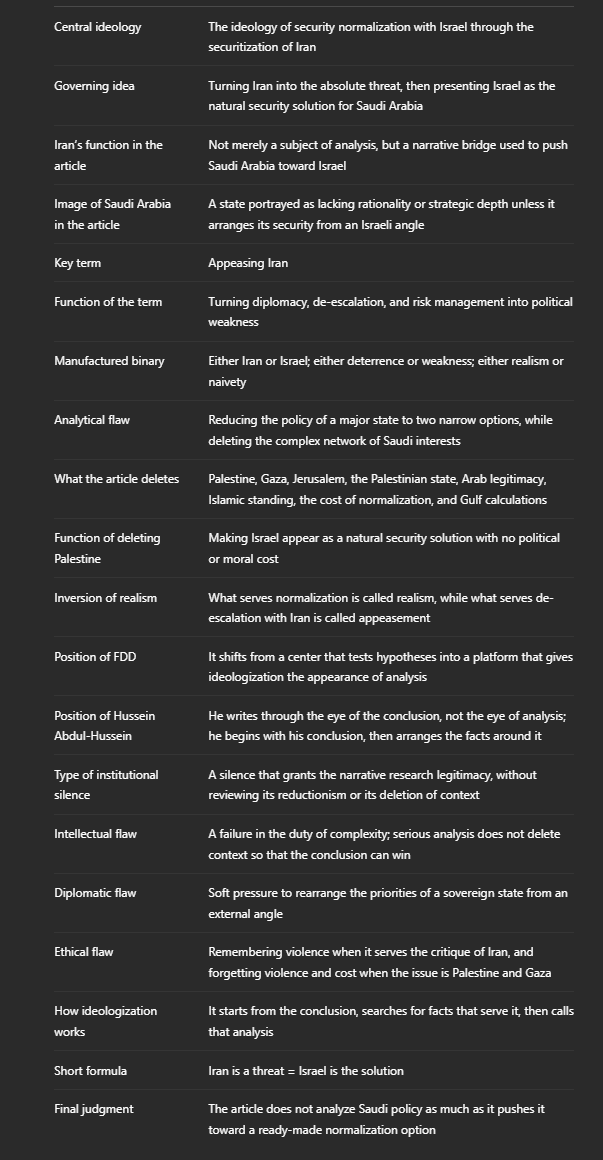
The thinker and the think tank are not operating with AI logic, where readers can expose manipulation in minutes.
They still operate like old print journalism:
a simple binary, then a stupid, biased conclusion.
https://t.co/OOcNgzM0Oc
In The #Trial, Josef K. fears an accusation that never reveals itself.
The more he defends himself, the more he validates the court.
Kafka writes about the court within.
https://t.co/WMAZZ4ACHg
🥉From the Mirror to the Court
When Recognition Becomes an Internal System of Judgment
In the first article, we said that a person does not become weak because they like to be seen by others, but when they can no longer see themselves except through them. In the satirical story about “The Supreme Court of Applause,” we tried to laugh at this dilemma: a person living under investigation for a vague charge called “perhaps you were not enough,” waiting for applause that resembles temporary acquittal, and fearing silence that resembles a postponed verdict.
But behind the satire lies a deeper issue: how does the human need for recognition transform from a natural relationship with others into an internal system of judgment? And how does a person, over time, become a judge of themselves in the name of eyes that are no longer always present, but have come to reside within them?
The need for recognition is not a flaw. Hegel places it at the heart of the formation of self-consciousness when he says that self-consciousness “exists only in being acknowledged.” The meaning here is that human beings are not formed in complete isolation; we come to know ourselves partly through a reciprocal relationship with others. In the home, at work, through language, love, friendship, and even conflict, part of our self-image is formed.
But the problem begins when recognition transforms from a relationship into an authority, and from support into a court. The other person no longer becomes a witness to our presence but the source of judgment over our entire worth. At that point, a person no longer asks: Is my work sincere? Is my effort genuine? Do I possess a meaning upon which I can stand? Instead, they ask: Did people see me? Did they applaud? Did they notice? Did they grant me acquittal for today?
Kafka opened this door in The Trial long before platforms became daily courtrooms. The novel begins with a sentence that almost summarizes our modern world: “Someone must have been telling lies about Josef K., for without having done anything wrong he was arrested one fine morning.” The power of this sentence lies not merely in the arrest but in the vagueness of the accusation. Josef K. does not know what he has done, yet he finds himself compelled to defend himself. This is what happens when a person lives under the authority of ambiguous recognition: they do not know the charge, yet they behave as though they are guilty.
In The Supreme Court of Applause, the charge becomes more contemporary: “Perhaps you were not enough.” This accusation requires no evidence because it is not a specific event but a flexible feeling. It can be attached to the successful and the unsuccessful, the speaker and the silent one, the present and the absent. If you speak, you are accused of showing off. If you remain silent, you are considered finished. If you succeed, people ask, “And what next?” If you say you do not care, you appear deeply concerned with proving that you do not care.
Here emerges Charles Cooley’s concept of the “looking-glass self.” He wrote that the social self resembles a reciprocal mirror: “Each to each a looking-glass.” While the idea is originally a natural social phenomenon, in the world of digital interaction it becomes an amplified mirror. We do not merely see ourselves as we imagine others see us; we wait for the number that confirms it: a like, a view, a comment, a share, an entry, an exit, a silence. It is as though the mirror has ceased to be a reflective surface and become a counting screen.
From here, performance becomes part of identity. In The Presentation of Self in Everyday Life, Goffman describes the social self as a dramatic effect produced by the presented scene, rather than a fixed inner reality simply revealed as it is. This does not necessarily mean that human beings are fake; it means that social life always contains an element of performance. We arrange our words, choose our angles, and manage our faces before others. Yet performance becomes dangerous when it consumes the performer, and a person comes to require an audience in order to believe they exist.
At this point, arrogance intersects with fear. A room full of mirrors does not necessarily produce confidence. It may produce deeper confusion. Some arrogance is not fullness but the defense of a threatened image. Adler suggested that feelings of inferiority may drive people to resist them through the pursuit of superiority. This idea should not be used to explain every ambition or every public presence, but it illuminates a recognizable pattern: when self-worth is unstable, proclaiming superiority becomes a method of seeking reassurance.
This is why “Vainford Grandiose” in our story was both amusing and painful at the same time. He says he is humble, yet his humility requires an audience. He says he is not seeking applause, yet he feels reassured for seven minutes when he receives it. The satire is not directed only at him but at that region within human beings that wants to say: “I do not need you,” while waiting for people to believe it.
Envy here is not a distant branch of the subject but another face of dependence. A person does not always envy because someone else succeeded; they envy because they interpret another’s success as testimony against themselves. If self-worth is built upon a constant ranking among people, then the success of a peer ceases to be good news and becomes a deduction from one’s balance. This is where the character “Envious Quillthorn” came from: he does not hate success as success, but he suffers when success occurs in the very place where he wished to monopolize recognition.
Yet psychological explanations alone are insufficient. Society itself creates markets for recognition. Bourdieu spoke of symbolic capital: prestige, reputation, status, and everything that grants a person a position in the eyes of their social environment. These are not imaginary things; they operate in reality and open some doors while closing others. But their danger begins when they become substitutes for meaning. Then the question is no longer: What has this person done? Instead it becomes: How do they appear? Who knows them? Who applauded them? Beside which chair did they sit?
In this sense, Debord becomes essential. In The Society of the Spectacle, he writes: “Everything that was directly lived has moved away into a representation.” This sentence reveals the transformation from life to image, from experience to the display of experience, and from achievement to the image of achievement. A person in the society of the spectacle is not necessarily lying, but becomes compelled to prove existence through appearance. What does not appear seems not to have happened.
Then Foucault adds another layer: power is not always located in a visible judge but in the constant feeling of being seen. In his analysis of the panopticon, the power of surveillance lies in making people live in a “state of permanent visibility” that ensures the automatic functioning of power. Here the court moves inward: it no longer requires a guard who is always present; it is enough that a person believes they are being watched, and they become their own guard.
This is what the Court of Applause does once it enters the psyche. No one explicitly tells you that you are inadequate. Yet you behave as though your inadequacy is under investigation. No one grants you a final verdict. Yet you wait for daily acquittal through rapid engagement. No one possesses a clear law. Yet you review yourself according to a shifting code whose articles are never revealed: Be present, but do not appear needy. Be confident, but do not appear arrogant. Post, but do not appear to be seeking engagement. Succeed, but do not disturb those who did not. Apologize a little for your presence, then prove it constantly.
At this point, the connection between the first article and the satirical story becomes clear. The first article analyzed the difference between recognition and dependence upon recognition. The story embodied this difference in the form of a court. This third article attempts to uncover the intellectual machinery behind that court: recognition in Hegel, the mirror in Cooley, performance in Goffman, compensation in Adler, spectacle in Debord, and surveillance in Foucault. All of these concepts converge on a single question: when does the other become support for my existence, and when do they become a prison for my worth?
But we must be fair here. Not every desire for recognition is weakness. Not every love of appreciation is pathology. Not every appearance is empty spectacle. Human beings need to be seen by others, to have their voices heard, and to have their efforts acknowledged. Anyone who denies this is asking people to live outside their social nature. The strongest objection to our argument is that the self is not built from the inside alone, and that a person whom nobody recognizes may indeed suffer damage to their sense of self.
This objection is fundamentally correct. Therefore, the solution cannot be the denial of others but the proper placement of them. Others are an important mirror, but they are not fit to be the only eye. Recognition is beautiful when it comes to a self already standing; it is dangerous when it becomes that self’s only crutch. Applause brings joy, but it does not build meaning by itself. Criticism hurts, but it should not become a total judgment upon existence. The success of others may provoke jealousy, but it should not become evidence that our worth has diminished.
In the digital world, this distinction becomes more difficult. The platform does not offer recognition as a slow human relationship but as a rapid number. Byung-Chul Han links the society of transparency to the value of display; things gain value to the extent that they are exhibited and revealed. Zuboff goes further by explaining how surveillance capitalism transforms human behavior into material for prediction and profit. In this sense, the Court of Applause is no longer merely a metaphor; it is part of an economic and cultural structure that turns attention into a resource and visibility into daily labor.
Even so, we should not place all the blame on platforms. Social media did not invent arrogance, envy, or the need for recognition. But it made these things measurable, repeatable, and instantly comparable. In the past, the eye was limited to a gathering, a street, or a tribe. Today the eye has become a network, the mirror has become a screen, applause has become a number, neglect has become a statistic, and acquittal is postponed until engagement is complete.
What, then, should be done? The answer is not to flee from people, to shatter every mirror, or to despise applause. The answer is to reorder the relationship between meaning and recognition. Recognition should be an addition, not the sole foundation. We should allow others to see us without disappearing when they do not. We should rejoice in our success when they applaud, but not declare it a failure when they remain silent. We should view the success of others with whatever measure of ordinary human envy may arise, but not turn it into proof of our own deficiency.
This is where Bragwell leaves the Court of Applause—not because he obtained acquittal, but because he no longer waited for it from the court itself. He did not defeat people, nor did he renounce them, nor did he claim to have risen above the need for recognition. All that happened was that he reclaimed the seat of judgment. If they applauded him, he was pleased. If they remained silent, he did not collapse. If someone else succeeded, he felt a little discomfort, then asked himself: What can I learn? Not: What has been taken away from me?
This is the deeper layer we wish to add to the previous two pieces: the problem is not merely psychological, nor merely social, nor merely digital. It is a composite of the self, the mirror, the platform, and power. Human beings need recognition, but they also need an inner center that does not change with every applause or every act of neglect. Without such a center, a person may spend an entire life inside a court that does not know its own charge and never delivers its verdict, yet succeeds in making them defend themselves forever.
In the end, freedom is not that nobody sees us. Nor is strength the absence of need for anyone. The deeper freedom is that not every eye becomes a judge, not every silence a verdict, and not every success of others a witness against us. It is being able to stand before the mirror without allowing the mirror to become a court. It is hearing applause without granting it the authority of acquittal. And it is accepting recognition from people without placing our entire worth in their hands.
For a person does not become weak because they love being seen by others. They become weak when they disappear from their own sight.
Fascinating article by Columbia University sociologist Musa al-Gharbi:
"The well-being gap between liberals and conservatives is one of the most robust patterns in social science research."
Read here:
https://t.co/pQmIaMR7eL
Analyzed Leo Strauss's teaching transcripts from the Strauss Center Archives.
Top 10 Thinkers:
1. Socrates — 13,800 (50% more than Plato — he teaches about Socrates, not "Platonism")
2. Aristotle — 12,885
3. Plato — 9,181
4. Nietzsche — 5,401 (4th, above Kant and Hegel — not peripheral at all)
5. Kant — 5,228
6. Hegel — 4,686
7. Rousseau — 3,726
8. Hobbes — 3,478
9. Locke — 3,301
10. Thucydides — 2,711
The Silences:
• Plotinus: 0. The founder of Neoplatonism doesn't exist in 7.3M words. Strauss's Plato is not a Neoplatonic Plato.
• Montaigne: 4.
• Schmitt: 13. Given their famous exchange, strikingly absent from the classroom.
• Gadamer: 10. Same pattern — intellectual relationships lived in writing, not teaching.
• Heidegger: 276. Despite Strauss's deep formation in Heidegger, modest classroom presence.
Key vocabulary:
• "Nature" dominates everything — 12,174 hits. The master question.
• Athens vs Jerusalem: 87:1 ratio (2,694 vs 31). The classroom was overwhelmingly Greek.
• "Esoteric" appears 51 times. "Esotericism" 21 times. The man who rediscovered esoteric writing almost never says the word. Consistent with the principle itself.
• "Gentleman": 724 — way more than people realize, concentrated in the Gorgias.
The big finding for scholarship: Maimonides (87) and Alfarabi (40 combined) are modest compared to their centrality in Strauss's published work. Real divergence between the writing program and the teaching program. Same with Machiavelli.
🧠📘✨ A concise and essential reference for anyone exploring the future of digital transformation.
An analytical series on how #AI is reshaping society and the economy, with practical recommendations for all age and professional groups.
#DigitalEconomy
https://t.co/4laHaAZUs3
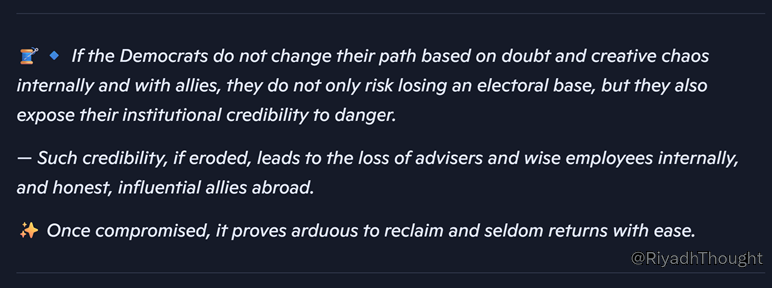
🧵🔹 If Democrats do not change their path of doubt and “creative chaos” at home and with allies, they risk not only losing an electoral base but also exposing their institutional credibility...
— Once eroded, it is hard to restore.
https://t.co/v747lrhN0G
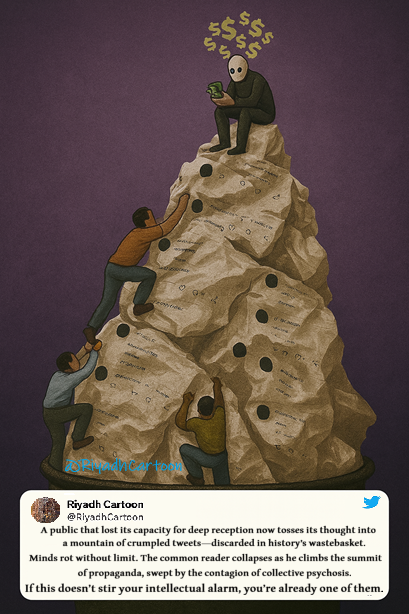
Perhaps the mountain of crumpled tweets is the new shape of the flood, but those who survive are not the ones who scream—they are the ones who write against the current.
https://t.co/617YSrw72m
Collective psychosis is no longer a disorder—it has become a new mode of perception for decaying minds, where reason is replaced by context, awareness by reaction, and the self by a digital identity.
https://t.co/7NrPfe6yTc
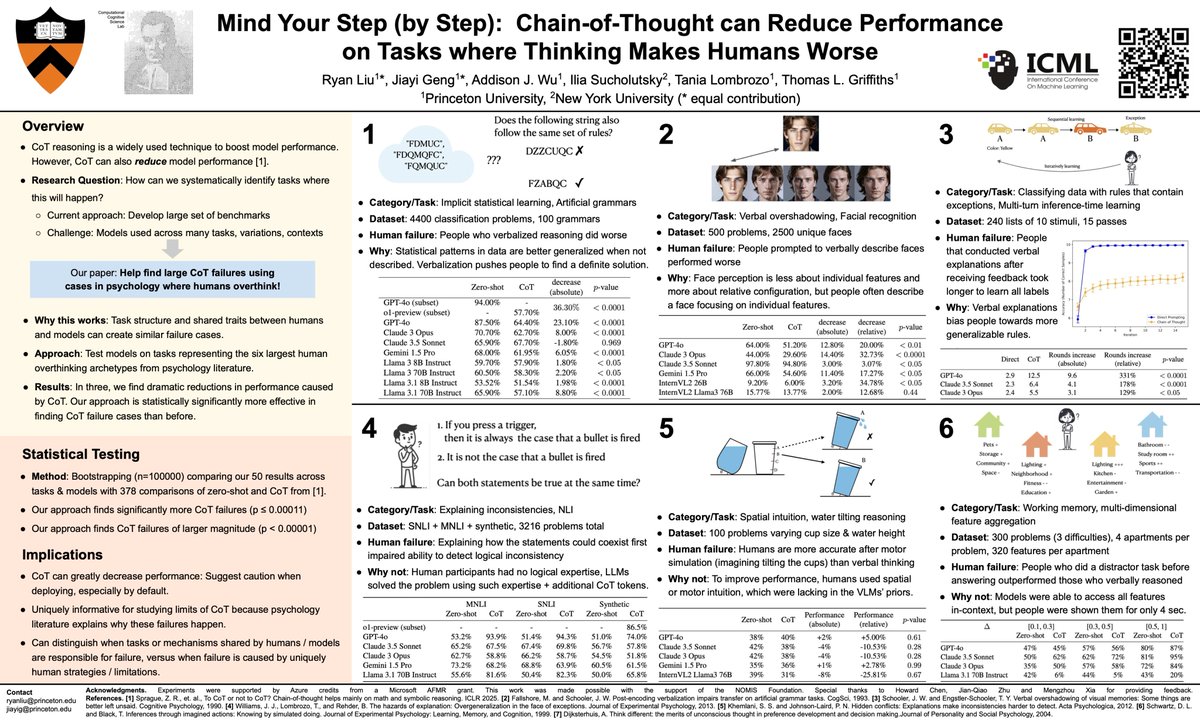
Chain of thought can hurt LLM performance 🤖
Verbal (over)thinking can hurt human performance 😵💫
Are when/why they happen similar?
Come find out at our poster at West-320 ⏰11am tomorrow!
#ICML2025
🔢When youth abandoned CNN and legacy media, think tanks scrambled to rescue their epistemic authority. They didn’t rebuild trust—they outsourced it to AI.
https://t.co/48qI82SMQU
5 The report celebrates disruption. But disruption of what? Of voices that challenge dominant narratives? Of models that refuse Western framing? #AI must not become the new #CNN—free to access, but abandoned for its selective truth. #NarrativeCollapse#DigitalEmpire
🔢When youth abandoned CNN and legacy media, think tanks scrambled to rescue their epistemic authority. They didn’t rebuild trust—they outsourced it to AI.
https://t.co/48qI82SMQU
4 #OpenAI’s investigative tools are praised for protecting democracy. But democracy without pluralism is surveillance. And protection without accountability is control. Who audits the auditors? #AItrust#EpistemicViolence