Multi-cap funds, decoded!
Tune in as Chinmay Sathe, Fund Manager, The Wealth Company Mutual Fund, breaks down the category and what investors should know.
Watch here: https://t.co/31Y7PQweF8
#MultiCapFunds#MutualFunds#Investing#Podcast
A Note to SIP Investors (Not for Lumpsum & Market Timers)
Many of you have started your SIP journey in the last five years. Data shows that nearly 3 in 4 existing SIPs were initiated during this period. Many who began investing in the aftermath of the pandemic have enjoyed extraordinary and, in some cases, unbelievable returns. While the long-term historical return for Indian stocks has ranged between 10% and 13%, some investors—particularly those focused on Small & Midcap segments—have registered over 20% CAGR. Congratulations!
Equity markets have corrected by about 10% to 15%, depending on the index you consider. Similarly, the funds you invest in may have performed slightly better or worse within this range. At this juncture, it is important to remember three critical lessons:
1. The First Rule of SIP Investment: NEVER Stop
If you start a SIP (Systematic Investment Plan) and never stop, you don’t have to do anything else. You don’t need to follow expert opinions or read reports (including #DSPNetra). By averaging your investments over the long term, you automatically accept average valuations, average returns, and average volatility. Ironically, most investors don’t even achieve average returns due to emotional decision-making. SIP provides a structured approach that removes the need for timing the market. Stopping your SIP disrupts this compounding effect and negates its mathematical advantage.
2. Past Returns Are Irrelevant to Future Performance
The returns you have made (or missed) are in the past—they may or may not be replicated in the next five years. Through #DSPNetra, we have repeatedly emphasized that holding overvalued equity investments is similar to owning bonds with stock-like volatility. Small & Midcap segments have been expensive in recent quarters and are only now beginning a mean reversion, with some way to go.
There have been extended periods when Smallcaps, Midcaps, or even Largecaps have delivered little to no returns. These rough patches often lead investors to stop their SIPs. Consider an investor who started Dollar Cost Averaging or SIP in Japan in 1989—could they continue investing for nearly two decades with minimal returns? Probably not. But those who did emerged better off than market timers and those who quit. (See Image 1 for instances where broader markets remained flat, yet SIPs delivered results.)
3. Investing Has Been Gamified—Resist the Urge to Swipe Start or Stop
In recent years, investing has been gamified—it’s now extremely easy to swipe and invest in seconds. Unfortunately, this convenience has also increased impulsive activity. Many investors, driven by adrenaline, news, opinions, and rapid market movements, end up making frequent transactions, which only increase costs and reduce returns. Do not mistake the ease of investing for the ability to time the market.
4. If You Started a SIP Recently, Timing Is Irrelevant in the Long Run
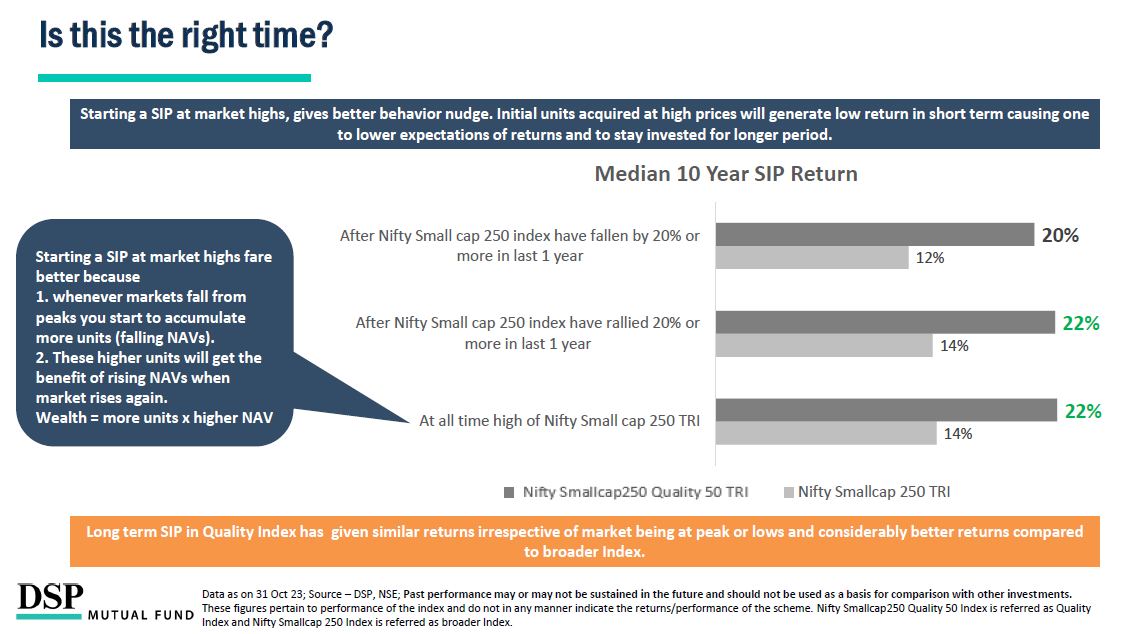
For those who started a SIP in the last year or are considering starting now, remember: if you stay invested long enough—i.e., over decades—timing becomes irrelevant. Take the case of Smallcaps. History shows that even starting a SIP at market peaks, provided you focus on quality investments, allows you to stay invested longer. Why? Because initial low or negative returns help reset expectations, making it easier to remain committed. Lower expectations = higher probability of staying invested. (See Image 2 for data on SmallCap indices at recent peaks.)
5. A Bear Market in NAVs Is a Bull Market in Units
If you are leveraged, overexposed to equities, or if SIP forms an insignificant part of your portfolio, these pointers may not be helpful. However, for disciplined investors, even bad initial outcomes should not deter you. When equity prices fall and NAVs decline, you accumulate more units for the same SIP amount. Bear markets in prices are bull markets in units. They allow you to accumulate more investments, potentially leading to better long-term returns—provided your underlying investments are sound.
Stay the Course. Happy Investing!
"Akash Deep- you beauty"
I always feel that "TOUGH SITUATIONS & poor background" in the early life will give enough fire in the belly.
Lost father due to Stoke in his young age & after 2 months his elder brother- What a tragedy & to take care of his single mother for 3 years.
In #life , You have to pass through failures, criticisms and disappointments on your way to success
👉Today, he makes his Test debut for India in front of his mother. What a journey indeed
#INDvsENGTest
#TeamIndia | #INDvENG |
With 1 Crore income in India:
You could buy:
- A great car.
- A great house.
- Great healthcare/education for kids.
- May be 5 foreign trips a year.
- Premium/Business class flights.
With 10-15 Lakhs income in India:
You could buy:
- A decent car.
- A decent house.
- A decent education/healthcare for kids.
- May be 1 foreign trip every 2 years.
- Economy flights.
Point is: At both these income levels, you would be in top 2% earners in India. And, should not have to worry about things that most Indians worry about.
The magic is: that if you hardworking & sincere, you will get to this level.
Therefore:
If you are in the top 2% earner, worry about other things than money.
If you are not, then work hard to get there (you will get there!)
The "money comparisons" only hurt our mental well-being.
The ratio of mutual fund AUM to India's GDP at market prices reached 17%, which has expanded by 3.8% over the past five years.
Now compare it with Global Avg of 74%, we have a very long way to go but Financialisation of savings will get us to Global avg soon.
A Thread for Discerning Investors
Equities are simple, if you know why they exist- to help you beat inflation and prepare for your longer-term financial goals, so you can earn a good lifestyle for yourself & your loved ones.
Except, this space often gets confusing, which makes people take sub optimal decisions, based on ease, recent performance, emotional triggers and/or limited understanding.
“Should I invest in Growth? Or should I go for Value? Should I prefer mid & small cap funds? But large caps have also started doing well, maybe I can think of them? Which sector offers the next best opportunity?”
--
Decisions! Decisions! What can you do to simplify?
Here is a basic, 3-step approach we recommend:
--
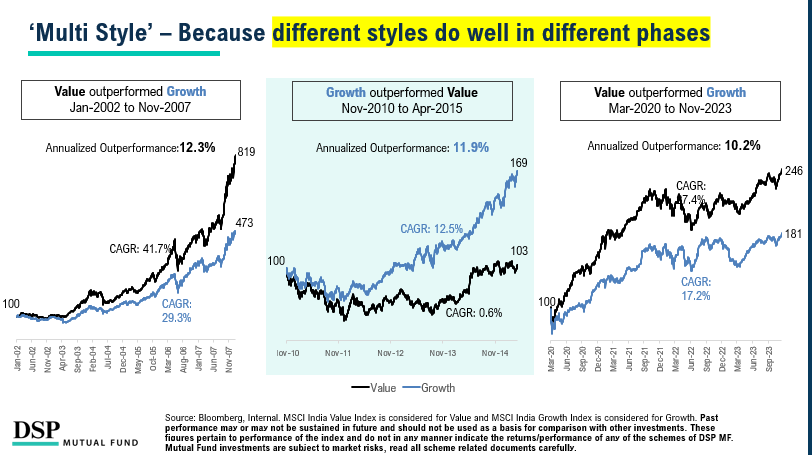
1. Follow a ‘Multi-Style’ approach. Why? Because different styles gain favor at different times. See the evidence below.
2. Find a smart way to run a ‘Multi-Sector’ approach. Why? Opportunities arise across different sectors at different times, and you need diversified exposure to all of them. See below.
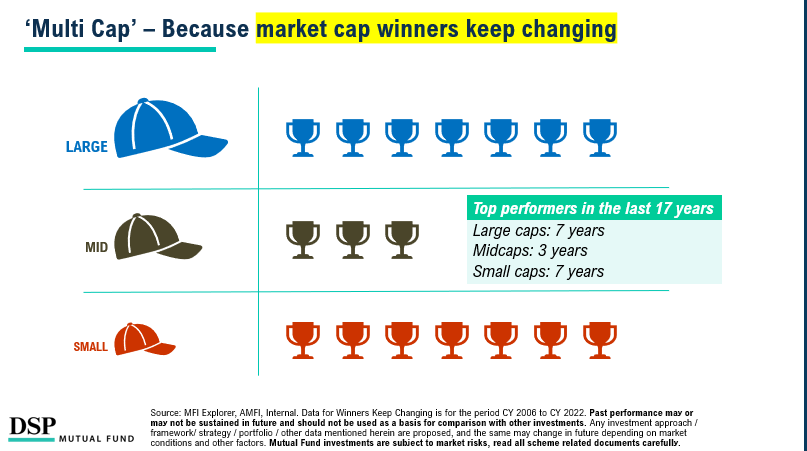
3. Don’t forget to ensure a ‘Multi-Cap’ approach. Don’t get greedy by the allure of past, recent high performance. Remember, the best performing market cap segments keep changing- and by buying only past winners, you may be missing out on future potential performers. See below.
--
The TL DR?
Smarter equity investors should choose a Multi-Style + Multi-Sector + Multi-Cap approach.
--
Possible? Yes, it is. Watch this space for a simple solution, or speak to your MFD today.
Don't miss the 65 fearing the 6
Virginia retirement system has provided a very interesting chart.
I want share some observations based on this chart.
They have studied US stocks (S&P 500 index) for a period from 1926 to 2014, 89 years.
Out of 89 years, there was a positive average return of 21.47% for 65 years, 73% of the time.
The balance 24 years, 27% of the time, there was a negative average return of -14.29%.
65 positive years are distributed as follows:
Return of 0% to 10%: 14 years
10% to 20%: 18 years
20% to 30%: 15 years
30% to 40%: 13 years
40% to 60%: 5 years
24 negative years are distributed as follows:
Return of -10% to 0%: 13 years
-20% to -10%: 5 years
-30% to -20%: 3 years
-40% to -30%: 2 years
-60% to -40%: 1 year
Out of 89 years, there has been loss of above 20% only in 6 years. Except for these 6 years (where the loss ranged above 20% to 60%); the other negative years were emotionally more manageable. Many, fearing these 6 years, let go the opportunity available in 65 years.
Please note that in stock markets, good years are always more than bad years. Study of both US and Indian markets show, during 70% of the years markets are positive. Don't miss the wealth creation opportunities during this 70% fearing the 30% of negative years. Stay invested during the both good and bad years. The reward is wealth.
(I wrote this piece in 2015)
Congratulations DSP AMC generated 15X in nearly 16.5 Years. The beauty of power of compounding is start early and giving more time to your investments. There is a high probability this fund can double in the next 4.5 years. SIP returns are mind boggling it is 20.8% XIRR! Your 19.8 lakhs grown to whooping 1.36 Crore...
Assume if that happens those who are investing today will only double their investments, whereas the investors who invested 16.5 years before his investment will become 15x to 30x. 21 years 30X is huge.
This is just an illustration to understand how big the power of compounding is! Hardly very few understand and acted on this.
Disclaimer: Please note that investing in mutual funds carries market risks. It is important to carefully read all scheme-related documents before making any investment decisions. The information contained in the reports is intended for informational purposes only and should be used solely by the recipient. While we have taken great care in compiling the data and contents of this report, we make no representations about the reasonableness of the assumptions or accuracy of any data. Any decisions made based on this information are the sole responsibility of the recipient. We reserve the right to correct any errors or discrepancies in the reports if they are observed or brought to our attention at any time. @dspmf@SahilKapoor@KalpenParekh@KVijue@_KiranRajput
The seamless user experience & instant payment capabilities of UPI is reshaping the digital payments landscape.
It brings millions of new users and businesses across India into the formal banking system.
An opportunity to participate in the BFSI sector that is fueled by modern tech is #ComingSoon
This #VigilanceAwarenessWeek, we encourage you to join India's fight against corruption.
Take the first step by taking the Integrity Pledge on the Central Vigilance Commission website: https://t.co/kkj5sCPwXY
#SayNoToCorruption#VAW23
Supplying Garments to H&M, marks & spencer, earned this Farmer’s Son a place among India’s Richest - Mr.K.P.Ramasamy - Founder & Chairman of K.P.R Mill
who made his debut among India’s richest this year at No. 100 with a net worth of $2.3 billion.
#DSPNetra is out now! It tracks the latest economic trends & insights that matter
Follow the thread or download https://t.co/D1kS17JC1W
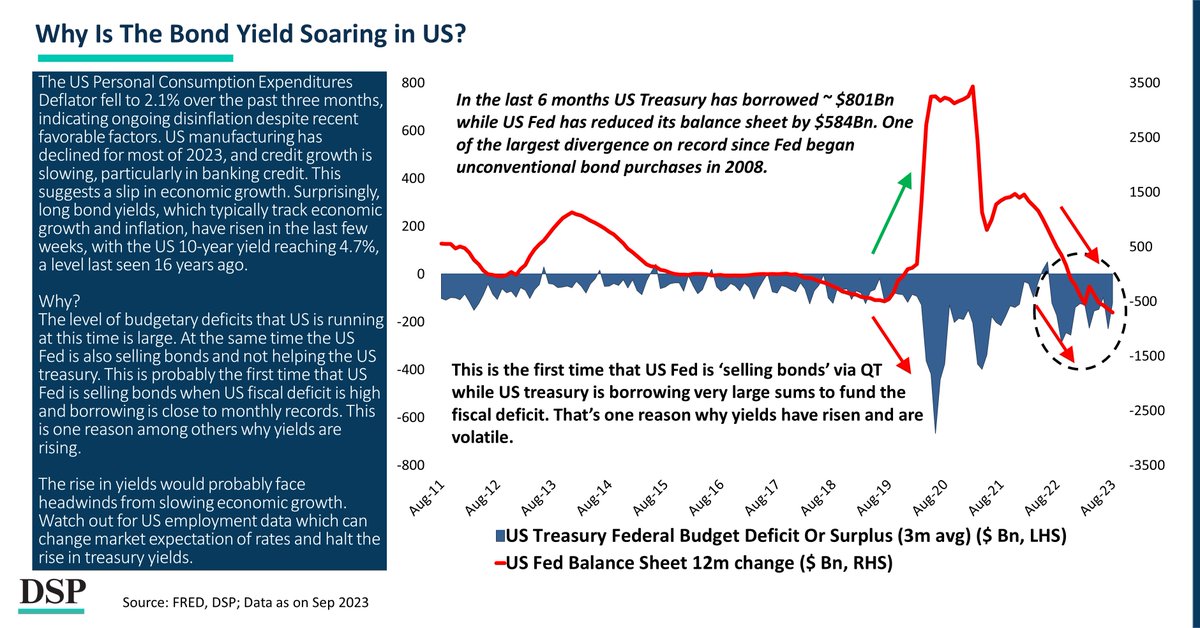
Why is the bond yield surging in the US? Because the US treasury is borrowing heavily while the US Fed is selling bonds. A double whammy. 1/15
So proud! Our Chairman Hemendra Kothari received the prestigious Oak Leaf Award from @nature_org, the global leader in conservation for his lifelong contribution to the field of conservation in India. 😇
He was recognized as a key individual contributor to India's wildlife & environment conservation & his efforts were celebrated at a ceremony at Smithsonian Institution’s National Museum of the American Indian in the US capital of Washington D.C. 🌿🏆
#ConservationChampion
#DoGoodBeGood
#StateoftheEconomy: @vardhiniritesh talks to Vinit Sambre, Head Equities at DSP Mutual Fund (@dspmf), who knows this space well, about the outlook for mid-and small-cap stocks. #Markets
https://t.co/OxNIgVKnPc
"The total number of unique investors directly investing in the stock market has surged to 80 million for the first time, with the latest 10 million additions taking place in just eight months, according to data shared by the National Stock Exchange (NSE).
Of the last 10 million new PAN-based investor additions, around 45 per cent has been from cities beyond the top 100 with the northern states leading at 43 per cent share in the first-time investors, followed by west and south at 27 per cent and 17 per cent, respectively."
Read more: https://t.co/JO1TIuwIQ4