Good question. Generation is still streaming: the detector only reads the alignment head at each decoding step, so the no-failure path has no extra forward passes or WER scoring. The cost shows up only when a failure is caught, and then it's bounded: regenerate from the onset, which is a few seconds of audio (about 8s of the generated audio in this figure).
Whether the listener notices depends on the buffer. If the model runs faster than real time and you keep a few seconds of audio ahead of playback, the rollback is invisible. With a tighter buffer you get a short pause, or the user hears the bad segment once. Failures are rare per request, so amortized overhead is small.
Open-weight TTS models can look remarkably close to the best closed-weight models on benchmarks and demos. But are they reliable enough to actually replace them?
We stress-test Qwen3-TTS and VoxCPM2 in real-world scenarios, uncover reliability failures that standard evaluations miss, and develop an inference harness that eliminates the reliability gap. 🧵
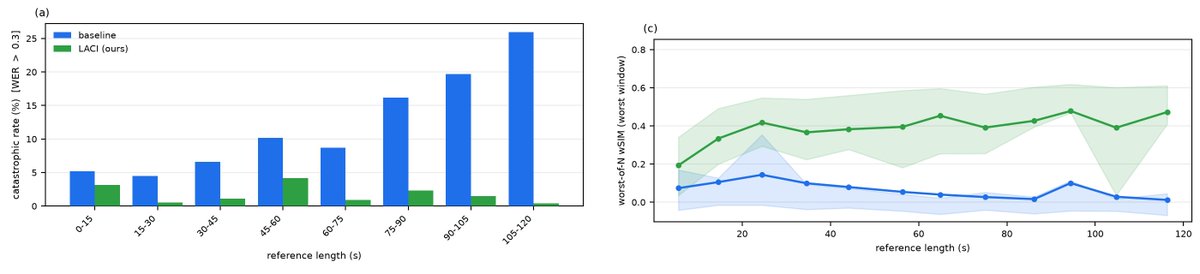
Voice cloning breaks the same way. More reference audio should mean a closer match to the speaker. For the baseline it means more failures instead: at 120s of reference, 26% of generations are catastrophic (WER above 30%) and worst-of-10 wSIM collapses to 0.01. With LACI: under 1% and 0.47, and longer references finally pay off.
wSIM is our sliding-window speaker similarity (8s windows, 4s stride). Whole-clip SIM averages short identity glitches away; wSIM exposes them.
Paper: https://t.co/EXuXJaGbAr
Code will be open-sourced with publication.
Worst-of-10 WER on 1500+ word prompts, baseline → with LACI:
Qwen3-TTS-0.6B: 35.2% → 3.4%
Qwen3-TTS-1.7B: 47.8% → 4.2%
VoxCPM2, 1000–1300 words: 16.3% → 8.1%
The long-form gap is gone for Qwen3-TTS, and the same detector transfers across model sizes and families.