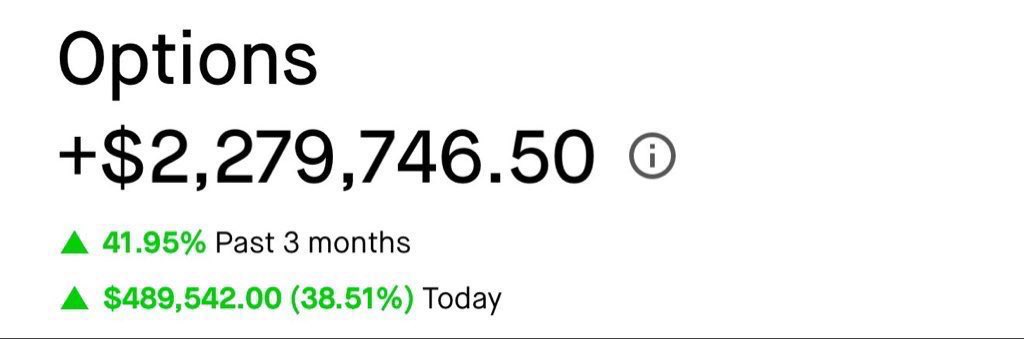
Finance analysts earn $95k–$250k/year.
The ones using Claude AI close work 3x faster.
📘 Claude AI for Finance Professionals — 120+ institutional-grade prompts for equity research, DCF, fixed income, portfolio strategy, earnings analysis, and IB workflows. Excel models included.
Normally $189 → 100% FREE for 48 hrs
Like + RT + comment 'Ebook'
Must Follow me so I can DM you.
"Wanted to give a shout-out to this girl — I don’t know her name, but I won’t forget what I saw.
We were on the rooftop at Old Crow Smokehouse in Wrigleyville when I noticed a blind Cubs fan trying to hail a cab. For several minutes, no one stopped.
Then this young woman walked up, asked if he needed help, and stood beside him until a cab finally pulled over.
No cameras. No attention. Just pure kindness.
In a world where headlines often focus on hate, it’s moments like this that remind us — compassion is still everywhere.
Let’s make this kind of story go viral."
[Rashawn Copeland via IG]
Every time the put/call ratio drops below 0.65, the S&P 500 pulls back. No exceptions over the past 2 years.
The red circles on this chart mark every sub-0.65 CPC reading since mid-2024. What followed each one:
-8.33% (Jul 2024)
-4.26% (Nov 2024)
-18.32% (Mar 2025)
-2.79% (May 2025)
-1.25% (Sep 2025)
-5.24% (Jan 2026)
6 for 6.
The CPC just printed back-to-back readings at the lowest levels on this entire chart. Two consecutive days more extreme than every prior signal that preceded a selloff.
To be clear: this is not a crash call.
Goldman has a 7,600 year-end target. Morgan Stanley is at 7,800. JPMorgan just reset to 7,200. A positive resolution on Iran and the Strait of Hormuz could unlock another leg higher. The macro tailwinds are real and the majority of Wall Street leans bullish through year-end.
But sentiment indicators don't care about narratives. They measure positioning. And right now positioning shows:
- SPX calls topped 3M contracts in a single session for the first time in history
- Total call volume at 47M/day
- VIX at 18.18 sitting on the lower Bollinger Band
- Back-to-back CPC readings lower than any prior signal on this chart
The drawdowns that followed ranged from -1.25% to -18.32%. The signal doesn't tell you how deep. It tells you the market is offsides and a reset is coming.
Every prior occurrence resolved with a pullback before the next leg higher. This one probably will too.
Hedge accordingly.
New all-time highs and nobody is paying attention to this.
Top chart is the Value Line Geometric Index. For those that don't know, it's an equally weighted index that tracks roughly 1,700 stocks.
Bottom chart is the S&P 500. I'm highlighting the times where the SPX makes a new high but the $XVG does not confirm. As you can see, it's not a great sign, these divergences eventually resolve themselves in some way.
This is not a crash call, but it would be nice to see more participation as we just cracked into new all-time highs.
Tariffs and the U.S. Position thoughts.
The problem with “100% tariffs or else” is that, eventually, a country will become so frustrated by constant pressure, coercion, and perceived disrespect that it will choose pain over submission.
When that moment comes, the entire world will be watching.
If that transition proves anything short of an outright disaster, it could trigger a broader domino effect. Others will realize that economic independence, even at short-term cost, is survivable. And once that realization sets in, leverage shifts.
The deeper issue is the United States’ reserve-currency privilege. This status has long kept borrowing costs artificially low and positioned the dollar at the center of global trade, finance, and power. But that privilege rests on trust, cooperation, and systemic stability.
Recent studies show that roughly 96% of tariffs are ultimately paid by U.S. consumers, not foreign exporters.
The consequences are compounding:
•Deteriorating business conditions via reduced imports and exports
•Strained relationships with key allies
•Strengthening economic ties among non-U.S. blocs, particularly with China
•Increasing geopolitical aggression as pressure builds
•A structurally weaker dollar, higher debt burden, and rising bond yields
This is precisely the type of macro backdrop that invites further U.S. credit downgrades.
Europe and especially Canada have effectively reached a breaking point. While their business ties with the U.S. remain far stronger than with the East, geopolitical decisions are not always driven by pure economic rationality. Political pressure, public sentiment, and national pride matter.
At the same time, India, China, Brazil, and Poland are reducing U.S. Treasury holdings and increasing gold reserves.
That is what the metals market has been signaling all along.
Many still believe the U.S. does not need the world. In reality, U.S. prosperity has been built on global capital flows, foreign demand, and the willingness of others to finance American debt.
The United States remains the epicenter of global capital markets. But its greatest asset, stability, is eroding rapidly.
America provided the world with the deepest capital markets and security guarantees through NATO. That system created decades of growth and prosperity.
Tariffs changed from incentivizing discussion and fairer terms for all to an ultimatum for all.
It works until someone would rather endure pain than humiliation. A lot would be repaired if dignity and appearances alone would be part of equation. Just like the US does not want to look weak, so do other countries.
This is the most dangerous I have ever seen the world. We had decades of stability, I hope we can get a few more.
Global instability is something we should avoid at all cost. Any US debt linked issues would trigger a worldwide recession and likely some sort of war.
This influences all of us in the US and abroad.
We need each other.
We need to fix relations now.
Here are five of the worst potential outcomes from a US invasion of Greenland:
1. Fracturing of NATO and the Western Alliance
Denmark is a founding NATO member. An unprovoked attack on Danish sovereign territory would trigger Article 5 considerations in reverse—allies forced to choose between the US and the principle that members don’t attack each other. The alliance that has underpinned American security strategy for 75 years could splinter, with European nations accelerating independent defense arrangements and questioning whether American security guarantees mean anything.
2. Driving Europe Toward China
A US that seizes allied territory by force becomes an unreliable partner. European nations, already hedging on economic ties with Beijing, might accelerate that pivot. Germany, France, and others could conclude that strategic autonomy requires balancing between Washington and Beijing rather than alignment with an unpredictable America. The great power competition we’re supposedly trying to win gets substantially harder.
3. Legitimizing Russian and Chinese Territorial Revisionism
Every argument Putin has made about Crimea, every claim China makes about Taiwan—they all become easier to justify when Washington has abandoned the rules-based order it built. “The Americans took Greenland, so international borders are negotiable by force” becomes the new normal. The precedent cascades in ways that damage American interests for decades.
4. Economic Retaliation and Dollar Vulnerability
The EU represents America’s largest trade relationship. Coordinated sanctions, tariffs, and—critically—accelerated efforts to build alternatives to dollar-denominated trade could follow. The dollar’s reserve currency status rests partly on trust in American institutions and predictability. That trust, once broken, is extraordinarily difficult to rebuild.
5. A Protracted Arctic Insurgency
Greenland’s 57,000 people have spent years building toward independence from Denmark—not absorption into America. An occupation facing persistent local resistance, in some of the world’s most inhospitable terrain, with supply lines stretching thousands of miles, could become a frozen quagmire that drains resources and attention indefinitely.
Hopefully Trump will be impeached and removed from office if he tries this. It is no longer a zero probability.
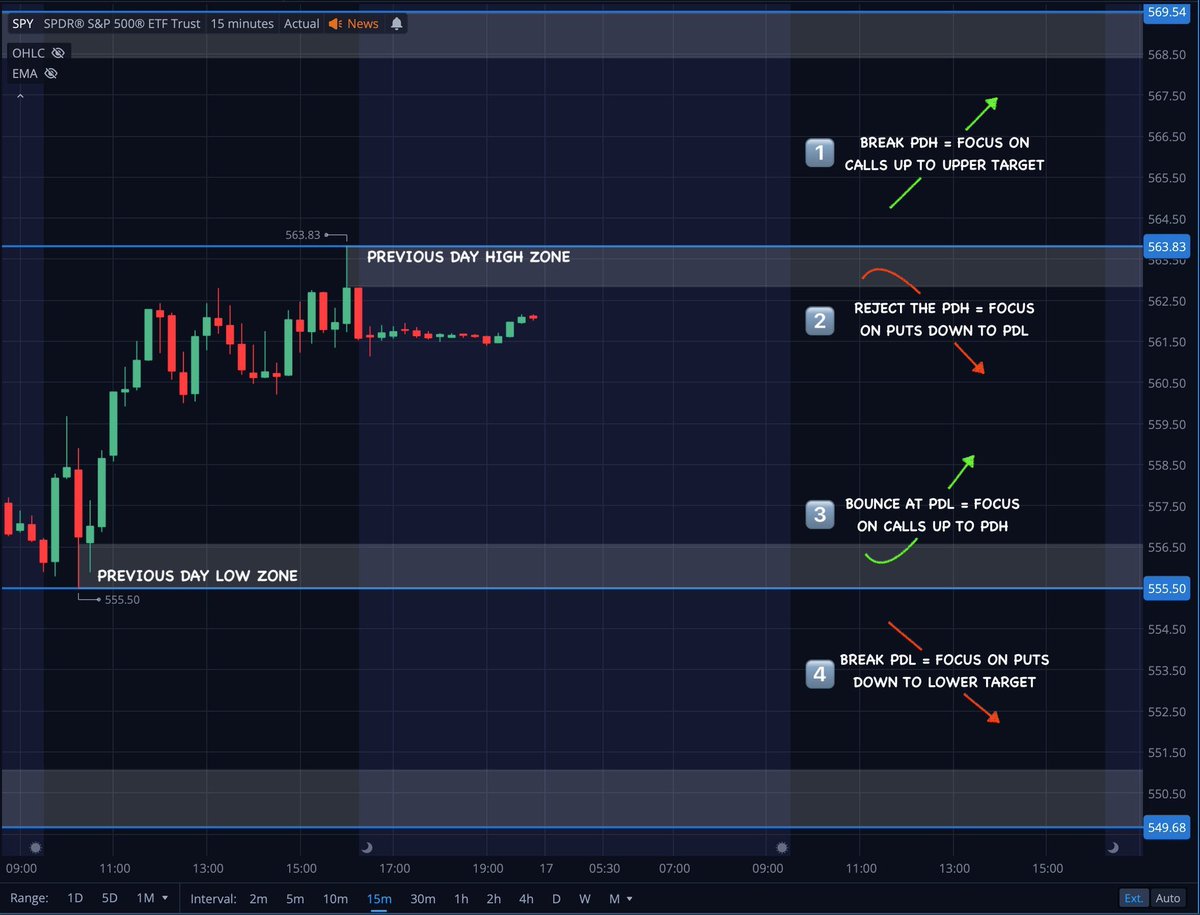
$SPY • If you are a day trader who struggles with your directional bias this will help a lot! 📝
Mark the previous day high / low support & resistance zones (15 minute chart, high / low of day wick to following candle body) ✍️
Now use these zones to assist you with your trade bias…
• Scenario #1 • Breaks previous day high resistance = focus on calls up to next zone 📈
• Scenario #2 • Reject previous day high resistance = focus on puts down to previous day low support 📉
• Scenario #3 • Bounce off previous day low support = focus on calls up to previous day high resistance 📈
• Scenario #4 • Breaks previous day low support = focus on puts down to next zone 📉
(1 & 4 will cover trend days…. While 2 & 3 will cover range days)
These are the 4 most common scenarios that occur on a day to day basis.
This simple technique will be an absolute game changer for many who apply it in 2026 🤙
I AM OFFICIALLY RESTARTING THE $1,000 TO $1,000,000 $SPX 2026 CHALLENGE NEXT MONDAY! 💸
I’M GOING TO RESTART AND LET EVERYONE FOLLOW MY EXACT TRADES FOR COMPLETELY FREE IN A PRIVATE X GROUP CHAT! 🦅
LIKE, REPOST, & COMMENT “$SPX” TO BE ADDED! ❤️🔥
YOU MUST BE FOLLOWING ME TO JOIN! ☢️
All the signs point to Trump pushing Bessent to maximize non-Fed liquidity levers. Main one on the table is further lowering the WAM (weighted average maturity) of outstanding debt by shifting more issuance from long-dated bonds into short dated bills.
At a high level, this is the Treasury Dept bypassing a reluctant Fed to provision liquidity through its own sandbox. Note that the Treasury Dept has already been leveraging this tool, but I expect Bessent to push it much further over time.
Shifting issuance doesn't have the same narrative impact + pavlovian animal spirit response as classic Fed actions such as rate cuts or QE, but it still flows into risk appetite.
Why does shifting issuance add liquidity despite representing the same amount of issuance?
1. Simplistically, bills will be more anchored to Fed Funds rate regardless of scale of issuance, so more debt can be absorbed by the market without raising interest rates. Thus vital financial instruments that are driven by long-dated rates (such as mortgage rates) will not get adversely affected
2. It removes duration from the market, so then funds with a certain allocation for duration must go further out the risk curve to meet those needs, which loosens financial conditions.
3. Banks have higher capital requirements for longer duration assets, so it frees up capital.
4. T-bills are the ultimate form of collateral so increased circulation helps improve conditions in markets such as repo (not an expert on repo market, so if anyone wants to add color here or argue against this, I'd welcome it).
Once bills become the entirety of new issuance, a more radical step will be to overissue bills beyond financing needs and use proceeds to buy back bonds.
🇨🇳🇺🇸🇬🇧Chinese Ministry of Foreign Affairs: At the invitation of the British government, Vice Premier He Lifeng will visit the United Kingdom from June 8 to 13 to hold the first meeting of the Sino-US Economic and Trade Consultation Mechanism with the United States.
#CHINA#US #TRUMP #TARIFFS
U.S. Treasury Secretary Scott Bessent just went on CNBC to discuss the state of the economy.
A recap for those that missed it: 👇👇👇
🤝 On trade policy: "I don't think it's a radical change, it's just a much needed course adjustment... what we are trying to do is make Free Trade Fair Trade because the trading systems have become incredibly imbalanced."
💸 On tariffs: "Tariffs are one-time price adjustment" and not inflationary. Bessent emphasizes the administration's focus is shifting "from public spending to private spending" to create sustainable economic growth.
💪 On economic priorities: "If we bring back more manufacturing, if we have cheap energy, good tax policy, deregulate, we will end up with a strong dollar... what is unacceptable is other countries trying to weaken their currency."
📊 On helping working Americans: "The Biden Administration created this bad equilibrium where the top 10% of Americans are 40 or 50% of consumption... the bottom 50% of working Americans have gotten killed. We are trying to address that."
🇺🇦 On the Ukraine economic deal: "This is an economic development deal... Economic Security is National Security. We want to help Ukrainians succeed economically... Who doesn't like this deal is the Ukrainian oligarchs."
₿ On cryptocurrency: "I am a big proponent of the US taking the worldwide lead in crypto. I think we have to bring it onshore and use our best practices and regulation... before you can accumulate it you have to stop selling it."
🇨🇳 On China relations: "The China relationship is very complicated because in the past our biggest economic partners were also our allies. We are now military rivals with China and economic rivals."
🔄 On supply chains: "The only good thing to have come out of COVID was it was a test run for what could happen if we really got into a deep economic war... everyone has realized that optimal supply chains are not reliable supply chains."
⚖️ On tariff strategy: "President Trump's been saying tariff is his favorite word, I think reciprocal may be his second favorite word... it'll be a choice: either they can drop the market manipulation... or we'll put up the Tariff wall."
🇪🇺 On European defense spending: "After 25 years of baiting and cajoling, President Trump achieved what five other presidents couldn't achieve. The Europeans are going to up their defense spending."
🚀 On the future: Bessent says the administration is committed to policies that will lead to real wage gains for working Americans and a rebalanced economy where growth comes from the private sector rather than government spending.
Thanks for reading, and I hope you found this recap useful.
$SPY $QQQ $IWM
📈 #Bitcoin BROKE DOWN BUT....
• Bitcoin broke down and hit the measured move exactly at 79k and bounced.
• Bitcoin Strategic reserve is something Trump has been talking about and it looks really good in terms of the macro perspective.
• One company that can have a huge benefit and also has had some good news last week was $COIN with the SEC legislation dropped and it being the only company right now USA to store its bitcoin at.
• Currently the break down is being retested this morning and once 91.5k is reclaimed we are looking at the upper trendline to break this time around.
• Once the upper trendline is broken we are looking at all time high as a obvious target but the extended target goes all the way to 130k for 2025.
Watch for the move.
Stocks that benefit from #Bitcoin include $MSTR $COIN $TSLA $HOOD $PLTR. I am not a fan of miners so you do you there.
If you like my analysis hit the ❤️ and repost.





![MrPitbull07's tweet photo. "Wanted to give a shout-out to this girl — I don’t know her name, but I won’t forget what I saw.
We were on the rooftop at Old Crow Smokehouse in Wrigleyville when I noticed a blind Cubs fan trying to hail a cab. For several minutes, no one stopped.
Then this young woman walked up, asked if he needed help, and stood beside him until a cab finally pulled over.
No cameras. No attention. Just pure kindness.
In a world where headlines often focus on hate, it’s moments like this that remind us — compassion is still everywhere.
Let’s make this kind of story go viral."
[Rashawn Copeland via IG]](https://pbs.twimg.com/media/HGPrzewaIAA_brb.jpg)