Top tax lawyer James Quarmby has produced a set of advice on how to avoid the main UK taxes. Here it is:
🔸CGT
"DON’T sell.
The tax base for CGT is absurdly small, with the vast majority of receipts coming from a few thousand taxpayers. If CGT rates feel too high then those people will simply sit on their assets until such time as it feels right again.
The OBR pointed out this uncomfortable fact to Rachel Reeves the last time she considered pushing up rates to much higher levels.
🔸SDLT
DON’T buy.
SDLT is even more elastic than CGT and if you wish to avoid the absurd rates of tax on, particularly, higher value properties, then just don’t buy one. This is why SDLT receipts at the higher end of the housing market have collapsed. Simples !
🔸Employer’s NIC
DON’T employ anyone and if you’re already an employer, DON’T hire more people.
Lots of employers have been following this advice in the last 2 years, which is why unemployment is now a problem.
🔸 Income tax
DON’T work too hard and/or DON’T take that promotion.
Want to avoid the 60% tax trap at £100k ? Easy - just hover around the late £90k’s like so many of your fellow citizens.
If you’re a shareholder of a private company then DON’T take that dividend. Leave the cash in the company.
🔸IHT
DON’T die.
Ok, that might be hard to achieve but if you do plan on dying then spend your money or give it away before you do so.
🔸Wealth tax
DON’T remain in the U.K.
You have choices and can choose to live elsewhere. Lots of other people do."
On IHT leaving the UK and selling UK assets will also do the trick.
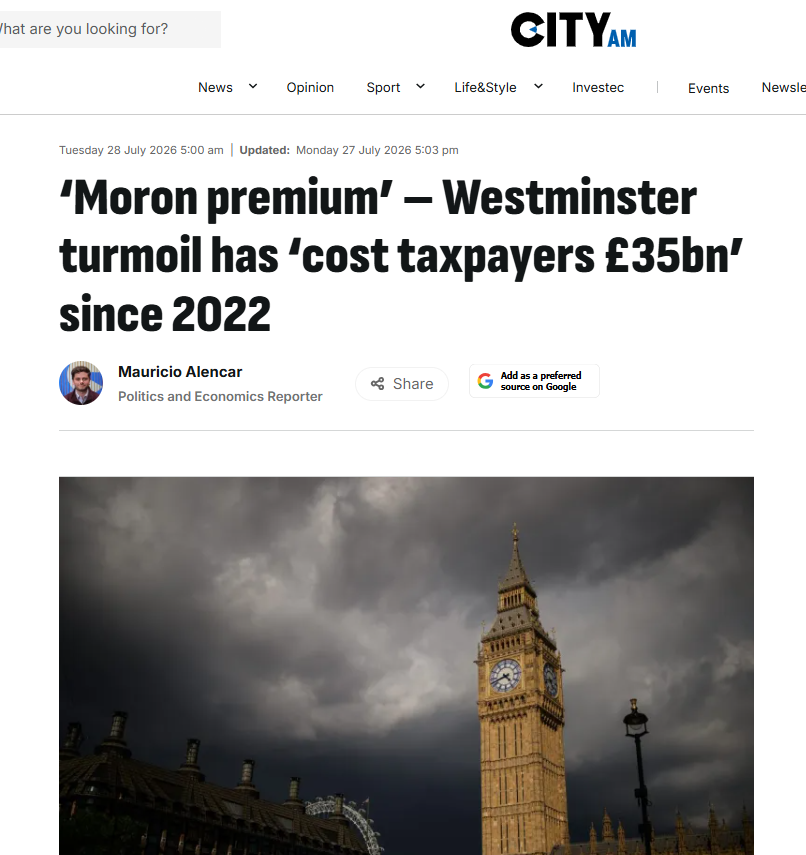
Researchers at Allianz, one of the world's largest insurance companies, have found that found that the UK government continues to pay a “distinct political premium” - more broadly known as the 'Moron Premium' - due to constant uncertainty over tax & spending decisions.
Allianz estimates the cost of our Moron Premium over four years at £35 billion. Debt interest costs are running at about £110 billion this year, twice the size of the defence budget & close to the amount spent on education.
Andy Burnham has so far done a good job of expanding the size of the Moron Premium.
@Shar_A_ £2 bus fares is great and all public transport should be affordable. I would like to see them address the horrendously overpriced train fares.
@chrisrich88 HMRC and DWP class it as a "contributory state benefit". This isn't some young person thing. If it boils your piss when people call it by the label their own Government gives it then you need to seek some help. Maybe direct your anger at the government instead of young people.
Supposedly, Burnham wants to increase capital gains tax in order to be able to reduce energy bills. What he seems to have difficulty in understanding is that hiking CGT will significantly reduce revenues.
That's not just what HMRC is saying. It's also the clear evidence from previous increases in the CGT rate in Britain and in multiple other countries.
UK History (1988–1998): When CGT was aligned with income tax rates and indexed, revenues fell sharply (55% after 3 years, 70% after 5 years).
Blair/Brown Era: Cutting CGT on business assets to 10% more than doubled revenues.
Later Hikes: Raising rates (e.g., to 18% in 2008, then 28% in 2010) led to revenue declines.
Ireland (1997): Halving CGT from 40% to 20% nearly trebled revenues.
Australia (1999): 50% cut led to strong growth in individual CGT revenue.
Sweden (1990s): Rate cuts doubled revenues.
US: Multiple cuts (e.g., 1978, 1997, 2003) boosted revenues significantly (up 46%, 50%, 45% in periods cited).
For fuller details see below:
@George_Davison1@alexanderrX_ Let's say an international company employs a UK resource and pays them £120k for their talents. To your delight they leave the UK so the company decides to fill the vacancy by employing someone in a different country. Now the UK receives zero tax revenue.
Three UK-listed stocks, $200m - $500m range: $MKA $AVCT $IES.
NdFeB magnets. Precision oncology (okay, perhaps not up your street!). Energy storage.
All absurdly undervalued relative to US / other international peers, primarily due to the UK investment community being atrocious at attributing any proper value to growth / pre-revenue stocks.
.......
1) Mkango #MKA (43p, $222m mkt cap):
A vertically integrated rare earths pure play - mining, refining, magnet recycling, magnet making. Key competitive advantage being patented, world-class (lowest cost and most energy efficient) NdFeB magnet recycling technology.
Original asset is a near-construction ready mine in Malawi. Backed by US DFC ($5m grant to complete FEED, then a further $100m loan for mine construction being considered). Fully permitted and safe jurisdiction (for Africa!).
Also is developing a rare earths separation plant (processing / refining) in Poland. Both have been designated EU CRMA Strategic Projects and are also very likely to secure major financing from governments, besides the US. These two projects are being spun out onto NASDAQ - $MKAR - likely to complete next month, at a valuation of circa $500m. See $CRML mkt cap ($1.5bn) for likely closest comp.
The other (more valuable!) half of Mkango’s business is HyProMag - which has a technology that recycles end-of-life permanent magnets without the use of chemicals (which all other REE recyclers must use). It uses hydrogen to break down the magnets into a demagnetised fine powder, which can then sieved and then repressed and sintered back into brand new magnets.
HyProMag now has two recycling / remanufacturing plants operating in the UK and Germany; and is shortly to announce financing and commencement of construction at its first plant in the US. Ultimately wants to build out 6-7 plants across the US, and evaluating plans to roll out plants in Japan, Canada and South Korea.
Expecting big news on HyProMag USA progress in the coming weeks, which may include a second NASDAQ listing. Were Mkango listed on NASDAQ in its entirety right now, I estimate it'd be trading in the $1.5bn to $2.0bn range.
Robotics, data centres, EVs and the budding space industry will drive a monumental step change in NdFeB magnet demand, which all the mines under development in the world will not be able to meet. Magnet recycling / remanufacturing will be a requisite. HyProMag's patented process can ensure it becomes a global market leader, in time.
Key risk is securing further financing for global rollout programme, which is trickier with a tiny mkt cap (relative to overseas peer group). My view is that $USAR is already lining up a bid, given that its CEO has recently stated her ambition to acquire further downstream / magnet businesses.
[Search "mylesmcnulty MKA" for a fair whack of research on the stock in recent times!]
......
2) Avacta Group #AVCT (73p, $461m mkt cap):
UK-based precision oncology business. Owns the "pre|CISION delivery platform", which the company believes to be the most targeted delivery platform for drugs treating solid tumors, ever developed. In layman's terms, super-charged chemotherapy without the side-effects.
That alone should be a monster attraction for investors; but then Avacta can also boast that the platform can be used to modify almost any anti-cancer drug on the market (dramatically reducing side-effects of the original drug, whilst simultaneously boosting efficacy); AND that pre|CISION modified drugs can be used to treat circa 85% of all types of cancer cases.
Its first candidate in the clinic, AVA6000 (modified version of doxorubucin) has been in a P1a/b for just short of 5 years now (only just wrapping up), with a pivotal Phase 2/3 to commence in H2 for salivary gland cancer (for starters).
The second candidate, AVA6103 (modified version of the much more potent drug, exatecan), commenced its Phase 1 three months ago. In extensive pre-clinical data presented this year, Avacta demonstrated that 6103 not just outperformed, but completely obliterated the leading antibody-drug conjugates on the market (including the market leader, Enhertu).
Across a range of animal models, it boasted a complete response rate of >90%. The three key attributes of the pre|CISION platform (industry-leading targeting; ability to modify almost any drug; able to target c.85% of all cancer types) - backed up by numerous other complementary advantages (such as significantly lower manufacturing cost of a pre|CISION peptide-drug conjugate relative to a conventional ADC; and superior tissue penetration owing to much smaller molecular size of a PDC relative to an ADC) - will in my view ensure that the owner of the platform could dominate global oncology for decades to come.
If AVA6103 merely replicates the data generated in pre-clinical models, it is straightforward to perceive how it could become an all-time best selling oncology drug.
Key risk? As with Mkango, it is financing the various workstreams. I believe multiple commercial partnerships could be announced in H2 (Big Pharma using the platform to enhance their own existing drugs), which could bring in significant non-dilutive funding.
Were Avacta listed on NASDAQ right now, I estimate it'd be in the $2bn to $3bn range, based on the peer group. Any sniff of 6103 replicating the animal model data, in the ongoing P1 trial, over the next 6 months, then the sky really is the limit for the share price.
.......
3) Invinity Energy Systems #IES (37p, $280m mkt cap):
A global manufacturer of vanadium flow batteries (VFBs), the leading non-lithium, utility-grade long-duration energy storage technology. Its modular systems are already deployed or contracted across more than 90 sites in 17 countries on five continents, and have discharged thousands of MWh in real-world operation.
Core competitive advantage is the inherent chemistry of VFBs: non-flammable and incapable of thermal runaway (critical for data centres, industrial sites and dense urban deployments), zero degradation over 20,000+ deep cycles, and a 20–30+ year operational life that matches the asset life of solar and wind farms. This delivers the lowest levelised cost of storage for high-throughput, long-duration applications.
The new Endurium platform (launched late 2024) further improves energy density, round-trip efficiency and cost, enabling GWh-scale projects, while Endurium Enterprise (smaller configuration) targets the fast-growing commercial & industrial (C&I) segment.
Recent project momentum has been awesome:
- Delivery of the 20.7 MWh Copwood VFB Energy Hub in the UK, Europe’s largest operating VFB.
- 32 MWh sale to Pacific Steel Group’s new Mojave Micro Mill in California (North America’s largest VFB, California Energy Commission-backed) for sustainable rebar production.
- Multiple Endurium wins including 20 MWh in Hungary (solar-plus-storage) and several US projects (including a 12 MWh system for Pacific Northwest National Laboratory and a 2 MWh DOE-funded project in Wisconsin).
- Most significantly, selection by Switzerland’s FlexBase Group to design and deliver the world’s largest flow battery - up to 1.5 GWh, with potential expansion to 2.1 GWh - for a major new AI data centre and technology campus in Laufenburg.
This last one is a landmark validation for the technology in the exact high-value use case (data centres + renewables integration + grid services) that is exploding globally.
Invinity also has 16.7 GWh of Endurium projects confirmed eligible under the UK’s LDES Cap & Floor scheme (with awards expected from 2026), plus active engagement in equivalent procurement programmes in the US, Canada and elsewhere. The company is expanding manufacturing (UK base plus plans for US, India and regional partnerships) and aggressively driving cost reduction.
The market tailwinds are enormous. Renewables penetration, grid modernisation and, crucially, the power demands of AI data centres and hyperscale computing require vast amounts of safe, long-duration storage that lithium-ion struggles to serve economically or safely at scale. VFBs are uniquely positioned for these high-cycle, long-duration, safety-critical applications.
Invinity, as the most experienced Western pure-play with proven deployments and a newly optimised product, is exceptionally well placed to capture a material share.
Key risk remains scaling manufacturing and supply chain fast enough to convert the pipeline into revenue while managing cash burn. I suspect another equity raise in the next 12 months is inevitable.
As with the above two tickers, our dullard UK investment community refuses to see the big picture unfolding here. I estimate that the company would be pushing $1bn mkt cap, were it listed on NASDAQ.
Invinity has been a serial loser in the past, in terms of downgrade after downgrade to forecasts; but I now believe we could start seeing analysts upgrade their numbers in the coming months, such is the momentum building.
Current consensus has revenue of $320m for 2028 (first year of profitability), on an EV/EBITDA of 7x.
A lot of ardent Gold Bulls will turn tail, and pronounce the PM Bull era has ended. The Weekly Cycle is the driver of this consolidation.
I remain patient.