Lest We Also Forget on Memorial Day
(Context) Some time ago, I wrote about the uniqueness of the U.S.S. Indianapolis memorial. On engraved stones, it lists both survivors of the sinking and the crewmen lost at sea. Most war memorials, however, if they list names at all, list only those who were killed during the recognized event. Ironically, future generations may read, research, and remember these names, while the preponderance of survivors, unless they achieved something else with their extra years beyond the ordinary, may be forgotten.
(A Statistic) Absent from both the memorials and any chance to build something extraordinary beyond their time in service—service generally being an endeavor of the young—is the greater share of the approximately 63,000 servicepeople killed since 1980. Roughly half of this number fell while training for battles they would never fight—the greater share of the rest also falling off the battlefield—and yet they lost their lives in the service of their country, nonetheless.
It’s a bold move. I’ll admit that. The VA Governor signed a statewide assault firearms ban in the very state that hosts the National Rifle Association, and she did it within just hours of conceding that the attempt to redistrict Virginia had failed.
With the legal fireworks that were looming—and while on a much-appreciated diving vacation—I read a book on the 2nd Amendment to the U.S. Constitution written by an attorney who served on the Clinton team when the National Assault Weapons Ban of 1994 took effect. The book is mostly a legal text, only devoting about three pages to public safety, but that’s what I was after. By chance, another guest on the boat was one of the head architects of the data system New York State uses to monitor legal gun ownership. When he saw what I was reading, it sparked an hour-and-a-half discussion. Believe it or not, we had more in agreement than disagreement.
One important point of agreement was that focusing so much money and political capital on banning legally owned weapons that account for a small fraction of gun felonies, ostensibly for public safety, while comparatively ignoring gun possession by criminals, makes as much sense as gearing a beach’s safety around the one shark attack that happens in a few dozen years, headlines notwithstanding, while ignoring all the drownings. (I think he will be borrowing that analogy.)
A second point of agreement was that my previous point above is irrelevant to understanding the gun laws, especially the more draconian parts. Such laws, of course, are driven more by constituents' emotions than by logically promoting public safety. Law enforcement has the tools and the talent to get guns in dangerous hands off the streets. The question is more about political will.
What’s happening in Virginia ahead of the new gun ban is a surge in purchases of tens of thousands of new AR-type weapons targeted by the ban. No one knows how long the ban will last, so anyone considering a purchase is making it if they haven’t already. What will likely happen is that the ban will ultimately be struck down as unconstitutional, either at the state or national level. The U.S. Supreme Court is apparently looking for the right case: Virginia, Rhode Island, Minnesota, Illinois, or elsewhere, to put the constitutionality of state bans to the test. In the end, for those who are concerned about such things, far more AR-type weapons will be in circulation in Virginia than if lawmakers had done nothing.
This led to a third point of agreement. For many people, an AR-type weapon is not the best tool for the reason they own a gun, the versatility of the platform aside. For hunters and target shooters, there are long rifles that hit harder and more accurately. For home defense, when stress levels may spike, a shotgun can be a better choice. For those who wish to conceal carry, you can’t put an AR in a purse. I think gun owners before the 2000s appreciated this better than gun owners today. AR-type weapons have been available since the 1960’s, but they were never that popular. Though I do not have the data to prove it—and I know some of the growth in sales of the AR platform is its customizability—I’d be willing to bet one of the things that helped AR-type weapons take off in popularity was the aforementioned National Assault Weapons Ban from 1994, which told people, for a time, they couldn’t buy one.
In an earlier post, I stated my reservations about the conflict in Iran. No nation has ever liberated another nation from itself. My question was whether the Iranian regime was more like an occupying force than a true reflection of the Iranian people, optimistic that the Iranian people could, in fact, be liberated.
Is there a reason for further optimism about this conflict? Who am I to say? But here’s a lens to look through.
To win a war in good order, a military needs one or more of the following advantages:
1. Overwhelming Force (More power than the enemy can resist);
2. Surprise (The enemy does not recognize what’s happening early enough to counter it);
3. Asymmetry (The ability to do something to the enemy that the enemy cannot do back); or
4. Sanctuary (A place to recover and reconstitute out of reach of the enemy).
Looking first through a lens of humility—recognizing that what is apparently happening, narratives about what is happening, and what is really happening commonly bear little relationship to each other—the above provides a straightforward way to view the conflict with Iran. The U.S. currently has all four of the above advantages. The Iranian regime has none. (And unlike the “forever wars,” there is no meaningful conduit of weapons or funds to sustain an insurgency.) Theoretically, therefore, the U.S. can maintain a blockade on Iran via the Strait of Hormuz and economic pressure on otherwise willing adversarial governments indefinitely, with little physical risk to military personnel. By doing so, the Iranian regime will, ultimately, collapse and free the Iranian people to, hopefully, build something better.
One danger remains, however. Just as the only real hope of the Confederacy during the American Civil War was the election of a new U.S. administration to displace Lincoln’s resolve, the last best hope of the Iranian regime may be America’s own political opposition. This will be an interesting few weeks to say the least.
When I joined the Army, I swore an oath to support and defend the Constitution of the United States. After leaving the service, I still felt bound by that promise. In that light, I acquired a high-powered rifle very similar to the one I carried while in uniform. We can debate the utility of this rifle, and whether owning it should require the equivalent of a driver’s license, and the one time I aimed a weapon at my door in self-defense, I shouldered a shotgun. But I appreciate that the rifle is there.
The rifle I bought is now considered obsolete, tech of the 80s and 90s. It relies on iron sights. I keep it mostly locked away in secure storage. Under Virginia’s new law (SB 749), I can keep this rifle, but I will be prohibited from buying a new one after July 1, 2026. We are told this is as far as the law will go, that grandfathering will protect existing owners. Is this believable?
In Rhode Island, lawmakers have already introduced H8073, which would go further by banning possession of rifles like mine and their updated counterparts outright, with penalties of up to 10 years in prison for noncompliance. Similar patterns of incremental restrictions have played out in Canada, Australia, and parts of Europe, especially with progressive governments, often leading to broader disarmament. Virginia’s government has introduced HB702, which creates a voluntary firearm “give-back” program. HB702 provides the infrastructure to follow Rhode Island.
A government that does not trust its citizens to be meaningfully armed is not itself to be trusted, a wisdom that dates at least to the Romans. If the goal is safety, as stated, then collect the guns of the criminals. All the above laws are aimed at the source of maybe 1 percent of gun felonies. What about the other 99 percent?
This is yet another reason why I voted No on the proposed constitutional amendment that would otherwise legislatively enable gerrymandering of congressional districts (enable cheating). When political power goes unchecked, and politicians no longer need to care about a huge portion of their constituents, rights that were once tolerated tend to disappear, not because curtailing those rights makes logical sense or has been properly debated or challenged, but because that's what those in power want.
Whenever a person justifies an action, you can assume that person recognizes the action as nefarious. The redistricting maps proposed for Virginia by the Democratic Party are, apparently, the most gerrymandered in the history of the United States. Gerrymandering results in politicians selecting their voters rather than voters selecting their politicians. It is cheating. Since it is unconstitutional in Virginia, for good reason, the Democratic Party must first change the constitution. That is the vote being held right now.
Some $40 million-plus in outside funds have flooded into Virginia to buy advertisements urging a Yes vote on redistricting. The messages appear to be directed mostly to low-information voters. The spokesperson for each of these advertisements, usually Obama, justifies redistricting with phrases such as “we’re just leveling the playing field,” with many of these advertisements adding the false promise that it’s “temporary.” Bottom line, these spokespersons are asking their voters for the green light to cheat.
Counter advertisements simply point out that gerrymandering is wrong and will leave nearly half the state without representation.
Redistricting, if it happens, will turn Virginia into a one-party state, which is a fertile environment for corruption, no matter which party. Fairfax County, which will determine elections in five districts, will correspondingly have its representation divided by five. Interesting to see how that will work out.
Virginia has been a highly functional, business-friendly state that had a $2 billion surplus in 2025 under a moderate governor, with balanced representation in districts that make sense geographically, demographically, and economically. Virginia would inevitably become dysfunctional. Taxes are already going up, and based on other such one-party states, the state will likely start running big deficits.
All states should have representation that is statistically likely to match the affiliations of their population. That’s how you get representative government. Gerrymandering leads to one-party rule. Whichever party is in charge can prioritize donors and party ideology over the interests of constituents. It’s also the common vehicle by which politicians can effectively get elected in their districts for life.
Per an earlier post, enemies can become friends, but otherwise, wars do not truly end until the loser surrenders (unconditionally) or no longer inhabits the earth. Here’s another lens for viewing the situation in Iran—not a partisan lens, just an observational one.
In this lens, the Aces are high and denote strategies common with well-resourced parties to the conflict. The Twos are strategies commonly used when resources are scarce. Commentary illustrates an example of each. (In practice, it's combinations of strategies that bring about results, but each can be viewed singularly.)
Ace of Hearts: By conducting operations mostly from the air, U.S. and Israeli forces have been relatively out of reach of Iranian defenses.
Ace of Clubs: The President and his administration have most likely offered that the current leadership in Iran can make a lot of money if they significantly change their ways.
Ace of Diamonds: Separating Iran from Kharg Island, one way or another, would isolate the Iranian regime from its primary revenue source.
Ace of Spades: The U.S. and Israeli kinetic action thus far has destroyed most Iranian defenses and eliminated layers of leadership, and the threat looms that kinetic force could escalate.
Two of Hearts: The Iranian regime likely views that all it needs to do is survive, and then it can rebuild. This has been the common playbook for winning wars against the U.S.
Two of Clubs: The Iranian regime likely believes that if it can prolong the conflict even just a few weeks, with the U.S. midterm elections on the horizon—where, if things go badly, the power in the House and Senate will likely shift—then it can obtain a better peace from which to rebuild.
Two of Hearts: It is possible that the Iranian regime might welcome some U.S. boots on the ground that can then be targeted for political advantage.
Two of Spades: The F-15E shot down was a small victory and might have offered significant political leverage had one of the two crewmen been captured or had the rescue proved too costly.
I had a friend in college, kind of like a fraternity brother, who gave me this book, "Fire From The Mountain", before I reported for duty in the Army. He had read the book for one of his classes. The book was translated from Spanish and written by a guerrilla commander and leader in Nicaragua's Sandinista National Liberation Front. My friend’s views were socialist enough to be communist. But so were most of the philosophy majors.
The book was oddly appropriate for someone, me, who displayed a Support Nicaraguan Freedom Fighters bumper sticker on his truck, this being the Contras (contrarevolucionarios) who were fighting the Sandinistas. I read the book and had it in my office at Fort Campbell. Know your enemy as you know yourself. Truth is, neither my friend nor I knew much about anything.
Anyway, it had been more than a quarter-century since I last talked to my friend, and maybe he will read this. He still registered left of Lenin back then and had moved to New York City to try his hand at acting a year before I left for the Washington D.C. area.
I looked him up a few years back, curious how things were going. Apparently, somewhere along the way, he gave up on all the comunista stuff because I found his photo at a large Wall Street brokerage with him dressed in a suit and tie, a brokerage known for aggressive securities sales, super capitalistic. I smiled and thought to call, but I never did.
To my neighbor down the street who openly advertises himself via bumper sticker as an Armed Liberal: Will you be happy when you receive the knock on your door to surrender your guns? Will you be surprised that by running and electing a governor who spent a career in intelligence doublespeak, you’d get—what do you know—a whole lot of doublespeak? Will you also heed the incessant advertising, message after message after prime-time message, to vote for “fair elections” in Virginia through that bill for “temporary” redistricting of the state—leaving nearly half the residents taxed but without representation—full well knowing that there is nothing more permanent in government than that which is called temporary? They're counting on you. When that day comes, and you receive the knock on your door, I’ll gladly buy you a new bumper sticker. I won’t care at all how high the bumper-sticker tax is by then.
In 2016, Julia and I were flying to the Galápagos on an airplane with extensive maintenance issues that needed to be resolved before we left the gate. Hours later, while the plane taxied toward the runway, a passenger became so panicked that we had to return to the gate to let her disembark. I told Julia, once we finally took off, that this meant there was at least one person in the world who was desperately hoping we would all crash to justify her decision.
I thought about that this morning after spending too much time on the news and social media yesterday. But it was hard to turn away. On the news of the day, I have for years—on the record—stated that no country in history has ever liberated another country from itself. No one has ever shown me a contradiction. I am hopeful, however, that the student and Islamist overthrow of the Iranian government in 1979 became more of an occupation than a tacit reflection of how the Iranian society was structured. Maybe this will work out. One thing is for sure. The country has left the runway on this one. I am surprised by how many people, from American politicians down, have already called the negative outcome and might be desperately hoping their predictions come true.
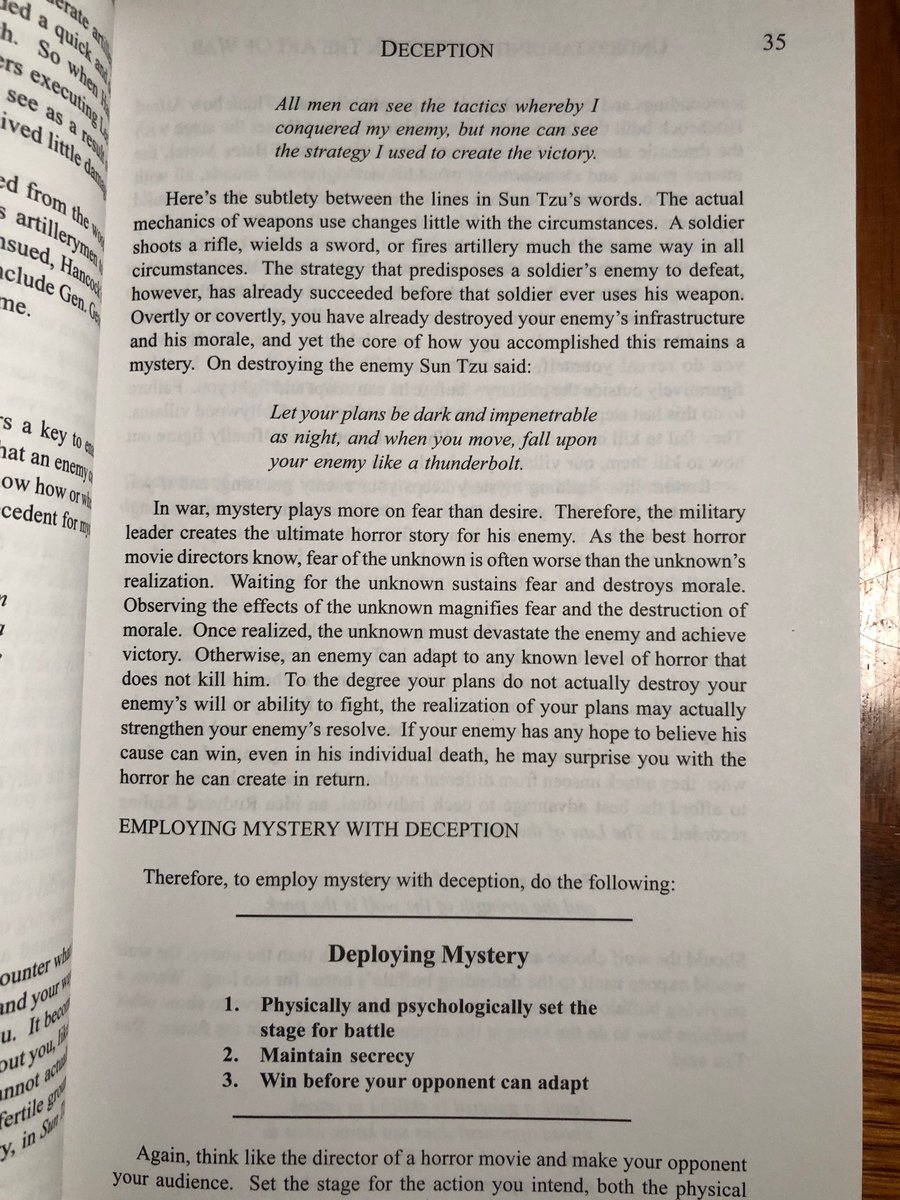
JAFO, but couldn’t help thinking this morning about something I wrote around 2002 and published this month in 2003, one page shown below. This is from an interpretation I wrote of Sun Tzu’s Art of War that made it into all the war colleges at the time except the Army (which figures since I was in the Army). I bring it up because for decades, Trump has made references that align with Sun Tzu, such as a tweet that “The supreme art of war is to subdue the enemy without fighting.” This aligns with his general use of economic power to advance American interests in preference to military power, as was being geared up by the Bush administration in 2002-3.
However, Sun Tzu was not a pacifist, as noted on this page. Winning without fighting was pragmatic because long-term wars are a drain on a country in pretty much every way you can imagine. They also, if you don’t win quickly and decisively enough, serve to educate your enemies how to fight you. Anyway, here’s a lens to look at everything if you’d like to use it.
In this photograph, where V = the volume of the glass and W = the volume of the water, the water volume is W = 1/2V. This is a fact. I know because I measured it. If I'm credible, you might even believe me.
Now, whether a person interprets this glass as half full or half empty is another matter, but once you know, you can predict with near certainty how that person will view every other such glass. The next best step is to understand why.
Wars unleashed do not end until the loser surrenders unconditionally or no longer walks the earth. Enemies can become friends, but in no instance has a war truly ended if the enemy still breathes and is willing to be violent.
This, of course, is why there are veterans.
Honored to have contributed to Project 888, including the poem Buddy At Your Back. (See https://t.co/0wAssvje2S). Here you will find stories, letters, and photographs about the three-quarters of a ship's crew who never came home.
Just putting this out there for the record, since my colleagues appear to be running with it. Along with @ScottAdamsSays Department of Imaginary Concerns, we must not forget the Department of Unnecessary Drama (DUD).