Gulf stocks mostly rose as rate-hike expectations eased and oil supply improved, while Saudi shares fell.
Easing concerns over energy disruptions and reduced expectations of an imminent Fed hike supported regional markets Monday.
Key drivers:
Lower rate-hike odds: According to CME FedWatch, the probability of a hike this month fell from 64% to below 20% following weak U.S. jobs data and downward wage revisions. Traders still expect a possible December hike.
Increased oil supply: Shipping data showed Middle Eastern crude exports exceeded pre-war levels on four days in late September. G7 reserve releases added further supply.
Dollar-linked currencies: Most Gulf currencies are pegged to the dollar, making regional markets sensitive to Fed policy expectations.
Market performance:
Dubai: +0.1%; Emirates NBD gained 0.9%.
Abu Dhabi: +0.3%.
Qatar: +0.5%.
Saudi Arabia: −0.7%; Al Rajhi Bank fell 1.3%.
Geopolitical risks remain. As fighting escalated in Yemen, the Houthis claimed attacks on Saudi Aramco facilities in Riyadh and Khurais caused fires. The original report provided no independent verification.
The focus now is whether supply improvements can last—and whether regional conflict will disrupt energy shipments again.
Weak September jobs data eased expectations for an October Fed rate hike—but the market’s initial rally faded.
🌈Nonfarm payrolls: +29,000 vs. +89,000 expected—the slowest growth this year.
🌈Revisions: July and August payrolls were revised down by a combined 60,000.
🌈Unemployment: Rose to 4.2% from 4.1%.
🌈Fed expectations: CME FedWatch showed a roughly 22% chance of a 25-basis-point hike and a 78% chance of no change.
🌈Stocks and Treasuries initially rallied, but stocks later pared gains as yields rebounded. The 10-year Treasury yield rose 3.4 basis points to 5.272%.
JPMorgan’s Michael Feroli noted that average monthly job gains over the past three months fell to 51,000, close to the pace needed to keep up with labor supply growth.#spy #qqq $QQQ
Nike ($NKE ) Q1 earnings: EPS beat, revenue miss. Shares fell more than 4% after hours.
⚡️EPS: $0.48 vs. $0.44 expected.
⚡️Revenue: $11.21B vs. $11.35B expected.
⚡️After-hours trading: Down 4.41% to around $33.60.
⚡️Year to date: Down roughly 44%, versus a 12.05% gain for the S&P 500.
⚡️Elsewhere in the consumer sector, Costco ($COST) beat both earnings and revenue expectations in its September 24 Q4 report:
⚡️EPS: $6.75 vs. $6.55 expected.
⚡️Revenue: $95.7B vs. $94.85B expected
#STOCK #Tard #wealth #invest #Dollar #NKE
@Venu_7_ Getting stopped out just before a rebound hurts. But your next trade isn't there to redeem the last one.
One lesson from over a decade of trading: when you feel rushed, stepping away is discipline too
@LukeBruni17 Getting stopped out just before a rebound hurts. But your next trade isn't there to redeem the last one.
One lesson from over a decade of trading: when you feel rushed, stepping away is discipline too
@alc2022 Getting stopped out just before a rebound hurts. But your next trade isn't there to redeem the last one.
One lesson from over a decade of trading: when you feel rushed, stepping away is discipline too👍
@alc2022 Getting stopped out just before a rebound hurts. But your next trade isn't there to redeem the last one.
One lesson from over a decade of trading: when you feel rushed, stepping away is discipline too
@mikealfred After more than a decade of trading, I’ve finally realized that no method works in every market condition.
A trading system must clearly define not only when to enter, but also when to stop.
Only by recognizing the limits of a method can you use it effectively.
@LukeBruni17@stock_analysisx After more than a decade of trading, I’ve finally realized that no method works in every market condition.
A trading system must clearly define not only when to enter, but also when to stop.
Only by recognizing the limits of a method can you use it effectively.
@LukeBruni17 After more than a decade of trading, I’ve finally realized that no method works in every market condition.
A trading system must clearly define not only when to enter, but also when to stop.
Only by recognizing the limits of a method can you use it effectively.
@Venu_7_ After more than a decade of trading, I’ve finally realized that no method works in every market condition.
A trading system must clearly define not only when to enter, but also when to stop.
Only by recognizing the limits of a method can you use it effectively.
@midascabal After more than a decade of trading, I’ve finally realized that no method works in every market condition.
A trading system must clearly define not only when to enter, but also when to stop.
Only by recognizing the limits of a method can you use it effectively.
@midascabal After more than a decade of trading, I’ve finally realized that no method works in every market condition.
A trading system must clearly define not only when to enter, but also when to stop.
Only by recognizing the limits of a method can you use it effectively.
@midascabal After more than a decade of trading, I’ve finally realized that no method works in every market condition.
A trading system must clearly define not only when to enter, but also when to stop.
Only by recognizing the limits of a method can you use it effectively.
@Invest_Brandon After more than a decade of trading, I’ve finally realized that no method works in every market condition.
A trading system must clearly define not only when to enter, but also when to stop.
Only by recognizing the limits of a method can you use it effectively.
@Invest_Brandon After more than a decade of trading, I’ve finally realized that no method works in every market condition.
A trading system must clearly define not only when to enter, but also when to stop.
Only by recognizing the limits of a method can you use it effectively.
@Invest_Brandon The longer I trade, the more I say, “I don’t know.”
I can’t predict every move, but I can plan scenarios, manage risk, and wait for the right setup.
Sharing thoughts on stocks, probabilities, and trading psychology.
You don’t need certainty to make a sound decision.
@Invest_Brandon The longer I trade, the more I say, “I don’t know.”
I can’t predict every move, but I can plan scenarios, manage risk, and wait for the right setup.
Sharing thoughts on stocks, probabilities, and trading psychology.
You don’t need certainty to make a sound decision.
@pdicarlotrader The longer I trade, the more I say, “I don’t know.”
I can’t predict every move, but I can plan scenarios, manage risk, and wait for the right setup.
Sharing thoughts on stocks, probabilities, and trading psychology.
You don’t need certainty to make a sound decision.
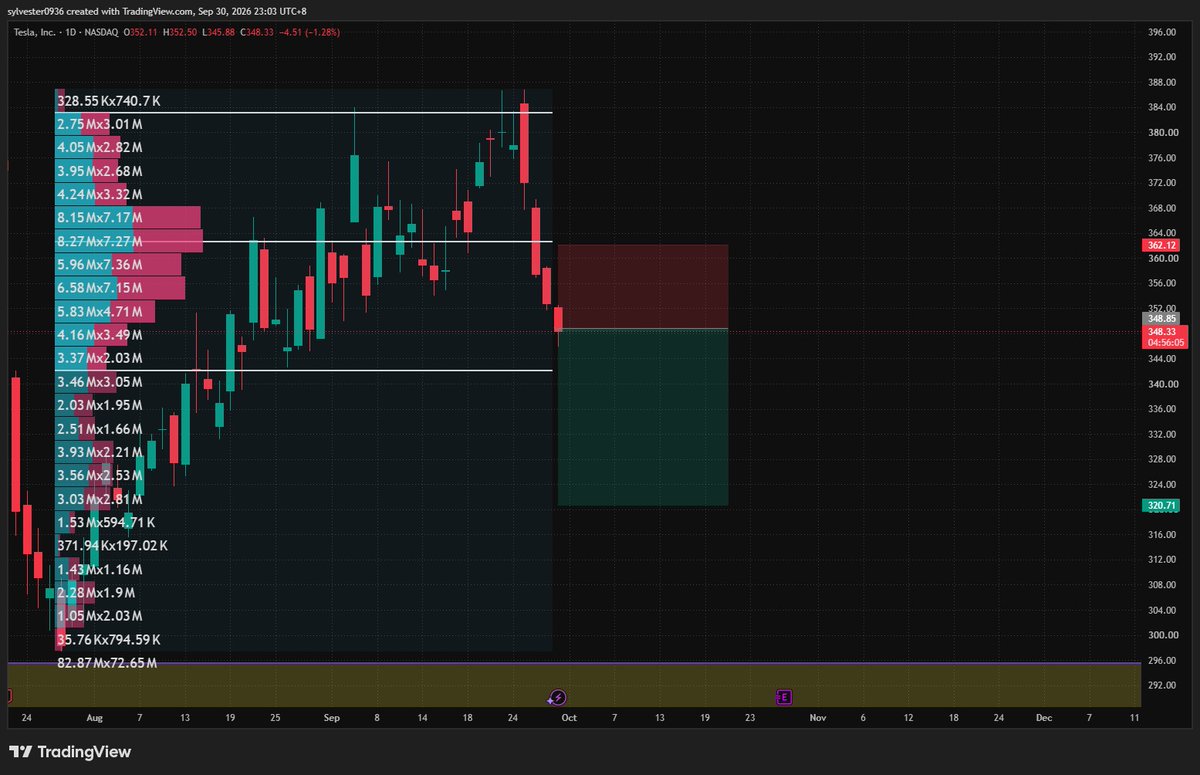
$TSLA Daily Strategy: Short-term bearish bias. Watch for a breakdown and failed retest. Price is around $349.11 on the chart, below the $354–367 high-volume zone after consecutive declines. $362–363 is key overhead resistance.
🚀Entry: Use $348.85 as the reference level marked on the chart. Consider a small short position after a daily close below it and a failed retest. The current daily candle is still open, so confirmation is pending.
🚀Stop-loss: $362.12. Size the position according to the stop distance.
🚀Targets: $342 first, then $328, with a final target of $320.71. Take profits in stages.
⚡️Reward-to-risk: An entry at $348.85, stop at $362.12, and target of $320.71 offer approximately 2.1:1, excluding costs. The first target offers only about 0.5:1, so watch nearby support closely.
⚡️Invalidation: If price closes back above the $354–357 zone and holds a retest, put pending short entries on hold. Manage existing positions according to the planned stop.
High-volume zones alone don’t confirm selling pressure. Watch for a confirmed break below $348.85 and whether support at $342 gives way.🔥🔥
#TSLA #STOCK #TardeDePerros