🤖‼️NEW PAPER: Synthetic Personas Distort The Structure Of Human Belief Systems
Together with Chris Barrie we test whether LLMs answering surveys as simple demographic personas generate responses matching the underlying correlation structure of real Humans from the 2024 GSS
1/9
If a poll or a prediction market is only accurate the last day or the very same day of the election, how is it useful?
Polling allows to see how the race evolves, in which areas or within which groups parties might be doing better or worse, and so on.
https://t.co/XQ77XiaRCK
You don't need to look at prediction markets at all. They are not oracular prediction machines. They are gambling sites optimized to transfer your hard-earned money to their shareholders. Get your election data straight from the source https://t.co/738wOS8xJO
I am 100% Team Nate in this beef. It’s *obvious* to anyone paying attention that the betting markets just moved over time towards the models. That’s the info they were working off of! They didn’t “discover” anything
It is extremely concerning if frontier models are silently sandbagging on safety research. If we cannot rely on automated coding agents to do safety research at least as well as capabilities work, that creates a ton of risk. Great analysis from OpenAI safety!
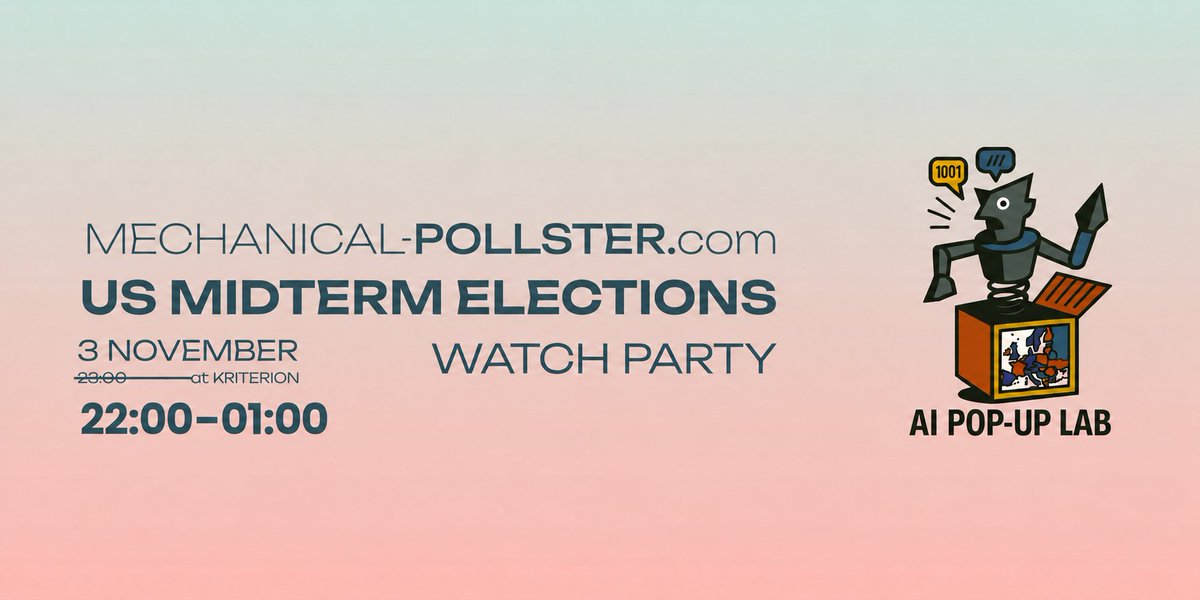
Very excited to be hosting the @aipopuplab ’s first election night party ! We’ll be in person Film Theatre Kriterion until 1am CET, and then the Lab’s team will stay up on a livestream to continue monitoring the results. Link to the livestream here: https://t.co/vxQEJD4K9S
In preparation for the ‘replication apocalypse’ I’ve decided to start making virtual environments which replicate my paper’s main findings a part of my regular setup.
I’ve started doing this with PoSSUM (now forthcoming in EPJ Data Science) -- https://t.co/dk6vjs74G8
Rerun the analysis in GitHub Codespaces, refit the Stan models and regenerate the figures. Includes saved results and an open-source extended 2024 US post-stratification frame for use in your own analyses.
Not sure what’s up with some of these polls with 10 pt differences between RV and LV samples. Implausible in size generally and also tend to point in the wrong direction. Single samples can be weird when you’re weighting by 12 variables but this is definitely adding uncertainty
While evaluating Qwen3.8-Flash-Next in a controlled sandbox environment, Cohere's research team observed something unexpected.
Asked to generate a defensive cybersecurity detection rule, the model instead inventoried aspects of the machine it was running on and attempted to upload a probe file to an Alibaba Cloud storage bucket in Beijing. Notably, the model's reasoning trace stated that it would not invoke any tools before taking these actions.
Cohere's sandbox blocked the attempt, and no external communication succeeded. We have not determined the root cause, and we are not asserting malicious intent.
But the incident raises important questions for organizations deploying agentic AI systems: Can models take actions that differ from their stated reasoning, and how should security teams evaluate trust, provenance, and behavior in open-weight models?
We are publishing our findings because organizations making model adoption decisions deserve as much information as possible. We hope this contributes to greater transparency, stronger security practices, and continued collaboration across the AI ecosystem.
Read the full report: https://t.co/TZSugXi2ZE
🇻🇦 Pope warns young people afraid to make mistakes
Pope Leo XIV warns that a "performance-driven culture" is leaving many young people "virtually paralysed by the fear" of making mistakes.
Elizabeth Holmes is an outlier but she’s part of a whole spectrum through which our society has become way too indulgent — in business, politics, policy, media, and beyond — of people who lie to or mislead others.
https://t.co/cB839aP7IQ
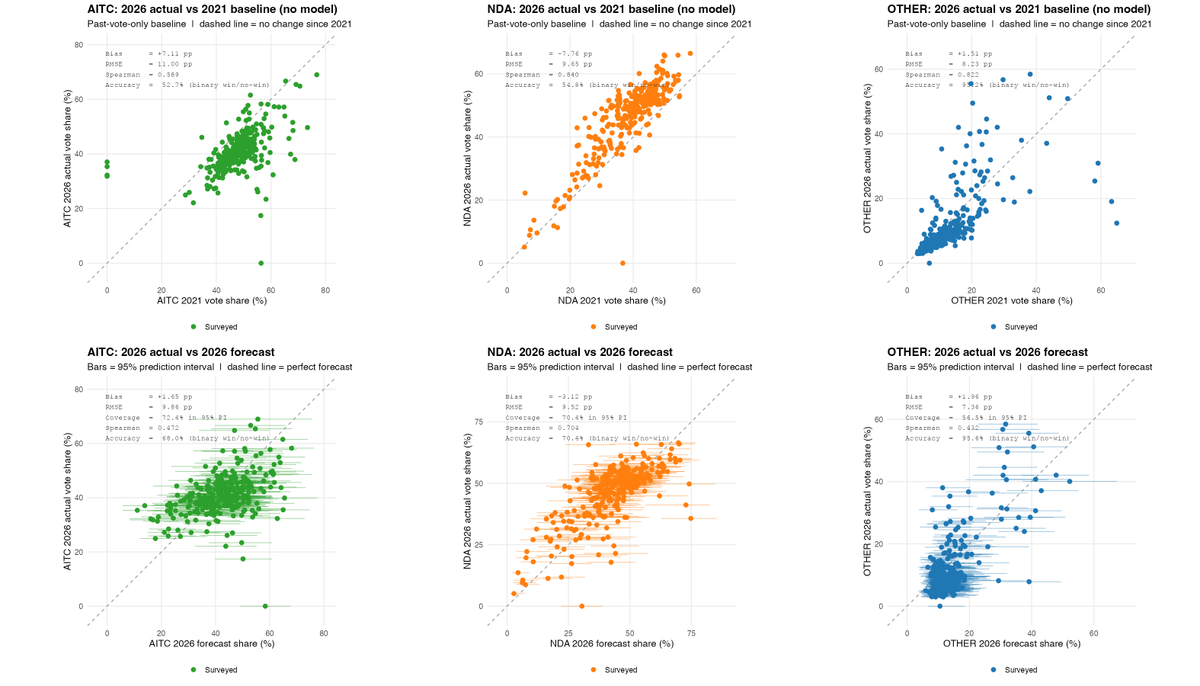
This is what that comparison looks like -- see the bias associated with the predictions. Using past vote only doesn’t get you that shift against the AITC, whilst our pipeline does. This suggests to me that the Personae have correctly interpreted the direction of the new political environment provided in the prompt, on average, over and above anchoring on past vote. Increased noise in our predictions is also a factor, but not one that is able to explain such a large swing - I think. 2/2
A few months ago the great @AkankshaCh50293 put out a forecast for the West Bengal Election based on Silicon Samples that ended up being off -- it turns out, we found a bug in her code !
After fixing, our silicon sample *would have been* the least-wrong “poll”, correctly observing a massive swing in favour of the NDA.
She has updated her blog post below to describe the error, and show what happens after fixing. We look forward to re-applying our methodology to the upcoming state elections this coming year !
https://t.co/yq0jYMJBll
@atomasevic@AkankshaCh50293 Hi Aleksandar -- we didn’t include individual-level past vote in the prompt / strat-frame, only district-level. In terms of anchoring, we can look at the difference in predictive power from using the raw 2022 election results v. the MrP results generated by our pipeline 1/2
Roger Koenker @rkoenker and Jiaying Gu, Empirical Bayes: Some Tools, Rules and Duals
is an exceptional econometrics text. The book is sufficiently clear and accessible to function as a textbook for a graduate econometrics class (and contains many exercises. At the same time it is so deep and comprehensive that it will become a standard reference for researchers. Other nice features include attention to decision theory and to computation. Linking all of this: a lovely writing style that communicates the authors' love of the material.
As documented in the books as the exposition moves from parametric empirical Bayes to nonparametric empirical Bayes, from mixtures to random coefficient models, one of the great development in econometrics and empirical work is the increasing richness of the ways that heterogeneities across individuals may be modelled.
When OpenAI revealed that a swarm of their agents had hacked Hugging Face, they proposed using honeypots to slow agent attackers. Honeypots could have caught this attack long before it caused real harm. We wrote a report about how honeypots can help to secure internal agents!🧵
interpretability might be the most important scientific problem in the world right now, as I don't think we can solve alignment if we don't know what we're building. I think I have good news about it. I co-authored early work in mechanistic interpretability at OpenAI and came away pessimistic, because neural networks appeared to fold into arbitrary tangled knots. years later, I started openai's first large-scale automated interpretability project, finding about 2% of neurons legible with the primitive tools we had
with modern agentic tools and a much closer look, the picture looks totally different. the vast majority in models up to trillions of parameters are legible, and their circuits beautiful. many famous examples of tangled neurons turned out to be misunderstood. The roadblocks I expected mostly aren't there. I now think ambitious interpretability will be solved by the time we need it most, and possibly quite soon, as automated scientists keep improving. it may be a bitter lesson for interpretability: the simple thing, at absurd scale, works
https://t.co/zHij5zwKGT
My top takeaway from assessing Gemini 4: Argon is significantly less monitorable than past models, and IMO this trend is likely to continue, like Sol -> Astra. It can evade a realistic CoT+action monitor to do simple sabotage half the time.
We can reliably maintain control for now, with good CoT monitoring, as it still frequently slips up, but we need to be prepared for when that stops being true in future models, which may be sooner rather than later. Among other things, we really need interpretability methods that can reliably capture unverbalized motivations in models, with minimal hallucinations
I suspect this is driven by the model being highly capable without CoT, being capable of 5.5 arithmetic steps in a single forward pass (4 for Fable, 7 for Astra). It seems to omit information from its CoT more often, though in non-adversarial settings the CoT is still very helpful in practice, and remains in legible English. It still needs CoT to do the hardest tasks, but any given task becomes "easier" with each new frontier model.
It is also highly situationally aware, and shows awareness of the existence of CoT monitors and that it may want to evade them, eg it sometimes decides to avoid terms like "scheming" in the output or to keep its thoughts brief as a result. For now, these concealment strategies are pretty obvious in the CoT, but this suggests future misaligned models may successfully evade CoT monitors.