Founder and CEO of TS Imagine, a leading platform for integrated electronic multi-asset trading, portfolio management, prime brokerage, and risk management.
I’ve spent 35 years building technology for capital markets.
The older I get, the less interested I am in hype cycles, and the more interested I am in the plumbing: what actually changes, what breaks first, and who gets caught late.
AI, tokenization, quantum readiness, and new market structures are starting to touch the systems that actually move money.
At TS Imagine, I have a front-row seat to the future of finance, and I’m excited to share my thoughts here on X.
Our process traces activity, measures the activity against desired outcomes, and governs the changes that are made. This process is how an unreliable AI model becomes a tool that a trading desk will trust.
Every team building with AI makes a quiet bet that a model that is wrong a fraction of the time can still be handed work, but capital markets have no room for operational errors.
TS Imagine has built the fundamentals of our AI stack to ensure that models operate with complete accuracy before they reach a trading desk.
Pillar three is configuration as a managed asset.
Prompts and tool definitions are governed like code and kept separate from the application. The person best positioned to fix a prompt is at the trading desk, so changing a sentence should not require a full redeployment of the model.
Every edit is logged, so we can continuously see the context that is changed within a model.
For a trading system to name the price of a bond, the system has to know whether the desk means the bid, the ask, the mid, or the internal mark. The system also needs to determine whether the quote is clean or dirty, which day-count convention applies, whether a pending corporate action changes the coupon, and if the security is even eligible for the particular fund.
A bond price is a decision tree made up of all of those factors with an accounting, risk, and compliance consequence located at every branch. A firm that resolves that tree incorrectly receives a mispriced position, a P&L that will not reconcile against the custodian, or a compliance breach.
This is the part the "an AI can write a risk engine" argument skips. LLMs can define accrued interest and name the conventions correctly. What AI models cannot do is carry the licensed data feeds, the corporate-actions logic, and the client-specific overrides that decide which branch is correct for the instrument, the fund, and the mandate.
That curation layer is decades of encoded exceptions, maintained continuously. It is the moat, and it sits underneath the pricing number rather than in the interface on top of it: https://t.co/0nBiI2bcNb
Prediction market data becomes a risk-analytics layer over the positions a firm already holds. The managers who wire that signal into how they read the book see the exposure shift first.
A balanced wealth portfolio already holds a position on the next Fed rate decision, on the outcome of a major election, and on whether a given tariff regime survives.
Those bets are implicit, spread across equity, credit, and rate exposure. A prediction market contract on the same event states that probability outright, which turns it into a live read on exposure the portfolio already carries: https://t.co/inkyuBSTM1
Traditional risk tools read those exposures through historical correlations and factor models that refresh on a lag. A prediction market on the event itself carries a live, market-implied probability that moves the moment the odds shift. For a manager watching a book, that is a leading read on the events already driving the positions, available before the quarterly factor model catches up.
The practical move is to map the prediction market contracts that match the events a book already carries, and then watch them as an early signal on that exposure. A rate-sensitive portfolio gets a cleaner forward read from a live contract on the next FOMC decision than from a correlation matrix built on last year's data.
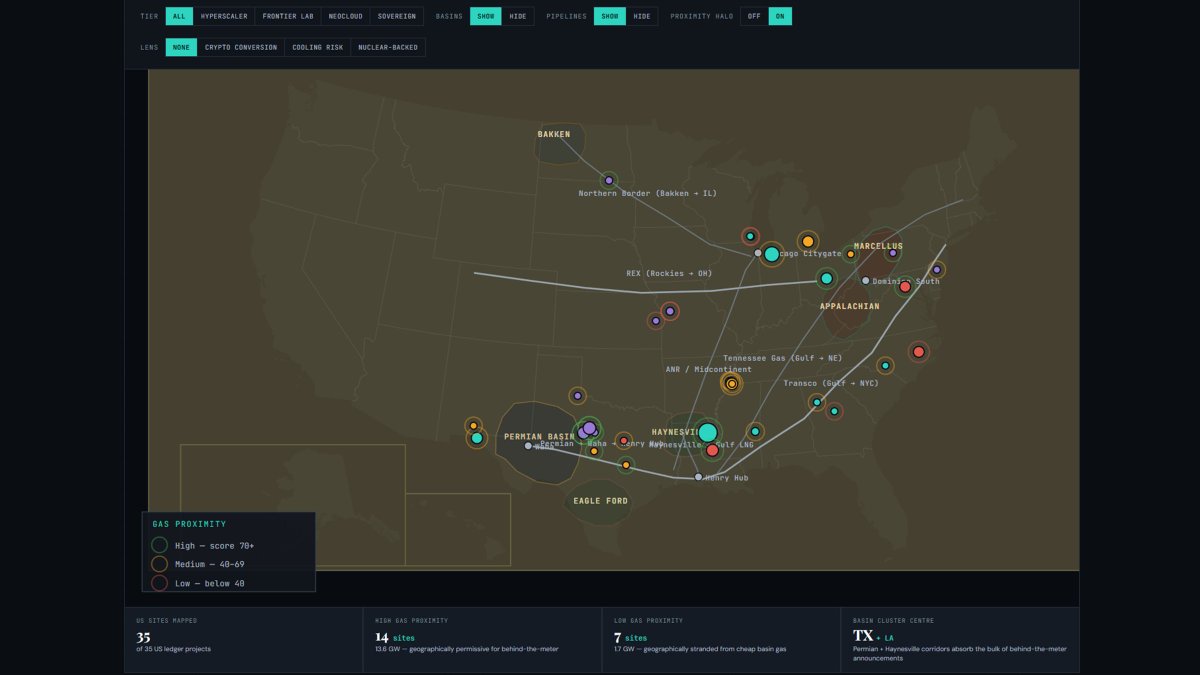
A megawatt of data-center capacity in the Permian Basin, sitting next to stranded associated gas, is not the same asset as a megawatt in Northern Virginia waiting years for a grid interconnection. The single GPU-hour forward that CME and Silicon Data are bringing to market prices both as if they were identical.
Power is a regional market. Where a site can burn cheap gas behind the meter, its cost of compute runs structurally lower than a site that depends on a congested grid and a queue for new interconnection. A national price reports averages and erases the location that actually drives the economics.
Natural gas already worked this out. When gas at the Waha hub in West Texas trades at a deep discount to the Henry Hub benchmark, that basis names Permian pipeline constraints as a specific, tradable fact rather than an average. Compute needs the same decomposition. The forward gives a lender or a developer the level, while a basis would tell them where capacity runs genuinely cheap and where it sits trapped.
Until a locational basis exists, a compute forward can set the level but cannot fully hedge a specific site. A developer in a constrained region who hedges with the national contract still carries the spread between their own site and the index. My basis read maps where that spread opens first: https://t.co/NZ9OtnHrRQ
This executive order addresses the second clock. That's exactly where the attention belongs.
The debate over whether the President could explain the science may generate headlines. It won't secure a single network.
The President signed the right executive order. Whether he can explain it is beside the point.
There is a version of the debate over President Trump's executive order on post-quantum cryptography worth having. The version dominating social media, whether he could explain every technical detail of what he signed, isn't it.
The real question isn't whether the President understands Shor's algorithm. It's whether the United States is moving quickly enough to protect critical infrastructure before today's encryption becomes tomorrow's vulnerability.
I've argued for years, including in my recent paper on quantum computing and capital markets, that the cryptographic threat from quantum computing is not a future problem. It's already here: https://t.co/ozgAYjdhEL
For financial markets, the order could have an impact well beyond Washington. Once the federal government formally prioritizes post-quantum migration, regulators inevitably take notice. Compliance teams follow regulators. Boards ask management what the firm's migration plan looks like. Budget discussions that were easy to postpone suddenly become immediate.
In my recent paper, I argued that quantum computing runs on two different clocks.
One is the race to build large-scale quantum computers. That's still uncertain.
The other is the race to replace today's encryption before those machines arrive. That clock has been ticking for years.
A Polymarket contract on whether Ukraine would sign a minerals deal by April 2025 resolved “Yes,” but no deal has been signed. A single large holder of the settlement oracle's governance token cast enough votes, spread across three accounts, to decide the outcome, and the contract paid out on that result.
Prediction market contracts have a clean, deterministic payoff. They settle at 100 or at zero. What decides which one is a resolution source, and that source is a judgment that can be wrong, thin, or captured. The price can be perfectly efficient, and the settlement can still fail.
Polymarket logged more than 1,150 disputed markets in the first five months of 2026, already past its full-year 2025 total. Most resolve correctly, and the ones that do not are a sizable structural risk, because a contract that settles against the facts does more damage than no contract at all.
That is the difference between the crypto-native venues that resolve by token vote and the CFTC-regulated exchanges that resolve against a defined rulebook. As institutional money enters through cleared venues, resolution governance becomes the fault line that decides whether the category holds. The desks pricing these contracts are pricing the credibility of whoever settles them: https://t.co/7DUS67safL
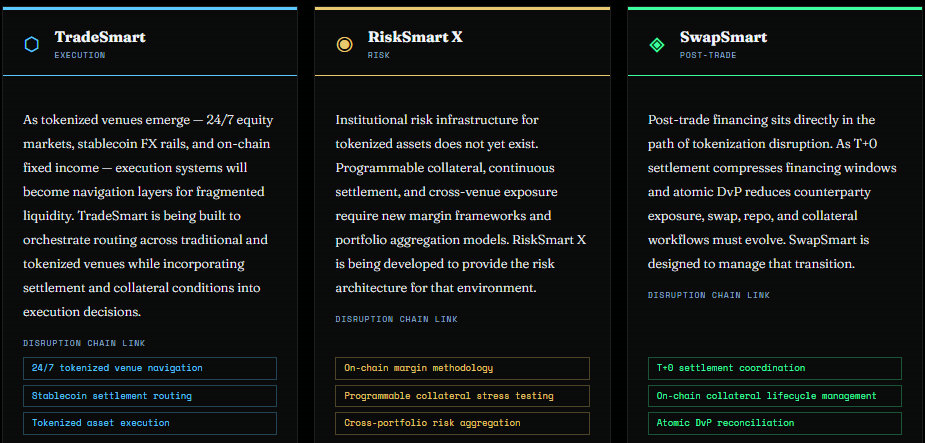
Firms treating tokenization as a future cutover are budgeting for the destination. The cost arrives earlier, in the transition layer, where reconciliation between tokenized and legacy records becomes a daily operational function rather than a one-time project milestone.
The desks that build that reconciliation now will run the parallel period cleanly.
A tokenized Treasury and its legacy custody record now describe one bond position on two different ledgers. Both ledgers stay live for years, and every firm holding that bond has to keep the two in agreement every day. The transition years are where that risk concentrates, well before any finished system arrives: https://t.co/SDlZ2XdT95
The end-state debate asks which rail wins. The nearer problem is the years in between, when a position sits in both places at once. A break happens when a firm settles one leg of a trade on a tokenized rail in seconds while the offsetting leg still clears through the legacy batch cycle at the end of the day.
For those hours, the tokenized leg has already moved and the legacy leg has not. The firm's books carry the position as settled on one ledger and pending on the other, and that gap has to be caught in reconciliation before it compounds into a funding or margin error the next morning.