I am sure that the widely quoted statement: 2 kids in every class room have a language disorder is wrong. Most of my family over 3 generations has had something odd about their language and I am usually aware of others with a similar language quirk. #devlangdis
Forget all the huge supermarkets and their mawkish Christmas adverts, this was the best Christmas advert - Enniskillen pub Charlie's put out this advert back in 2023. It’s brilliant.
@davecurtis314@JamesLNuzzo In 1980 black people made up 1.2% of UK population. Assuming average age of a professor to be 45ish then you should expect about 300 black professors in the UK in 2025. We are not far off.
i never knew there was an actual term for this:
epistemic loneliness is a cognitive form of isolation that happens when you cannot share complex ideas, inner thoughts, or meaningful perspectives because you lack a willing, able, or understanding conversational partner.
I know people think the Monty Hall problem is a game show trick or a silly math puzzle, but the fact that most people get the logic wrong can have real world consequences. I'll walk you through an example I teach in my undergraduate Human Genetics class.
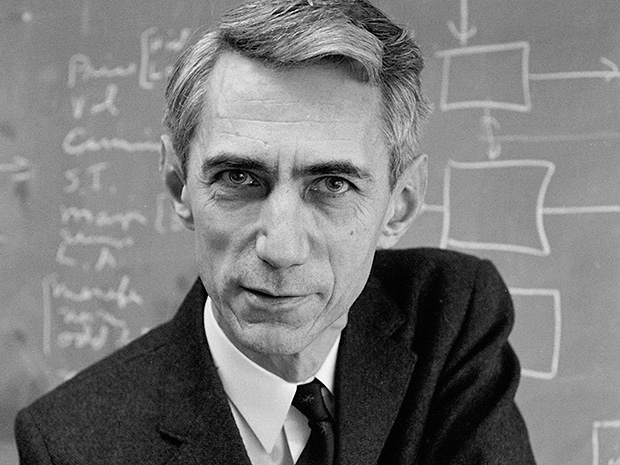
In 1948, a 32-year-old at Bell Labs published a paper nobody fully understood.
Engineers found it too mathematical. Mathematicians found it too engineering-focused. One prominent mathematician reviewed it negatively.
That paper - "A Mathematical Theory of Communication", became the founding document of the digital age.
The man was Claude Shannon. Father of Information Theory.
At 21, he wrote the most important master's thesis of the 20th century.
Working at MIT on an early mechanical computer, Shannon noticed its relay switches had exactly two states - open or closed. He had just taken a philosophy course introducing Boolean algebra, which also operated on two values: true and false.
Nobody had ever connected these two things.
His 1937 thesis proved that Boolean algebra and electrical circuits are mathematically identical, and that any logical operation could be built from simple switches.
Howard Gardner called it "possibly the most important, and also the most famous, master's thesis of the century."
Every digital computer ever built traces back to this insight.
At 29, he proved that perfect encryption exists.
During WWII, Shannon worked on classified cryptography at Bell Labs. His work contributed to SIGSALY, the secure voice system used for confidential communications between Roosevelt and Churchill.
In a classified 1945 memorandum, he mathematically proved the one-time pad provides perfect secrecy, unbreakable not just computationally, but provably, permanently, against an adversary with infinite power.
When declassified in 1949, it transformed cryptography from an art into a science. It laid the foundations for DES, AES, and every modern encryption standard.
At 32, he defined what information is.
His 1948 paper introduced one equation:
H = −Σ p(x) log p(x)
Shannon entropy. The average uncertainty in a probability distribution. The minimum bits required to encode a message.
Three things followed:
> He defined the bit - the fundamental unit of all information. His colleague John Tukey coined the name.
> He proved the channel capacity theorem, every communication channel has a maximum rate of reliable transmission. You can approach it. You can never exceed it.
> He unified telegraph, telephone, and radio into a single mathematical framework for the first time.
Robert Lucky of Bell Labs called it the greatest work "in the annals of technological thought."
Where his equation lives in AI today:
Cross-entropy loss - the function training every classifier and language model, is derived directly from H. Decision tree splits use information gain, which is H applied to data. Perplexity, the standard LLM evaluation metric, is an exponentiation of cross-entropy.
Every time a neural network trains, Shannon's formula runs inside it.
He also built the first AI learning device.
In 1950, Shannon built Theseus, a mechanical mouse that navigated a maze through trial and error, learned the correct path, and repeated it perfectly. Mazin Gilbert of Bell Labs said: "Theseus inspired the whole field of AI."
That same year he published the first paper on programming a computer to play chess. He co-organized the 1956 Dartmouth Workshop, the founding event of AI as a field.
The man:
He rode a unicycle through Bell Labs hallways while juggling. He built a flame-throwing trumpet, a rocket-powered Frisbee, and Styrofoam shoes to walk on the lake behind his house.
He called his home Entropy House.
When asked what motivated him: "I was motivated by curiosity. Never by the desire for financial gain. I just wondered how things were put together."
In 1985, he appeared unexpectedly at a conference in Brighton. The crowd mobbed him for autographs. Persuaded to speak at the banquet, he talked briefly, then pulled three balls from his pockets and juggled instead.
One engineer said: "It was as if Newton had showed up at a physics conference."
He died in 2001 after a decade with Alzheimer's, the cruel irony of information slowly leaving the mind of the man who defined what information was.
Claude, the AI model, is named after Claude Shannon, the mathematician who laid the foundation for the digital world we rely on today.
We started a podcast with the deliberate aim of talking to a range of voices. We had had enough of the polarisation and mudslinging of social media.
We went to significant effort to seek out different perspectives. Our criterion was not whether they agreed with us, but whether we thought they would have an interesting angle to add. We made it clear in the podcast that the views of the guests did not necessarily represent those of the hosts.
From the start we wanted this to be a space where people explained their ideas so that the listener could understand and make up their own mind. We wanted to model openness and tolerance of disagreement. We wanted to do something different to what happens on social media.
When we released our first episode, with Dame Uta Frith, we quickly discovered why these conversations are impossible. She said things which some people disagreed with, and as a result they blamed us for platforming her. There was little reasoned discussion of her ideas, and a lot of flinging of mud. People I had worked with and who I respected recorded videos about the harm I was causing and how disappointed they were. Others made huge assumptions about what we, as interviewers thought, including dismissing the suffering and experience of others and having a right wing agenda to cut benefits. Things that Uta had not said were attributed to her, and by association to us.
Immediately, our other podcast guests started to withdraw. People whose work I really respected and who had fascinating things to say backed away, scared perhaps that they too would be tainted by association. Their viewpoints were very different to Uta and that is exactly why we asked them. Just like when we interviewed Uta, we wanted to really hear and understand what they had to say. That won’t be possible now.
There’s something going on in the online autism world, and it’s not healthy. Many people are terrified to say what they think, for fear of the sort of thing that has happened to me this week. Useful and valid viewpoints are not being heard. Self-censuring is rife. Online shaming has been normalised. As a result, the growth of knowledge is stifled.
If you disagree with what Uta Frith said and you’d like to come on our podcast, please email me. We’d love to have you.
https://t.co/NCV214Mcz2
I know. I'll post this and no one will see it or share it.
It's just the rolling annual total of NHS England Staff dying.
The media won't mention it
The government will stay silent about it
Doctors will pretend it's not real
But it's real.
Tell me:
When did the pandemic end?
The Language Trap, as proven by MRI: people don't get math because they process math statements like standard linguistic expressions, while mathematicians recruit non-verbal regions of their brains.⤵️
Please share the post below, there are up to 15m O2 customers in the UK, they need to understand what's happening (& all on mobile and broadband contracts need to worry about this trend)
this winter, dress like Samuel Beckett: chunky, textured sweaters, merino turtlenecks, long raincoats, textured sport coats, tweeds, and warm shearling overcoats