You are spending hundreds of hours writing, but your audience is scrolling right past your best ideas.
I help creators bridge the gap.
By turning your concepts into highly recognizable visuals, we build a mental shortcut that forces people to stop, process, and remember.
Technology is essential to fully automate these strategies and can accelerate a student's learning by 4x.
While a human teacher might try to loosely implement these cognitive strategies, manually tracking optimal, individualized learning schedules for dozens of students requires an impossible amount of bookkeeping, making the human teacher a bottleneck. By using an automated technological system to completely bypass this limitation, serious students can learn four times the amount of material in the exact same amount of time.
Traditional schools force students to march through linear sequences of topics.
But even if you try to personalize learning, manually tracking schedules makes the human teacher a bottleneck.
- Chapter 2 "The Math Academy" by @justinskycak
Thanks for your support! It means a lot to know The Math Academy Way has made such a big impact on you.
For anyone else who may be interested, the full 500+ page PDF is freely available: https://t.co/LeAKXUWrJW
It compiles and synthesizes evidence from hundreds of scientific papers to answer the following questions:
1. What techniques exist to maximize student learning and talent development, particularly in the context of math?
2. Why are these techniques so impactful, and if they are indeed so impactful, then why are they so often absent from traditional classrooms?
3. How does Math Academy leverage these techniques?
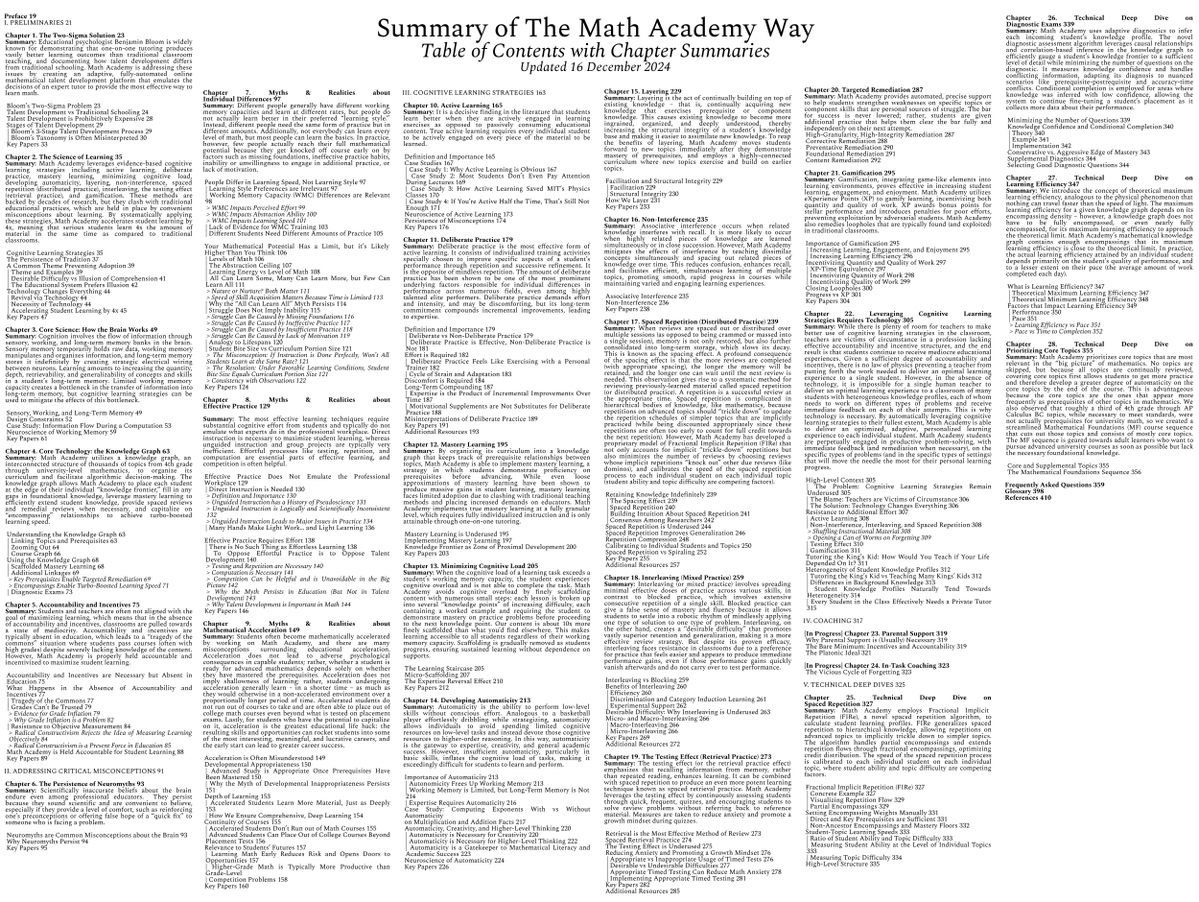
The table of contents of The Math Academy Way is very extensive and functions as a summary of the book; each chapter also has a one-paragraph summary.
Here is a not-too-out-of-date collection of all that summary info.
Despite decades of proven cognitive science, traditional classrooms still force students to march through linear sequences of topics.
By keeping everyone at the same predetermined pace with uniform assignments, schools promote coordinated cheating and confusion over genuine learning.
Forget “learn first, do later.” Do first, learn later.
@zarazhangrui about a different take on learning as adults: starting with a real-world project you actually care about, and work backwards to acquire only the knowledge you need
Scaffold vs Crane:
"A chatbot hands over the finished answer to the task in front of you and asks nothing of your memory whatsoever.
One is a scaffold, put up so that something can be built and then taken down; the other is a crane that lowers the finished object into place and leaves you standing beneath it, having lifted nothing and learned nothing about how it was made."
- Article by @C_Hendrick
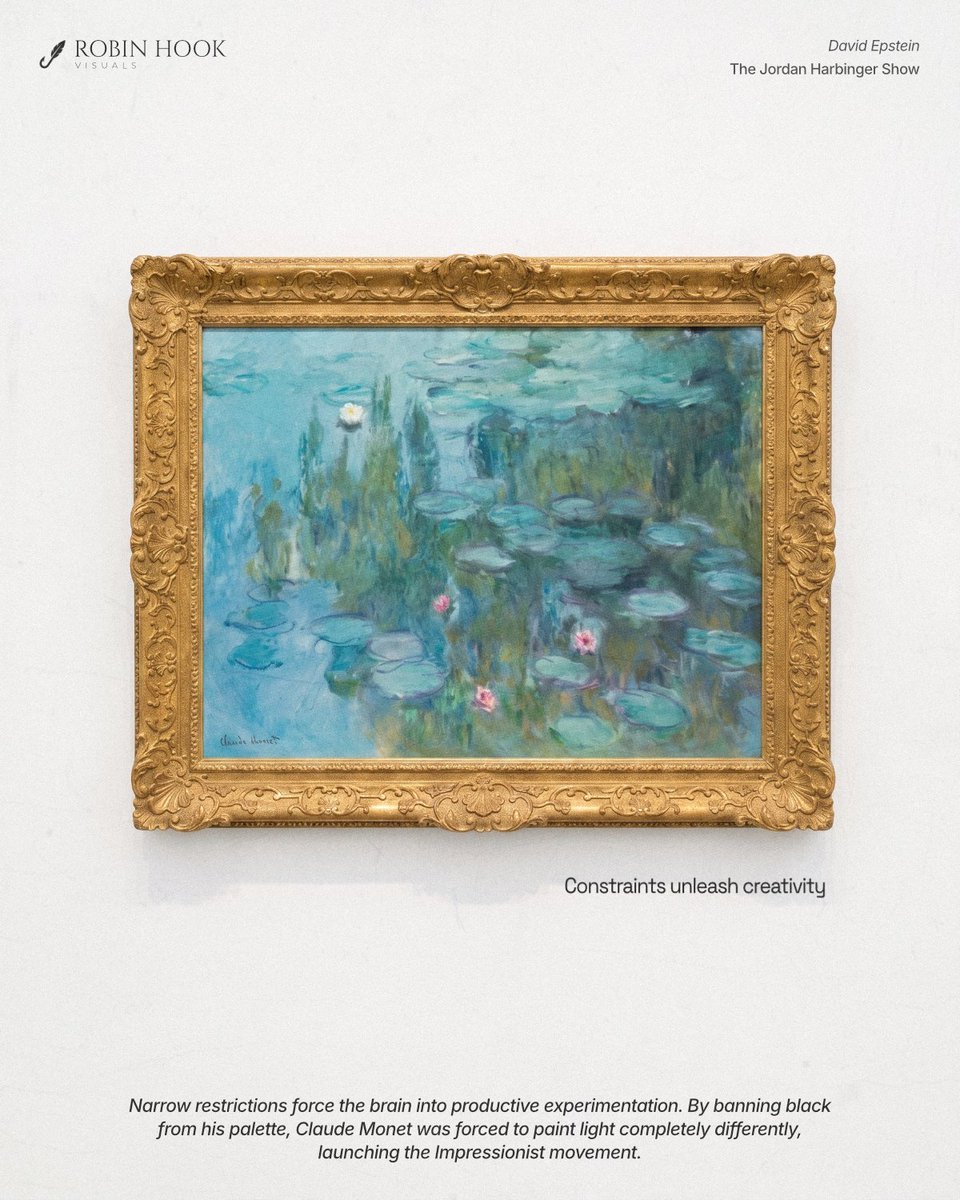
Imposing narrow restrictions blocks our default solutions and forces the brain into productive experimentation.
By banning the color black from his palette, Claude Monet was forced to find completely original ways to paint light and shadow, giving birth to the Impressionist movement.
Host: @JordanHarbinger
Guest: @DavidEpstein
Maximizers are miserable, satisficers are happy. Inside the Box author @DavidEpstein shows why limits beat limitless options for creativity and sanity.
Notes
https://t.co/aKFwrkDTE2
Apple
https://t.co/67XwsngDww
Spotify
https://t.co/pEV1YhznHa
Overcast
https://t.co/ezof0ZNXIT
"You cannot analyse a text on a subject you know nothing about; you cannot evaluate a claim in a field whose hinterland of knowledge is unavailable to you"
@C_Hendrick
The "beautifully shaded penny problem" is a concept coined by Ed Catmull, the co-founder of Pixar, to describe the ultimate creative trap of misplaced priorities.
It refers to a situation where a creator, such as a director or animator, becomes obsessively focused on perfecting a tiny, marginal detail in the background of a scene, like the exact shading on a penny, that the audience will never actually notice.
While they pour massive amounts of time and creative energy into polishing this trivial element, much higher priorities and core aspects of the project are neglected.
Total creative freedom is a trap.
In an interview with @DavidEpstein, he explains why "think outside the box" is terrible advice.
- @JordanHarbinger Show
Two visuals to keep in mind:
Maximizers are miserable, satisficers are happy. Inside the Box author @DavidEpstein shows why limits beat limitless options for creativity and sanity.
Notes
https://t.co/aKFwrkDTE2
Apple
https://t.co/67XwsngDww
Spotify
https://t.co/pEV1YhznHa
Overcast
https://t.co/ezof0ZNXIT
Imposing narrow restrictions blocks our default solutions and forces the brain into productive experimentation.
By banning the color black from his palette, Claude Monet was forced to find completely original ways to paint light and shadow, giving birth to the Impressionist movement.
Forget “learn first, do later.” Do first, learn later.
@zarazhangrui about a different take on learning as adults: starting with a real-world project you actually care about, and work backwards to acquire only the knowledge you need
The Church Business vs. The Banking Business:
Music executive Jimmy Iovine used this metaphor to highlight their contrasting approaches to the music industry. Iovine viewed himself as being in the "banking business" (focusing on the bottom line and commercial success), while he told Rubin that he was in the "church business" because his work is driven entirely by passion, devotion, and belief in the art
@FoundersPodcast@RickRubin
My conversation with @RickRubin
0:00 Less Is More But Harder
2:00 Def Jam From The Dorm Room
4:00 Capturing Club Energy On Record
6:00 Going Deep On Influences
12:30 Why Reduced By Rick Rubin
14:00 Beatles Structure Meets Rap
16:00 The Ruthless Edit
19:30 Eminem: The Most Obsessive Artist
22:00 Lazy Workaholic
25:30 Protecting The Moment Of Magic
29:00 Dana White And Becoming A Podcaster
32:30 Professional Listener
44:00 Fishing And Showing Up
47:00 Johnny Cash And Constraints
55:30 Church Business vs. Banking Business
58:50 Run On Intuition Alone
1:01:00 Jay-Z vs. Eminem Process
1:04:30 In Service Of The Artist
1:09:00 Work As Diary Entries
1:13:30 Four Ways Success Destroys You
1:16:00 How To Sustain Success
1:21:00 The House On The Mountain
Includes paid partnerships.
“The day you teach the child the name of the bird, the child will never see that bird again”
Labels act as filters that prevent us from seeing the world as it truly is, blocking our ability to explore the depth of the things around us.
- Article by @drgurner
Providing a private tutor to every child is an impossible limitation of human labor.
Math Academy is trying to solve Bloom’s 2-sigma problem by using an automated learning platform to overcome the bottleneck of human teaching labor, making elite, individualized talent development accessible to everyone.
@justinskycak breaks this dynamic down in "The Math Academy Way." Its a massive, 500-page framework detailing exactly how to leverage cognitive science to build math mastery at high speed.
Visualizing the whole thing would take me forever, but I will definitely dive deeper into more of these ideas with future designs.
A beautiful knowledge graph drew me to edTech in the first place, but the learning science behind it was the most interesting part about building in the education space.
The benefit goes beyond building a better learning app, it helps me reflect on how I learn at work and in life.
For those who are curious about what goes into this mastery-based learning engine, Check out @justinskycak 's the Math Academy Way.
AI is a disastrous shortcut for the novice, but a remarkably powerful tool for expert learning.
@C_Hendrick about the danger of letting AI do the thinking for students, contrasted with how Alpha School successfully harness AI to engineer the exact right amount of desirable difficulty.
"The morning block at Alpha is short by design.
The point of compressing the academic core into a couple of hours of intense, guided, machine-monitored work is not to maximise time on screen but to minimise it, to buy back the rest of the day (6 hours) for other stuff that they would never get to do otherwise.
The paradox I saw there was that technology enabled more human interaction, not less."
AI is a disastrous shortcut for the novice, but a remarkably powerful tool for expert learning.
@C_Hendrick about the danger of letting AI do the thinking for students, contrasted with how Alpha School successfully harness AI to engineer the exact right amount of desirable difficulty.
Instead of guiding a student's effort, an AI chatbot simply drops a finished, fluent answer directly into place. By handing the novice a completed product, it acts as a free pass to bypass the thinking process altogether.
The student may get the correct answer, but because they skipped the necessary cognitive labor of connecting the information themselves, they learn absolutely nothing.