We’re excited to announce that Pudgy World, our free to play browser-based game, is now live.
Explore 12 unique towns across The Berg, help Pengu find Polly, and play mini-games, all on @PudgyWorld_.
Play now: https://t.co/x7lkMt8Rre
The Ethereum Foundation is using DVT-lite to stake 72,000 ETH:
https://t.co/V5x9TrdXoU
My hope for this project is that in the process, we can make it maximally easy and one-click to do distributed staking for institutions. Choose which computers run your nodes, make a config file where they all have the same key, and then from there everything gets set up automatically.
The idea that "running infrastructure" is this scary complicated thing where each person participating must be a "professional" is awful and anti-decentralization, and we must attack it directly.
It should be a docker container or nix image or similar, one click or command line per node, enter the same key in each node, and they automatically find each other, the networking is set up, the DKG happens, and the staking begins.
I also plan to use this soon, and I hope more institutions holding ETH can stake in this way. We want the authority over staking nodes to be highly distributed, and the first step to doing this is to make it easy.
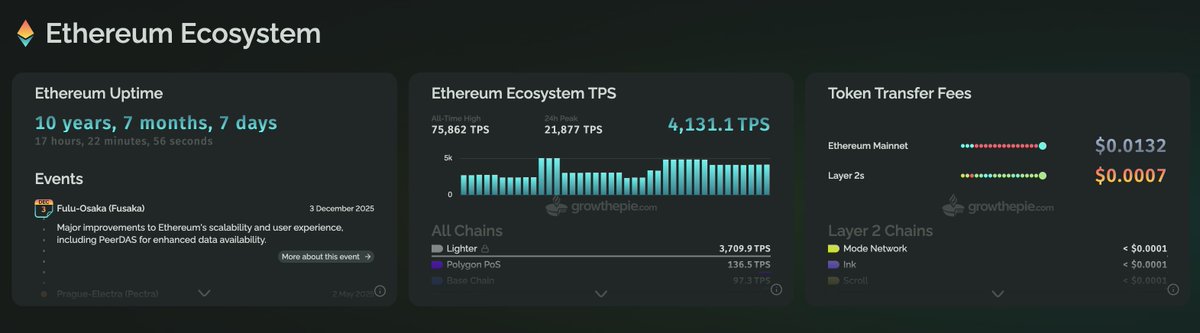
Ethereum is expensive: Fixed. $50 > $0.009 on L1 alone.
Ethereum is slow: Fixed. 15 TPS > 1000s across the ecosystem.
Ethereum wastes energy: Fixed. 99.95% less energy after The Merge.
Ethereum is hard to use: Fixed. One-click smart wallets with EIP-7702.
Ethereum censors transactions: Being fixed with FOCIL
Ethereum is centralized block building: Being fixed with ePBS
Ethereum exposes your trades: Being fixed with Encrypted Mempools
Every year a new obituary. Every year @ethereum ships the answer.
The critics kept a list of problems.
Ethereum kept a list of fixes.
Americans deserve financial privacy, real consumer choice, and the freedom to innovate. Prohibiting a government-issued CBDC protects those values while allowing market-driven solutions like stablecoins and decentralized networks to modernize payments. The future of money should be open, competitive, and privacy-preserving. Consensys whole heartedly encourages Congress to pass this bill.