Java in the browser, on the desktop, and now on mobile. I’ve taken TeaVM + Capacitor for a spin, including calling native Android device APIs from Java.
https://t.co/mmGmsv5iQP
One of the nice things about working with coding agents: finding an idea someone else has shared, pointing your agent at the article and saying “I want this”.
@brunoborges approach to Java publishing, adapted for Awesome Java UI.
https://t.co/Za7c2Yb5ro
I took the same TeaVM Java game from the browser to the desktop using JCEF and jr. Same game, now running as a Windows desktop
#Java#TeaVM
https://t.co/wk784YFv0A
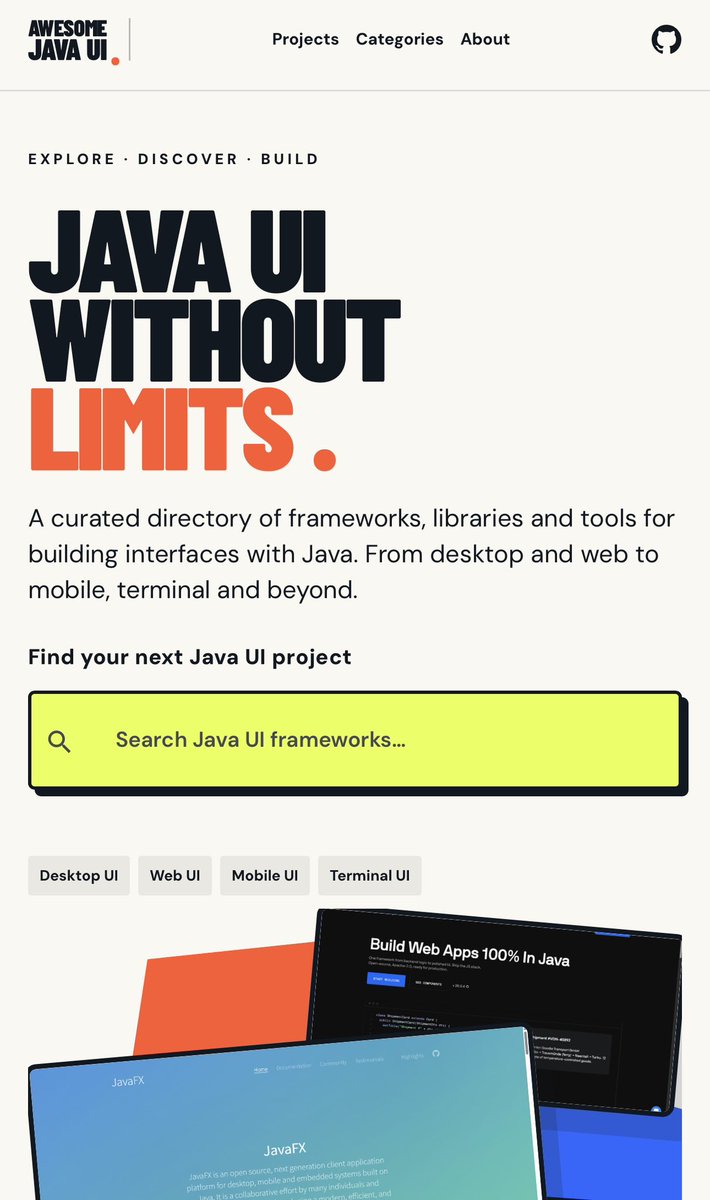
Given all the great Java UI projects out there being built and shared it was about time https://t.co/SlnnQROEro got a fresh lick of paint and some agentic workflows to work harder and showcase those efforts. #java#java-ui #awesome-java-ui
Java in the browser? I’ve been exploring TeaVM through three small projects: a guessing game, a Spring Boot-backed currency explorer, and an interactive drawing app.
Here’s what I learned along the way.
https://t.co/FUcnkXLsOp
Are we generating software faster than we can find ideas worth keeping?
We’re maxing out tokens, running multiple agents and shipping constantly. But how much of that output do we actually keep using?
https://t.co/13DP5XFs30
@pierceboggan I love the product and now using as my daily driver.
For agent merge I would love to selectively address review comments. Some reviews either from agents or humans don’t always need a code change
Also for agent merge, I’d like a way to potentially review the responses.
August was about making AI tooling fit my day-to-day workflow: agent skills, cloud/background agents, and deciding when local models aren’t worth the trade-off.
“…increase bandwidth by running concurrent jobs…”
https://t.co/NNDR8YC1gM
I’ve turned a bare Ubuntu VPS into a remote development machine for OpenCode: separate admin/agent accounts, Tailscale, tmux, GitHub and Playwright. The goal: useful capabilities without giving the agent the keys.
https://t.co/P0DSceLLMQ
@donnfelker Thanks for sharing. Following some same instructions for a VPS. Seems a relatively simple setup and fits into my usage pattern. Excited to code in the go
I’m changing my default for exploratory API work: let an agent derive requests from intent, contracts and live responses instead of maintaining Postman collections. https://t.co/7y0bEwG6S8 #AI
I’ve been looking at Spring Boot 4 observability and three tools that take quite different approaches: Boot UI, Spring Boot Admin and Ostara. “Maybe one of them will hit a sweet spot.” https://t.co/QxJ5lCDHmR
I’ve been reshaping ai-toolkit around the new VS Code agent plugin model. It turned out to be a much better fit than the bundle approach I’d been using, and it also led to a new Javadoc Central plugin for Java projects.
https://t.co/nTS7sXjBf9 #AI#Java
July was mostly about making AI fit my day-to-day development workflow a little better. I’ve been experimenting with skills, MCPs, alternative model providers, and thinking a lot about feedback loops rather than bigger models.
https://t.co/FhFKqEKBJt
AI coding agents default to controller/service/repository structures. That’s what they’ve seen most.
I wanted a package-by-feature (Screaming Architecture) so I built a skill that makes agents organise code by business capability instead.
https://t.co/lmHlFKRc0T