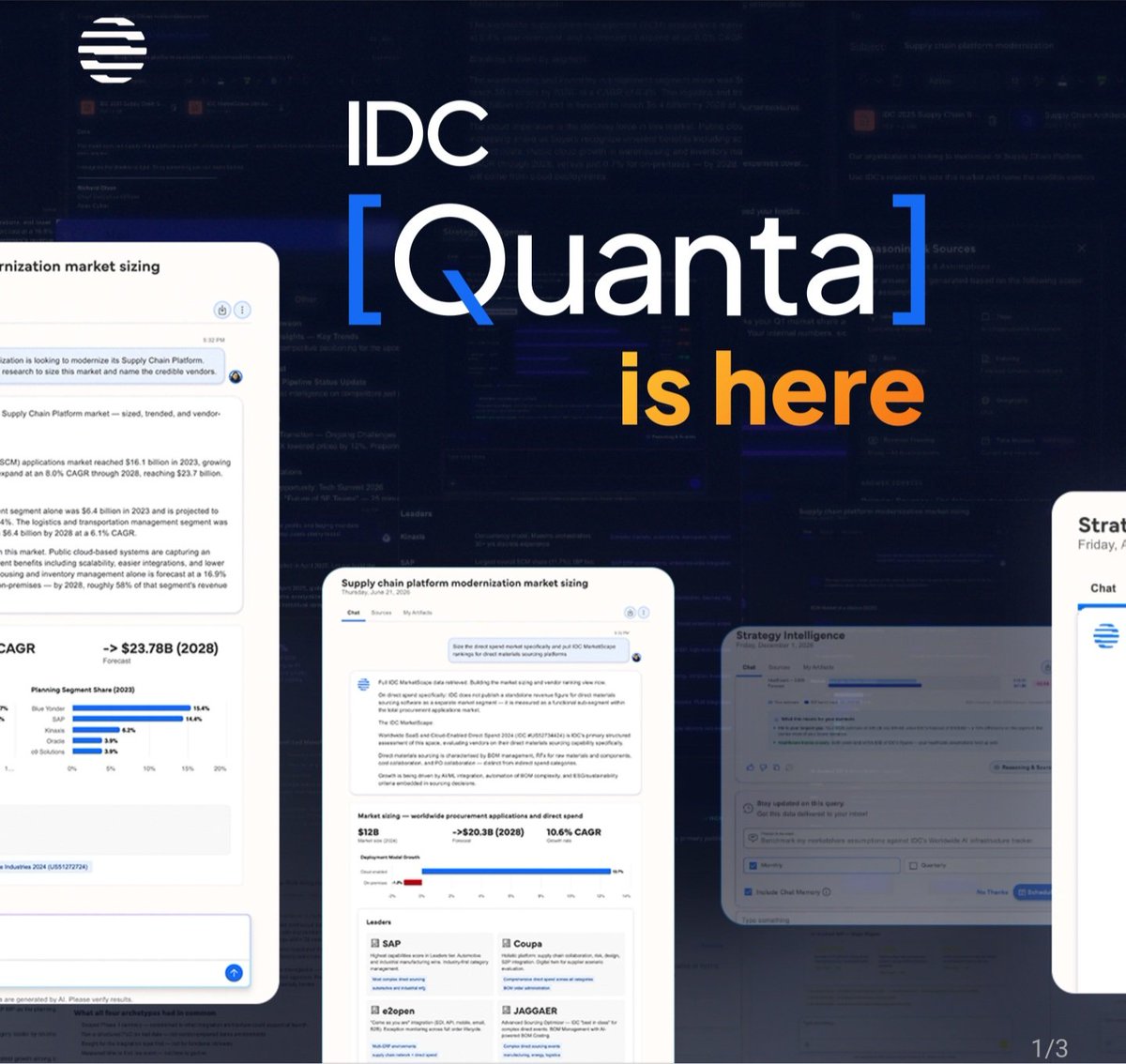
.@IDC Quanta is here.
This is the intelligence fabric for the AI enabled enterprise that's embedded in the tools you already use, grounded in IDC's proprietary research + data, and ready to deliver answers you can trust.
Quanta represents a new era for IDC and a new standard for the industry.
Explore IDC Quanta today: https://t.co/fHzn0wGC5s
#IDCQuanta #IDCAIPlatform
#EmbeddedIntelligence
.@LockheedMartin announced the signing of a definitive agreement to acquire Ultra Maritime, a global defense company specializing in advanced undersea and anti-submarine warfare capabilities for allied naval forces.
Read more:
Open models are only half a strategy
NVIDIA's open model portfolio now spans six domains — Nemotron for reasoning, Cosmos for robotics, Alpamayo for autonomy, Clara for healthcare, Earth-2 for climate. Jensen's framing: enable every company and every country to be part of it. Right — but open weights without private infrastructure is a demo, not a strategy. Nemotron shipping inside the Agent Toolkit on HPE Private Cloud AI is the missing half: frontier-class open models running behind your own firewall.
https://t.co/l0p7lOpnxt
@HPE@NVIDIA #HPEdiscover
NUCLEAR 101: What is uranium enrichment? ⚛️
Before natural uranium can be used as fuel in most nuclear power plants, it needs to undergo enrichment in order to sustain a nuclear chain reaction.
Here's everything you need to know about how it works.👇
https://t.co/GGTfPm1LPF
Morgan Stanley's Adam Jonas has just initiated coverage on @SpaceX for the first time with a $300 price target & a bull case of $600/share, which would be an $8 trillion market cap.
Adam thinks SpaceX could generate $319 billion of revenue in 2030, and $3.3 trillion in 2040:
"With an 'X of 1' position in space infrastructure, we believe SpaceX can convert energy into intelligence at scale with optionality to monetize through a range of consumer and enterprise solutions for the next era of AI…the final frontier.
Key Fundamental Drivers of @SPCX Stock Over the Next Few Years:
1) How Does SpaceX Monetize Enterprise Al? While neo-cloud deals are the bulk of the business near term, we see end-to-end Al services as the longer-term business model. We believe the progress of Cursor, including annual recurring revenue estimated at $4 billion and ongoing Pareto frontier performance, remains underappreciated by the market.
2) Can SpaceXAl Achieve Industry-Leading Cost and Time-to-Power? A large portion of SPCX's capex is directed toward Terafab, Solarfab, and other vertical integration efforts (including blade/vane foundry, terrestrial communications infrastructure) to drive down both $/watt and time-to-power on Earth before moving Al "off Earth". While we are believers in the advantages of space-based Al infrastructure over the long-term, we also think the market underappreci-ates SPCX's terrestrial Al economics, with cost per watt running at half the industry average, excluding chips, and deployment speeds ~6-8x faster than peers.
3) Will Starship Achieve a Step Change in Economics? Rapid reusability of both the first and second stages is key to increasing mass-to-orbit capacity and lowering launch costs ($/kg), but the program is still in early testing. The testing regime won't be easy, but we ultimately see a path to launch costs of ~$500/kg by 2030 and below $150/kg by 2040, which could materially expand both connectivity and Al TAMs.
4) Will Starlink Achieve Broad TAM Adoption? Starship, V3 broadband satellites, and Mobile Gen 2 satellites should significantly expand available capacity, enabling materially improved speeds, lower latency, and more effective pricing across consumer, enterprise, government, and mobile mar-kets. Longer term, the primary driver is Starlink becoming a connectivity layer for virtually every data-transmitting device that requires reliable coverage beyond the reach of terrestrial infrastructure.
Our financial forecasts: Balanced execution risk near term with large TAM creation long term:
• Our 2030 revenue forecast of $319 billion balances execution, regulatory and engineering risk with the company's technological and vertical moat which allows it to move faster than peers.
• Our 2040 revenue forecast of $3.3 trillion gives the company credit for creating all new TAMs for connectivity and physical Al services.
• High spending needs ($300 billion capex/year by 2031) means SPCX is not FCF positive on our forecasts before 2035, requiring, on average, ~$84 billion of external capital needs per year from 2027-2034. Ability to secure necessary capital is one of the greatest risks to our forecasts.
• Where do we expect our forecasts to be different? General Longer-term optimism but with balanced nearer-term forecasts accounting for challenges of scaling in the physical world, conservative Starlink mobile adoption, optimistic government & enterprise connectivity opportunity particularly loT/embodied Al, conservative space/launch revenue due to majority capacity used internal, more conservative orbital compute ramp and capex but with credit for long-term scalability advantages, optimistic enterprise monetization potential with more conservative forecasts for traditional X & Grok business.
SpaceX combines near-monopoly launch economics, the world’s largest LEO satellite network, and a fast-scaling AI infrastructure business. We see the company as one of the few platforms that can link real estate in orbit, global connectivity, and compute capacity into one infrastructure stack. Our base case models revenue rising from $45B in 2026 to $319B in 2030 and $3.3T in 2040, with the largest upside tied to Starship, Starlink capacity, terrestrial compute, and orbital compute."
3GPP's June plenary locked in real 6G decisions: Release 21 milestones and air interface baselines. The standard is taking shape faster than the hype cycle suggests. https://t.co/1HHA5zPcjv
AI data centers are on track to eat 70% of the world's memory chip supply in 2026. If you're buying a laptop or phone next year, this is why it costs more. The AI buildout is being paid for by everyone, not just hyperscalers.
🔥🚨LATEST: Canadian engineer John Tse is going viral after revealing his umbrella that follows him around as if he is in a futuristic movie. Tse created a fully autonomous umbrella that will assist people that need both of their hands while providing cover.
🇳🇴 Norway just pulled off a massive one, eliminating Brazil from the tournament.
And it didn’t stop there, the Norwegian army even posted a video doing the Viking celebration afterward.
When your national team wins, and the military joins the celebrations… you know it’s a very big deal.
Writer: Lynn
Today, on America’s 250th birthday, Susan and I are celebrating by giving $250 each to the first 25 million qualifying American children who sign up for their @InvestAmerica24@TrumpAccounts.
This makes every child a shareholder in the greatest prosperity-creating engine the world has ever known — American capitalism. Through this public-private partnership, we’re giving the next generation a real stake in our economy and a path to the American Dream: education, a first home, starting a business, and building lasting wealth.
It unites us all in hope and optimism for every child’s future.
Happy 250th Birthday, America! 🇺🇸
https://t.co/Jd7nb98JDT
July 4th, 2030. In just four years, almost every part of America will be reachable by an autonomous car.
People don't believe me when I say that, but it's already happened for me.
In fact, I've probably driven through your community by my robot.
Which gets me to a new point.
I've been all over this country with my robot, and there are some places that are stunningly beautiful: Wyoming, Montana, Alaska, California, and Utah. Even the East Coast has stunning natural beauty in places like Maine and New Hampshire. It's different than Yosemite National Park, of course, but they have their own national park up there that is really nice.
Someday you're going to pay a cheap price for a thrill ride ticket. Yesterday, I did basically San Jose to San Diego in one drive along the coast. This is a way better drive than going to Disneyland and riding the Matterhorn. Disneyland costs something like $150 or more per person; for a family of three or four people, that gets expensive. It’s cheaper to take an autonomous car and buy a box of strawberries.
Also coming in 2030, you're probably going to be wearing a pair of glasses. I know you hate the idea; I have to wear glasses and I hate the idea too. But I've seen the prototypes in the labs and they are so stunning that someday a company is going to bring a product to market that makes us all go, "Oh."
I still believe that company is Apple. There’s a reason for that: they own exclusive rights to Formula One. A lot of people watch Formula One (I watch it myself, though I'm not rich enough to go many times). Someday you're going to have a 3D track on your kitchen counter and you'll be watching the race in a whole new, mind-blowing way. You're going to show it to all your guests at your Fourth of July party and they’re all going to want one.
By 2030, the question isn't whether I have a robot in my house. I already have a couple of robots, like the Matic robot that cleans our floors, and I’ll probably have another one by the end of this year. I'm talking about a humanoid. The real question is: how many humanoids will be in my house at my Fourth of July party in 2030? I could see saving up a little bit to rent a whole bunch of them. Why not? It’s America.
Someday soon, you're going to have robots lighting off the fireworks in certain communities. When I lived in Seattle, we had mortars on our front driveway. It's a little dangerous for a human to get close to, so you send the robot. That’s what I learned in Las Vegas when I met the bomb disposal unit; they let me drive a robot around and blow up a bomb. As an American, that highly entertained me because blowing up bombs is just the best.
That’s why we all like fireworks, except for my autistic son who can’t stand them. He has shown me a different way, so we go to drone shows now.
Regardless, soon you’re going to have humanoid robots lighting the fireworks. In fact, I won’t be shocked if a robot company does that tonight and uses it for marketing tomorrow.
Happy birthday America!
Hope your day is like a box of strawberries.
The Day Amazon Was Just a Strange Bet on Books
Thirty-two years ago today, on July 5, 1994, Jeff Bezos founded a company called Cadabra. Not Amazon. Cadabra, as in "abracadabra." As startup lore has it, a lawyer heard the name as "cadaver," which is not ideal unless your business model involves haunted inventory.
The company became Amazon. The name sounded huge, started with "A," and ranked better in early web directories where alphabetical order still mattered. Very 1990s SEO, before anyone called it SEO.
The idea was strange in 1994. The web was slow, clunky, and mostly a playground for academics, engineers, and curious weirdos with modems. Normal people were not waking up thinking, "I should put my credit card into this browser and buy a book from a garage startup in Bellevue."
Bezos went ahead. Books made sense as the first product: the catalog was massive, the data was clean, and nobody needed to try one on. An online bookstore was just the entry point. The actual bet was whether the internet could become a trusted commercial system. Search, click, pay, ship, repeat.
In April 1995, before the public launch, a software engineer named John Wainwright placed the first customer order: Douglas Hofstadter's Fluid Concepts and Creative Analogies. An AI book, years before AI became every board meeting's favorite budget line. Amazon later named a building after him.
Early on, a bell rang in the office every time an order came in. Employees would gather around to see if they knew the customer. That ritual did not survive scale. Hard to keep ringing a bell once the company becomes a global logistics organism with a cloud business attached.
Amazon went live in 1995, went public in 1997, then kept widening the wedge: music, video, marketplace, Prime, AWS, Kindle. AWS was the big turn. Amazon stopped being a store that used infrastructure and became infrastructure other companies used to build the internet.
Today it is retail, cloud, ads, logistics, streaming, devices, pharmacy, grocery, satellites, and AI infrastructure piled into one company. Try describing it without a whiteboard and a stiff drink.
The next decade gets decided far from the shopping cart. AI workloads on AWS, custom chips, warehouse robotics, advertising tied directly to buying behavior, and agents that shop, compare, recommend, and maybe negotiate. The store is still huge. The deeper play is infrastructure.
Regulators see it too. The FTC and states have accused Amazon of illegally maintaining monopoly power, with trial set for 2027. Amazon already agreed to a $2.5 billion FTC settlement over Prime enrollment and cancellation practices.
Amazon started as a question: would people trust the internet enough to buy a book?
Thirty-two years later, the question is bigger and more uncomfortable: how much of commerce, cloud, media, logistics, advertising, and AI should run through one company?
Not bad for a bookstore that almost sounded like a corpse.
@AmazonLeo@amazon@amazon@ajassy
🎆 Happy 250th Birthday, America! 🇺🇸
Today, we're celebrating in style — lighting up the Brandenburg Gate in honor of 250 years of American independence.