if i was starting my FIRST DAY as a new Head of Content, here's what i would do:
- build a new blog using a static site generator, host with GitHub, deploy with Netlify or Cloudflare Pages. for an existing blog like WordPress, set up an MCP connector. the goal is a fully AI-native blog, analysis, content creation, updating, all from the terminal, all in my control
- get access to Gong/Intercom/Slack and extract common entities and n-grams. find the language customers and prospects really use, use this as seed keywords for topic research
- build key "source of truth" files in markdown i can reference throughout my workflows: a master list of product features and use cases, canonical writing voice with specific reference articles, key strategic priorities to shape everything we do
- crawl our sitemap and generate vector embeddings for every article. use this to analyse topical authority (and topic "drift") and automate internal linking
- schedule a recurring, automated content audit: pull rankings and backlink data via the Ahrefs MCP, analyse AI search visibility with Brand Radar, flag technical issues with Site Audit, look for traffic decay via GSC and make a priority list of content updates
- set up a daily cron job to refresh our highest priority articles: extract the article content, run through AI Content Helper to fill topic gaps, update old claims and statistics, save as a draft for my review
- run a content gap analysis using the Ahrefs MCP to find key topics our competitors have covered that we haven't. use Firehose to get a daily update of new articles and industry news emailed to me
- build my Content OS: a centralised dashboard that pulls all of these reports and workflows into one place. this is exactly what i've done at Ahrefs using Agent A
- get fired for spending $80M in AI credits in my first day (maybe?)
---
i sound like an obnoxious AI hype bro, but all these workflows are things my team have actually built. many of them will become the norm sooner rather than later
AI is truly putting the "manager" into "Content Marketing Manager". we now operate at a higher-level of abstraction, building systems to support our work instead of doing everything ourselves
we don't have to consign ourselves to Google Docs and rely on developers and designers: we can build AI-native blogs as malleable as plasticine and shape every facet of them to our exact specification. if you can imagine it, you can build it!
and as crazy as this sounds, this isn't so much the "first 30-days" of content marketing as the first 30-MINUTES, because so much of this infrastructure can be built agentically. you just need to have the vision, know what to ask for, and use your taste and experience to nudge as these systems get built for you
if you don't know where to start: pick one of these ideas, login to Claude Code or Codex or Agent A, paste the bullet and ask it to build it (and some of these are already available as free apps in Agent A!)
after generating +$10M for service businesses through meta ads funnels...
i put together the system i wish i had from day one:
the exact quiz funnel playbook we used to generate multi-7-figures for clients while almost nobody in B2B service runs them
here's what's inside:
→ the full funnel architecture:
(meta ad → quiz landing → personalized results → CTA → 7-day nurture → booking, the entire path mapped step by step so you can build it this week)
→ the 8-question quiz framework:
(every question qualifies, educates, or agitates, so a cold meta click walks in pre-sold. includes the "financial health score" build you can copy)
→ the personalized results page:
(3-5 score-based profiles, each one giving a real diagnosis, the dollar impact of their gap, and 2-3 fixes before they ever book. this is what gets them booking at 42%)
→ the 3 meta ad creative hooks:
(curiosity, diagnostic, and social-proof angles, plus the 30-45s founder-face video format that pulls the cheapest clicks we've ever bought)
→ the 7-day email nurture sequence:
(results day 1, case study day 2, education day 3, objection handling day 5, direct CTA day 7, written word for word for you to swipe)
→ the CAPI scaling edge:
(quiz leads hand META their revenue, gaps, and timeline before the call, so the algorithm finds your buyers faster and your creative lasts 3-4 weeks instead of 2)
all so that you can qualify, self-diagnose and pre-sell cold leads before they even hit your calendar
and for 24h, EVERYTHING can be yours for free
like + comment "QUIZ" and i'll send it over
(must be following + RT for priority access)
Claude Code creator:
"I don't prompt Claude anymore. I write loops - and the loops do the work. My job is to write loops."
in 30 minutes Boris reveals his actual daily Claude Code setup.
Claude Code + loops + dynamic workflow
Worth more than a $500 vibe-coding course
JUST IN: Scientists say AI has decoded communication patterns in mice, dolphins, apes, birds, whales, & cuttlefish — could eventually lead to humans communicating directly with animals.
Marriage stuff the church never warned me about:
1. Sex is a skill. It’s a gift from God and It’s worth learning how to do well. Being better at sex (only with your wife) only blesses your marriage. And the “best sex” isn’t what you think. It’s facilitated through intimacy, safety, and love. For the man - this means you need intimacy with the Holy Spirit, first. You need to view your wife as a daughter of the King and love her in way she’s worthy of. You need to die to yourself, serve her, protect her, provide for her financially, emotionally, and spiritually. You need to LEAD her. That typically translates into more frequent, more pleasurable, more intimate sex - which energizes a marriage.
2. Your view of money matters. If all you want is more, you won’t steward it well, you'll still live in comparison to what you want next, and funny enough - you'll probably end op with less of it. On the contrary, if you don’t prioritize increasing your wealth, you’ll miss out on the abundant opportunities God gives you to glorify him through what money can do. Money is a tool. It's a gift God has given you to steward and multiply for his glory (yes you can buy nice things to the glory of God, and you can exhibit financial discipline to the glory of God). Worship him with every dollar you receive, and every dollar you deploy.
3. Pray together every single day, even if you're really tired or you just fought. The divorce rate for the average couple is 50%. The divorce rate for couples that pray together is less than 1%. God hates divorce. Divorce is hell. God can always redeem divorced believers, but avoid it if you can. Establish the basic discipline of praying together every single day. This is more important than brushing your teeth and eating food.
4. Be willing to cut friendships. Especially ones that began before you were married. The two of you have became one flesh. Your dynamic with every human being you interact with has forever changed. Everything you do directly affects your wife, everything she does directly affects you. Have conversations early on about who is no longer welcomed in your life, cut them quickly. And if there are people who simply need to be kept at greater distance, orient your calendars accordingly. Do the same in reverse. The couples who sharpen you, draw near to them, prioritize them. They will be there for both of you in your hardest times. They will fight for your marriage in moments where you offend one another. Your friends matter. And no - your wife cannot have male friends that are not directly friends with you, or vice versa.
5. You are not part of your parent’s family anymore. Non-believers have a harder time with this, but the Bible speaks to it so directly. You are no longer part of your parent’s family. They are now extended family. If your parents have friction with how you live your lives, that’s OK. There is tension between consistently honoring your parents, while being OK if they disagree with you. Bring that tension to the Holy Spirit and ask for his guidance in every interaction, every boundary, and all communication.
6. Marriage isn’t the goal. It’s the beginning of a journey. It’s a common temptation to become complacent in improving yourself after getting married. There’s this mindset of “jobs done! We’ve arrived.” and that’s absolutely hilarious. The most challenging, and most rewarding work begins after you’ve gotten married. This is where you’re now directly cleaved with the person who’s supposed to sharpen you. Then this means men, you need to lead, cast vision, and continually grow. And women, you are the person this man is willing to die for, you’re the person he’s trusting to deliver his child, and nurture his offspring. You’re the primary helper God designed to support his mission. It is your duty as a woman of God to continue to grow. A proverbs 31 woman was not a weak, powerless housewife scrolling Instagram all day. Read it.
7. Set the culture of how you’re going to steward your bodies in the home, early. How you honor the temple of God is such an integral part of your daily life, it impacts sleep schedules, grocery lists, it impacts every single meal, it impacts how you use your time. If there’s not agreement in the home about how you’re going to honor your bodies, it will become an intense point of contention in your day-to-day life. The person with greater health will be burdened with taking care of the one who has worse health. And although some things are not preventable, most prognosis are totally preventable. Don’t burden your partner because you couldn’t stop eating Twinkies and never worked out. Do your part so that you can show up well with them, with energy, presence, and confidence in who God made you. Your health will be the #1 determinant of your quality of life in your later years when grand babies come. Heck - after your relationship with God, it's one of the primary determintants of your quality of life even before grand babies come. And - back to my first point, you want to be able to keep those hips moving as you guys get older 👍
8. Marriage is not a thing you do for mutual benefit. He provides, she makes the home - in practice yes, but that's not the point. The point of marriage is so that you know Christ more deeply. It's a reflection of the most valuable thing in the universe. Eternal life, knowing God. Take that view into every trial, and every mountain top - you work towards an excellent, intimate marriage - to know Christ more deeply, as a testemant and service to his people, and to glorify his Holy name.
Married people, what would you add?
In the last 6 months at @Ahrefs, we analyzed over 1 billion data points across 14 studies. Here's what we learned about AI search optimization:
1) "Best X" blog listicles are the single most prominent content format cited by AI chatbots. They make up 43.8% of all page types cited by ChatGPT specifically.
2) 67% of ChatGPT's top 1,000 citations come from sources marketers can't influence: Wikipedia (29.7%), homepages (23.8%), app stores (6.6%). Only 32.3% are influenceable content like educational pages, reviews, news, and blog posts.
3) 28.3% of ChatGPT's most-cited pages have zero Google organic visibility. These pages get cited repeatedly by ChatGPT despite not ranking in Google at all. A completely separate discovery layer.
4) ChatGPT only cites about 50% of the URLs it retrieves. It fetches dozens of pages per query but uses half as background context without attribution. This means that being retrieved and being cited are very different things.
5) Adding schema markup had zero meaningful impact on AI citations. AI Overviews actually dipped −4.6%, while AI Mode (+2.4%) and ChatGPT (+2.2%) showed changes indistinguishable from zero.
6) YouTube mentions have the highest correlation (0.737) with AI brand visibility out of all the factors we studied (including all the conventional SEO metrics like backlinks, page count, DR, etc). This held true for both Google-owned and OpenAI products.
7) AI Overviews reduce clicks to the #1 result by 58%. That’s up from 34.5% just 10 months earlier. The trend is accelerating.
8) 99.9% of AI Overviews appear on informational intent queries. Transactional, navigational, and local searches are almost entirely AIO-free. Shopping triggers AIOs just 3.2% of the time.
9) For a given search query, Google’s AI Mode and AI Overviews reach the same conclusions 86% of the time — but cite almost entirely different sources (only 13.7% citation overlap).
10) AI Overviews change every 2.15 days on average, with 70% of content differing between consecutive observations. But semantic similarity stays at 0.95. The words, sources, and entities constantly shuffle, but the actual meaning barely moves.
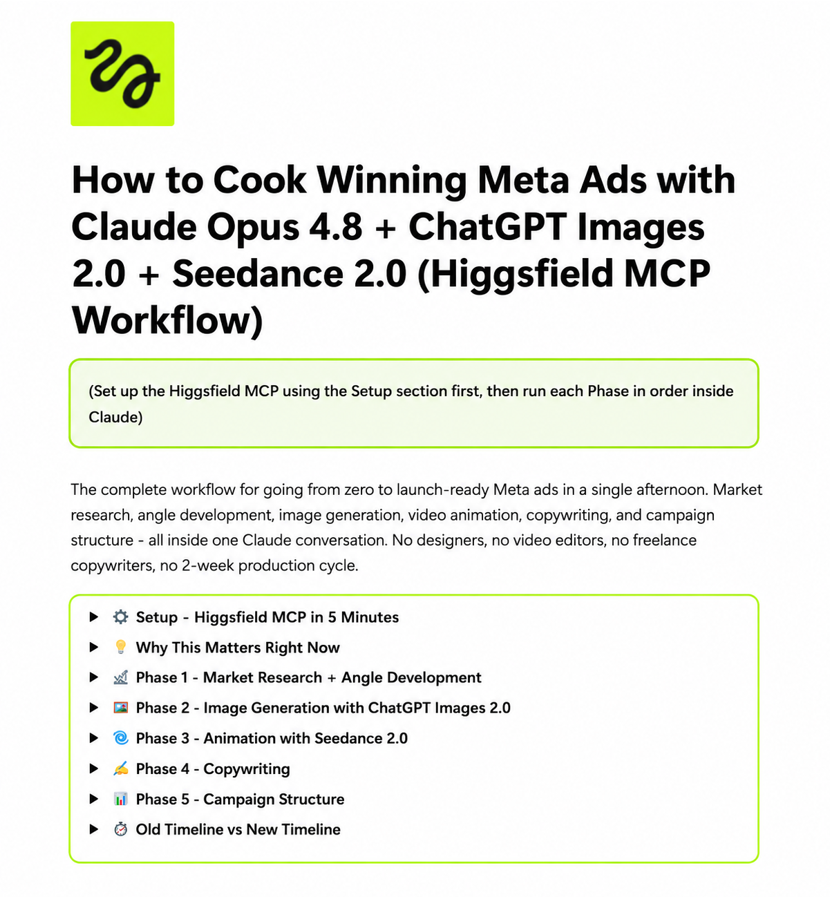
i've been testing Higgsfield MCP + the NEW Claude Opus 4.8 to generate ALL our Meta ads creative inside 1 conversation...
and it has been ABSOLUTELY cooking
so i've decided to document the ENTIRE workflow...
covering the setup, market research, image gen, animation, copy, and 7-day test campaign structure to take a Meta ads creative batch from 0 to launch in a single afternoon as a service based business (agency, firm, brick and mortar, consultant, etc)
here's what's included inside the guide:
→ Higgsfield MCP setup in 5 minutes (https://t.co/xMyAvg7v9p integrations → paste mcp URL → authorize. 30+ image and video models inside one Claude chat)
→ phase 1, market research + angle development (master brief prompt that returns 7 ad angles ranked by differentiation, top 3 expanded into 3 hook variations each)
→ phase 2, image generation with ChatGPT Images 2.0 (3 variations per angle in under 90 seconds. model selection table covering ChatGPT Images 2.0, Soul 2.0, Nano Banana Pro)
→ phase 3, scroll-stop animation with Seedance 2.0 (static image to cinematic motion loop. first 0.5s stops the scroll. one client hit 5.1% CTR week one... their highest-performing creative ever)
→ phase 4, the 4-variation copy stack (loss aversion, authority + specificity, contrarian, identity. 12 ready-to-test ad combinations from one session)
→ phase 5, 7-day test campaign structure (budget allocation, day 3 signal thresholds, day 7 kill and scale criteria, the 3 highest-probability winners to launch first)
all backed by $10M+ generated through Meta ads funnels for service-based businesses (and a legal funding client that we expanded from 8-12 to 40+ creative variations per month using this method... even finding 3 winners that scaled him to $89k/mo within 90 days)
like + comment "COOK" and i'll send it over
(must be following + RT for priority access)
another successful test our team ran last week
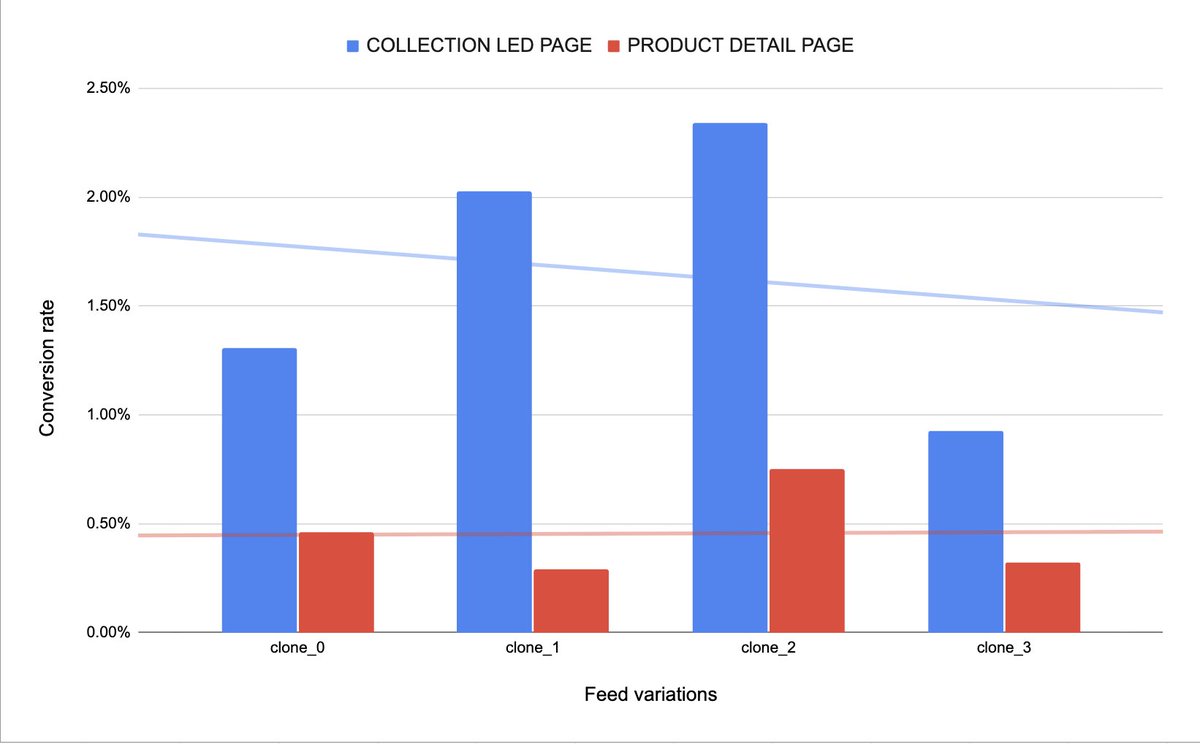
we added a “you may also like” section on the PDP to showcase related products.
result:
conversion rates increased 3-8x
AOV increased by 10%
quick breakdown on why this works (and whether you should run it)
in some industries, people often buy multiple products together instead of just one item.
especially in food, grocery, beauty, and apparel.
when that’s the case:
a standard PDP can actually cause a lot of friction in the buying process by focusing on one product.
think about the buying flow.
someone wants 3 different products from your store.
they land on a page, add to cart, go back to the collection page, open another product, then repeat the whole process again.
every extra step is another opportunity for the customer to drop off.
on top of that
you also miss out on higher AOV, because many shoppers are willing to buy more
but the additional products just aren’t visible enough during the buying process.
a simple fix for this is adding a “you may also like” section with related items underneath the main product information
each one should include:
- product page
- product title
- price
- rating
- add to cart button
the original product stays the main focus.
the extra products work as upsells and cross-sells inside the shopping flow.
we tested this recently for a brand, and the upgraded version converted 3 to 8 times higher than the standard PDP setup.
AOV went up by around 10%.
and more shoppers finished checkout instead of abandoning their carts.
this is just one of the many wins we’ve got while testing for brands.
we found these by looking outside the usual stuff brands do on google.
we’d spot something working in another market, industry, or platform
then adapt it to our google ads and landing page strategy
that process has uncovered a lot of new findings which helped our clients scale spend much further