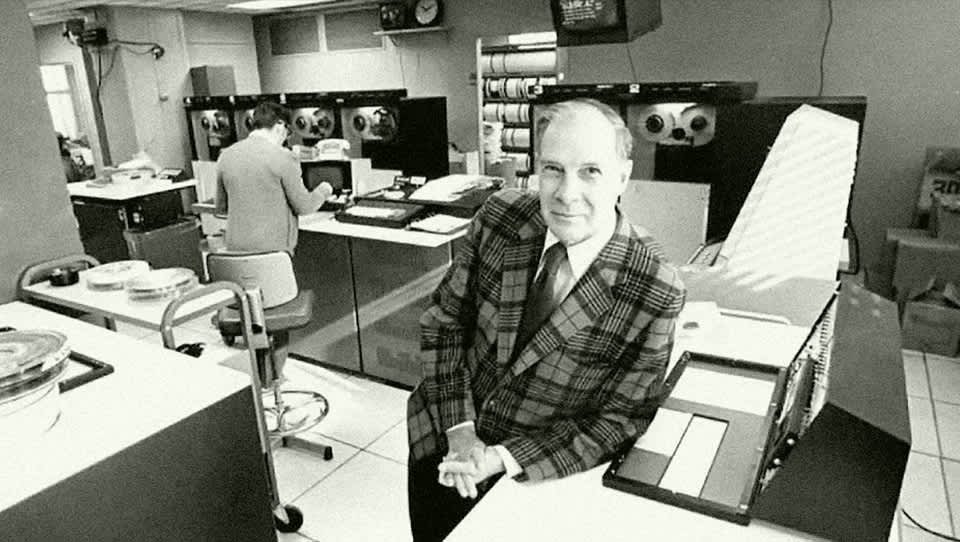
A mathematician who shared an office with Claude Shannon at Bell Labs gave one lecture in 1986 that explains why some people win Nobel Prizes and other equally smart people spend their whole lives doing forgettable work.
His name was Richard Hamming. He won the Turing Award. He invented error-correcting codes that made modern computing possible. And he spent 30 years at Bell Labs sitting in a cafeteria at lunch watching which scientists became legendary and which ones faded into nothing.
In March 1986, he walked into a Bellcore auditorium in front of 200 researchers and told them exactly what he had seen.
Here's the framework that has been quoted by every serious scientist for the last 40 years.
His opening line landed like a punch. He said most scientists he worked with at Bell Labs were just as smart as the Nobel Prize winners. Just as hardworking. Just as credentialed. And yet at the end of a 40-year career, one group had changed entire fields and the other group was forgotten by the time they retired.
He wanted to know what the difference actually was. And he said it wasn't luck. It wasn't IQ. It was a specific set of habits that almost nobody is willing to follow.
The first habit was the one that hurts the most to hear. He said most scientists deliberately avoid the most important problem in their field because the odds of failure are too high. They pick a safe adjacent problem, solve it cleanly, publish it, and move on. And because they never swing at the hard problem, they never hit it. He said if you do not work on an important problem, it is unlikely you will do important work. That is not a motivational line. That is a logical one.
The second habit was about doors. Literal doors. He noticed that the scientists at Bell Labs who kept their office doors closed got more done in the short term because they had no interruptions. But the scientists who kept their doors open got more done over a career. The open-door scientists were interrupted constantly. They also absorbed every new idea passing through the hallway. Ten years in, they were working on problems the closed-door scientists did not even know existed.
The third habit was inversion. When Bell Labs refused to give him the team of programmers he wanted, Hamming sat with the rejection for weeks. Then he flipped the question. Instead of asking for programmers to write the programs, he asked why machines could not write the programs themselves. That single inversion pushed him into the frontier of computer science. He said the pattern repeats everywhere. What looks like a defect, if you flip it correctly, becomes the exact thing that pushes you ahead of everyone else.
The fourth habit was the one that hit me the hardest. He said knowledge and productivity compound like interest. Someone who works 10 percent harder than you does not produce 10 percent more over a career. They produce twice as much. The gap doesn't add. It multiplies. And it compounds silently for years before anyone notices.
He finished the lecture with a line I have never been able to shake.
He said Pasteur's famous quote is right. Luck favors the prepared mind. But he meant it literally. You don't hope for luck. You engineer the conditions where luck can land on you. Open doors. Important problems. Inverted questions. Compounded hours. Those are not traits. Those are choices you make every single day.
The transcript has been sitting on the University of Virginia's computer science website for almost 30 years. The video is free on YouTube. Stripe Press reprinted the full lectures as a book in 2020 and Bret Victor wrote the foreword.
Hamming died in 1998. He gave his final lecture a few weeks before. He was 82.
The lecture that explains why some careers become legendary and others disappear is still free. Most people who could benefit from it will never open it.
If you made a mistake, apologize quickly.
If you are confused, ask more questions.
If you miss someone, reach out to them.
If you appreciate someone, show them.
If you want to feel lighter, forgive first.
If you are stuck, ask others for help.
If you love someone, tell them, now.
🌊 Nível do Guaíba
📏 Cais Mauá
Cota atual: 4,62m
Cota de Alerta: 2,5m
Cota de Inundação: 3m
Informação obtida às 17h15 por meio da régua da Secretaria Estadual do Meio Ambiente e Infraestruturas (SEMA) e Agência Nacional de Águas (ANA).
Bom dia, Porto Alegre! O nível do Guaíba segue estável.
Com quase 15 mil abrigados e protegidos, é hora de começar a limpar nossas vias! Trabalho árduo, mas muito necessário para superar a crise.
📏 Cais Mauá
📍Cota atual: 5,22m
Cota de Alerta: 2,5m
Cota de Inundação: 3m
Seguimos monitorando o nível do Guaíba, que segue em elevação. 🏞
📏 Cais Mauá
📍Cota atual: 4,94m
Cota de Alerta: 2,5m
Cota de Inundação: 3m
ℹ️ Informação obtida às 13h15 por meio da régua da SEMA e Agência Nacional de Águas (ANA).
ATUALIZAÇÃO - Nível do Guaíba
📏 Cota atual: 4,75m
🔴 Acompanhe: https://t.co/E0NLqjBdN4
Informações da Agência Nacional de Águas e Saneamento Básicos (ANA) às 06h15min desta segunda-feira (13).
ENCHENTE | Ponte sobre o Rio Caí, na BR-116, na Serra, cedeu parcialmente e foi interditada. Ponte fica entre Caxias do Sul e Nova Petrópolis. 📷 Redes sociais
💧 Entenda o passo a passo dos Sistemas de Abastecimento de Água (SAA) de Porto Alegre!
De forma lúdica, explicamos como funciona a operação. Por não ser algo tão “simples” é que leva mais tempo para chegar a todos.
The State government, through Banco do Estado do Rio Grande do Sul, made banking channels available for international deposits in order to assist flood victims in southern Brazil.
Defesa Civil: Alertas de chuvas intensas e persistentes com risco de alagamentos ventos fortes e descargas elétricas. Válido até as 11h de domingo. Emergência ligue 190/193.
Governo Eduardo Leite não colocou em prática estudos contra desastres pagos pelo estado. Servidores, técnicos e cientistas propuseram medidas que poderiam diminuir impacto do desastre - Da @agenciapublica https://t.co/XaNaYvVm8j https://t.co/XaNaYvVm8j
🔴 AGORA | O @NWSSWPC acaba de elevar a tempestade solar para extrema (G5). Ultima foi a tempestade solar de Halloween em 2003, que causou falta de luz na Suécia e problemas elétricos na África do Sul. Pode afetar satélites e GPS. Auroras alcançam até latitudes médias do planeta.
AGORA | Pausa na cobertura das enchentes para contar a vocês algo incrível. Tem aurora austral nesta noite em Ushuaia, Argentina, o que é raro. Tempestade solar afeta a Terra e gerou primeiro alerta de tempestade geomagnética severa em 20 anos pelo @NWSSWPC. 📷 @SMN_Argentina
‼️ Atualização | 10/05 - 18h
🌊 Nível do Guaíba
📏 Cais Mauá
Cota atual: 4,71m
Cota de Alerta: 2,5m
Cota de Inundação: 3m
Informação obtida às 17h15min por meio da régua da Secretaria Estadual do Meio Ambiente e Infraestrutura (SEMA) e Agência Nacional de Águas (ANA).