leftie, fervent anti Reform fascism , pro European. supporter of Ukraine & Palestine human rights, LGBTQI+ fraternity, eco warrior and political agitator.
The world changed rapidly today. Orbans hold on Hungary has ended giving EU freedom to financially support Ukraine. As Iran wouldn’t agree to USA demands Trump decides to blockade Hormuz so will bring world economic disaster. And Israel has become worlds most hated nation.
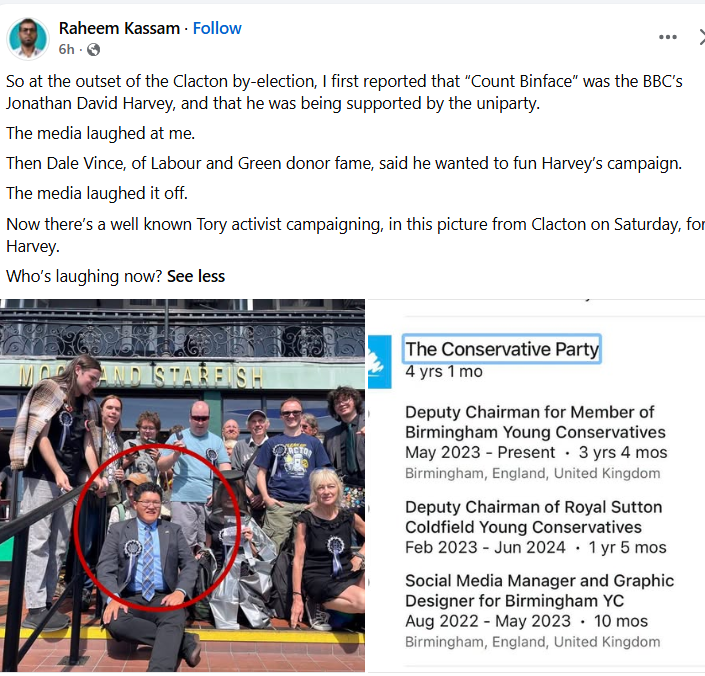
Farage fan boy has hissy fot because people from other parties have supported Binface because they have no candidate.
Maybe he needs research the word democracy - guess it isn't used in Reform circles that much
Brigades of North Korean female workers are arriving in Russia.
They are being employed on assembly lines, in garment factories and kitchens, and on farms, with promised wages starting at 480 rubles ($6) per hour.
Human rights activists earlier reported that, from recruitment through their daily lives in Russia, workers from the DPRK are under the tight control of the North Korean government. The DPRK authorities confiscate their documents, restrict their movement and communication, and withhold a portion of their earnings.
Jeff Bezos has just been crowned the world's third richest person...while Amazon dodges billions in tax. Right now, governments are negotiating new global tax rules. Tell the UK Government: don't cave to the super-rich. https://t.co/uMiYdQ9Mef
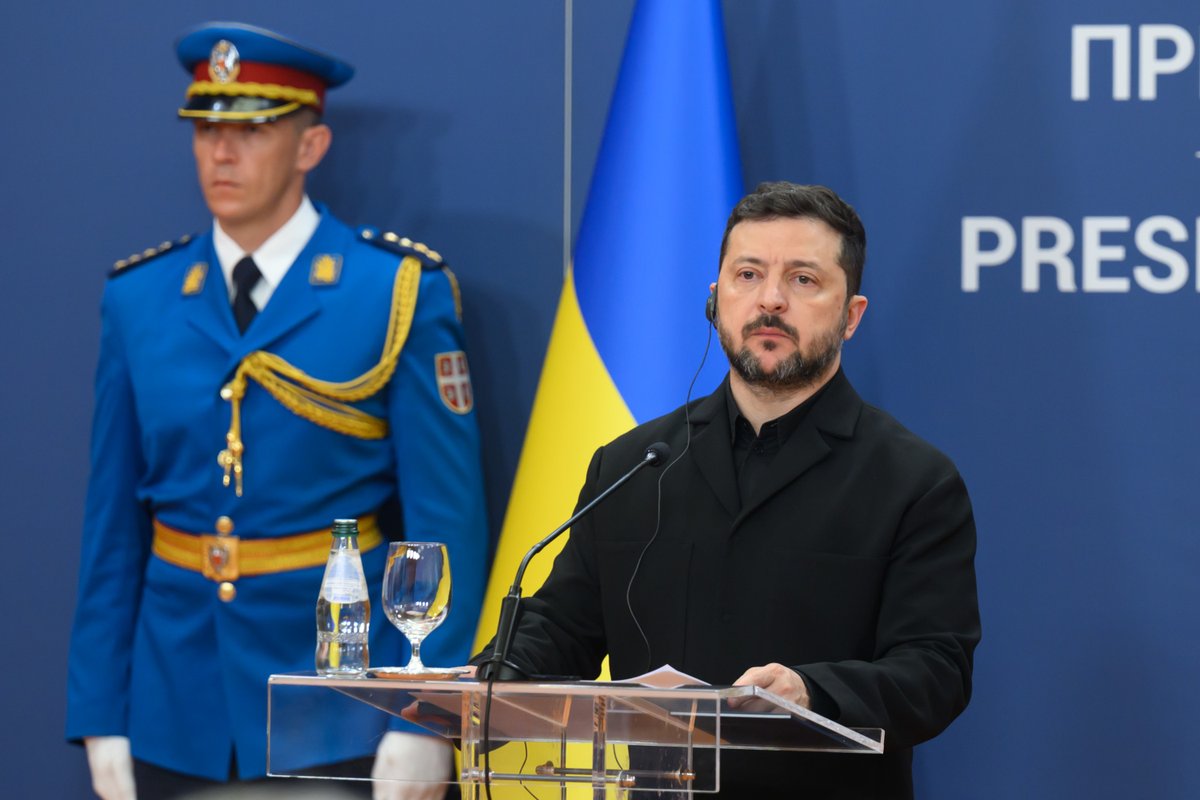
We have been living in a constant search for protection against ballistic missiles since the first days of the war, when Ukraine had nothing to intercept them with. This is extremely difficult work. How can this problem be solved? Who has anti-ballistic missiles and systems? The manufacturer does. That is the United States, first and foremost. Can they help? We are working on it. Every month. Will they provide us with missiles? Yes. We have arrangements under PURL. Are these missiles enough? No. In 2026, there are fewer of these missiles. Monthly deliveries were higher in 2025.
The second part of this is Europe. Who has them? Germany has them. Poland has them. These are the countries that can provide serious help. With all due respect and gratitude to the German side, they truly have helped. And Poland has helped as well. But I will be frank. We are constantly working with the Nordic countries and the Netherlands, and they are helping little by little. Every day I communicate with various European and Middle Eastern countries to ensure that Ukraine receives additional aid packages outside of the PURL framework.
We have simply reached the point where all of our institutions must be working on this. Not just the President. Everyone has to work. Otherwise, there will not be enough missiles. South Korea and Japan could also help. Have they helped us with air defense during this war? No. Because of their domestic legislation. People also frequently ask about Israel. We would like to receive air defense systems from them as well. We would be ready to buy them. So far, we do not have that opportunity, although we are in dialogue.
From answers to journalists’ questions. (1/2)
Your weekend reminder Nigel Farage wants to
- leave the ECHR
- repeal the Equality Act
- Strip back workers rights
- Lift restrictions on exploitative zero-hours contracts
- repeal the Renters’ Rights Act which abolishes “no fault evictions”
A Russian woman says:
"To every f*cking bastard who supports this war, waits for the 'SMO' to achieve its goals, and still wants this bloodshed: go fight in it and die there!"
May everyone who started this war be cursed. But I curse even more those who keep it going."
More and more, I find myself thinking that we're asking the wrong question. We ask: Can Russia conquer Ukraine now? Can it seize the country militarily? And we answer with relief - probably not.
But that is the wrong question. The right one is different - and more frightening: Can Russia destroy Ukraine's energy system and infrastructure? Here, the answer is yes.
Ukraine's defense against ballistic missiles is now approaching zero because of a global shortage of interceptors, in which Ukraine is not a priority. In 2026, deliveries of interceptor missiles have fallen to roughly one-third of their 2025 level.
The enemy understands this. In 2026, Russia has significantly intensified its use of ballistic and hypersonic missiles, including Zircon, Iskander-M, and S-400 missiles.
In just the last two massive attacks, Russia launched 60 ballistic missiles. Ukraine managed to intercept only two.
Contrary to the widespread perception, the Ukrainian energy system is not as large as it seems. Its operation depends on a relatively small number of critical facilities: nuclear power plants, several major power stations, several dozen key substations, and high-voltage transformers. The transformers are the weakest link. They are expensive, almost entirely imported, take months to manufacture, and there are almost no reserves left.
During the 2025-2026 heating season alone, the UN Monitoring Mission documented 423 attacks on electricity infrastructure facilities and another 74 strikes on heat supply systems. According to Ukrainian energy analysts, since the start of the full-scale invasion, Russia has carried out more than 60 major campaigns against Ukraine's energy infrastructure, using around 2,900 missiles and more than 12,700 drones.
The situation this winter promises to be significantly harder.
Of course, frozen and half-destroyed Ukrainian cities are not necessarily conquered cities. But they are cities becoming unlivable, cities people are forced to leave. And that means weakening the institutional and socioeconomic fabric of the state - and weakening support for the front.
At current rates of Russian ballistic missile production and Ukraine's lack of air defense, Russia sees an opportunity to destroy Ukraine's energy and logistics infrastructure in a single winter. I see no grounds for optimism here, and I will not offer any.
If this happens, what comes next? No one can say for certain. But we know exactly what Russia wants: all of Ukraine. And knowing how Russia behaves in occupied territories and areas under its control, we can imagine what it plans to do.
Russia does not necessarily have to capture the entire territory of Ukraine with troops. It has experience in establishing puppet regimes and taking control of the key functions of a state. The model is already familiar from the occupied territories: administrations installed and cultivated under the FSB, Russian passports made a prerequisite for access to basic services, and filtration turned into a routine procedure. The population's loyalty is not required.
Mariupol, Melitopol, and Kherson region have shown: a non-loyal population is not an obstacle to control, but material to be processed. Those who can be intimidated, bribed, or reprogrammed through school, television, and passports will be. Those who cannot will be filtered, imprisoned, deported, or killed. Children will be taken away and re-educated.
That is why assuming that public resistance alone will make occupation impossible is a dangerous illusion. Russia's model of control is designed specifically for a hostile population and treats that population as a resource.
The occupied Ukrainian population has already become a resource for the Russian army. In occupied Donbas, Russia has forcibly mobilized, according to various estimates, more than one hundred thousand men since 2022 - and used them as expendable infantry in the first waves.
If Russia occupies more Ukrainian territory, it could gain access to hundreds of thousands of potential future soldiers, many of them with experience in modern warfare.
If Russia establishes political control over most of Ukraine, a large part of Ukrainians will want to leave. But the number of refugees reaching the EU would be determined not by people’s desire to leave, but by the border regime Moscow chooses to impose. Potentially another 5-10 million could leave the country. But Russia would decide who gets to cross the border.
There are three possible border scenarios.
The first is closure and filtration, following the model already used in occupied territories. Perhaps 500,000 to 1.5 million people would make it to the EU, while most would be trapped inside. For the Kremlin, this would be the optimal scenario - both for erasing Ukrainian identity and for creating a mobilization base.
The second is a controlled wave: selectively opening the border and releasing groups of 1- 3 million people in several stages, with the aim of overwhelming the EU, fueling anti-immigration sentiment, and deepening political divisions across Europe.
The third is a collapse of control. If the authorities, the army, and the border system disintegrate faster than Russia can establish its own control, the flow could approach the upper estimate of 5-10 million people, constrained only by the capacity of the borders.
If Ukraine falls, Russia will gain more than a new recruitment pool for its military. It will gain the time and space to prepare for its next military campaigns. And the next war will be fought on EU territory.
Of course, we can listen to those who insist that Russia would never do such a thing. But it is worth remembering that these pseudo-experts are not risking their own lives. If their predictions prove wrong, they will simply shrug and say, "Who could have known?"
That leaves one practical conclusion that I consider honest: we do not have the luxury of wishful thinking. Europe's future depends on whether Ukraine survives this winter.
And this is a very practical matter: missile defense, interceptors, reserves of high-voltage transformers, and decentralized power generation. Every month of delay in delivering what Ukraine needs increases the risk that, for the first time, the pace of destruction will exceed the pace of recovery.
Resilience is a resource that may run out as early as February.
Blow to Trump as Iranians strike deal to police Strait of Hormuz
Donald Trump was facing humiliation on Wednesday night after Iran secured a deal with Oman to police the Strait of Hormuz.
After five months of regional conflict, the prospective deal paves the way for Iran to deny access to Western ships along the key route.
https://t.co/Bg4Rv13J5H via @DailyMail
#BrightonPride
For 75+ years Commonwealth leaders have refused to support LGBT equality
29 #Commonwealth nations criminalise LGBTs. 6 have life imprisonment. 3 have death penalty
It’s against Commonwealth Charter.
Commonwealth leaders do NOTHING
@SGCommonwealth@commonwealthsec
Under Trump, the US has become such a radical outlier at the UN that even Russia now votes more often with EU and NATO countries than Washington does.
Absolutely wild.
À Kyiv et dans sa région, la Russie a une nouvelle fois choisi de cibler des civils. Cette politique de terreur, menée à coups de missiles et de drones, est inacceptable.
Chaque nouvelle attaque renforce une évidence : la Russie doit payer le prix de son agression et répondre de ses crimes. Aux côtés de l’Ukraine, nous ne céderons ni à la lassitude ni à l’intimidation.
L’Union européenne et ses partenaires continueront d’accroître la pression sur la Russie, notamment par de nouvelles sanctions, tout en renforçant le soutien militaire à l’Ukraine afin qu’elle puisse se défendre et protéger sa population.
The war of attrition entered a new phase, Serhii "Flash" Beskrestnov, Ukraine's presidential adviser, said
Russia expanded its strikes beyond the battlefield, targeting retail warehouses, food storage facilities, logistics hubs, and businesses to wear down Ukraine’s economy and daily life
📷 Flash
Zelenskyy: Ukraine will keep destroying Russian ballistic missile launchers
Volodymyr Zelenskyy said eliminating Russian ballistic missile launchers remains a top priority, alongside strengthening Ukraine’s air defenses and securing more anti-ballistic missiles from partners.
Ban donations. No MP should be given donations. It is clear that they work for donors and not the British people. Enough is enough.
Zero donations, expenses capped at 10k and no subsidised food or alcohol.
Russia killed Oleksii Yukov, the head of the Platsdarm body recovery group.
Oleksii repatriated over 10,000 bodies in more than 25 years of his work. Born and raised in Sloviansk, Donetsk region, Oleksii was initially recovering the remains of soldiers from World War II.
After Russia first invaded Ukraine in 2014, Oleksii founded the Platsdarm group, which, to this day, is systematically searching for bodies of Ukrainian and Russian soldiers, as well as civilians, in the hottest spots of the frontline.
Oleksii was fatally wounded while exhuming bodies on the frontline.
Eternal memory and eternal glory to Ukrainian Hero.
Everyone can see the ballistic missile threat posed by Russia – and this threat is growing. At the same time, Russian enterprises that manufacture ballistic missiles are still not subject to strict global sanctions.
Some key Russian enterprises involved in ballistic missile production are not under sanctions imposed by the United States, the United Kingdom, Japan, Switzerland, and other jurisdictions. Of the seventeen key Russian enterprises involved in producing ballistic missiles, most, unfortunately, can exploit sanctions loops in the jurisdictions of various partners. We need greater coordination, daily engagement with partners on sanctions, and greater synchronization of sanctions.
Unfortunately, one of the worst consequences of Russia’s war against Ukraine – and of Iran’s tactics as well – is that potential aggressors around the world can see how much harm ballistic missiles can inflict on human life. The global ballistic missile threat will therefore continue to grow, and all anti-ballistic defense capabilities must grow as well.
Our FREYJA can become a shared European system providing integrated protection. FREYJA will be quick to produce and battle-tested. Ukraine is capable of manufacturing both the missile itself and the launcher. The decisive factor is cooperation with those European countries and companies that have the radars, sensors, and everything else required for an effective anti-ballistic system. And we already have agreements in place with all of these companies and all the necessary countries.
These are the ten countries participating in the Anti-Ballistic Coalition: Ukraine, Denmark, France, Germany, Italy, the Netherlands, Norway, Spain, Sweden, and the United Kingdom – as well as twelve manufacturers that have already joined. The Anti-Ballistic Coalition and the FREYJA project are open to other participants capable of making a genuine contribution to security across Europe.
From an address at the meeting of heads of Ukraine’s foreign diplomatic missions. (4/7)